"British Light Infantry during the AWI" Topic
27 Posts
All members in good standing are free to post here. Opinions expressed here are solely those of the posters, and have not been cleared with nor are they endorsed by The Miniatures Page.
Please be courteous toward your fellow TMP members.
For more information, see the TMP FAQ.
Back to the American Revolution Message Board
Areas of Interest18th Century
Featured Hobby News Article
Featured Link
Featured Ruleset
Featured Profile Article For the time being, the last in our series of articles on the gates of Old Jerusalem.
|
| jbfrage | 07 Jul 2013 3:45 p.m. PST |
Hey all, Quick clarifying question about British Light Infantry during the Revolution: I know that they were elite companies that were often converged into more powerful fighting formations. However, were they equally as good at fighting in lines like regular troops, or did they solely operate in loose order? Thanks, J |
79thPA  | 07 Jul 2013 4:23 p.m. PST |
They could form line and fight like "regular" infantry. The grenadiers and lights formed an assault column and attacked the American left flank at Bunker Hill. They would fight in line as needed or ordered. |
 John the OFM John the OFM | 07 Jul 2013 4:28 p.m. PST |
Rarely did they operate in "loose order".
If you read any battle reports, invariably they were used as converged battalions, as elite line troops.
They were almost always in the Cornwalis Task Force, the dream of all wargamers. The CTF included ALL the grenadiers, ALL the Guards, ALL the LI…
Only the best gamers can steal all the elite troops from the army and claim them as their own. Cornwalis was one such gamer. |
| jbfrage | 07 Jul 2013 5:25 p.m. PST |
Thanks guys. So in your opinions, would you say that the lights fought more often in line than in loose order? If they didn't fight in loose order very often, should they be allowed to do so on the wargame board, or would it be more historically accurate for them to always be in line? Thanks again, J |
| Old Contemptibles | 07 Jul 2013 7:56 p.m. PST |
Been there done that. TMP link
Almost everyone on both sides fought in loose order. I believe it was General Howe who wrote a light infantry manual (maybe wrong about that). He set up special light infantry training in Ireland and Canada for troops being deployed to America. Do not confuse this loose order with Napoleonic skirmishing. The center, light and grenadiers fought in loose order. I am sure SM can provide more information and correct my errors. Which there is usually many.
You want this book. link |
| oldnorthstate | 07 Jul 2013 7:58 p.m. PST |
"Rarely did they operate in "loose order".
If you read any battle reports, invariably they were used as converged battalions, as elite line troops"…uh, just because they were organized in converged battalions doesn't mean they didn't operate in loose order or skirmish order for that matter. db |
| John the OFM | 07 Jul 2013 8:09 p.m. PST |
Suppose I just step back and pretend I never said anything? 
Talking about "loose order", "skirmish order" and the way they "normally" operated is a minefield into which I gleefully tapdanced.
Napoleonic LI and AWI LI were NOT the same thing, and the terms must be understood perfectly to discuss this.
I did not. |
| Old Contemptibles | 07 Jul 2013 10:16 p.m. PST |
Not skirmish order, loose order. There is a difference. Yes the British almost always converged their elites but they did not fight shoulder to shoulder as they would on European battlefields. In fact the French were looking forward to meeting the British in their loose order formations. It took a while for the French to catch on if they really ever did. As OFM said do not confuse any of this with Napoleonics. |
| Old Contemptibles | 07 Jul 2013 10:25 p.m. PST |
The British Army that fought in North America from 1775 to 1783 was what modern American officers call "a thinking army." British officers, such as William Howe, were well aware that they had to adapt to American conditions from the outset, and they trained all their foot soldiers to function like light infantry. After Bunker Hill, they invariably led their Redcoats into battle in open order. Lacking large amounts of cavalry, they trained their foot soldiers to move quickly to overtake and strike a speedy foe. In battle, the Redcoats usually sought a quick decision. They preferred to close to within 75 yards of the enemy, fire a volley, and then charge with the bayonet. These tactics brought them victory more often than not.Spring realizes, of course, that the British lost the war, and he explains how these frequently successful tactics contributed to that defeat. The fact that British officers tried to clinch victory on the battlefield reflected an improper appreciation for the political dimensions of the Revolution. In addition, pressing the enemy with troops deployed in loose order worked only so long as the attackers were superior to their foes. As the Revolution progressed and the Continental Army upgraded its own fighting skills, the Redcoats' tactical practices backfired on them -- as seen at Cowpens and Guilford Court House. Review of "Zeal and with Bayonets Only"
Dr. Gregory J. W. Urwin, History Dept. Temple University They fought mostly in looser or open formations. They were almost all trained in light infantry tactics. |
| Old Contemptibles | 07 Jul 2013 10:46 p.m. PST |
If they didn't fight in loose order very often, should they be allowed to do so on the wargame board, or would it be more historically accurate for them to always be in line? Our club rules allow for loose or tight formations. Loose formations are three to a base, tight is four to a base. I only have an early war converged British Gren. battalion in tight formation and one German Gren. battalion in tight formation. All Americans and all the rest of my British and German battalions are three to a base for loose formation. Until I get to doing up some French I will probably not have anymore tight formation battalions. Not sure about the French yet. We use 25/28mm figs on 60 x 30mm bases. |
| Supercilius Maximus | 07 Jul 2013 11:45 p.m. PST |
Historygamer, or another re-enactor, can correct me on this, but my understanding is that the various "orders" were as follows:- "Close order" is 6" between files (as specified by the 1764 Manual of Arms – not an official drillbook, but by far the most widely used, even if it was open to different interpretations). "Order" (which, confusingly, is one of the spacings that come under the generic description "loose files") is 18" between files, which is what Howe introduced in 1775 and equates approximately to a man-sized space between each file. "Open order" is slightly wider, usually arm's length. "Extended order" is anything wider, up to about 10 feet between files. Note that order and open order were linear formations, just as much as close order was; they simply allowed a unit to cover more ground (especially when facing a more numerous enemy) and/or move more easily through difficult terrain. They were not necessarily "skirmish" formations as would be thought of in the Napoleonic era – in fact, put that idea completely out of your head, as the purpose of these more open formations was not to "screen" an attack by a denser formation; it WAS the attacking formation. Later in the war, generals such as Phillips recommended a "mix" of orders to bolster the line – eg half the battalion in front in order/open order, and the other half behind in close order to provide a rallying point, or add "punch" if the front half was halted, or faced by a close order line/cavalry. Oddly, as the war progressed and the Continental infantry got better, it seems to have fought more in close order – one officer complains about this, and contrasts it to the British move in the opposite direction, after the debacle at Green Spring in 1781 (referring to "stiff German order". However, I can't find evidence that this was universally done; equally, it could be a dig at the influence of Steuben, who was not popular with many senior American officers.
But if you do nothing else, read Spring. |
| Old Contemptibles | 07 Jul 2013 11:50 p.m. PST |
Just to confuse everyone. In our rules your loose/open order battalion can be in line, column or skirmish formations. Just as your tight order foot can also be in line, column or skirmish formations. The tight battalion gets a meele bonus. Your loose battalion can move more easily through rough or wooded terrian. The tight foot have some real issues with rough or wooded terrian. |
| Old Contemptibles | 07 Jul 2013 11:57 p.m. PST |
SM Seems like I read in one of the Saratoga books. Maybe Luzader, that the German officers were very reluctant to adopt the open formation. That ring a bell? |
| Supercilius Maximus | 08 Jul 2013 3:26 a.m. PST |
Might have been another book, as it was the Hesse Cassel troops who were prevented from using "loose files"; they adopted two-rank line almost on arrival in America (see Rodney Attwood's The Hessians), but their ruler was most strict about them not adopting the extended lines, despite the officers themselves begging to be allowed to. In his journal, Riedesel (who commanded the Brunswick/Hesse Hanau contingents in Canada) describes in some detail how he tried to make his troops fit in with the British tactically. In our rules your loose/open order battalion can be in line, column or skirmish formations. I think column might be taking it too far, as I suspect the troops would have closed up in most cases in order to keep the column as short as possible. Perhaps if it was a temporary column to get through a narrow gap, though, and they were going to form/re-form line again straight away. |
| Ironwolf | 08 Jul 2013 5:27 a.m. PST |
I've read the above book and can say Zeal and with Bayonets Only, By Spring changed my view on AWI battles. (Thank you SM) Now something keeps being said about files and the distance between the "files." But I can't recall ever hearing the distance between the two ranks. Based on me understanding the book and above posts correctly? example, Three ranks of close order files, men shoulder to shoulder.
OOOOOOOOOO
OOOOOOOOOO
OOOOOOOOOO Two ranks of order files, 18 inches between men.
0 0 0 0 0 0 0
0 0 0 0 0 0 0 Two ranks of open order files, arms length between men.
0 0 0 0 0 0 0 0
0 0 0 0 0 0 0 0 So what is the distance between the front and rear rank?
thanky |
| historygamer | 08 Jul 2013 3:38 p.m. PST |
You form up on the men of the right of the rank. The distance is roughly an army length to the front. I have always found the 18 inches an odd number. Why 18 inches? How do you come up with that in field? When we form up at "order" we usually form at an arms length apart. As the formation moves that is hard enough to maintain. The ranks usually close and the men need reminded to maintain the "order" formation. A quick reach out with your left arm (your right has the musket) to keep the open files. However, to the original question: "However, were they equally as good at fighting in lines like regular troops, or did they solely operate in loose order?" In a word, yes. The manual exercise was the basic building block. Whether they loaded and fired from open files, or closed, the flank companies were the picked men either way. Since almost everyone in the Brits was using open files, it was all kind of the same. " So in your opinions, would you say that the lights fought more often in line than in loose order? If they didn't fight in loose order very often, should they be allowed to do so on the wargame board, or would it be more historically accurate for them to always be in line?" Well, any reading of the Lights at Brandywine would lead a reader to believe they actually fractured into company formations – though how close the files were is not clear. In short, they fought in the formation that was called for, or needed. It was much the same for most British infantry units, but the Lights and Grens would have a higher morale. So, I'd allow all British units after 1775 to fight in open files. The thing that would vary would be the morale, not the ability fight in open files. No doubt some units were better than others, but that is best reflected in morale, not the ability to open files – as morale usually reflects both training and how they felt about themselves. |
| redcoat | 10 Jul 2013 2:28 a.m. PST |
I have always found the 18 inches an odd number. Why 18 inches? How do you come up with that in field? Because 18 inches was accepted as the *average width of a man*, measured from shoulder to shoulder (C18th men were after all rather smaller than us). This can be deduced from the tactical instructions that Campbell issued to his force in Georgia in Dec 1778. In essence Campbell said that for a line to change front, the front-rank men turned about and stepped into the intervals between the rear-rank men, who then turned about and stepped back to cover the front-rank men. Campbell was definitely working with the 18-inch-interval formation, because his orders of battle (for which he calculated the notional frontages in yards) can be deconstructed to show that he was allowing exactly one yard per file: 18 inches for the man, and 18 inches for the file interval. See p. 315, fn 26, in Spring's book 'With Zeal and with Bayonets Only.' Rather niftily, you can find and read this footnote by doing a 'Look Inside!' search within the book on Amazon and looking for the phrase 'change its front'.
link |
| Ironwolf | 10 Jul 2013 2:53 a.m. PST |
Redcoat and history gamer,
thank you for the information, I've read several books on the subject and just never paid attention. If I had it would have been very simple to reason the 18 inch between ranks. |
| jbfrage | 10 Jul 2013 8:49 a.m. PST |
Thanks all for the great info! It is very helpful. J |
 Der Alte Fritz Der Alte Fritz | 10 Jul 2013 8:13 p.m. PST |
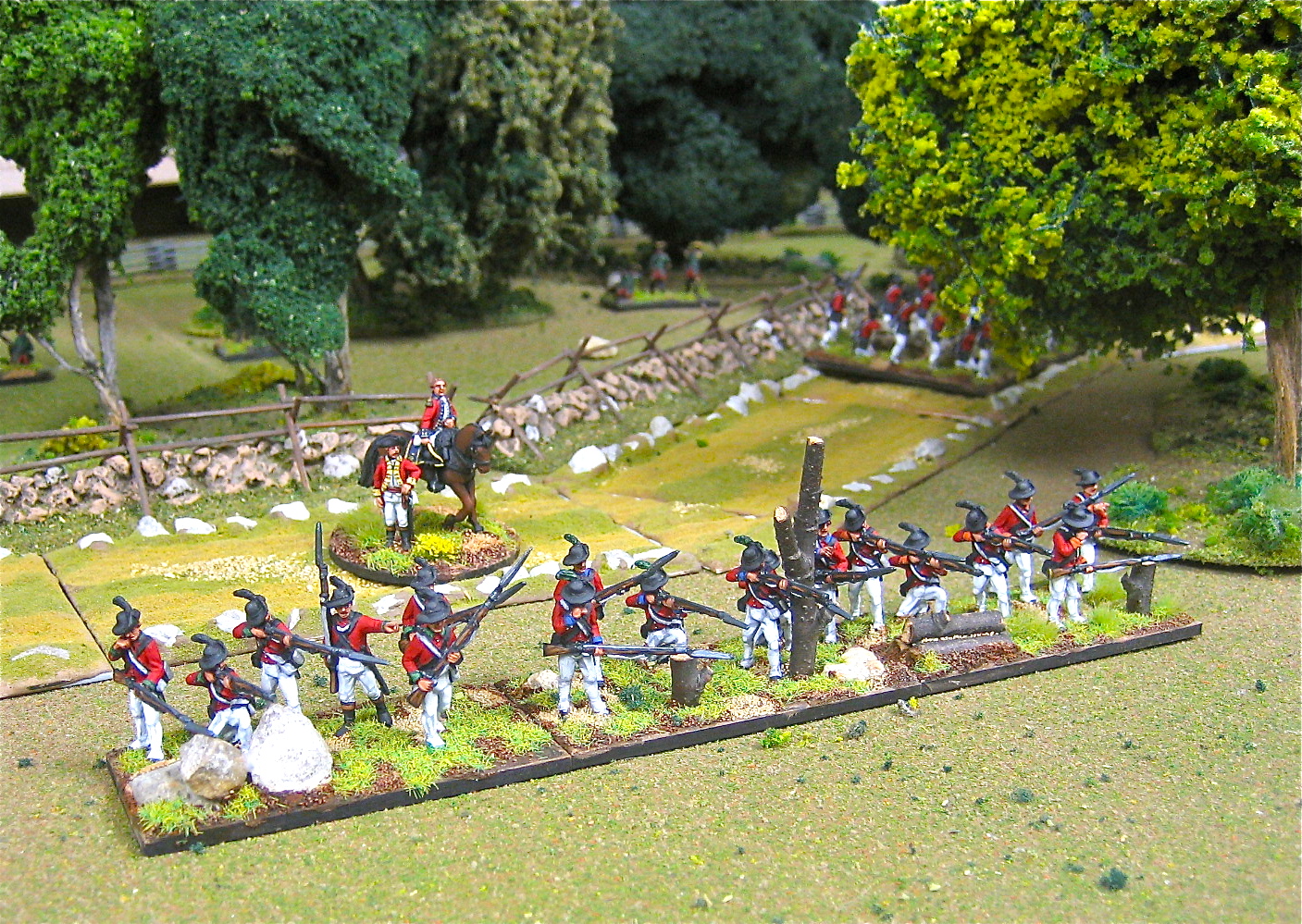
Here are some of my Fife & Drum British Light Bobs for your viewing pleasure. Note that they are a 48 figure unit at 1:10 but have been split into two 24-figure "wings" that can operate independently:
|
| Alyxander100 | 18 Jul 2013 7:59 p.m. PST |
Der Alte Fritz, The simple beauty of your sculpts is making me wish I had not already thrown so much into 15mm AWI. Simply stunning sculpts made even better with an amazing paint job. My compliments good sir! Your table trimmings are equally impressive. I love looking at the pictures you post! Best of luck with your line! |
| Brooklyn Wargamer | 18 Jul 2013 8:54 p.m. PST |
Just a dumb question, Why were they called "light" infantry? Thanks
Jorge |
| Alyxander100 | 18 Jul 2013 9:21 p.m. PST |
Traditionally, in antiquity, you would have had Light, Medium and Heavy troops depending on armor and roles. Heavy – just as it sounds, wore armor, heavy plated armor. They were the main battle force for an army. They would have carried the "heavy weapons" such as Polearms, Pikes, Halberds, battle hammers/picks, long/bastard swords and the like. Medium – would have worn leather armor and carried weapons like swords, axes, maces etc, Men-at-arms type troops, middle of the road grade troops, auxiliaries basically. Light – these would have been the skirmisher type units, operating in open order, screening the advance of the heavier troops. They would have been the archers, javelin and slinger type foot troops that would have been used to harass the enemy and provide ranged support as the heavier troops advanced on the enemy. As the ages wore on the names stayed pretty much the same. Heavies were re-named Line or Foot units, kept the same role and basic tactic, tight packed formations (line, column assault column, square etc), heavy weapons (long muskets, land pattern weapons, grenades in the early eras) Light troops kept their same basic tactic as well, depending on the era would carry lighter carbine type weapons with shorter reload times or rifles when they came available. They still operated in open/skirmish formations used to harass the enemy and screen the main body of the army. The major difference exists in that the "light troops" were often the elite elements of the "line" units, where as in antiquity they would have been made up of the lesser elements of the auxiliary troops, men who could not afford better weapons and armor. In the powder age though, lights were the marksmen, sharpshooters and when they operated in line formations could be as devastating as a line unit volley with half the men. Hope that helps :) Alyx |
| historygamer | 19 Jul 2013 7:49 a.m. PST |
Today we simply form up an arm,s length apart. So given the subtle change in size from men from then to now, that should be about correct – allowing for the differences in size. Once you start moving anything more than an arm's length apart is just a guess by the soldier. |
| Brooklyn Wargamer | 23 Jul 2013 5:31 p.m. PST |
Super explaination Alyxander100. Thanks |
| number4 | 25 Jul 2013 11:40 p.m. PST |
The DISTANCES of the various ranks and files, as described by
Lieutenant-General Humphrey Bland in 1759, are: * CLOSE ORDER: one pace (30") between ranks, 6" between files.
* OPEN ORDER: two paces (60") between ranks, one pace (30") between
files.
* EXTENDED ORDER: four paces (120" or 10') between ranks, two paces
(60") between files. Smith (1779) also indicates identical distances for close, open and extended order. The following is the order from Howe's Orderly Book: "Head Quarters, Boston, 29th. Feb., 1776. Regiments, when formed by Companies in Battalion, or when on the General Parade are always to have their files Eighteen Inches Distant from each other, which they will take care to practice for the future, being the order in which they are to engage the enemy…" |
| CAG 19 | 26 Jul 2013 2:05 a.m. PST |
Today we simply form up an arm,s length apart and even today it is still two paces between ranks in open order |
|