| Yesthatphil | 11 Nov 2012 3:15 a.m. PST |
This is a follow up to an interesting comment made on another thread (mcaras, down the page on TMP link ) … following it up deviates us from the original issue significantly so I'm using a new topic. mcaras said
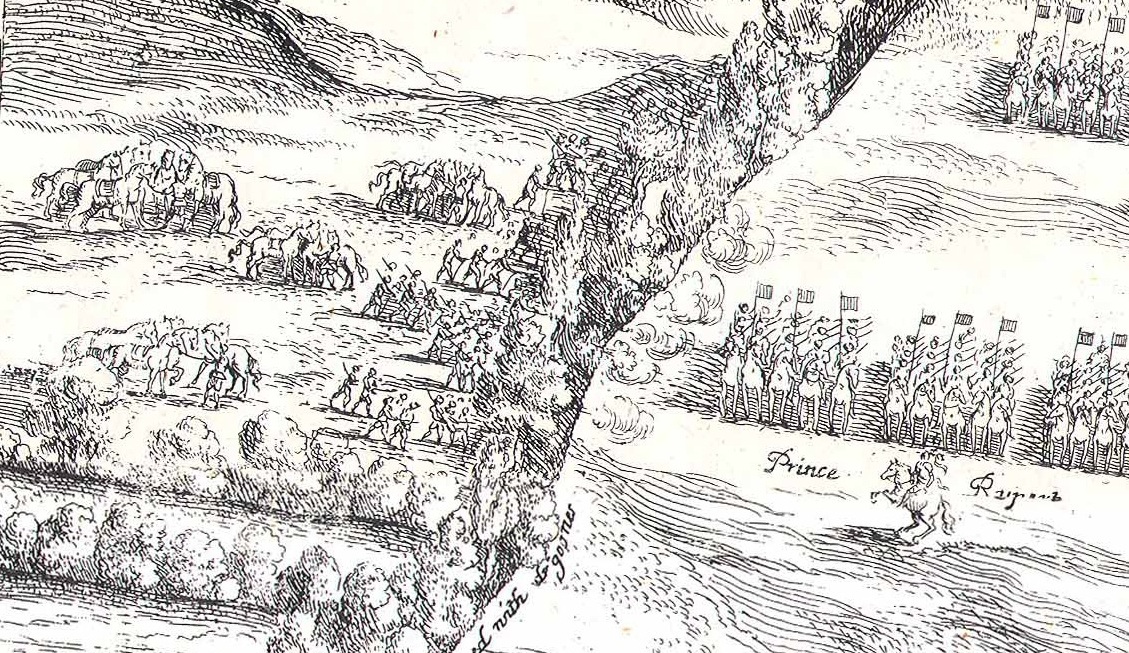
Ask any cavalryman if they would dismount from their own horse in order to try & control 4 horses while on foot. ABSURD. I suspect he is right. I have made my Zulu War horse holder bases controlled by a man on a horse … However, I have made my ECW horse holders for Okey at Naseby dismounted because this is how Streeter's contemporary illustration shows them …
(dragoons and horse holder parties at Naseby) I'm interested what other evidence people have from these and other periods. Is there a universal answer? Do firearms make a difference (I wouldn't want to hold my horses where any of me or them could be shot, but if there was the slightest risk, I'd rather not be perched on top …) Thoughts? |
rmcaras  | 11 Nov 2012 4:05 a.m. PST |
Phil, While I can not expand my comments to all periods, I was told this by experienced ACW cavalry re-enactors [who of course are also "horse people" ie…they own many horses themselves] 1. Horses are herd animals; by sitting on one horse, under control, that horse exerts calm/control to the other horses who do not have a rider upon them. 2. I was told it is nearly impossible for a single person to easily control a horse on foot if the horse is frightened; much less 4? If one horse rears, the others move out of the way. Now you are holding the reins [not for long] of 4 very large, heavy, strong horses all moving in different directions. How long do you really think you'll be holding those reins? 3. So if you are on foot, and you have to displace for any reason, how do you mount your horse while holding the reins of the others? And all while under stress of battle [sound especially]. Again this is what I have been told by ACW cavalry re-enactors, and watching them drill; including dismounted operations. I took them at their word [and they laughed when I asked about dismounted horse holders] It was apparent to them I did not know much about horses. But I am interested to hear from other experienced re-enactors or those who own horses. I did hear from some figure makers who indicated they sold mounted horseholders for ACW. |
Stronty Girl  | 11 Nov 2012 4:58 a.m. PST |
Does it make a difference that a man on horseback next to a group of horses milling about is a clearer target than a man on foot in amongst a group of horses milling about? After all, the re-enactors know lots about horses, but might be willing to exert a little less control over their charges if bullets/arrows were zipping past their ears and they could use a horse as cover!  |
 Flashman14 Flashman14 | 11 Nov 2012 5:21 a.m. PST |
The general doctrine was to take the horses to the rear, off the line. If the horse holder is a target then they are out of position or the dismounted riders are out of action somehow. |
| Elenderil | 11 Nov 2012 6:31 a.m. PST |
I recall reading that in the ECW the riderless horses' rains were looped through each other in some way to make them easier to control. Can't recall where I came across it though. It may have been on Gavin Robinson's blog "Investigations of a dog". Do you think this would have any impact the whether the horse holder could maintain control on foot? |
| Skeptic | 11 Nov 2012 7:06 a.m. PST |
I was thinking along the lines of what Elenderil posted, too. A chain of reins might make them easier to control. I would also speculate that that would tend to cause the horses to radiate from around the holder, much as in the Naseby diagram, so that they would pull against each other. Of course, hobbling the horses would make them easier to control. Finally, to what extent are the horses that are ridden by the ACW re-enacting "horse people" actually trained to be held together, rather than being used to being controlled individually? |
| rmcaras | 11 Nov 2012 8:10 a.m. PST |
I was surprised to be told that the doctrine for the ACW was the horses were to be approximately 1/4 mile to the rear of the firing line! Though terrain also dictated to this distance….so perhaps a ridge line or woods might change that distance. By the way, the 1862 "Regulations for Instructions, Formations and Movements of th Cavalry of the Army and Volunteers of the United States" by Brig. General Philip St. Geo. Cooke 1862, confirma that doctrine was for #4 to remain mounted, at the command "prepare to fight on foot".
"At the command all prepare to dismount except #4"
"Dismount except Nos. 4 and form rank"….. Command: Into line At this command move 12 paces to the front and close in on the centre"
Nos 4 who remain mounted have charge of the dismounted horses;"… so the re-enactors were following doctrine. and probably comporting with physics. |
 Grelber Grelber | 11 Nov 2012 9:40 a.m. PST |
While it was US policy during the Civil War and Indian Wars for three men to dismount and the fourth to hold the horses, other arrangements have also been used. Two men dismounting and the third holding the horses was used in some of the colonial wars, and it looks like one man is holding five or six horses in the print of Naseby (above). So, your answer could differ with time and location. Grelber |
| Ilodic | 11 Nov 2012 12:40 p.m. PST |
Khurasan miniatures in their TYW range has a set of horse holders with dragoons. I know this range of theirs is largely based upon feedback from Daniel S., who frequents this boards often. Below is an image to the photo on khurasan's site (via goodle images.) Daniel S. might be a good person to answer this question with regards to this period if he chimes in.
link
ilodic
|
| Lion in the Stars | 11 Nov 2012 1:05 p.m. PST |
Read in Churchill's 'Malakand Field Force' that the best practice (ie, the practice of the Guides) in the NWF was a mounted man holding 3 other horses, and that only the horse-holder had a cavalry lance. |
| Thorfin11 | 11 Nov 2012 3:29 p.m. PST |
Yes, I'm just reading Barthorp's "The Frontier Ablaze" (NWF 1897) and there is a sketch of the Guides Cavalry doing exactly that. As a horseman myself, I would far rather be holding 3 other horses from the back of another than be on my feet holding 4 horses, especially in or near a combat situation – whilst I might make a better target, I would still retain good mobility which is likely to be far more important. |
| Garryowen | 11 Nov 2012 3:42 p.m. PST |
There is no doubt about the regulation way to do it in the US cavalry in the Civil War and the Indian wars. Number 4, the horse holder, stayed mounted. I used to do Civil War and Indian Wars re-enactment and it was a surprise to me how many units could not fight on foot. I rode with the Michigan Cavalry Brigade who would move all over the battlefield, dismounting to fight on foot, then the horseholders would bring the horses up (and often the skirmish line would alternately fall back) to mmount up, move to a flank or wherever and do it again. A horse holder on foot would have one devil of a time moving those horses. He has to be mounted to really have any control. There is a link strap that links horse #1 to 2 and one links #2 to #3. Reenactors have the link strap running from halter to halter, in my expereince. In the real cavalry it went from bit ring to bit ring. This gave much better control. Reins in the cavarly are sewn together and the reins remain over the horse's neck. Trooper #4, in real cavalry held the reins of horse #3, which were NOT over the horses neck. As I said, all reenactors I have seen have the link strap going from halter to halter, not from bit ring to bit ring. The horseholder holds the halter lead strap of number 3 to control them all. This is not as effective as holding the reins. Reenactment horses do not get as much experience with this as real cavalry horses. The theory is they may not "give" to it and their mouth would be injured by the bit. I have a number of the very nice Sash and Saber led horses. I just throw the dismounted horseholders in a bag in case I ever find a use for them. I use three of the led horses with one cavalryman mounted. So, with three sets of four horses from Sash and Saber, I actually can do the led horses for four sets of four. Tom Tom |
| rmcaras | 11 Nov 2012 4:10 p.m. PST |
Tom,
I agree. I did not replicate the details of how Nos 1, 2, 3 give their reins over to #4 [it was not the main point being raised] but the regs do describe how #3 hands his reins to #4, while Nos 1 & 2 link theirs as you described. I could not speak to doctrines of other eras. I bet if there were not 4 men; they'd hold whatever horses from the dismounted. But the physics don't change. Its easier to control horses from the back of another. The unit I observed and interacted with was the indeed the Michigan Cavalry [Wolverine Brigade/Custer's Brigade] Brigade. They were excellent! Demonstrating all manners of movements/deployments, sabre techniques [on balloons at the gallop] as well as skirmishing.
It was interesting too in that they indicated that they were using several horses that were somewhat green to fire; and in fact when there was gunfire the officers horse was extremely skittish. Another horse reared and threw its rider. It took off and ran to the other horses where it was collected and returned to the grounded trooper. |
| Yesthatphil | 12 Nov 2012 4:28 a.m. PST |
Excellent discussion, and especially the references. I am glad I asked to expand the topic. Thanks so far … Phil |
| kabrank | 28 Nov 2012 9:28 a.m. PST |
Note that there may be a significant size difference between the ECW Dragoon "Nags" and ACW or other Cavalry horses. Smaller Nags, particularly if Gelded or Mares [out of season], may also be much easier to control than full blood Cavalry horses. Also the illustration shows the horses looking at the holder and each other and hence less likely to "see" disturbing events around them as much as if in line facing the action. |
| mashrewba | 28 Nov 2012 10:12 a.m. PST |
There's a drawing in "The Frontier ablaze" about the NW frontier of an action -drawn by an officer present at the time -the horse holders are all mounted.
There is also a another drawing of a staff group where the horse holders are on foot but then maybe they weren't mounted in then first place. |
| kabrank | 29 Nov 2012 3:17 a.m. PST |
One of the differences in horse holders being mounted or not may depend on the actual troop type. Cavalry are mounted first and foot users second whilst Dragoons in ECW are essentially mounted infantry and hence may be more comfortable on foot in these circumstances. There may also be regional differences depending upon the level of horse ownership and usage |