| Ruben Megido | 08 Nov 2012 2:40 p.m. PST |
Regarding Bolt Action rules there´s something important you have missed and it´s the fact that a .50 have a penetration value of +1 So the damage roll 1d6+1. Since an armoured car have a defence value of 7+ technically it could penetrate the Puma but an equal roll as the armour value also means that it´s SUPERFICIAL DAMAGE (d6-3 roll in the table). 1: Crew Stunned
2: Inmobilised
3: On Fire
4-6: knock out So, technically, you can´t destroy a Puma with a .50 but you could ignite it, blow out a tire or supress the crew, which is consitent with everything that have been said before in the discussion. |
| number4 | 08 Nov 2012 5:07 p.m. PST |
'On Fire' is pretty much the same as 'knocked out' in real life – no soldier I ever met wanted to hang around in a burning vehicle full of explosives. |
| badger22 | 08 Nov 2012 7:28 p.m. PST |
I have seen crews baol from vehicles that just smelled like they might be ob fire. In peace time, and definatly nt under fire. Fire inside an armored vehicle is bad news. Very bad news. Owen |
| Martin Rapier | 09 Nov 2012 3:28 a.m. PST |
"So, technically, you can´t destroy a Puma with a .50 but you could ignite it, blow out a tire or supress the crew, which is consitent with everything that have been said before in the discussion." Ah, that probably _underestimates_ the damage a .50 cal could do. We let normal small arms 'neutralise' AFVs (if they roll high enough – minor damage, commander wounded or whatever). .50s have genuine AT capability and can actually destroy AFVs, which was why they were fitted as anti-tank weapons to light tanks…. (.50 BESA etc). Back to the OP, a tank choosing to engage an AFV with its AAMG is somewhat gamey. It would be busy shooting with its main armament. Not sure I'd fancy standing on the back of a tank with the main gun firing! |
| Mechanical | 09 Nov 2012 4:37 a.m. PST |
I think it is a little gamey that a vehicle with something like 100 total units produced makes it on the games table as often as it does. I find it a tactically silly that a armoured car would try to go head to head with a medium tank and expect to survive at all. However I am a little suspect of the god like capabilities given to the .50 Firing AP it can indeed shred a Puma especially the side armour. One must ask what was the mix used for a pintle mount on a tank in WWII? I am thinking ball with maybe some tracer which would have reduced penetration. Bottom line though put your Sonderwankfahrzeug 234/2 in front of a Sherman or T-34 it is going to die. |
| mysteron | 09 Nov 2012 5:22 a.m. PST |
Unfortunataley many gamers including our club members treat armoured cars like tanks . Clearly they are not and have different defined roles.The possible exception would be the British AEC Heavy AC. For me this is just a tank on wheels. |
 Legion 4 Legion 4  | 09 Nov 2012 8:13 a.m. PST |
Yes, we were instructed that a .50 cal could take out a BMP and other light armor, no doubt it could do damage to some armor in WWII. And most .50 cals were mounted on vehicles for AA use, but as already mentioned AA weapons also very useful against ground targets and in many cases were and are used in that role … |
| DaveyJJ | 09 Nov 2012 9:14 a.m. PST |
Having been on a live fire range 30+ years back and watching a .50cal absolutely demolish both concrete block walls and poured concrete walls without any problem, I'd wager that 13mm armour wouldn't be too much of a stretch. P.S. Got to throw my first live grenade that day, too. |
| donlowry | 09 Nov 2012 11:46 a.m. PST |
IIRC, I read somewhere that the standard load for a U.S. MG (not sure which caliber) was 1/3 ball, 1/3 tracer, 1/3 AP, alternating. Anyone know for sure? Was the .50" on a tank not placed where the commander could fire it without leaving the turret? I know the .50" on TD's was originally mounted on the back/top of the turret, but many crews moved them to the front, since they had no coaxial or hull MG. M20 AC's, and many M8 AC's had .50"s on skate rings, as did many U.S. halftracks. |
| Andy ONeill | 09 Nov 2012 12:52 p.m. PST |
Most shermans didn't have the mg mount altered and so the commander would have had to get out.
The tank would effectively be left without a commander whilst he swans around on the back deck.
The commander is the guy spots the enemy and directs the gunner onto targets. So firing the 50 cal seems unlikely in any but the most static situation. Picking on two men and a dog from a mile away or someone turning up during dinner whilst the crew are out the tank. That kind of stuff. |
| warhawkwind | 09 Nov 2012 1:49 p.m. PST |
I don't see what's so astounding about a 50 cal. knocking out a Puma. Did it blow up into a jillion pieces or something? or was the crew so rattled by all that paint flaking off the interior walls that they just fled? I certainly agree that Wargamers tend to think in absolute terms rather that more abstract ones. And after all, aren't most wargames written with abstractions? Did the rules say that a 50 cal. can EASILY knock out your Puma? Or did they say it was POSSIBLE?
After all, almost anything is POSSIBLE. |
| Rudysnelson | 09 Nov 2012 1:52 p.m. PST |
Against the Geneva convention to use a .50 cal against human targets on the ground. They were to be used against aircraft, vehicles and hard targets like bunkers and buildings. Does that mean that men did not use them against human targets? of course not. |
| Lion in the Stars | 09 Nov 2012 2:31 p.m. PST |
@Rudy: I keep seeing that quoted, but a .50cal doesn't shoot explosive rounds (which do have a minimum size of 400grams). It shoots solids. There's no restriction on solid slugs that I have been able to find. |
| tuscaloosa | 09 Nov 2012 6:42 p.m. PST |
"Against the Geneva convention to use a .50 cal against human targets on the ground….There's no restriction on solid slugs that I have been able to find." The Geneva Convention says nothing about the M2 .50 cal machine gun. It does say that force used should be proportional to the target so as not to cause unnecessary damage and suffering. The US Army's lawyers have therefore concluded (not unreasonably), that when lesser weapons are available against targets such as enemy troops, they should be used. If you can shoot someone with a rifle or SAW, then do so. If you don't have one, and a .50 cal is your only weapon, do what you have to do. That's what the oft-quoted chestnut about use of the M2 against enemy troops means. |
| badger22 | 09 Nov 2012 6:44 p.m. PST |
Yes that is one of those old lines drill sgts like to trot out, but there is no legal basis for it. For Desert Storm we where given a specific brief on the ROE and .50 was pointed out. There is no prohibition to shooting people with a .50. After all you can shoot them with a 155mm howitzet. fiftys are a bit smaller than that. The prohibition is against hollowpoint or explosive bullets. Yet tracer is allowed. And the Soviets neatly did an end run with that bullet with a sort of hollow interior space. Remember if you cant use a fifty on people Audie Murphy would have been prosicuted. Owen |
| tuscaloosa | 09 Nov 2012 6:56 p.m. PST |
There is a legal basis for it, Owen. Read my post. |
| number4 | 09 Nov 2012 8:44 p.m. PST |
Back to the OP: "a Sherman fired it's main gun at a Puma's side armor and missed." not unreasonable then, to use the .50 BMG as a spotting weapon for the main gun.
|
| leesow | 10 Nov 2012 5:35 a.m. PST |
There is another reason M2 use is discouraged in favor of rifles etc. in urban areas. That is the penetrating power of the .50 cal round which was after all originally designed as an anti-armor round. In built up urban areas the risk of collateral damamge to civilians and bystanders, not to mention buildings and structures, is much higher with the M2 than with standard .556 ammo weapons. |
| Skarper | 10 Nov 2012 5:49 a.m. PST |
I can't say .50 cals were never used against ground targets. Many .50 cals were on trucks, halftracks, jeeps and SP artillery guns. As such they would often be the best weapon available for use against infantry or vehicles and the crew could fire them without needless risk. If you're sitting in a 30 ton medium tank with a 75mm gun, and .30 cal coaxial MG I think your primary weapon against armour is the 75mm – very rapid firing for it's calibre or the .30 cal coax. versus 'softies'. @vojvoda – your example seems to be a different case from using the .50 on a TANK to fire at an enemy AFV….so it being true doesn't refute my contention. I just can't see the .50 being the usual weapon of choice in any normal circumstances. I'm sure it happened sometimes. But I contend it was rare. After all, the British removed the .50 cal AA from their tanks. Also – not many rounds carried for the .50 on a tank which further implies is was seldom used verus ground targets – and there were very few enemy aircraft to shoot at – though I gather many were mistakenly fired at allied a/c! |
| Martin Rapier | 10 Nov 2012 7:42 a.m. PST |
"The Geneva Convention says nothing about the M2 .50 cal machine gun" The Geneva Convention in force in WW2 (the 1929 one) had nothing to say about particular weapons, it was concerned with the treatment of prisoners. The Geneva Protocol covered the use (or not) of chem and bio weapons, which covered WP as well. There has never been a Geneva agreement prohibiting the use of .50 cal weapons against humans. It is an urban myth. The Hague conventions covered things like dum dums. |
| tuscaloosa | 10 Nov 2012 7:56 a.m. PST |
"There has never been a Geneva agreement prohibiting the use of .50 cal weapons against humans. It is an urban myth." First sentence is true, second sentence is not. |
| number4 | 10 Nov 2012 7:03 p.m. PST |
Think through the scenario: Sherman is likely unbuttoned anyway, and covering his arc for potential danger as it's an encounter with enemy light recon elements, not assaulting infantry. TC spots the target, orders the gunner to engage – shot misses; Puma turret is turning to engage the threat. TC uses a few expletives and opens up with the dual purpose .50 caliber MG in front of him and neutralizes the target, because in war, you do what you have to do to get home alive, and that includes using every tool in the box. |
| Skarper | 10 Nov 2012 9:43 p.m. PST |
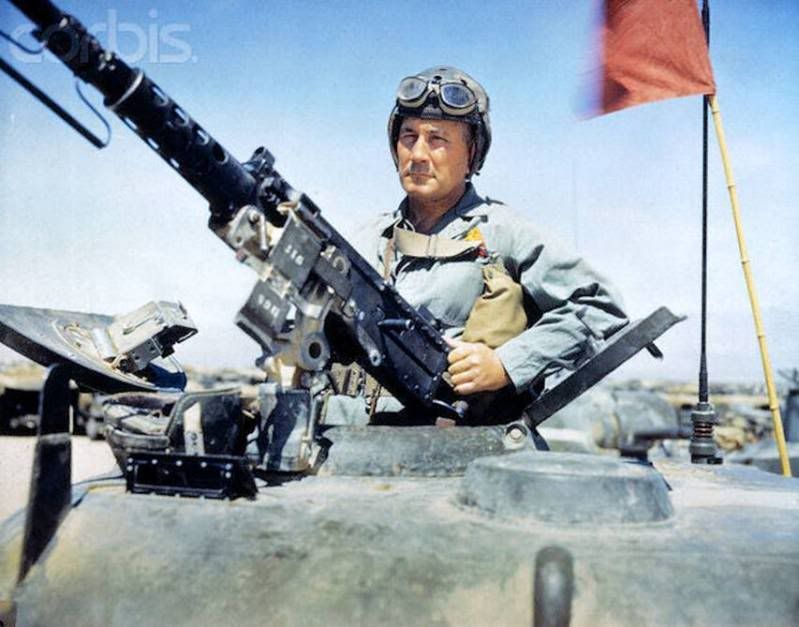
I think the confusion comes from people not realising how unhandy the .50 cal on a Sherman was. The .50 in a pulpit mount on a ht or Priest is ready to rock and roll. The .50 on the Sherman is stowed and can't be fired at a ground target from inside the turret hatch – you had to climb out and stand on the engine deck – like in the inspiring pic above. Point is – .50 could make scrap metal of a Puma at 200m or less – mess it up at longer ranges. BUT – Mr TC sure as heck aint getting out and firing it in the scenario quoted. If I were playing I would make the point and then move on. In my younger days I'd have taken it to the supreme court and ruined everyone's game. |
| Kaoschallenged | 10 Nov 2012 10:23 p.m. PST |
It would certainly be easier to get to on a M10,
link
M18,
linkM36,
|
 Mserafin Mserafin | 11 Nov 2012 3:03 a.m. PST |
BTW, what do you mean by a "spotting weapon"? I believe he is talking about a smaller weapon used to determine the shot of the main gun. The Chieftan had this system – an MG fired tracer at the target until hits were observed, then the main gun was fired. I would guess the trick is matching the ballistics of the two weapons. |
| Skarper | 11 Nov 2012 7:35 a.m. PST |
TD used the .50 cal as the only or at least main MG armament. A Sherman used the M2HB .50 cal almost entirely for AA fire since it had 2 x .30 cal MGs for use verus soft targets. Hence the different mounting system on an open topped TD, HT, SPA, or Armoured car/scout car. Were I the umpire in the OPs game I'd have disallowed the shot from the .50 cal since the MA had already fired and as such the TC was 'busy'. |
| number4 | 11 Nov 2012 11:04 a.m. PST |
I believe he is talking about a smaller weapon used to determine the shot of the main gun Yes I am; don't know if it was done in WWII (but the idea had to come from somewhere), and it was established practice by the 1950's – centurions were fitted with a version of the .50 for the purpose. |
| number4 | 11 Nov 2012 11:07 a.m. PST |
Well, there are at least two photos posted in this very thread showing the .50 in the Sherman turret being held (if not actually fired – the first one looks like he's aiming) by the TC….from within the turret hatch. I don't have the excact reference to hand now, but I read just the other day that in contact was expected, the TC would have the .50 ready to go as the biggest/most likely threat was not the rare panzer 1200 yards away but infantry tank hunters lurking in the shrubbery… the drill was for the TC's to cover alternate arcs i.e. the lead track covering the left flank, 2nd vehicle looking to the right etc. Here's General Bruce Clark of the 4th Armored on the subject: link Here's yet another photo of the TC using the .50 without leaving the turret: link This was for the US Army – British tankers removed the .50's because it was felt they just got in the way of guys trying to bail out. I suspect the British operated under rules that disallowed the kind of 'recon by fire' practiced by American forces. I don't know how the Brits handled the threat of close in infantry ambush. TMP link Third US Army had a program that began in about March of 1945 that added extra steel armor to the front of some M4A3 tanks and also changed the MG layout of the turrets of some M4A3 76mm tanks and M4A3E2 assault tanks – the .50 cal pedestal mount was relocated in front of the loader's hatch and a .30 cal. Browning was added in from of the TC cupola. |
| Martin Rapier | 11 Nov 2012 1:56 p.m. PST |
" I don't know how the Brits handled the threat of close in infantry ambush. " i) they brought their own infantry along ii) they went in 'BESAs blazing' ie hosing down both sides of the road with hull & coax MG fire. iii) the TC took pot shots at the Germans with his Sten from the turret hatch. iv) a rolling 25pdr barrage 200m in front…. |
| number4 | 11 Nov 2012 2:23 p.m. PST |
No idea Tim! Not being a tanker myself, I guess the TC calls his estimate of the range, while the tracer and impact of the spotting rounds give a visual aid for the gunner if the target location is not obvious (or there is more than one) – a bit like the difference between telling someone where to shoot and physically marking the target, in the days before laser designators. Either way, the TC is still acting as commander. I think we can put this one to bed now. There is photographic and anecdotal evidence from WWII (not movies) that show a US Army Sherman commander could – and did – use the pintle mounted.50 without leaving the turret on most models. Some later variants with cupolas had the pedestal mount that prevented this, but many of them were field modified specifically to allow the use of the MG without dismounting. "Reconnaissance by fire" using the TC's .50 was established practice, according to US veterans, so with respect to the OP, in reality, the Sherman would be just as likely to engage the target with MG first, or BOTH weapons simultaneously. *FM 17-12 (1943)Armored force field manual, tank gunnery 33. SELECTION OF WEAPON AND AMMUNITION.--a. General.-
Conserve the 75-mm and 37-mm ammunition. Do not use
the tank gun against a target when the machine guns can
handle it. When necessary, do not hesitate to use both
machine guns and tank against a target. (See FM 17-30.) PDF link * 54. ADJUSTING FIRE.-a. General.-The tank commander
always observes all firing from the turret hatch if enemy
fire permits. Frequently the gunner will be unable to observe
consecutive rounds; that is, he will see one round
clearly but the next will be obscured by dust or smoke.
Therefore, the tank commander gives the gunner proper
orders for the range and deflection change on every round. |
| Qman157 | 11 Nov 2012 3:04 p.m. PST |
| 11 Nov 2012 3:52 p.m. PST |
"Late War (Canadian Field Mod) with .50 cal and AA Bren .303 MG"
link |
| badger22 | 11 Nov 2012 4:36 p.m. PST |
Tuscaloosa, thatnk you for the clarification. I suspect that in a lot of uses it would be very hard to prove that a .50 was not justified in the situation as it was. But certainly at times it probably was not justified. I have never been a tanker, but I have done direct fire on an SP howitzer. The TC is way to busy directing that fire to be faffing about trying to shoot a .50 at that time. Sure it sounds like it was legal in the game being played. One of the many problems of tryig to balance reallity with playablity. WWII tanks dont multitask very well. Owen |
| number4 | 11 Nov 2012 5:30 p.m. PST |
The TC is way to busy directing that fire to be faffing about trying to shoot a .50 at that time OK, putting aside the actual historical evidence, why do some folks have a problem with the concept of an NCO or officer in a tank being able to walk and chew gum at the same time? It's not as if were talking about engaging separate targets simultaneously – this is why real tanks work in formations so every arc is covered (a fact often ignored by wargame rules that treat tanks like skirmishers) Many early war TC's in all armies had to act as their own gunner in a 2 man turret and often direct the operations of the rest of the platoon as well! |
| Hazza31B | 11 Nov 2012 8:08 p.m. PST |
Inside a tank the TC will direct the gunner to targets and usually watch the first shot. After the first target is down he will give the order "Gunner go on" the gunner is then free to enage all targets in his own time and the TC will tend to the comms or his own weapons system. I used to crew leopards 1's and i can say i wouldnt have wanted to be shot at with a 50. Thing would have destroyed the track and running gear. Not critical damage but still deminishes efficency. Abrams would laugh at 50cal rounds. Also another thing to remember is they didnt have QCB back in world war 2 so it was a pain in the ass to change barrels becasue then you then need to set head space and timing and if this is out the gun either fires single shot or you fire the barrel. |
| Etranger | 11 Nov 2012 11:14 p.m. PST |
I believe he is talking about a smaller weapon used to determine the shot of the main gun.
But if that's the case, how does the crew commander know what range to give to the gunner?
Tim IIRC the 'spotting rifle' was mounted co-axially & calibrated in such a way as to 'reproduce' the trajectory of the main gun & therefore the reading would be the same. |
| Milites | 12 Nov 2012 3:47 p.m. PST |
Surely if the US M4's had .50's mounted they used them and given there were even less German aircraft than armoured vehicles, they used them against other targets. The heavy AP round could penetrate ATG shields, buildings where infantry might be hiding and HT's. The sheer destructive nature of hits, on people, (1-2 rounds and you are likely to be missing limbs) would be ideal to disuade the types of soldiers they faced in the ETO. As for the, would the TC use the gun, anything goes to survive. Read an account from a HJ kid whose friend attacked a Sherman with a Panzerfaust, late 44. He missed and, as his friend struggled to prepare another faust, he was gunned down by the TC's SMG. The US crew were shocked at the age of the boy and the mess the SMG had made of him (took 8 hours for him to die). |
| badger22 | 12 Nov 2012 7:00 p.m. PST |
OK putting aside actual historical evidence why do some people continue to feel that TCing an armored vehicle is as easy as chewing bubble gum? As a TC for almost all my adult life, I have figured out how to chew gum and supervise the rest of the crew. What I dont get is getting out of the turret to operte a secondary system and stopp observing what wlse is going on around you. Sure in a tabletop wargame you are aware that there is not another on of those things just behid that stand of trees. In the real world, you have no such knowledge. And you sure are not observing while piling in and out of the turret. Bet in the real world you would feel pretty silly standing on the back deck of that M4 when the 20mm autocannon opened up on you. Of course in a wargame that wont happen, you know its your turn. Real world, no such assurance. It is not the engageing of the target I see as the wrong thing to do. A front mount fifty can probably do the job quite well. It is the bailing out of the turret I object to. Abandoning your job to play machinegunner. Owen |
| number4 | 12 Nov 2012 9:48 p.m. PST |
What I dont get is getting out of the turret to operte a secondary system and stopp observing what wlse is going on around you. What you obviously don't get is the evidence posted here that clearly show it wasn't necessary to get out of the turret at all. Those guys back in WWII knew what they were doing, and it certainly wasn't "playing machine gunner". Real World. |
| badger22 | 13 Nov 2012 8:23 a.m. PST |
Go actualy look at the photos posted by CArdinal hawkwood on the 1st pa the hollywood ones, the other two. In both cases, inorder to fire to the front, you have to be on the back deck, unless you rotate the turret around. Or, if there happens to be a base around you, go crawl on a real sherman. We have a fair number of them right by me on ft Lewis. Real tanks not ones by PSC. You know real world. And yes some of them do have the MG mount so you can fire to the front. But some of them dont. Which way is is makes a huge difference. Yes, some of those NCOs TCing WWII tanks knew what they where doing. And some of them where some of the dumbest mothers to walk the planet. Did you read your own link? It mentions that units moved the .50 over to the loaders hatch. Wonder why they did it? There are actualy people out there in the Army that think the tank commanders job is to command the tank. Imagine that. There are times when engaging targets with the ity bity .50 is a very good idea. And I have also had to sit through stern chewings out about TCs who turn thier armored vehicle into a mobile MG nest because they get so wraped up in shooting stuff them selves. It seems to me most of those who where the most guilty where young LTs, who seem to commit a world of sins no matter what Branch they go into. I also got to listen n on a bunch of DATS getting reamed for casing down and runnning over a fleeing wheeled vehicle rather than just shooting it. The whole platoon got wrapped up in it and nobody was watching out to the flanks where there where still real tanks lurking. Ones that may have had trouble puching them from the front, but certainly would have had no trouble from the side. Real army units survive because they are a team. Where everybody has a job and does his job right, not jumping around doing everybody elses. Makes a good exciting movie script, doesnt normaly work so well n the real world. Hosing down a Puma may not be a bad idea, depends on what else was going on. I dont see that a puma was much threat to a sherman, so probably would have been better to just reload and reengage with the main gun. But, I can also see that if you where there up in the hatch and had the grips of the .50 in hand it would make a lot of sense to hose it down before it could get away. I certainly tend to be over agressive and fire at things when perhaps I should have been a bit more patient. hence some of those lectures. Owen |
| number4 | 13 Nov 2012 10:04 a.m. PST |
Owen, I have crawled around on a real Sherman. Many times. I understand your confusion, so let me explain: early M4's, Ma4a1's and M4A5 (75)'s have the pintle mount for the .50 on the commander's hatch ring. It's usually shown at the rear so the gun is out of the way, but in combat, that hatch ring could be rotated so the pintle mount was toward the front. It's a total myth that you had to get out of the tank to operate the gun. The confusion arises with the later 76mm T23 turret and the adoption of the cupola with all round vision blocks; the rotating hatch ring was obviously gone, so the .50 MG mount was changed to a short pedestal in the center of the roof.
This meant the TC could no longer operate the .50 from inside so was modified by units in the field. Did you read your own link? It mentions that units moved the .50 over to the loaders hatch. Wonder why they did it? See above. It certainly wasn't so the loader could quit the team and go "play machine gunner" Yes, some of those NCOs TCing WWII tanks knew what they where doing. And some of them where some of the dumbest mothers to walk the planet Really. You just slapped a couple of thousand WWII vets in the face. "I told my men the greatest thing on a tank was a free.50 cal in the hands of the tank commander. We were not able to to fight from tanks with the tank commander buttoned up – that has never been successfully done. [Buttoned up] he can't hear or see and so pretty soon he unbuttons. Now if he's go a free .50 cal machine gun, all he has to do is press his thumb and he can pick out a dangerous spot. It may be a bazooka flash or something. He can throw a burst in there without even thinking about giving an order" – General Bruce Clarke, 4th Armored Division
An M4A1 of B Company's 3rd Platoon, 752nd Tank Battalion, on the road to Pisa, July 1944. The commander takes aim with the .50 caliber machine gun, while the assistant driver is at the ready with his .45 caliber Thompson submachine gun. Note the jug of wine on the front fender!
|
| Milites | 13 Nov 2012 11:09 a.m. PST |
Don't know if anyone has linked this link pages 56-9 |
| number4 | 13 Nov 2012 11:25 a.m. PST |
badger22 11 Nov 2012 3:36 p.m. PST
I have never been a tanker, but I have done direct fire on an SP howitzer. badger22 12 Nov 2012 6:00 p.m. PST
As a TC for almost all my adult life, I have figured out how to chew gum and supervise the rest of the crew.
Okay….. :) |
| Deadone | 13 Nov 2012 5:30 p.m. PST |
Isn't the bigger issue firing the 0.50 cal at the same time as the 75mm main gun? This is dependent on the time scale in the ruleset involved. Flames of War for example assumes 15 min – 2 hour per turn depending on action being performed (so 2 hours for an arty bombardment or 15 minutes for an infantry platoon moving). Hence firing main gun and 0.50 cal in the same turn is plausible. If it's more like one of the older D&D games where time scale is 1 minute (or in our version 6 seconds) then firing main gun and 0.50 cal in same turn might not be plausible. |
| badger22 | 13 Nov 2012 5:33 p.m. PST |
OK, my turn to roll back confusion. TC=track commander. Not just tank commander. So in the US Army anything with tracks is called a track and the guy in charge is a track commander, shortened to TC. Real soldiers are real people. Many are very bright some not so much. I dont see how [ointing that out is a slap to all the good ones. Talk to them for a few minutes and they all have lots of storys about the idiots they served with. Note please, that I am not saying that is is not possible for a sherman to engage to the front, just not in all makes and models. The problem is that there where many mods over many years and not all of themmake sense. In front of BN HQ of 3/32 armor ( I think, it has been a few years) There was a 76mm Shermn with a hard mount backwards faceing .50. Back of the turret even. Not sure why although it could well have been due to damage and that was the only way to stick it back on. I read somewhere that Patton wanted an MG over every hatch. A problem you will find on rotating rings is the locking mechanisim.They are not all well designed and frequently dont work. On my M548 (which is certainly no sherman ) I had to fire from the cargo compartment if I was going to shot more than 1-2 rounds at a time because it would not hold still. On one range the Bn comander insisted I shoot from the proper possition. Wirth my section chief and platoon Sgt trying to hold it in position I could not fire a proper burst. And my vehicle was far from the only one with that problem. Newer rings have been improved. So, as you seem to have more data than me (True question not internet snark) what was the percentage of M4 that could MG to the front? I have put up with people outside the Army calling my howitzers tanks since I frst came in the Army. If it has tracks and a turret it is a tank, howitzers are towed behind trucks. Annoys the crap out of me. I will conceed that many, maybe most shermans can engage to the front with the .50. I will maintain that the first dury of any TC is to command the vehicle. Anything that detracts from that lessens the combat value of the vehicle as a whole. In the OPs question, due to a game thing it is possible to shoot the MG and the main gun at the ame time. The TC should be watching for fall of shot, something not easy to see with the old periscopes, whih is why the TC has his head out. In a game you can do that. But in the real world it is not two discrete actions, but rather an ongoing proccess. Owen ( amazed he has not picked up more stifles for this conversation) |
| badger22 | 13 Nov 2012 5:58 p.m. PST |
Just to make the expersion TC even more inclusive, the guys that crew strykers call the man in charge TC. For truck commander. And yes the call strykers Trucks. I drives me crazy to call an armored combat vehicle a truck, but I dont know what else to call them. We got so used to using TC you would refer to the guy in the front of a Jeep as the TC. Just part of how military brains work( or dont as the case ma be). Owen |
| number4 | 13 Nov 2012 7:59 p.m. PST |
Real soldiers are real people. Many are very bright some not so much. I dont see how Pointing that out is a slap to all the good ones. Talk to them for a few minutes and they all have lots of storys about the idiots they served with. I agree – but only they have earned the right to say that. We haven't. I read somewhere that Patton wanted an MG over every hatch.<q/>This tells us there were guys up there using those guns, doesn't it? what was the percentage of M4 that could MG to the front? It should be possible to extrapolate a number from the production figures, as I believe it was only the 76mm T23 turret models that couldn't. However that figure won't include the ones that were modified in theater, although it would be fairly safe to bet all the ones in Third Army were modified. I have never read of there being a problem with the commander's hatch rings on the Sherman (and we never had a problem with ours which were also not Shermans – I'm not really that old!) Even going by the book (in this case FM 17-12), target indication could be done by the commander with MG fire – the actual order was "Watch my burst". In combat, this was taken a step further as the GI's learned to machine gun anything that might be a threat first (and who could blame them). This means the other player in the OP was right, but just did it 'bass ackwards' ;) While it may seem like a distraction to us with our modern experience, the fact is, in WWII, they did it, and have left written accounts and photos as proof. I'm inclined to take their word for it. Buy you a beer some time! |
| badger22 | 13 Nov 2012 8:26 p.m. PST |
OK on the beer. I find this sort of discusion works a lot better face to face on the whole. I have no doubt that the fiftys where being used, it is just the details I was questioning. |
| Warlord | 14 Nov 2012 5:51 a.m. PST |
|
| Hazza31B | 14 Nov 2012 12:40 p.m. PST |
A stryker is a Stryker, A lav a lav. And no just becasue it has a turret and tracks does not make it a tank. As a former tanky i find it insulting. |