Der Alte Fritz Der Alte Fritz  | 07 Feb 2012 1:51 p.m. PST |
I have problems making my own hills. They tend to look like stacked blocks of foam tile, which is what they actually are. How can I get a smooth gradual rise in the hill and have it actually look like a hill. I think back to the Bussaco game featured at Salute last year (or was it two years ago)- that was the perfect hill: long, gradual rise and no wedding cake hill contours. How do I do that? I've tried hacking away at pink insualtion board using a hot wire knife, but my end results still look like a wedding cake with layers. Any ideas or help? |
Dropzonetoe  | 07 Feb 2012 1:54 p.m. PST |
Go after it with some sandpaper. |
 Editor in Chief Bill Editor in Chief Bill  | 07 Feb 2012 2:03 p.m. PST |
Wedding-cake hills are actually preferable for some gaming, depending on period and scale. |
| rampantlion | 07 Feb 2012 2:04 p.m. PST |
Try a hot knife fam cutter that will allow you to get a really shallow angle. I had the same problem until I did that. If the hot knife has enough space between the wire and support you can cut really smooth angles that look like gentle slopes and it helps the stands of figures to stay upright on them as well. I bought one of the fam cutters from a guy at Historicon a couple of years ago. A little pricey, but if you make a lot of terrain a solid purchase I think. Allen |
| Samulus | 07 Feb 2012 2:05 p.m. PST |
Do the rough shaping with the knife, then use polyfiller and sand paper to get a nice smooth slope. |
| Bohemund | 07 Feb 2012 2:07 p.m. PST |
My solution is a large fisherman's filleting knife for initialling cutting the slopes (very long, thin and flexible blade), and then a large rasp to smooth them out. Not expensive hobby tools, yet these have served me very well. |
| The G Dog | 07 Feb 2012 2:09 p.m. PST |
|
| Farstar | 07 Feb 2012 2:16 p.m. PST |
Wedding-cake hills are actually preferable for some gaming, depending on period and scale.
And the size of the basing. We have two sets of hills locally. The smooth sloped hills get put out for larger basing (like WFB's movement trays) or when the big models are not all that tall, and the wedding cake hills (with a set of cut-off hill chunks to handle insufficient movement) are used for individual basing and models with high centers of gravity. |
| Greylegion | 07 Feb 2012 2:21 p.m. PST |
I saw a tutorial somewhere that a guy made a sand bucket (plastic pan with sand in it). He then dug out an inverted "hill" shape in the sand. He took a board drilled a hole in the middle (about 1" diameter). Put the board on top of the sand bucket, shoot the foam through the hole in the board, weight the board down to control the expansion of the foam. Let the foam cure and then cut the "hill" from the board. Seems pretty easy, if you can keep it from getting messy. I thought that was pretty cool. |
| MajorB | 07 Feb 2012 2:23 p.m. PST |
These days, I just buy 'em from Kallistra. |
| Mako11 | 07 Feb 2012 2:38 p.m. PST |
Steak knives, sureform grater (not sure that is the name, but it is like a large-scale cheese grater used for removing wood – it's rather thin, long, and has a wooden handle), and sand paper. |
| Big Red | 07 Feb 2012 2:43 p.m. PST |
Stanley Shureform is your friend. That is until your wife sees the mess! link |
| Mr Pumblechook | 07 Feb 2012 2:59 p.m. PST |
What I do is cut out the base from MDF or ply and bevel the edges. I then glue the base to the raw sheet of foam and let it dry. (It works well to do a whole batch of hills at once) It is important to do it bevel side down. Then I cut around the base with a sharp knife or hot wire cutter. (If you're good with a soldering iron, it's easy enough to make your own mains powered one BTW, rather than use the battery gulping ones) Then I use the hot wire cutter to shape the hill. It can be handy to have a figure on hand to check the slope is shallow enough that they won't fall over. Then use sandpaper and filler to smooth the rough edges and make it blend. Finally paint and/or flock to taste. |
| BTCTerrainman | 07 Feb 2012 3:15 p.m. PST |
Der Alte Fritz: I have made a ton of large foam based hills and terrain boards over the years. What I have learned is to cut the slope in step one ( I use a hot knife, but any type of cutter can be used – heck I even have a huge 24" bow hot wire for big projects). Then I go back to the edge of the slope (where the flat meets the slope) and usually take a little off again to remove the "sharp" change which helps smooth it. (this can also be done by a rough sanding of this area). Rough sand the slopes now. I then use light weight spackle and smooth it into place with a putty knife (allows you to lenght and smooth slopes and reduces the need for precise cutting with your knife/wire). Once dry, I then finish sand the entire slope/surface to smooth out any blemishes/lines in the spackle. Next I usually paint on a foam protective solution to provide strength (others have their own choices and ideas of solution type here). Once dry I can paint and then glue on flocking. The key for me has been to rough cut the foam (glue together layers if not already done), rough sand, spackle, sand and then protect/paint/flock. This practice creates very nice flowing slopes that look "real world" and allow figures to stand up on without toppling. DK |
 Saber6 Saber6 | 07 Feb 2012 3:24 p.m. PST |
I think that you need shallow slopes (@ 30 degrees or less) to look right. GeoHex is 2 1/2 inch rise in 2 inch distance. I think most of us cut too steep. |
| Force XXI | 07 Feb 2012 4:43 p.m. PST |
I haven't made hills for several years now, but when i did..
*Caution* Use sparingly. I used one of my wifes good pairing knifes…. It worked really good and I got the results I wanted. Good luck |
| Oh Bugger | 07 Feb 2012 4:52 p.m. PST |
Cut your base, me I like Polyboard. Glue some little boxes to your base, match boxes are good, to create peaks or whatever shape you want. Get some paper kitchen roll and some Spackle/Tetrion. Mix your Spackle/Tetrion medium thick and soak balls of kitchen roll in it. Place them while still wet onto your base until you get the shape you want. Dilute your mix a bit more then soak sheets of kitchen roll in it. Lay them over the balls etc and pat into place and smooth down. Tidy up edges etc and set aside overnight. Next day give the hill a base coat of acrylic and leave to dry. Then on with the PVA and gravel and flock. Leave overnight and then add a heavy coat of diluted PVA or Matt Varnish. I prefer Matt varnish. The end result should look natural, be suitable to stand your toys on and be practicaly indistructable. Oh and light/easy to store and cheap and fast to make too. |
| Cacique Caribe | 07 Feb 2012 4:56 p.m. PST |
Check out what shallow oval plastic dishes they might have at the party supply store. I don't need more hills, so I didn't grab any. But if I had needed any, that's where I would get them. Dan
PS. About optimal angles:
TMP link |
| Ken Portner | 07 Feb 2012 5:01 p.m. PST |
Problem is that most wargaming hills, even those with gradual slopes, still look like pimples on a flat surface because they're too small. At least where I live, hills don't appear that discrete. They're usually more like what I'd call ridges or rises and cover a large area. That's not usually practical for a wargames table though. |
| Cacique Caribe | 07 Feb 2012 5:46 p.m. PST |
Bede19025 is absolutely right. If you want natural, you'll need a much bigger footprint. Look at these pics: link link The hill in the background was built into the board but, with the small footprint the angle is too steep. The one in the foreground has the minimum practical angle, but the base footprint is much, much bigger. Dan |
| Jeigheff | 07 Feb 2012 6:48 p.m. PST |
I really like the look of those miniature hills, Cacique Caribe. But they look a lot like Enchanted Rock in Texas (and that's a compliment!): goatview.com/january11.htm Jeff |
| Wackmole9 | 07 Feb 2012 10:00 p.m. PST |
I would 2nd on the Stanley Shureform and various grades sanding blocks. Also always have a solid base of some kind of hard board. |
| Der Alte Fritz | 07 Feb 2012 11:55 p.m. PST |
Here is a picture of the Bussaco terrain from Wargames Illustrated. This is simply stunning beyond words. This is kind of what I am looking for, albeit I could never create anything as life like as this, but the slope of the model is amazing.
|
| Early morning writer | 08 Feb 2012 12:19 a.m. PST |
DAF, to create what is in the photo is not as hard as you think. You need rubber rock molds (from train supply stores), fresh plaster, and patience to create the rock facings (might try spackling compound but I don't think it will work as well). The trick to the rest of the terrain (for sculpting see earlier posts in this thread – but use insulating foam, NOT styrofoam) is to use a variety of colors and textures; don't just paint the base but paint it one color, then stipple on other brown shades, ditto a little green, then flock with various colors and textures and you'll be surprised how close you can get. Start small and experiment. You have the talent to do this, I'm sure. |
| Cacique Caribe | 08 Feb 2012 12:36 a.m. PST |
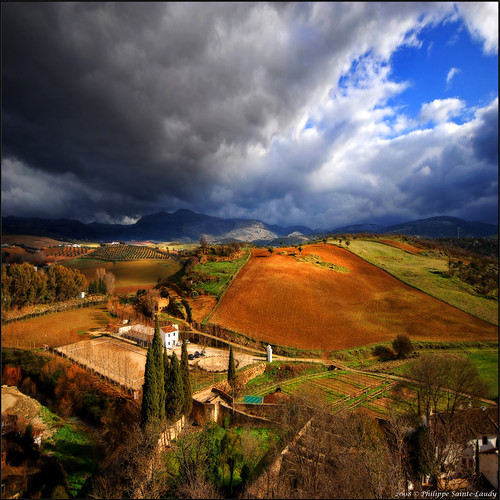
Jeigheff, Been to Enchanted Rock several times! Relatively close to where we live. LOL. I guess I failed in capturing the essence of these Andalusian hills:
I imagine that this other method could have been a lot easier:
Dan |
| dampfpanzerwagon | 08 Feb 2012 3:47 a.m. PST |
Great images and an interesting thread. I tend to skirmish game and small hill or the order of the day. Maybe I need to produce some more. Tony
dampfpanzerwagon.blogspot.com |
| stenicplus | 08 Feb 2012 6:37 a.m. PST |
If you have access to a belt sander and an open space (and a dust mask) then cut up and shape thick mdf boards, 18mm is usually good enough. Certainly as suggested, us a thin hardboard underneath to provide weight and a tougher edge, then us fillers to smooth out the contours. |
| Farstar | 08 Feb 2012 11:46 a.m. PST |
While the table DAF shows is gorgeous, there are games I wouldn't attempt to run on it, including the otherwise appropriate Flintloque/Slaughterloo. Individual basing and slopes are often tricky to put together. Note the models in that picture are element based… |
| Etranger | 08 Feb 2012 8:46 p.m. PST |
Here is a picture of the Bussaco terrain from Wargames Illustrated. This is simply stunning beyond words. This is kind of what I am looking for, albeit I could never create anything as life like as this, but the slope of the model is amazing. DAF, if I remember correctly that was built by Richard Jackson, who inhabits WD3 from time to time. The Busaco boards were his first attempt IIRC! There are some tips here
link |
| HammerHead | 08 Feb 2012 9:38 p.m. PST |
rail modellers used covered chicken wire for many years i guess using foam would become expensive to create something like your picture. As I remember I used dipped paper sheets built up in layers decide where you want your buildings & texture. |
| Cacique Caribe | 09 Feb 2012 12:07 a.m. PST |
To keep down the cost of Expanded Polystyrene (blue and pink stuff), I've often created a core made of something cheaper. Look at the materials you have left over from other projects. You can create a low but wide core "box" out of fiberboard, mdf, plywood or even bubble foam sheets (like what comes in boxed with tv, stereos, etc.). Make sure that the total height equals one or two of the blue/pink expanded polystyrene you buy. After that, just cut the sheets to expand the footprint and height of the core box. Note: If you make the core box with right angles, then you can adhere the edges of your blue/pink board right up against the box. You can even make a stepped pyramid core, which you can then extend with your blue/pink polystyrene sheets. This pic shows what I did a long time ago with a cliff side, but the core box idea is the same: link Dan |
| pbishop12 | 09 Feb 2012 7:00 a.m. PST |
Cacique Caribe.. I actually do what your demonstrating there. I use a pretty natural sheet from the fabric store, sewn together to form 12x6 1/2. Underneath I place the terrain, contour. One guy I know in Houston places carpet underlay under the sheets. Great effect as it gives a rolling affect. Paul |
| bodie1252000 | 09 Feb 2012 10:28 a.m. PST |
natural looking slopes look great but can be hard to play on, from the player's viewpoint… a large one inch sheet of foam insulation is about 20 bucks here in the states. after cutting the shape the edge can be eased with a metal cutting blade or hot knofe, I like a 2 to 3 inch edge which give a slope that allows figures to stand on it without tipping. and I mark the top edge with painters tape which is a bit better than masking tape. just angle the blade so it follows the base corner and the top line marked by the tape and the top edge can be softend further with 220 grit sandpaper. the nice thing about the large sheets of foam is you can make slopes that reach across the entire board and can be stacked to make impressive slopes. if you are not laying a cover over the foam a sense of depth and rolling terrain can be achieved by different shades of basing paint, I try to do it in a camo pattern to break up any straight lines and apply diferent colors of flock over the wet paint. a nice ashe waste effect can be done with a black and white camo base with a grey flock |