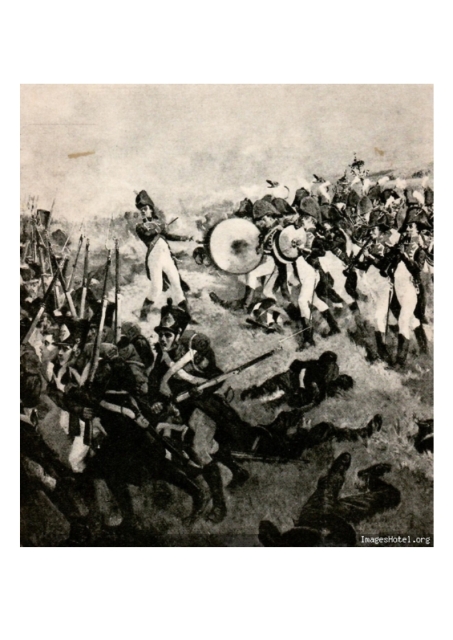
The musicians of the regimental band, I assume, the tête de colonne, because drummers and trumpeters are another story.
Read Chevillet's memoirs trumpeter of the 8e Chasseurs à cheval and also a member of the regimental band as seconde clarinette
As regimental/company trumpeters, they shared the fate of their companies. However, there were also non-combattants gagistes among them, and they did not have the same status as the soldiers of the regiment. This was the case in the 8e Chasseurs à cheval, where these gagistes did not necessarily follow the regiment :
his regimental band was organized, disbanded, reorganized, again disbanded
Our colonel has just created a band in the regiment; that is to say, until now we had only been trumpeters who played fanfares in a military style. Now we are going to become a proper wind band, organized with all the necessary instruments. A bandmaster has been brought in, and trumpeters and chasseurs with some knowledge of music have been selected. Some gagistes have also been recruited to complete the band as much as possible.
I have been assigned to play second clarinet, which I am practicing diligently. It is Captain Planzeaux, an amateur musician, who has taken charge of organizing the band; he is putting a great deal of care and energy into it, and the colonel's wishes have already been fulfilled. We have all been given new uniforms of a distinctive style (canary yellow, green velvet, richly braided).
Our little band is already ready to perform wherever it is needed, at the head of the regiment, on foot or on horseback, in camp or on the march. In short, I am pleased with my new position; this does not prevent me from carrying out my duties as a trumpeter as usual.
(…)
My friend, I have been 25 days aboard, anchored in the Texel roadstead. There is still no talk either of setting sail for England or of disembarking.
However, as our band was not very satisfied with its situation aboard the Trie Zusters, particularly the bandmaster and the gagistes, who are rather delicate gentlemen and could not get used to the uproar of the crew, our colonel, who was well disposed towards them, did everything he could to improve our situation. On 19 August, everything that made up the band was taken ashore.
(…)
From the bivouac after Neuburg, October 9, 1805
(18 Vendémiaire, Year XIV).
My dear friend,
It is only after having already travelled more than 80 leagues through Germany that I have found the time to give you some news of myself. I shall tell you first that, when we crossed the Rhine, our band fell into the water—that is to say, it was disbanded. The gagistes as well as the maître de musique, not being soldiers and therefore not being obliged to go to war, did not want to cross the Rhine with us. Some deserted, while others asked for their discharge. Consequently, I, along with my colleagues, remain attached as a trumpeter to the 2nd company, to which I belong.
(…)
The band of our regiment is not as large as the infantry bands. It is sufficient for it to be made up of between 16 and 17 men selected from within the regiment, among the trumpeters and chasseurs. Each receives an allowance, or additional pay, on top of his ordinary wages, according to his ability and musical talent. I receive the maximum: one franc a day in addition to my trumpeter's pay, which is 14 sous a day.
We are well dressed, well equipped, and receive campaign rations. Here we have nothing but a varied succession of exercises and entertainments, in which the band always takes an active part, and we often earn some extra money from them.
(…)
I must also tell you, my friend, that our band has been dissolved. We have returned to our duties in our respective companies, except for a few men who remain with the regiment's baggage train, together with our bandmaster and the most cumbersome instruments.





 's motivation to paint Napoleonic ships returns!