"Painted ancient sculpture" Topic
12 Posts
All members in good standing are free to post here. Opinions expressed here are solely those of the posters, and have not been cleared with nor are they endorsed by The Miniatures Page.
Please avoid recent politics on the forums.
For more information, see the TMP FAQ.
Back to the Ancients Discussion Message Board Back to the Terrain and Scenics Message Board
Areas of InterestGeneral
Ancients
Featured Hobby News Article
Featured Link
Top-Rated Ruleset
Featured Workbench Article A guide to how Stronty Girl  paints grey horses - specifically, dapple greys.
|
Please sign in to your membership account, or, if you are not yet a member, please sign up for your free membership account.
 20thmaine  | 05 Jun 2026 3:36 a.m. PST |
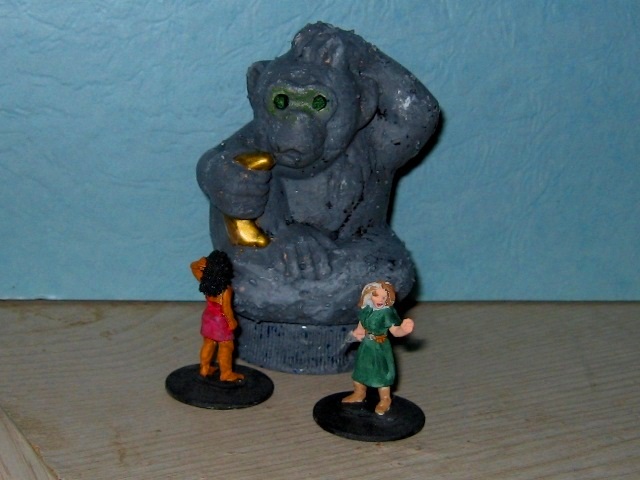
We've known for at least 150 years that statues in the ancient world were brightly painted – although film representations typically (not always) stick to gleaming bare stone. How about your statues used as scenery – gaudily painted or modern museum grey and white stone? |
 ochoin | 05 Jun 2026 4:39 a.m. PST |
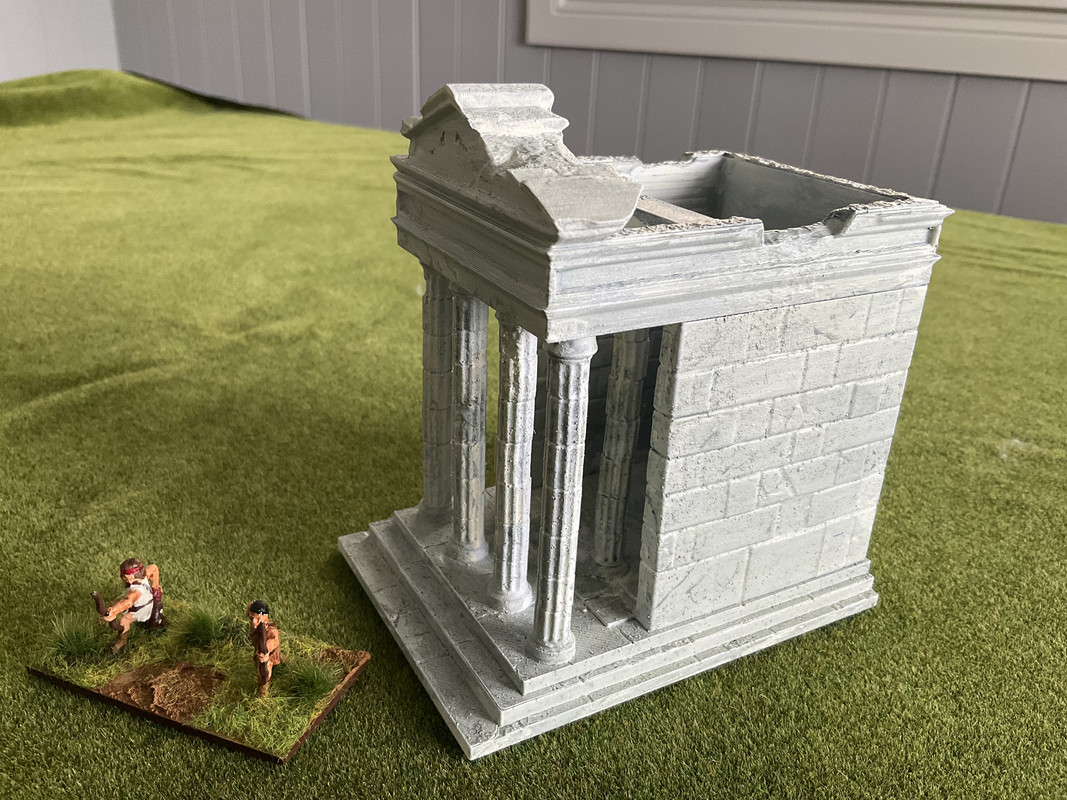
Ditto temples. However, my Table, my Rules: Wargaming relies on visual shorthand, and white marble is the ultimate symbol of antiquity. url=https://postimg.cc/ZBDDC8Wg]
|
| 20thmaine | 05 Jun 2026 4:51 a.m. PST |
Not criticizing – I have some the same – it's interesting though that "we" obsess over uniform details but the architecture can be wildly out. I have fought ACW battles with European thatched cottages on the table. |
 doc mcb | 05 Jun 2026 7:41 a.m. PST |
This is in the same category as Vikings in horned helmets and Buffy wielding her stake overhand. People expect things, as Bowie says to Crockett in the film. Also, as a practical matter, I have enough painting to do without tackling big buildings in complex color schemes. And I use Betsy Ross flags liberally in my Revos. So yes, a valid point which we will all ignore. |
| rustymusket | 05 Jun 2026 8:49 a.m. PST |
Priorities many times, I suspect, as it has been for me. |
 Grelber | 05 Jun 2026 9:42 a.m. PST |
My Egyptians have a number of statues which have been painted in non-stone colors. The Anubis statue, for example, is brownish black. Since I'm not at all sure the Ancient Egyptians used techniques like shading and washes, Anubis is just the one tone of brownish black, while the Egyptian human figures have shading, dry brushing, and washes, adding depth and detail. The idea being to make the statues look like painted statues while the people look (sort of) like people. I suppose this means the broken statue in my ruined temple should have had a few flecks of color on it, but I didn't think of that. Grelber |
| Erzherzog Johann | 05 Jun 2026 2:49 p.m. PST |
I'm pretty sure it wasn't only the Ancient Egyptians that didn't use shading, on their statues or on themselves – well maybe a bit of eye liner :^) We use shading to create a sense of depth that we would see on the full sized statue, person etc, not because the ancients used it. So when I. get around to painting my 25mm Augustus statue for my 18mm Meroitic baggage element I will paint it in bright colours but shade it for effect. Cheers,
John |
 etotheipi  | 05 Jun 2026 3:53 p.m. PST |
We've known for at least 150 years that statues in the ancient world were brightly painted This statement is about as accurate as the assumption that no ancient statues were painted. Many Greek and Roman ancient statues were painted, as opposed to Neo-Classical statues that weren't. Egpytian, especially Greek influenced Egyptian statues were painted. But many also weren't. For many others, the material used (Khafre, we're looking at you) was the point: black basalt, red granite, green stones, alabaster, diorite. This also applies to the majority of Asian sculptures – you didn't carve a Buddah from jade, then paint it to hide the jade. Nor put gold leaf over a statue to hide the gold. Ife and Benin provide a different option, common in the ancient world. The overwhelming majority of the sculptures made from metal show no signs of paint, but would have been displayed draped in cloth, flowers, shells, and in painted architecture environments. Another wrinkle is that surviving pigments are often the durable pigments. We know mineral pigments well because they leave traces. Organic dyes and glazes frequently disappear. So there are cases where we know color existed but cannot reconstruct its exact intensity. Ironically, this uncertainty can cut in either direction: some reconstructions may be too colorful, but some ancient originals may actually have been more colorful than the evidence allows us to prove. "Ancient" is just too broad a category to address these issues.
|
| 20thmaine | 06 Jun 2026 10:38 a.m. PST |
I admit that I was thinking of the greco-roman world. And Egypt. And the minoans. The med' in other words. It also explains all those blank eyed statues – the eyes were painted on. |
| etotheipi | 06 Jun 2026 4:43 p.m. PST |
I admit that I was thinking of the greco-roman world. And Egypt. And the minoans. It's (unfortunately) common use in wargaming that we say "period" when we only mean a very specific, small subset of thing that happened during that time. I say unfortunate, because it causes just the above kind of ambiguity. In that sense, I err on the side of reusability. An unpainted Egyptian sculpture can work in many eras. But a painted one only works in a small sliver. Since all Egyptian ancient art wasn't painted, unpainted statues in certain ancient Egyptian settings are more "outlier" than "wrong". In the Serapaeum, the Ptolomies collected older ancient statues. The Greek tradition would have pushed them to restore them, including paint. But some (especially the larger pieces) would not have been painted, or only "highlighted" – eyes and jewlery. And then later falling into the harbor pretty much nerfs the paint traces for that. So we draw conclusions from the parallel habits of the Ptolomies. Which were mixed. If modern museums (great place for a modern fight) would start restoring such antiquities or using new tech to have "this is what it looked like back in the day" reproductions, I might dress up some more ancient statues, since they would play in more eras. |
| Sgt Slag | 07 Jun 2026 1:18 p.m. PST |
I don't have any, which is surprising since I play fantasy games… Personally, I would like to see all statues painted. The few that I have seen, are quite fun. Bear in mind that ancient artists were not realistic in their renderings, like modern realistic artwork. It is more period realistic, to me, to paint the statuary, more in line with period artwork. That is my opinion. Do what works for you. Cheers! |
 Editor in Chief Bill  | 08 Jun 2026 9:11 a.m. PST |
I seem to remember this being controversial… In the Archaic and Classical periods of Greek art, the depiction of male nudity (the kouros figure) evolved significantly. Early statues often used stylized, incised lines or paint to indicate pubic hair, rather than sculptural texture. |
|