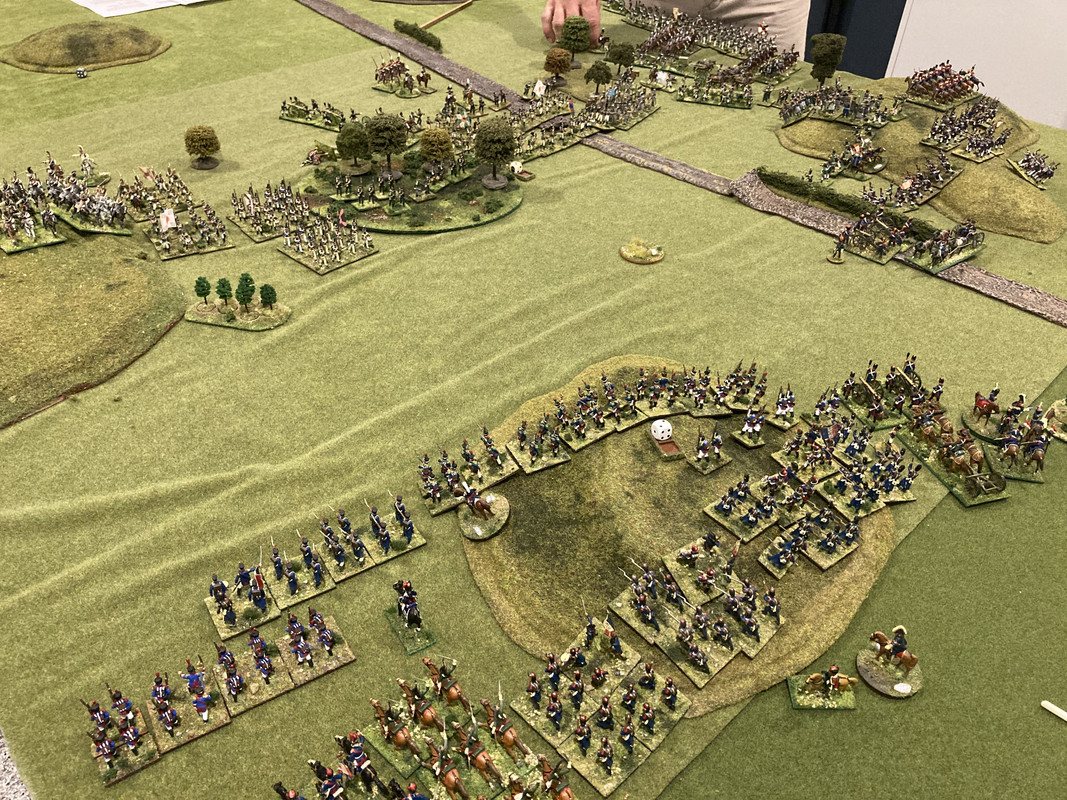
I was looking at my lovingly painted French voltigeurs the other day and reflecting that, in many rulesets, their battlefield contribution is largely abstracted away. They end up as little more than yellow-plumed eye candy decorating the front of a battalion.
url=https://postimg.cc/fkcFZBBG]
Now, I understand the trade-off. Giving skirmishers a meaningful tabletop role usually comes at the cost of extra time, extra mechanisms, and extra complexity. Every detail we choose to model has a price.
Which got me wondering about granularity in Napoleonic wargaming generally.
One of the fascinating things about the period is the sheer range of detail available in different rulesets.
At one end are games where a battalion is essentially a combat value with a frontage. At the other are rules that track ammunition expenditure, formation changes, skirmisher screens, gun types, fatigue, staff officers, and a host of other factors.
Most of us probably draw the line somewhere in between.
So what level of granularity do you enjoy, and where do you think diminishing returns set in?
Are there details that genuinely improve your games by creating better historical decisions? Conversely, are there mechanisms that add complexity without adding much insight or enjoyment?
Examples might include:
Ammunition tracking
Casualty accounting
Brigade and divisional command systems
Detailed artillery procedures
Formation changes
Skirmisher management
Morale and fatigue states
Weather and terrain effects
National characteristics
Do you prefer rules that model these factors explicitly, or rules that assume they are already baked into combat and command outcomes?
And has your preference changed over time? Many gamers seem to migrate either toward greater detail in pursuit of historical flavour, or toward simpler systems that let them fight larger battles and actually finish a game in an evening.
Where do you sit on the granularity spectrum?




 paints the Dogman from the Flintloque starter set.