ochoin ochoin  | 29 Apr 2026 5:58 a.m. PST |
In some rules, ammunition is abstracted away; in others, it can become a real tactical problem. In Rapid Fire Reloaded, for example, German infantry with Panzerfausts effectively get one shot before that capability is gone—simple, but it reflects a real battlefield limit. Other periods had similar issues:
Napoleonic artillery could burn through ready ammunition quickly, especially in prolonged bombardments.
ACW cavalry often fought dismounted and could run short of carbine ammunition far from supply wagons.
Zulu War actions like Isandlwana showed how ammunition distribution could become as important as the number of rounds available.
WW1 machine-gun teams depended heavily on ammunition runners and belt supply.
Desert War tank battles often turned on fuel and ammunition state as much as casualties. Do you track ammunition in your games—by shots, turns of fire, random rolls or not at all? Does it add realism and decision-making, or just bookkeeping that slows the game? |
| Col Durnford | 29 Apr 2026 6:51 a.m. PST |
My ACW rules track artillery by shots. I do like Rapid Fire's handling of infantry antitank weapons. |
| CAPTAIN BEEFHEART | 29 Apr 2026 7:02 a.m. PST |
I think you answered your question by bringing up some popular examples of ammunition supply. I suppose (here it comes) it depends on the level and scope of what is being 'simulated' On the skirmish level it could be obvious or simply implied. Counting the rounds expended for specific units or weapons, or a certain dice roll on the firing sequence. 2 hour games uses the latter technique. If you roll (I forget) a (whatever} on the to hit roll, you get a jam/empty result that will make the figure spend some effort to rectify. If ammunition is supposed to be scarce, it could be declared that the figure is out completely. In games like the Black Powder series, casualty markers
can be interpreted as injuries, exhaustion OR lack of ammunition. Perhaps a third solution could be stating certain pre-conditions before the scenario opens. Maybe something like having artillery units run out a few turns into the game or start to dice for ammunition exhaustion. I'm eagerly waiting for all the other ideas to come because there is always something worth borrowing. |
| BillyNM | 29 Apr 2026 7:44 a.m. PST |
In Chain of Command we track Infantry Anti-Tank weapons (IAT), light mortars and grenades. These weapons can be quite effective so limiting their availbility is definitely worth the effort. |
| Sgt Slag | 29 Apr 2026 7:50 a.m. PST |
It depends upon the scope of the game in question. For my skirmish level games, yes, I track the ammo for Tanks (only). I do not care about small arms ammo, nor Bazookas, nor Mortars, etc. I track Tank ammo, but, typically, the Tanks get destroyed before the super-majority run out of ammo! I rarely have had a Tank run out of shells, and still be able to move! My Tank games are played with 54mm Army Men (Tank models are 40mm sizes, because I can't afford 1/32 scale Tanks, and they take up too much table space!). My rules play fast, and fun -- historical accuracy is not a concern or interest. When I played Command and Decision III, 30 years ago, we did not track ammo that I recall. That game, however, is not skirmish level, either. For skirmish level games, I would track Tank ammo only. The rest… Meh! Cheers! |
| Frederick | 29 Apr 2026 8:30 a.m. PST |
We track single shot weapons like the panzerfaust but pretty much nothing else for WWII For ACW we use Fire & Fury which has a chance of going low on ammo but don't formally track it |
| TimePortal | 29 Apr 2026 8:45 a.m. PST |
True, ammo usage did affect an actual battle but this would vary greatly by era and situation. It would be a very long post if I cited the studies we did at the Quartermaster conducted back in the 1970-80s.
In gaming situations it does matter at the skirmish level but not as much at the operational level.
Guys can make it too complicated. One rules set sold at Historicon back in the 1990s had a turn length of only 3-5 seconds. It took three turns to reload a weapon.
I tend to prefer the infantry beginning a battle with enough ammo for the battle. Artillery or tanks , I have played both ways. |
 KimRYoung KimRYoung | 29 Apr 2026 8:53 a.m. PST |
We play "What-A-Cowboy" and ammo is tracked for each individual, but this is a skirmish level game and the ammo tract is on each cowboys game card. Kim |
| DeRuyter | 29 Apr 2026 9:22 a.m. PST |
I would suggest for Wild West games tracking ammo is critical to the game! Not really the total amount carried but for reloading purposes. As a famous line about a revolver goes: "Feeling lucky punk" |
| Major Mike | 29 Apr 2026 9:37 a.m. PST |
We have played Rapid Fire for WW2 and Modern and use a die to track a units ammo level. |
| Grattan54 | 29 Apr 2026 9:49 a.m. PST |
Never cared for keeping track of ammo. Its a game, let's have some fun playing. Enough with charts and paperwork. |
| doubleones | 29 Apr 2026 10:12 a.m. PST |
What A Cowboy for sure and often times for smoke rounds that mortar teams might have. It's easy enough to track, adds no complexity and gives players something to consider. |
| ochoin | 29 Apr 2026 12:55 p.m. PST |
Interesting. The thread mentions skirmish gaming & largely focusses on ammunition rules in WW2 terms—Panzerfausts, PIATs, mortar bombs or tank rounds—but the same issue existed in much earlier periods. Ancient armies had their own "ammo problems": pila, javelins, arrows, sling stones and artillery shot were all finite resources. At Carrhae, the Parthians' ability to keep their horse archers supplied with arrows was a major advantage, while Roman pila were very much a one-use weapon. At Hastings and Agincourt, missile supply and repeated resupply for archers mattered greatly. Does anyone track "ammo" in earlier periods? |
 McKinstry McKinstry  | 29 Apr 2026 1:04 p.m. PST |
In Blucher the artillery has limited ammunition that is tracked usually on the base. In Command & Colors ancients we have a house rule limiting Romans with pila to two attacks. |
| ochoin | 29 Apr 2026 3:37 p.m. PST |
As long as I've been wargaming, I've looked at Ancient skirmisher models, carrying a single javelin, or, sometimes a couple of extras in their left hand & wondered what happened after these were thrown in the first 2 minutes of a battle. Did they take PD day & go home? |
| TimePortal | 29 Apr 2026 3:49 p.m. PST |
I may be wrong but I think it was at Hastings in 1066 when the Normans ran low on arrows because the Saxons had far less archers to return arrows by firing. They had pages and other non-combats run between the lines to gather arrows.
I did read the account in a book. |
| mildbill | 29 Apr 2026 5:53 p.m. PST |
Ammo depends on the scale of the game. My great uncle was a newspaper man in the old west and said the most gunfights were two drunk cowboys at the bar and the winner was whoever reloaded first.
sometimes ammo would be critical to the outcome. |
| korsun0 | 29 Apr 2026 8:41 p.m. PST |
We use home grown rules predominantly, and add restrictions as appropriate. For example, fire your longbowmen ad nauseam, but you will run out of arrows. Horse archers have to go to a certain point after 3 rounds of firing to restock, so they are out of action for 2 turns. Black Powder weapons can be limited in firing by setting an ammo limit, or having reload turns. 1941 T34s in early Barbarossa? Yes, they gave the Germans trouble but they were severely limited in AP ammo and often had HE only. So hard to kill but not lethal. |
| Martin Rapier | 29 Apr 2026 11:48 p.m. PST |
Depends on period and level of game, but yes, if it is relevant within the time frame. This stuff usually needs to be kept simple, but some sort of depletion/resupply mechanism generally adds something whether it is by bean counting or some sort of randomised combat effect. |
| The Last Conformist | 30 Apr 2026 12:01 a.m. PST |
Caesar sometimes implies that pila-throwing went on for a considerable time. The implication would seem to be that whole units didn't throw theirs in massed volleys, but that individuals or smaller groups threw theirs as they saw an opportunity. I don't usually track ammunition, but that's partly down to me relatively rarely playing skirmish games, where it would make the most sense to do so. |
| pzivh43 | 30 Apr 2026 9:47 a.m. PST |
Battlegroup WW2 tracks AP and HE for armored fighting vehicles. I don't care for it (although I love the rules) and rarely track it. But some of the late war vehicles (T-34/85, IG 152, etc.) don't carry much ammo, and that can cause tactical issues. |
| Major Mike | 30 Apr 2026 10:42 a.m. PST |
For javelins/pila, we would put a toothpick with the unit. Once thrown the toothpick was removed. |
 Yellow Admiral Yellow Admiral | 30 Apr 2026 2:40 p.m. PST |
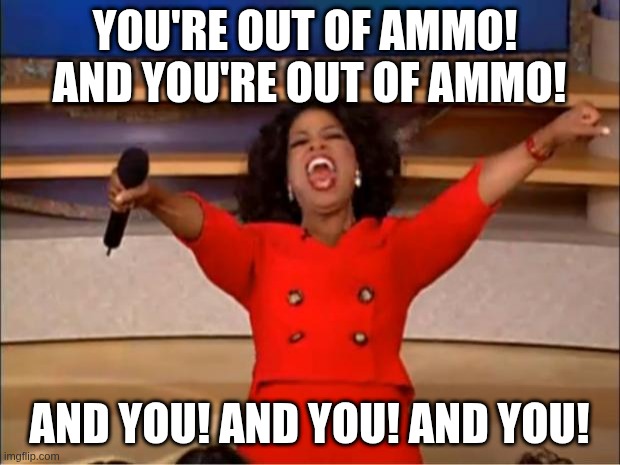
Tracking ammo is a PITA, so I tend to prefer it's abstracted if it has to be tracked at all. I'm reasonably happy with the method used in To The Strongest (ancients and Medievals) where units have a limited number of ranged shots and a system for resupply. It's a lot of markers on the table, but seems okay in operation. It's nice to automatically limit the shooting of especially devastating shooty units like massed bows or swarms of javelin/sling troops. I've always found the Fire & Fury method of a low-odds chance of rolling "low on ammo" during a shot acceptable enough, as long as I don't think about it too hard. Of course it's almost nonsensically generic (every type of weapon has the same chance of running out?), and also Lady Luck loves to do silly things like punish that one unit over and over or have an Oprah meme turn:
I've toyed with adding house rules to mitigate this kind of thing, but every special rule is an unevenly applied rule, and extra complication. Meh. I reserve this kind of house rule for special scenarios. For naval gaming I prefer to ignore ammo tracking altogether. Ships normally carried enough ammo for hours of shooting and games rarely last long enough for that. Still, sometimes there was a specific historical tactical impact due to ammo supply… e.g., I've played more than one naval battle in the Slot where the IJN ships arrive with HE ammo at the ready, so I add a timer (measured in turns or volleys) before the players can choose AP ammo. That's easier than tracking the whole magazine. Playing an operational naval campaign, the ammo supply starts to matter a lot. Most fleet/squadron/ship commanders knew to get resupplied ASAP between actions, but in a campaign setting the logistical concerns become player actions, and ships running low on ammo/fuel should be a concern requiring player attention. The only way I've ever seen this done is with X checkboxes per ship that get ticked off with each shot, but that's just too much paperwork. If I do one of these again, I'll probably do something more like: - No chance of running out of ammo in first action
- F&F-like chance of running out of ammo during second and subsequent actions (roll high = mixed elation and regret)
- Conduct operational resupply between actions to reset to condition 1
|
| huron725 | 30 Apr 2026 2:48 p.m. PST |
Yes we track ammo only in skirmish games. Anything larger no. |
| ochoin | 30 Apr 2026 3:40 p.m. PST |
"Ships normally carried enough ammo for hours of shooting" An anomaly, I know, but in one of Nelson's early battles, the ship he was commanding would have run out of powder & shot except that "somebody" had greatly overstocked the ammunition supplies. I can't remember the battle – anyone help? |
| KSmyth | 30 Apr 2026 7:53 p.m. PST |
In Hundred Years War games I limit the number of turns English longbowmen fire at full effect. Unlike bullets, one can only carry so many arrows, and when your super power is firing them quickly and accurately . . . alas. |
| Jcfrog | 01 May 2026 5:37 a.m. PST |
That is where computer games can do it so much better. In big battles, it can be useful, for exemple to have more realistic use of artillery. despite a bit of bookeeping (I favor a sort of abstract central "storage" representing the link to the rear reserve (which can be severed) and a semi random loss.It quietens player not to shoot on every 5% chance that shows up, actually speeding play together witha part realistic thinking. In WW2, we should, but is nearly unpractical as slowing games too much. the pb with random dies means there is no "planning" involved. you can start an assault, finding by turn 3 youare powerless sort of suddenly. It can be equally useful to show a doctinal difference such as 1870. french tend to withdraw to reload batteries, whereas Germans have a rolling number of caissons rotating to the rear, with possible mistakes. In the end, look at the historical sources, did they have a problem with it, did it affect the fight? |
| Wolfhag | 01 May 2026 6:41 a.m. PST |
Normally, in a battle the leaders had a plan to resupply the units at the FEBA. At the platoon level they used runners to bring up ammo. If a unit is cut off and could not resupply it would become a problem. In my 1:1 level AFV game, I was considering tracking the # of rounds in the tanks ammo rack. That would mean that in a lull the crew would reload the rack putting more record tracking in the game. However, after play testing, the number of rounds in the rack (5-12) was enough for a small engagement and no need to track the rounds unless the scenario accounts for it. The one exception is the T-34/76. It normally has only 3 rounds in the turret rack. The rest of the rounds are in 3 round boxes that make up the floor. The loader needs to remove a rubber mat, open a box, remove the round and reload. So when a t-34/76 is reloading there is a chance of this occurring and taking much longer to reload. Personally, if rolling for random ammo supply I'd say the first failure would result in the player knowing the unit is low on ammo and firepower is decreased. The second failure is out of ammo. At the lowest level tracking grenades, AT rockets, flamethrowers (should fire 3-5 times at the most depending on scale), and maybe light mortar rounds. Wolfhag |
| Oberlindes Sol LIC | 01 May 2026 9:46 a.m. PST |
I've designed TOEs for play with little boxes to tick each time a weapon was fired. After each game, I would look at the TOE sheets. No one ever got close to running out of ammunition. These were all skirmish games in a somewhat hard science fiction setting. |
| Yellow Admiral | 01 May 2026 4:33 p.m. PST |
I've had the same experience with naval gaming, which is why I stopped tracking ammo. |
 Grelber Grelber | 01 May 2026 5:13 p.m. PST |
Greco-Turkish War of 1897. The Greeks had a prime minister in the 1880s who bought new ships and got everybody as well supplied as they could afford. He was followed by a prime minister who disagreed with everything the first guy did on principle. So, when the war came along, the ammunition supply for the Greek fleet was low, and they generally avoided battle, or limited themselves to one or two shots before breaking off the action. This might have been a major problem if most of the Turkish fleet had not been so poorly maintained that they hung out behind the forts at the Dardanelles. So, ammunition (and maintenance) was important, but was largely handled at the strategic or grand strategic level, and the ship's commander didn't have the opportunity to have his ship sunk because he ran out of ammunition. On land, one of the most spectacular events occurred when a Turkish shell hit a Greek caisson, which exploded dramatically. It strikes me that an event like that might trigger a check to see if the nearest battery has to pull back to resupply, either immediately or after the next shot. Grelber |