
"Almirante Lynch, 1891 – sea combat in the Pacific" Topic
1 Post
All members in good standing are free to post here. Opinions expressed here are solely those of the posters, and have not been cleared with nor are they endorsed by The Miniatures Page.
Please don't call someone a Nazi unless they really are a Nazi.
For more information, see the TMP FAQ.
Back to the Naval Gaming 1898-1929 Message Board
Areas of Interest19th Century
World War One
Featured Hobby News Article
Featured Ruleset
Featured Showcase Article
Featured Workbench Article
Featured Profile Article
Featured Book Review
|
Please sign in to your membership account, or, if you are not yet a member, please sign up for your free membership account.
| Tango01 | 01 Apr 2026 1:50 p.m. PST |
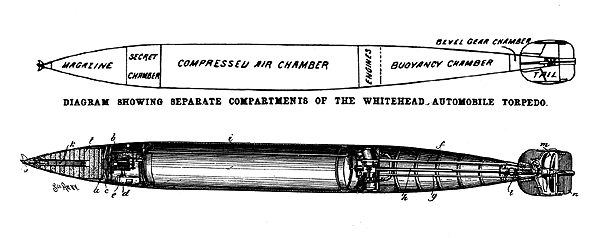
"The appearance of the successful self-propelled torpedo occurred in the mid-1870s, at the same time as light, efficient steam engines allowed the development of a new type of warship, the torpedo boat. Fast by the standards of the time – typically 18 to 20 knots – and cheap to build, these small vessels carried a weapon that, for the first time, allowed attack below the waterline. To this, even the most heavily armoured ships were vulnerable.
Some nations, such as France, which remained a possible enemy for Britain in any war likely at this time, saw flotillas of such gunboats as an economic and effective way of countering the numerical advantages of a larger navy. In the French navy this concept was central to the strategy advocated by the so calledJeune École, and other nations, including many smaller ones, followed suit. Swarms of torpedo boats were believed capable of swamping the onboard defences of their targets and, as when the airborne attack emerged as a threat in the 1920s, many came to believe that the day of armoured units, particularly battleships, was over. Though early torpedo boats were suited to inshore use only – as for defence of ports and naval bases – size and sea-keeping ability increased through the 1880s, thus allowing more aggressive deployment. Typical of such larger boats was the Falke, built by the British company Yarrow for the Austro-Hungarian Navy in 1885 and carrying two torpedo tubes and two 37mm quick-firing guns. 135 feet long and displacing 100 tons, she was capable of 22 knots at a time when the fastest armoured ships were lucky to make 16…"
The Dawlish Chronicles link
Armand
|
|


 adds an infantry platoon to his WWI Brits.


