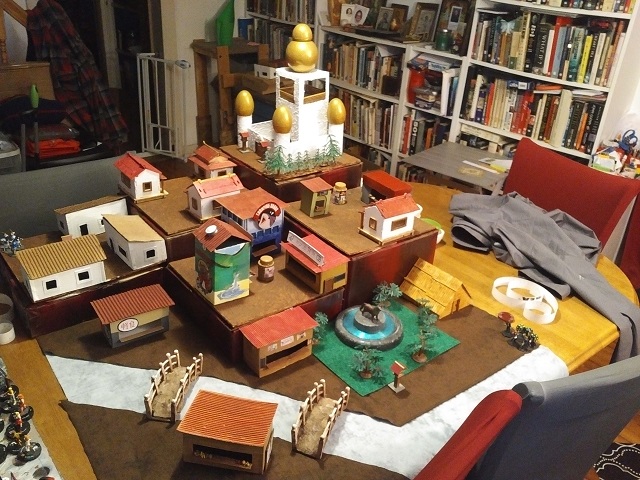
"Are Our Battlefields Too Tidy?" Topic
8 Posts
All members in good standing are free to post here. Opinions expressed here are solely those of the posters, and have not been cleared with nor are they endorsed by The Miniatures Page.
Remember that you can Stifle members so that you don't have to read their posts.
For more information, see the TMP FAQ.
Back to the Terrain and Scenics Message Board
Areas of InterestGeneral
Featured Hobby News Article
Featured Link
Featured Ruleset
Featured Showcase Article Need 16 square feet of gaming space, built to order?
Featured Workbench Article How do you clean dried ink from your palette?
Current Poll
Featured Book Review
|
 ochoin ochoin  | 01 Apr 2026 1:03 p.m. PST |
I've been putting away the various bits of terrain I've just used in a solo game – a few hills, some latex river etc. This has got me thinking about terrain and how we use it on the tabletop. In many games—especially tournament or pick-up games—terrain tends to be fairly sparse and often symmetrically placed for fairness. In other cases, terrain is present but simplified. Woods, hills and built-up areas that look right but don't necessarily behave in a very restrictive way. This seems to vary quite a bit by period.
WW2 games, for example, often make terrain central to play, while in Ancients it can feel more like a backdrop. The nice, open areas your "difficult to command" ECW Covenanters need. Rules also differ widely. Some systems (e.g. Valour & Fortitude or Hail Caesar) tend toward relatively simple terrain effects, while others introduce multiple terrain types with more detailed interactions. It does make me wonder:
Are we generally using too little terrain?
Does the need for fairness (especially in tournaments) lead to overly "balanced" battlefields?
Do our terrain rules make features too easy to move through, see over or fight in?
Should terrain be more of an obstacle—something that channels, blocks and disrupts rather than just decorates? Has anyone used random or semi-random terrain placement systems that produce more "natural" battlefields? More broadly, are we gaming on battlefields that are too tidy—and does that affect how our games play? Interested in thoughts from any period or rules set. |
| Frederick | 01 Apr 2026 1:57 p.m. PST |
For WWII almost certainly – for Horse & Musket it depends – commanders certainly in SYW did not especially want to fight thru tough terrain, if for no other reason than loss of command/control For ACW almost certainly, at least in our group, don't use enough terrain – and I think terrain should be important in channeling or guiding maneuver, not something that is just decorative |
| rustymusket | 01 Apr 2026 2:08 p.m. PST |
I agree that the battlefield look is sparse with terrain in many cases. On the other hand, the miniatures do not move themselves and it is not unusual for terrain to be moved while big hands move little bases through the area. It seems to come down to a compromise of battlefield look vs playable surface. |
 ColCampbell ColCampbell | 01 Apr 2026 2:23 p.m. PST |
Probably we don't have enough "terrain clutter" on our miniature battlefields. But it depends on the period and the area in which we are gaming. Many battles throughout history were fought on fairly "clean" battlefields. But many weren't – North America during the 1700s and 1800s, Southeast Asia in the 20th Century – are just two examples. I think we should be more deliberate in choosing and portraying the terrain in our miniature battlefields. Jim |
 etotheipi etotheipi  | 01 Apr 2026 2:42 p.m. PST |
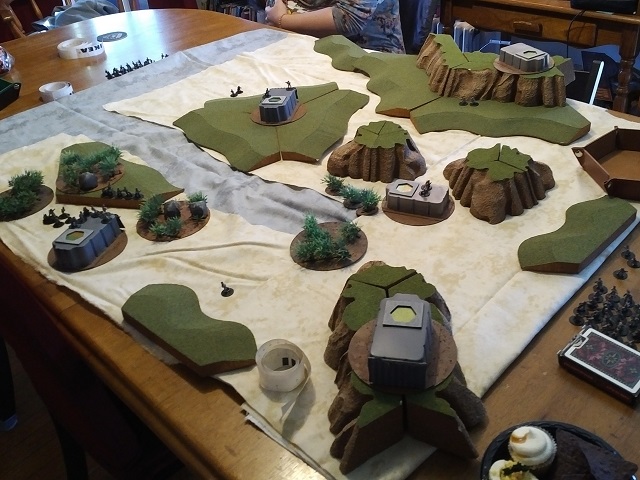
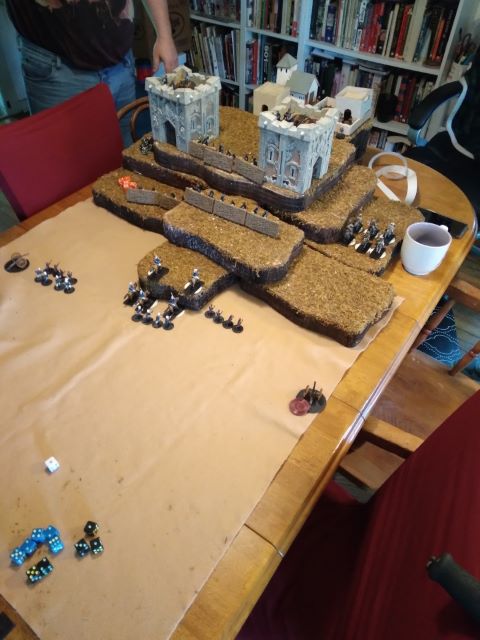
I can't speak for "us" because I have no idea who all of us is, let alone what all of us do routinely. Terrain is pretty much key to all our scenarios, no matter the genre. For OXI Day, this is pretty spot on, at scale (each 15mm figure represents a roughly company sized element):
For Puebla, the French start about where that lonely die near the bottom is, but it doesn't get interesting until they get the hill, which is 3-4 rounds. This pretty much matches the area, again at scale.
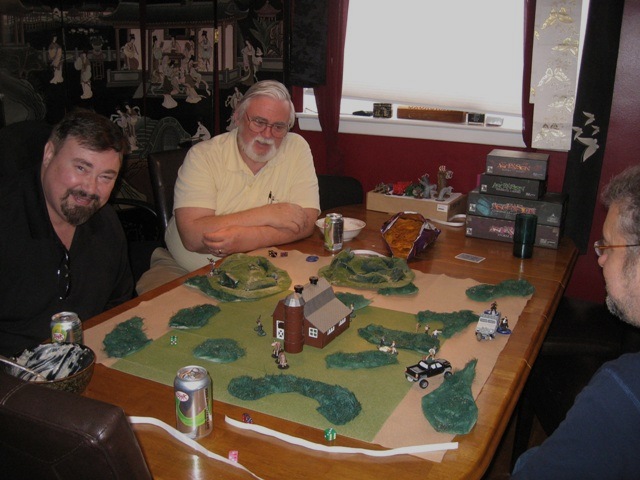
I am somewhat an authority on rural Appalachia, so this is spot on. The hidden terrain bit is the upper left corner of the board is "uphill", although there is no real slope.
This is a fictional scenario, but if you swap out the creek for a railroad track, it looks surprisingly like the area in Japan where I lived.
This is also ficiton, Atlantis sinking. But it's all about the (terrain) base, all about the (terrain) base, all about the (terrain) base … no rubble.
inlgames.com/atlantis.wmv None of this is decorative (though I like the way the pieces look). All the terrain affects maneuver and engagement, which cascades to things like C2, operational tempo, and risk management. |
| etotheipi | 01 Apr 2026 2:48 p.m. PST |
To the point about random, many of our scenarios have random terrain or base terrain with options that can be rolled or chosen. Some of the very brief example scenarios that come with the rules just describe 40-60% urban terrain (buildings). Most of the scenarios describe the terrain drivers (coverage, obscurance, hindrance, other dynamic properties) so people can change it up or port it to different game systems. Note that this is about scenarios. I don't really think terrain for a specific battle belongs in rules. As far as "fairness", if we are doing a competitive event with a record that drives later games, we usually swap sides, play again. |
| ochoin | 01 Apr 2026 3:32 p.m. PST |
Good points all. I think this is really getting at two different questions:
how much terrain should be there historically for a given period/region and
how much terrain we can practically handle on the tabletop Frederick's point about SYW command/control is key. Terrain isn't just visual, it directly affects what commanders were willing & able to do. rustymusket's point is the other side of the coin—we physically simplify terrain so we can play at all. Which makes Jim's point about being deliberate the important one. If we're going to reduce terrain for playability, maybe the question is: are we keeping the right terrain? The pieces that actually shaped movement and decisions? That might matter more than overall density. |
| ochoin | 01 Apr 2026 3:34 p.m. PST |
Samples of key terrain: forests for F&IW games.
jungle & clearings for Vietnam
bocage for WW2 Normandy
fields for ECW Different theatres don't just change how much terrain is on the table. They change what counts as important. |
|