Help support TMP


"USMC to Kharg Island?" Topic


11 Posts

All members in good standing are free to post here. Opinions expressed here are solely those of the posters, and have not been cleared with nor are they endorsed by The Miniatures Page.

Please don't make fun of others' membernames.

For more information, see the TMP FAQ.


Back to the Ultramodern Warfare (2016-present) Message Board


Areas of Interest

Modern

Featured Hobby News Article


Featured Link


Top-Rated Ruleset

Team Yankee


Rating: gold star gold star gold star gold star gold star 


Featured Workbench Article

Hasslefree's Morgan & Tony

With clean lines and not a lot of clutter, Minidragon Fezian says these figures are a painter's dream!


Featured Profile Article

Dung Gate

For the time being, the last in our series of articles on the gates of Old Jerusalem.


Featured Book Review


511 hits since 14 Mar 2026
©1994-2026 Bill Armintrout
Comments or corrections?

doc mcb14 Mar 2026 5:18 p.m. PST

Looks like a Marine force (MEU, about 2500 troops)is on its way to the theater. Seizing Kharg seems a likely target. And maybe then KEEPING it?

Does the regime use remaining missiles on Americans occupying its oil bottleneck?

Personal logo Editor in Chief Bill The Editor of TMP Fezian14 Mar 2026 5:42 p.m. PST

Marines might be useful grabbing the nuclear stockpile, too.

Col Durnford Supporting Member of TMP14 Mar 2026 5:47 p.m. PST

Or they could be doing just what the did in the Gulf War, look at the Marines and we hit you someplace else.

Another option is to watch where Iran sends troops and bomb them.

doc mcb14 Mar 2026 6:01 p.m. PST

from Wikipedia: Following the beginning of the 2026 Iran war on 28 February 2026, analysts interpreting satellite imagery noted that Iran apparently expected Kharg Island to become a target in an upcoming conflict and therefore had started to reduce the amount of oil in storage there since early February 2026. Although the facilities on Kharg were initially not attacked, only nine of the oil tanks were estimated to be full by 7 March 2026, compared to 27 in mid-January.[18] In March 2026, it was reported that Israel was considering bombing the island, while the US was favouring the idea of seizing the island.[7] On 13 March 2026, the United States announced that military installations on the island were bombed as part of the conflict.[19][20][21] CENTCOM said that about 90 military targets were struck, while oil infrastructure on the island was left intact.[22]

Civilian population has been about 8000.

Tango0114 Mar 2026 11:31 p.m. PST

Ghost of Gallipoli: U.S. Warships Cannot Control the Strait of Hormuz

"One factor should dominate global strategic policymaking today: that the Strait of Hormuz will re-open only with the consent of the Iranian government. No amount of U.S. naval power can either force passage or safeguard transit.


So Raelene Lockhorst's Strategist article on 9 March on the effect of its closure on Australia should be taken with deadly seriousness, now, by Australian policy makers.


On the surface, access through the Strait of Hormuz appears to be a naval challenge. And on the surface, the United States Navy has the upper hand. It has almost a fifth of its carrier fleet in the region—the USS Abraham Lincoln and the USS Gerald R Ford—plus a huge escort force. The U.S. military can eliminate all Iranian maritime activity. To date, it appears to have sunk 30 Iranian vessels.

But in naval doctrine, sea denial is one thing; sea control is quite another.

The problem is this: the U.S. Navy can deny the Iranians the ability to operate on the waters of the strait—or anywhere for that matter—but the U.S. Navy cannot control the strait itself. Iran can deploy cheap anti-ship weaponry along the littoral of the strait with far greater ease and assurance than modern naval forces can reliably counter them. Dumb mass will defeat cutting-edge quality.

On 12 March, U.S. Energy Secretary Chris Wright said the U.S. Navy would probably start escorting merchant ships through the strait this month. This will hardly be sustainable: the interceptor cells and anti-missile gun magazines on U.S. destroyers and frigates will empty more rapidly and expensively than Iranian arsenals.

Iran's task is not militarily taxing, anyway. Iran needs only to target the tankers, which can be hit with little accuracy. Iran's forces can ignore the escorts. Just a few hits on a few tankers are enough to force mercantile insurers to bail out. According to Britain's Maritime Trade Operations Centre, Iran has so far attacked 16 vessels in the strait, the Gulf of Oman and the Arabian Gulf. The strait is effectively closed.

Given the strong tides through the strait, Iran can also float mines into the waters from various points on the littoral. It doesn't have to load them onto mine-laying vessels (16 of which the U.S. claims to have sunk).

So, in the unlikely the U.S. Navy did attempt convoy, it would first need to destroy land-based anti-ship capabilities and operations on the Iranian side of the strait.

It's at this point the Dardanelles analogy becomes operative. The only reason the Gallipoli campaign was attempted in 1915 was because the most powerful navies of the day had failed to force a passage through the narrow Dardanelles, the shores of which were controlled by Ottoman forces. In this case, even 18 battleships—including the 381-mm guns of the new battleship HMS Queen Elizabeth—failed to sufficiently suppress defensive artillery.

In constricted waters, the combination of basic artillery and basic naval mines inflicted such damage on the world's most advanced navy and its French ally that they had to retire.

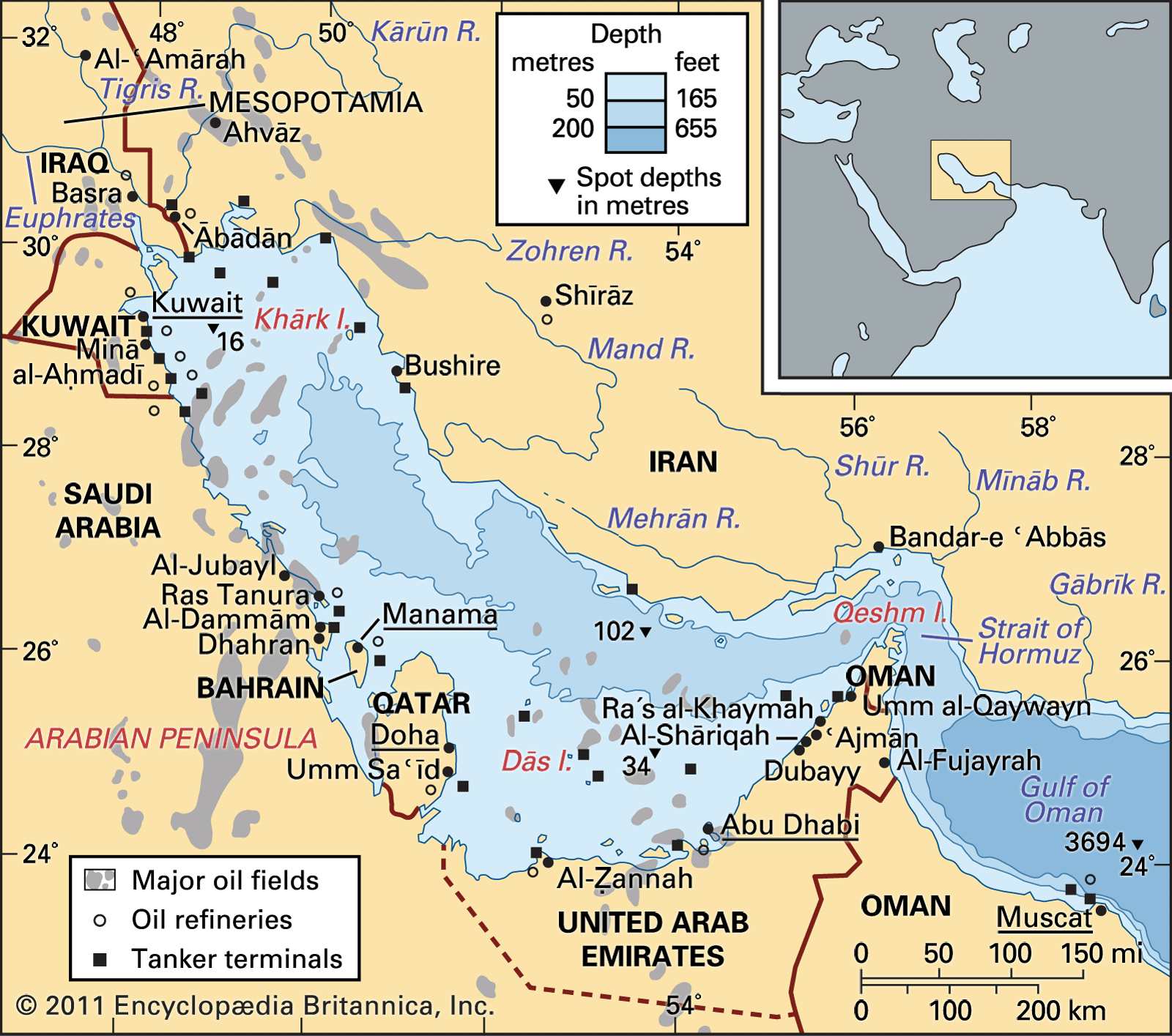
So, an attempt to force passage will present the United States with the same fallback option that Britain and France had in 1915: to take the littoral by force. But occupying the Gallipoli peninsular doesn't begin to compare with occupying more than 150 km of Iranian shoreline, from Qeshm island in the west to the Port of Bandar Abas and down the coast to Koo Mobarak, where the strait widens.

There is no defensible line that U.S. forces could ever secure. The attempt would be Gallipoli times 10, with the difference that the Iranians could always pull back to interior lines of defence. It is inconceivable that the U.S. would try.

Are there alternatives? U.S. air forces could continue to reduce Iran's ability to make drones and missiles. But even if that works, there are substitutes. Russia has every incentive to keep the strait closed, since its own hydrocarbons are becoming more valuable with every passing day. Russia is strategically on-side with Iran's actions.

Russia also has the kit to help. It has spent four years contracting the development cycles of cheap drones and non-smart missiles. It can fly or ship hundreds of such munitions across the Caspian Sea. Even if U.S. drones could interdict passage, an attempt would constitute a direct attack on Russian forces. So that won't happen either.

Consequently, Iran is in a far stronger position than might appear. It just has to persist—while the damage to Asian and European economies accumulates. As a huge energy exporter, the U.S. has autarkic options; Asia and Europe do not. This means the U.S. is in a far stronger position too, compared with its beleaguered allies.

And so back to Lockhorst's analysis. Australia should start planning now for restricted supply of essential fuels. The war will not be over when the U.S. stops bombing; it will be over when Iran allows free passage through the Strait of Hormuz. And there is nothing the U.S. military can do to change that equation."


picture

link


Armand

Andrew LA15 Mar 2026 1:48 a.m. PST

Yes they could take it if they wanted. But at what cost and at what cost to hold and supply the troops on it indefinitely? If the US Navy cannot even safely get through the Straits of Hormuz right now, how will they keep a Marine Unit sustained up in Khark Island? A threat of invasion is possibly a bigger strategic threat than actually doing one.

Grattan54 Supporting Member of TMP15 Mar 2026 9:58 a.m. PST

I was listening to a former admiral today. He said the US is going to have to defend the straits for a long time after this is all done. Could be another "forever war" but let us hope not.

Royston Papworth15 Mar 2026 11:25 a.m. PST

My takeaway from both the Russian and American Special Military Operations are that these things are never as quick or easy as expected.

I have the upmost respect for the US armed forces as being in the very top level of the world's militaries.

However…

For the last few decades both the US and more importantly Iran knew this was coming.
Iran can't bomb the US
Iran doesn't have nukes
Iran is unlikely to be able to sink a US carrier.

So what could it do?
It can damn well close the Straights of Hormuz. It's ideally placed to be able to do this.
So why does this seem like a surprise to the US Command??
Surely this should have been taken into account for Day 1 targets???

doc mcb15 Mar 2026 2:44 p.m. PST

We will keep the Straits open. Any weapons they launch will be backtracked to point of origin, which will then be destroyed. They will run out of men and weapons soon enough. And the regime will collapse. Even now they have almost no fuel to move around. Iran is a large and diverse country and there will be regional uprisings that will grow.

Guys, come on! it's only been two weeks.

Personal logo ochoin Supporting Member of TMP15 Mar 2026 3:25 p.m. PST

Optimism is a fine thing. even the "blind" version.

Personal logo StoneMtnMinis Supporting Member of TMP15 Mar 2026 4:04 p.m. PST

Epic Fury was designed to do one thing, end the 47 year "Forever War" waged against the US. This, it is successfully accomplishing.

Keeping the Straits open is a side issue that really doesn't impact the US goal. That we are setting the stage(by the destruction of the mullahs) is a side benefit for the rest of the world. All you have to do is listen to what is being said by the Administration and you will understand it is Europe's job to keep it open because they, not the US, depend on it for their oil shipments.

So, this is only a part of the strategy to deal with the real threat to the US, china. And to that end another one of their pieces have been removed from the board.

Sorry - only verified members can post on the forums.