"Wurmser Freikorps The "Red Cloaks" 1793-1801" Topic
9 Posts
All members in good standing are free to post here. Opinions expressed here are solely those of the posters, and have not been cleared with nor are they endorsed by The Miniatures Page.
Please be courteous toward your fellow TMP members.
For more information, see the TMP FAQ.
Back to the 18th Century Discussion Message Board Back to the Napoleonic Discussion Message Board
Areas of Interest18th Century
Napoleonic
Featured Hobby News Article
Featured Link
Top-Rated Ruleset
Featured Showcase Article I paint the last two figures from the Escape from the Dark Czar starter set.
Featured Profile Article
Featured Book Review
|
Please sign in to your membership account, or, if you are not yet a member, please sign up for your free membership account.
| Lilian | 09 Feb 2026 7:45 p.m. PST |
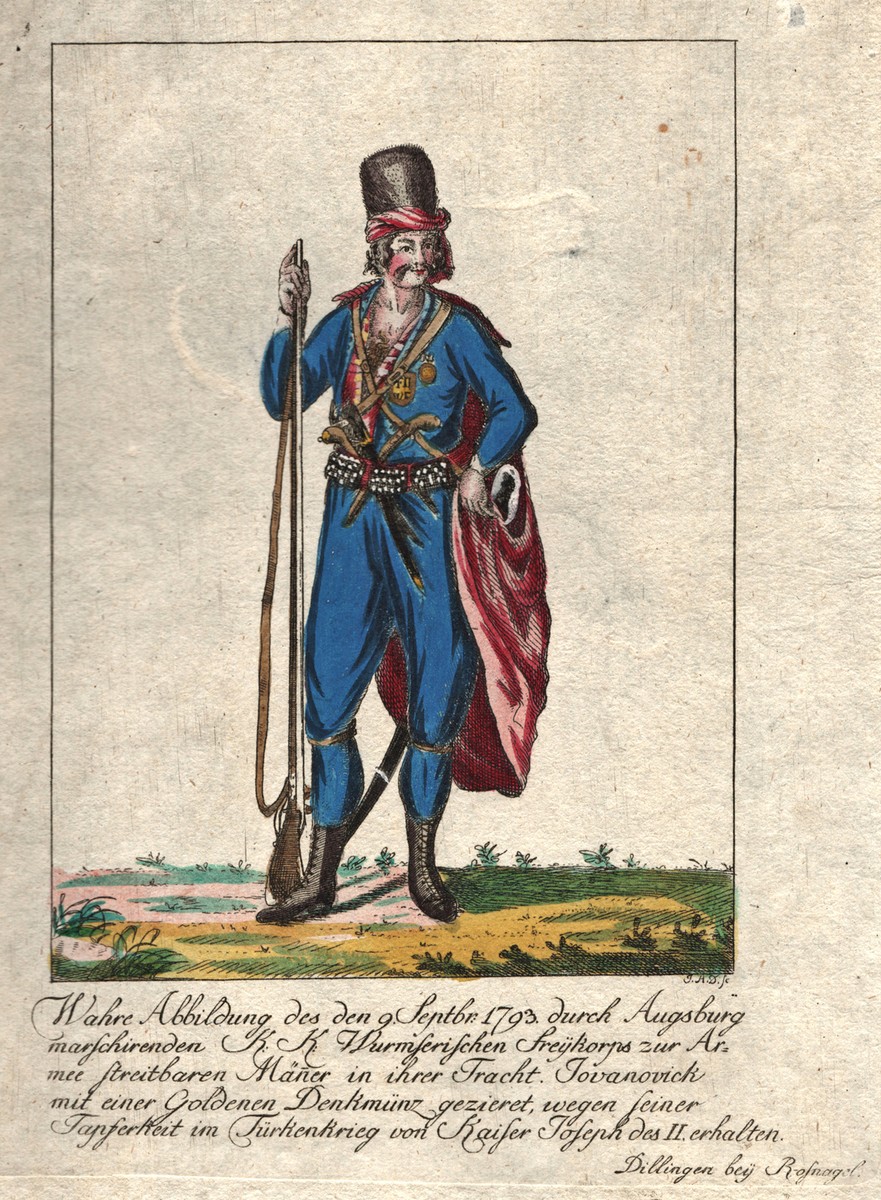
Raised in may 1793 a mixed free corps of 2 Battalions (6 companies each) and 4 divisions of 2 squadrons of Hussars who inspired terror In 1793, during the siege of Mainz, Austria advanced a horde of 5,000 to 6,000 bandits up the Rhine, drawn from the borders of Turkey, Wallachia, Croatia, the Šibeberge, and the Krapak Mountains. It is even claimed that the prisons and penal colonies of these various countries supplied the greater part of them. These bandits, who were called Red Cloaks because of the color of their cloaks, were armed and dressed in the Turkish style. Generally possessing uncommon muscular strength and a tall stature, their stature was further enhanced by a shakot (a type of hat) topped with a sugarloaf. This corps, seemingly formidable to the enemy, was in reality only formidable to the government that employed it. Organized in Temeswar, deep in Hungary, it had crossed the hereditary states of the Emperor and part of Germany, arriving at the operational line of Field Marshal Wurmser's army. During this long journey, a cavalry regiment escorted the Red Cloaks, who marched two by two in chains. Thus, they arrived, sometime in May 1793, at the Germsheim lines, near the Rhine at Landau. There, they were freed from their shackles and took part in the campaign. The Red Cloaks' appearance was truly terrifying. On their marches, as in their bivouacs, they inspired a kind of fear from which even the bravest could not defend themselves. Devoid of any sense of humanity, never showing mercy, they beheaded any enemies who fell into their hands and received from their commanders a ducat per head: this was their only pay. This corps could not hold its own in open country unless it had a vast numerical superiority. Each soldier, taken individually, was capable of vigorous effort; together, they were nothing more than an inert mass, without knowledge of maneuvers and tactics. Such men, moreover, harbored no idea of honor; and it is morale that makes the strength of armies. They were solely suited to partisan warfare. Scattered in the woods, in the devastated countryside, the Red Cloaks laid ambushes, harassed the enemy, surprised sentries, and captured outposts, thus satisfying the passions dearest to their souls: vengeance and greed. *****************************************************************
written by a French Emigré allied to Austrian Army who saw them closer :
We have sometimes seen troops in the Austrian army of a peculiar kind; it consisted of troops called free corps, quite a large number at the beginning of the campaign. They were all placed in the outposts. These troops were intended to cover the front of the line to warn of the enemy's approaches; they were only required to offer a small resistance and then fall back to the vanguards of the regular troops. This is a very strange assembly of men to us. They were taken from the Emperor's provinces, which are near Turkey; it is impossible for us to understand their language, which is related to Slavic. They are not given regular pay in the field; but they are clothed, armed, and receive their bread and rations. Moreover, they live as best they can in enemy territory; they are only permitted plunder in certain circumstances. They also profit from everything they can take from the enemy on the battlefield, or when they take prisoners, which often works surprisingly well for some of them, for there are some who are naturally very brave and skillful, but in general, they are poor soldiers, without valor or discipline. Furthermore, their officers, who are not much better, have difficulty getting them to obey; this is largely due to the necessity or the habit of dispersing them. While we marched towards the enemy, they rested, and some of them were busy exchanging all the money they had acquired for gold. They had a very amusing costume; they wore trousers and a red waistcoat of an unnatural color, and over that a large cloak of the same color made of very coarse cloth, which leads them to be known in the army and elsewhere as the "Red Cloaks". They always carry it stretched over their shoulders, even at midday, with their rifles held underneath, almost horizontally; they also have pistols at their belts. They are usually found at the outposts, dispersed in very small groups or positioned in isolation and crouched against trees, in order to see if the enemy is coming without being seen. Despite all this, their work is hard, as they are constantly exposed to the vagaries of the times, and quite perilous, due to the constant surprises. They are viewed with suspicion wherever they go, for they are notorious thieves, regardless of location or person. At the beginning of the campaign, they inspired in us a kind of horror; but we eventually grew accustomed to seeing them: consequently, we feared them much less by the end and did not despise them as much; for although we had witnessed great cowardice in most of them, we had also had occasion to cite some acts of valor and generosity to their credit.
a whole battalion of 600 men will be captured easily in may 1800 in Aitrach by a weak detachment |
| Bernard1809 | 09 Feb 2026 11:50 p.m. PST |
Intéressant !
Quelqu'un possède une image de ces "braves" gens ? |
ChrisBBB2  | 10 Feb 2026 1:22 a.m. PST |
These guys are from 1848 but their grandpas would have looked the same in 1800:
link Search for "Croat seressaner" and you will find more images. |
| T Labienus | 10 Feb 2026 3:26 a.m. PST |
|
| Bernard1809 | 10 Feb 2026 6:44 a.m. PST |
|
| Lilian | 10 Feb 2026 7:36 a.m. PST |
another from Ottenfeld, the second of course, there aren't many pictures of Rotmäntel ~ Rothmaentel ~ Rothen Mantel ~ Manteaux Rouges
a text about the corps but rather the Cavalry Hussars
PDF link In early 1793, officially on 1 May it was created a Freikorps called formally Imperial-Royal Austrian-Styrian Count Wurmser Freikorps for the areas belonging to the Croatian and Slavonic Military Frontier and the areas administered by civilian authorities, furthermore for the Turkish borders: the unit would have numbered 5000 men, which was stronger than a typical Freikorps
(…)
bigger part of the infantry was made up of Southern Slavic refugees driven by the last Turkish war to the borders, especially from Bosnia, while the smaller part was made up of Grenzer from the Croatian-Slavonic Military Frontier, of course and also we could find soldiers from the Croatian and Slavonic counties, even from Dalmatia belonging to the Venetian Republic, furthermore from Lower Austria, Moravia and Prussian Silesia and this mixed population was a rarity.
However they had a significant number of former Grenz Hussars, since as we have seen earlier, some Military Frontier Hussar units had been dismissed just some years ago and many of them was still on active duty and a lot of them was able-bodied, who was not on active duty. Accordingly the Freikorps cavalry was made up mostly former Grenz Hussars, furthermore a lot of above-mentioned dispatch-riders had been transferred to these units from the Grenz infantry
regiments, but we could find here formerly, exclusively infantry troops, even recruits without military experiences. Decisively the officers and the noncommissioned officers had been transferred from the standing army in both branch of service.
The cavalry of the Freikorps was made up of eight squadrons or four divisions – the strength of a squadron was between 221 and 250 soldiers – and the staff with nine men
(…)
The intended strength of the Freikorps was 1,865 men and 1,865 horses in May, but the number was increased up to 1,945 men and 1,945 horses in July.
However in the beginning the effective force consisted of 1,848 men and 1,848 horses in end of May and the numbers were raised to 1,865 men in August, but the unit had only 1,842 horses. Of course, subsequently after the first skirmishes the strength of the unit was decreased, thus the effective force consisted of no more, than 1,790 men and 1,645 horses in December.39 Certainly the able-bodied force was even lower than this, since always there were wounded, ill and detached troops or absentees for other purposes in the unit
Early in the year the Hussar Freikorps was garrisoned in the concentrated military camps around Steinmauern, Lanterbourg and Mannheim and they got some supplies. Due to this supply the strength of the unit was increased from 1,790 men to 1,868 and from 1,645 horses to 1,868 until December and besides the able-bodied force was managed to rise from 1,566 men to 1,792
(…)
The cavalry of the Freikorps was separated completely from the infantry with effect from 1 January, 1795, although the latter one retained the name Austrian-Styrian Count Wurmser Freikorps. no mention of the events reported above, only as footnote where the author precises Since strictly speaking it is out of our topic, we are omitting the detailed and further presentation of the history and organization of the Freikorps which was disbanded in 1801. However it is worth mentioning regard to this topic that the warriors of the unit were called Redcoats because of their Turkish garment and equipment and their name was feared by the enemy.
****************************************************************
The Battle of Memmingen resulted in few losses for the French army. The Austrians had suffered far greater losses than we did; the Bavarians had suffered particularly. A large number of prisoners remained in our hands, including an entire battalion of Red Cloaks, who had surrendered to General Lecourbe and his small escort : Lecourbe to Moreau. Aitrach, 20 floréal an VIII (10 may 1800). I captured, upon arriving at Aitrach with my orderlies, 600 red cloaks, which were surrounded, along with a major, 9 officers, and 6 uhlans;
we captured another 200 or so from several different units at Memmingen. The red cloaks were in Freiburg and arrived in large groups with General Sztaray. We also took some prisoners from the 6th Regiment, which was in Grisons. |
| Lilian | 10 Feb 2026 8:46 a.m. PST |
hum…wait a minute Organized in Temeswar, deep in Hungary, it had crossed the hereditary states of the Emperor and part of Germany, arriving at the operational line of Field Marshal Wurmser's army. During this long journey, a cavalry regiment escorted the Red Cloaks, who marched two by two in chains. I wonder if this author was not exaggerating or romanticizing and didn't try to add something more to his description, it looks like rather the 8 squadrons of Hussars simply accompanying the 2 Battalions of the Freikorps in campaign… |
| Red Jacket | 10 Feb 2026 8:55 a.m. PST |
Does anyone make a suitable miniature in 28mm? |
| Lilian | 10 Feb 2026 5:58 p.m. PST |
when the hunters became hunted Among the opposing troops was one of a particular kind, a sort of rogue from the military frontier nicknamed the Red Cloaks, ferocious men who, destined to reconnoitre the terrain between the two armies, surprised the sentries, the wounded, the stragglers, and, in defiance of the laws of war, cut off their heads and mutilated them atrociously. A fortuitous circumstance came to curb their brigandage. To replace the old uniforms that had fallen into rags, the brigade [19e & 23e Régiment de Cavalerie] had finally received new ones, made of blue cloth from Austrian stores but lacking the distinctive colored lapels. Either due to a shortage of suitable cloth, or for greater profit, the suppliers had omitted them. At first, some soldiers sewed their old lapels onto their new uniforms. But it was very ugly, then someone realized that, without being exactly the same shade, the cloth of the Redcloaks would look good. The hunt for the Redcloaks was organized. Before daybreak, men would lie in ambush a little ahead of the last posts; when day broke, one or two others, feigning injury, would arrange to be noticed by the Redcloaks and lure them towards the ambush, which would fall upon them and take their scarlet cloaks with them. Soon, the blue uniforms of the cavalry were adorned with triumphant lapels, and the Redcloaks, realizing that they were becoming the hunted instead of hunters, became much more cautious.


|
|