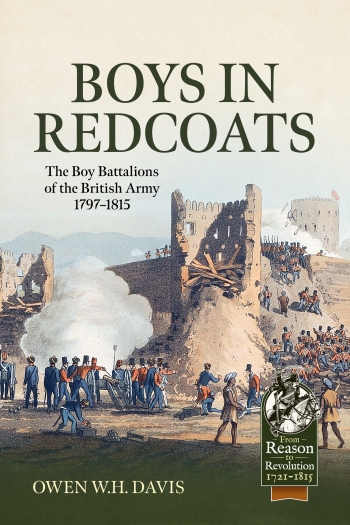
"Boys in Redcoats The Boy Battalions of the British Army" Topic
1 Post
All members in good standing are free to post here. Opinions expressed here are solely those of the posters, and have not been cleared with nor are they endorsed by The Miniatures Page.
Please do not use bad language on the forums.
For more information, see the TMP FAQ.
Back to the Napoleonic Discussion Message Board Back to the Napoleonic Media Message Board
Areas of InterestNapoleonic
Featured Hobby News Article
Featured Link
Featured Ruleset
Featured Showcase Article
Featured Workbench Article A simple, low-effort technique for naval bases.
Featured Book Review
|
Please sign in to your membership account, or, if you are not yet a member, please sign up for your free membership account.
| Lilian | 08 Feb 2026 7:32 p.m. PST |
not only Napoléon's Régiment de Pupilles at that time… link
In the 1790s Great Britain faced a crisis in recruitment. Swathes of men had been called up to fight against Revolutionary France. This left the British Army thinly stretched especially in the garrisons scattered across the British Empire. With a recruitment crisis brewing the army resorted to recruiting boys aged between 13 and 16. Three regiments were designated ‘experimental' battalions: 22nd (The Cheshire), 34th (Cumberland) and 65th (2nd Yorkshire, North Riding) Regiments of Foot. These regiments recruited boys, who were destined to grow up in the army before being sent east to serve in the burgeoning empire of Britain's Honourable East India Company. Boys in Redcoats is the first full-length study to examine the recruitment, training and deployment of these boys. The war with France was a catalyst for the Commander-in-Chief of the British Army, the Duke of York to future proof recruitment in the army and provide a source of manpower fit for the far-reaches of the British Empire. Some parishes across England seized the opportunity to reduce the growing cost of poor relief and relieve unrest in the counties and actively encouraged boys to join the army. The result was that a number of young boys raised into these battalions were sent to fight Xhosa warriors in South Africa, indefatigable Maratha defenders in the great citadels of India, French and Arabian pirates in Mauritius and the Persian Gulf. Those boys who survived and returned home were veterans of some of the harshest fighting conditions in the nineteenth century. |
|





 returns to Flintloque to paint an Ogre.