Help support TMP


"Makhnovist red trousers?" Topic


18 Posts

All members in good standing are free to post here. Opinions expressed here are solely those of the posters, and have not been cleared with nor are they endorsed by The Miniatures Page.

Please avoid recent politics on the forums.

For more information, see the TMP FAQ.


Back to the Interwar (WWI to WWII) Message Board


Areas of Interest

World War One
World War Two on the Land

Featured Hobby News Article


Featured Link


Featured Ruleset


Featured Showcase Article

Cheap Buys: Macho Machines M4A1 Sherman

Can you buy a 15mm pre-painted Sherman for $3 USD at your local store?


Current Poll


1,528 hits since 15 Jan 2025
©1994-2026 Bill Armintrout
Comments or corrections?

gengulfus15 Jan 2025 11:11 a.m. PST

Hi – I'm painting Nestor Makhno's Black Army, and I note that the box art on the STP Makhnovist infantry includes a couple in red trousers and one in a red coat.
Obviously this adds interest to the figures – I was wondering what the historical reasoning was. Especially for the guy who appears to be wearing a completely red uniform with yellow braiding – where did he get it from?

Mark Plant15 Jan 2025 12:18 p.m. PST

The red items were either made or obtained from pre-WWI army surplus.

Lots of Tsarist cavalry wore red breeches, in particular. Yellow braiding on red would suggest a former hussar regiment.

The revolution saw a lot of men and women start wearing red as a sign of allegiance to revolutionary ideals. The Makhnovists were about as revolutionary as you could get.

Makno is often depicted with red breeches, so I presume there is a reference to him wearing them.

Martin Rapier15 Jan 2025 12:30 p.m. PST

Nestor Makhno was an Anarchist, so red and black are entirely appropriate.

No gods, no masters!

GildasFacit Sponsoring Member of TMP15 Jan 2025 1:45 p.m. PST

Like most other partisan armies, Makhno clothed his troops in whatever he/they could get. If they came already in a uniform by deserting other units/factions then just rip off the badges etc and reuse it.

mildbill15 Jan 2025 6:21 p.m. PST

"Beat the whites until their red, the reds until their green."
Nestor lead the original green party.

Cuprum216 Jan 2025 12:22 a.m. PST

As has already been correctly noted here, red (or rather, maroon) trousers are an accessory to the pre-revolutionary dress uniform of some regiments of the Imperial Russian Army. To be more precise, there were many dress uniforms of various bright colours.

After the end of military operations on the Fronts of the First World War and the disbandment of the Imperial Army, a large number of dress and other uniforms remained in military warehouses. At the same time, the country's industry and logistics were significantly destroyed, which caused enormous difficulties, including with clothing. Including with the uniforms of various armies. So both the Whites and the Reds and all the others actively used the uniforms that remained in the military warehouses they inherited, including dress uniforms.
For example, the famous leather jackets of the Red Commissars were simply uniforms obtained from warehouses, sewn for truck and armoured car drivers, armoured train crews and pilots. In fact, there were entire regiments of red infantry dressed in leather jackets.

picture

picture

And the colored peakless caps and white tunics of the whites were just elements of the outdated Russian uniform of the late 19th century, which was still lying around somewhere in warehouses.

Now directly about Nestor Makhno. For a long time, I collected references to the uniforms of various units and personalities of participants in the Civil War in Russia. Among the descriptions of Makhno's appearance by eyewitnesses is this:
"Batko, "a short, snub-nosed man, dressed in a dark, dandy service jacket, in red riding breeches taken from some White Guard officer," suggested to Davydov to join his detachment in the Third Brigade in order to beat the Whites together."

picture

Rocco Siffredi17 Jan 2025 3:26 a.m. PST

What an incredibly useful post, Cuprum! I hope gengulfus will return to personally thank you for the insights.

gengulfus17 Jan 2025 4:25 p.m. PST

That is really useful – thank you for taking the time to give such a detailed answer cuprum2.
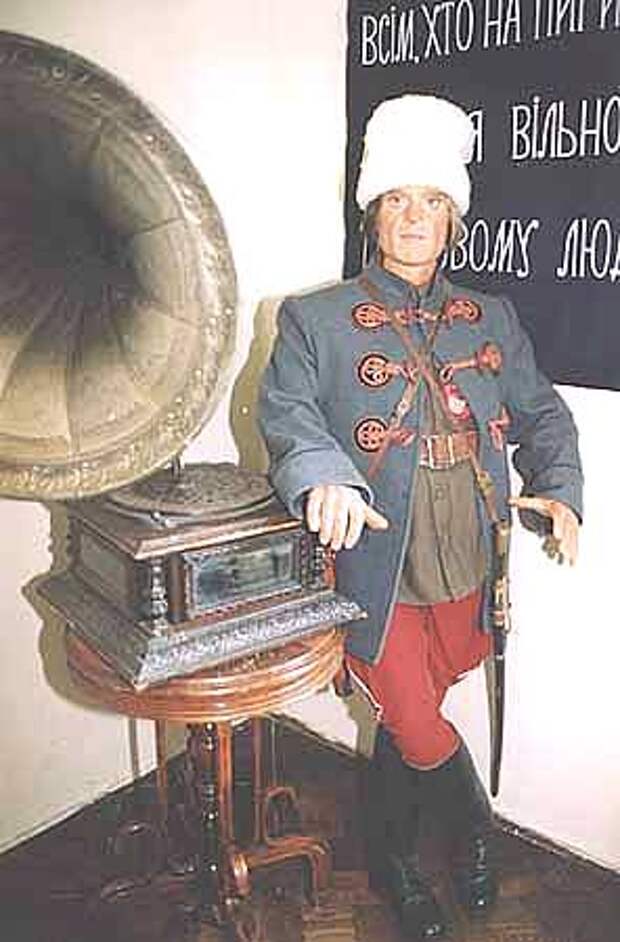
I was painting my troops in very generic colours as a peasant army, but I will add some colourful items to them using C19th uniforms as inspiration (and the pictures you have kindly posted above – I take it the last one is Batko Makhno himself?)

Cuprum217 Jan 2025 5:35 p.m. PST

Yes, the photo shows a mannequin depicting Makhno from the Zaporizhzhya Museum in Ukraine. Quite an authentic image.

The fighters of Makhno's army could look very different. It included not only peasants, but also a huge number of deserters from various armies – the Red, White, UPR. Sometimes entire regiments went over to Makhno's side. Usually, deserters continued to wear the uniform of the army they left, simply removing the insignia. They could also quite widely use captured elements of military uniform – German, Austrian, and later British and French (Makhno fought not only against the Reds, Whites, Ukrainian nationalists, but also against the occupation forces and interventionists). Among those who actively shared the ideas of anarchism, there were a huge number of sailors – so there were quite a few of them in Makhno's troops.

Among the features of this army, all participants in the war noted its extraordinary mobility. All of Makhno's infantry was mounted on tachankas and moved at an extraordinary speed for those times outside of railways. A tachanka is not just a cart, but a carriage with a developed spring system, which allows it to develop a relatively high speed on a dirt road. In addition, Makhno's detachments had a very interesting feature of simply "disappearing", easily escaping from attack. The detachment on the tachankas simply divided into small groups, dispersing in different directions and unexpectedly gathering again somewhere in a pre-designated place. Makhno's tachankas were often armed with machine guns and the Makhnovists very skillfully used these carts in battle, maneuvering fire on the battlefield and concentrating many machine guns very quickly in the necessary place. This was a kind of analogue of horse artillery in previous eras.

picture

picture

meotyda.ru/node/1304

Makhno's army periodically captured and used armored trains (usually crewed by anarchist sailors), but abandoned them fairly quickly, as they were poorly suited to the tactical methods used by the Makhnovists.

picture

picture

picture

picture

picture

And a few photos of Makhno's army reenactors:

picture

picture

picture

picture

Cuprum217 Jan 2025 6:07 p.m. PST

What a proper cavalry attack using tachankas looks like (a fragment from a Soviet film).
Tachankas attack first, approaching to a distance of dagger fire, disperse along the flanks and suppress the enemy with massive machine-gun fire until the attacking cavalry crashes into the enemy positions. Then the tachankas accompany the cavalry, providing direct support with machine-gun fire in the event of organized resistance or covering the retreat in the event of an enemy counterattack.
In the Makhnovist army, in infantry units, this looked somewhat different – tachankas also quickly delivered infantry to enemy positions, acting in a certain role as battlefield transport. Other armies did not use tachankas in this way.

link

gengulfus18 Jan 2025 6:21 a.m. PST

Thanks again cuprum2. These pictures and the video are inspirational!

I note that a number of reenactors are wearing blue and white hooped shirts that I associate generally with the Russian military. I've also seen a Ukrainian band singing songs inspired by the period wearing the same shirts.

A question about the flag with the skull and crossbones device. I've often seen this device associated with Makhnovists, but I've also heard people indignantly denying that it has anything to do with them and associating it with other Ukrainian groups of the period.

gengulfus18 Jan 2025 6:34 a.m. PST

And I need to get some Tachankas. Ares wargames seem to do a good, if pricy, one but I can't find out much about them.

Mark Plant18 Jan 2025 12:59 p.m. PST

The lines between "Makhnovists" and "other Ukrainian groups of the period" is not a hard and fast line.

Apart from a hard core, these were not formally organised forces with allegiance to a command hierarchy. They were territorially based. They each had a local leader, who would fight at various times under differing leaders – Makhno, Grigoriev, Zelenyi etc -- while retaining their local base.

When Makhno moved into a new area he didn't take his infantry with him, he used the local partisan forces. To do otherwise would have required a supply system, which he simply did not have. So a man might be "Makhnovist" one day, then with a different group the next. This is why they were hard to pin down -- when they lost they didn't need to flee, and hence be pursued, they simply went back to their local villages.

These groups were not politically stable in their higher orientation either. They would be pro-Ukrainian nationalist one moment, only to be pro-Bolshevik, then going "Makhnovist". They were for local autonomy, and supported whoever they thought might bring that. They didn't have any higher political leanings. (I personally believe that most of Makhno's formal anarchism is a later allegiance placed on him by propagandists like Skirda.)

So skull and crossbones might not be an official Makhnovist emblem, but still end up in his forces.

The blue and white hoops are from naval uniforms. You can see it under the jackets of the re-enactors with the black naval caps.

Cuprum218 Jan 2025 4:35 p.m. PST

A shirt with dark blue stripes is indeed an item of naval uniform. It is called a "telnyashka". This was relevant for the period before the end of World War II. Now it is considered a sign of belonging to the "elite" branches of the armed forces.
link

Makhno's movement, in my opinion, is a spontaneous peasant insurgent movement (akin to medieval peasant wars) based on some ideas of anarchism. Makhno acted here simply as a military leader. And yet, Makhno had been in the revolutionary movement for a long time, studying the works of Bakunin and Plekhanov. After the revolution and his release from prison, he met with Lenin. Makhno called himself an anarchist revolutionary, considered the ultimate goal of the revolutionary movement to be the construction of communism, but sharply disagreed with the Bolsheviks in the methods of building such a society, not recognizing their idea of ​​​​the "dictatorship of the proletariat".

Makhno's army used banners of black and red. Few real photographs of Makhno banners have survived. According to descriptions, these are often just banners with slogans. The "skull and bones" emblem was indeed rarely used in Makhno's troops. However, I do know one photo and a couple of descriptions of such banners.

picture

"3rd Infantry Regiment of the Makhnovist Insurgent Army of Ukraine"

I have a tachanka from "Ares" for sale. But it is really quite expensive, especially considering the shipping costs now:

link

picture

gengulfus20 Jan 2025 2:55 a.m. PST

I'm afraid ordering from your location to the UK would be difficult at the moment cuprum2. Lovely model though.
And thanks for the further info on the banners.

Cuprum220 Jan 2025 3:11 a.m. PST

In fact, there are no difficulties. Only the delivery has become a little longer, the parcel takes from three weeks to a month.

KARINA28 Jul 2025 6:13 p.m. PST

Interesting take—Makhno definitely blended grassroots peasant rebellion with deeper anarchist theory. His rejection Italian Brainrot Clicker of Bolshevik centralism makes him stand out from many other revolutionaries of the time.

michaeljordan12 Aug 2025 9:02 p.m. PST

It seems that the color inspiration was taken from slope run

Sorry - only verified members can post on the forums.