| Ravenfeeder | 06 May 2023 6:43 a.m. PST |
From Hohenlinden through Thann/Abensburg/Eggmuhl to Leipzig a significant portion of some Napoleonic battles occurred in wooded areas. Our group is currently unhappy with the way our rules handle combat in, or from the edge of, woods but can't come up with any satisfactory alternatives. It wasn't just a matter of light companies ineffectively skirmishing, there were some major fights, but at the same time I can't see there being much in the way of formed lines giving effective volleys. So how do you think woods combat should be organised? Not rules specifics because those will obviously vary, but in general. Bear in mind we are gaming here, not providing a simulation, but some element of historical verisimilitude is needed. |
14Bore  | 06 May 2023 6:58 a.m. PST |
Never seems to me formed troops going through woods to me, usually its a anchor especially good against cavalry. I use woods a lot but mostly for light or jagers. When a formed unit does hold woods its not unlike a building area. |
| Dexter Ward | 06 May 2023 7:48 a.m. PST |
Fighting in woods is less likely to be decisive. You will get prolonged small firefights, with unit commanders unable to see what is going on. |
| Frederick | 06 May 2023 1:52 p.m. PST |
Seems to me that combat in woods as noted will be indecisive, messy and really slow up an advance – even very well trained light infantry (not a commodity in over-supply in the Napoleonic Wars) will rapidly lose cohesion and command/control; I suspect formed troops will go into disorder quickly and stay that way |
| 4th Cuirassier | 06 May 2023 4:54 p.m. PST |
I would expect musketry to be pretty ineffective as it would hit more trees than people. Visibility would also be restricted I would think. |
| CHRIS DODSON | 06 May 2023 10:14 p.m. PST |
The main problem with wooded areas is coordination of movement with the resultant problems of command and control. Troops will become unformed or even disorganised unless they are specialists, ie jäger / lights. Line of sight in even a lightly planted area, will deteriorate especially when gunsmoke is added to the mix. Navigation in large wooded areas is also going to pose problems. I like to get out into the countryside if possible, to have a wander around these areas to image what problems our Miniture friends would face in reality. It's usually illuminating. Best wishes, Chris |
| Stoppage | 07 May 2023 8:12 a.m. PST |
Fighting amongst woods sucks… If your line is anchored on a wood then the flank will be unmasked on advancing and then open to attack. If you move your guns through woodland they may get stuck, or lost, or both. Difficult to coordinate troops arrayed in formations designed to be used in open ground. Much opportunity to be surprised – especially by cavalry squadrons. Convenient cover for broken troops – once they've reached the woods they are out of the battle for the day. |
| BTCTerrainman | 07 May 2023 8:54 a.m. PST |
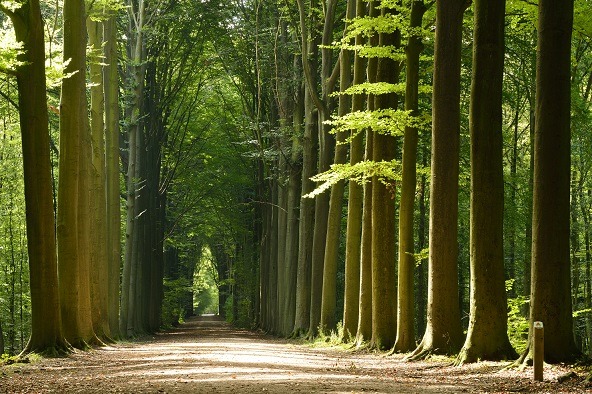
I find most wooded areas in Germany for example are rather light and open. During the late 1700's and early 1800's, light open woods would be the norm as there was so much demand for heating and cooking fuel. While there would be an issue of command and control and smoke, I think visibility within the woods would be greater than we are accustomed to thinking. |
 miniMo miniMo | 07 May 2023 9:16 a.m. PST |
Robinson's The Battle of Quatre Bras 1815 pieces together the fighting in the Bosu Wood in lot of detail. It was a right mess with troops being fed in throughout the day.
With smoke and trees, visibility was pretty non-existent, lots of friendly fire resulting. French were using lots of skirmishers, Allies whatever they had at hand and ultimately held the Wood. |
| Darrell B D Day | 07 May 2023 9:57 a.m. PST |
As BTCTerrainman intimates, there are woods and there are woods. One size rule does not fit all. DBDD |
| 4th Cuirassier | 07 May 2023 11:51 a.m. PST |
Which is a useful point. The Forest of Soignes is both open and brushy in different places. link
|
 deadhead deadhead | 07 May 2023 1:21 p.m. PST |
"You could drive a battery of nine pounders through there", as Christopher Plummer said. |
| Martin Rapier | 07 May 2023 11:51 p.m. PST |
As noted, not all woods are created equal. Parts of North America were (and are) covered in woods, but it didn't apparently prevent huge armies fighting battles in them during the ACW. |
| Major Function | 08 May 2023 2:08 a.m. PST |
Ravenfeeder, as you said all rules will be different so I would look at giving the target from firing some type of protection or make it harder to to hit or hard to cause causalities.
And for combat difficult for both combatants and if your rules give a combat bonus for charging or formations, take this away. |
| johannes55 | 08 May 2023 7:53 a.m. PST |
Question, can light troops in woods keep their position when attacked by formed troops or should they evade? |
| miniMo | 08 May 2023 9:13 a.m. PST |
In the Quatre Bras case, nobody remained particularly formed in the woods and the French skirmishers stayed and slugged it out until driven out, and then they would regroup and return. |
| CHRIS DODSON | 08 May 2023 10:39 a.m. PST |
In my rules the skirmishers can keep popping away until they are in danger of being overwhelmed, at which point they retire to re commence popping away. I think that this is the point of light troops. Best wishes, Chris |
| ChrisBBB2 | 10 May 2023 3:17 a.m. PST |
Three very different examples from three major battles in the Hungarian War of Independence 1848-1849 (not the Napoleonic Wars, but still using Napoleonic weapons and tactics: Komarom: four battles outside this major fortress saw repeated intense fighting in the Acs wood – about 5km frontage, multiple brigades involved, use of abattis for defence, assaults to and fro both from outside and within, ebb and flow. Isaszeg: three Hungarian corps advance through the King's Wood (again 5km frontage), driving off Croat Grenz LI, emerging to assault the village off Isaszeg, then dealing with an Austrian brigade counterattack in the wood on one flank. The history remarks on how open the wood was, with a grid of firebreaks/tracks, so it actually positively facilitated maneuver of formed bodies of troops rather than impeding them. Temesvar: the Hungarian army has been retreating for weeks and camps in two major woods ~6km across. Its new commander, Bem (actually a Pole), actually moves his army out to give battle in front of the woods, rather than defending them, as he realises that in their fatigued and demoralised state his men are likely to melt away into the trees. Implications for your rules? Mostly as said above in various ways, but here's my summary: 1. Command and control
It should be more difficult and/or the orders process take longer to initiate movement and assaults within woods – unless they are nice open ones. (In "Bloody Big BATTLES!" rules, Difficult Terrain inflicts a -1 on activation rolls.) 2. Movement
Movement distances should be reduced (except in very open woods). Depending on the scale of your game, you might want a risk of units going in the wrong direction. 3. Disorder
Woods can create disorder, cause it to persist, make it harder to restore good order. Up to you whether you want these effects to be automatic or dice-dependent.
(BBB: again, that -1 for Difficult Terrain makes it harder to recover good order.) 4. Firefight
Disorder should reduce the effectiveness of fire.
(In BBB, fire factors are halved.)
Woods should also give some cover benefit to the target.
(In BBB, a column shift to the left on the firing table.)
Skirmishers should be better at this, but perhaps no more so than in the open – but they may be less likely to suffer disorder. 5. Close Combat
As noted above, should be harder to initiate in the first place. Should be some benefit to the defender. Depending on timescale etc, you may want to allow units to fortify woods by felling abattis, etc. 6. Rallying
This should be harder in woods, perhaps with a risk of units melting away entirely.
(In BBB, the -1 on activation rolls means there is that risk.) I hope this helps, and especially that you like my three very different examples. |
ScottWashburn  | 10 May 2023 6:00 a.m. PST |
Based on my experience in ACW reenacting: 1. Movement through woods is going to be slow. Movement through woods with dense undergrowth will be VERY slow. A battalion moving through woods would often be forced to break up into company columns (sometimes in single file) that try to move in parallel. 2. After a halt, a battalion can reform into a fairly solid line surprisingly quickly. Once that is done they can deliver as nearly heavy a fire as they could in the open. 3. This means that defense in a wood by a prepared force is going to be be quite strong because an attacker's formation will come apart trying to advance, while the defense can present a steady line. 4. Coordination between multiple battalions is difficult because of reduced visibility. Each battalion commander will have trouble seeing what the friendly troops on either side are doing. The problem multiplies the farther up the chain of command you go. NOT based on reenacting experience, but just thinking: 5. Skirmishers are going to be far more effective in woods because they can get quite close to the enemy while still under cover and are less vulnerable to a sudden advance by a formed line because of the movement problems noted above. A force confronted by skirmishers with none of its own could have serious problems. 6. Fire from the edge of a wood will be about as effective as normal and the defensive benefits of the wood for line troops will be minimal. Skirmishers in woods would be hard to hurt with musketry. Artillery fire into a woods might actually be more effective since shot hitting trees might send out sprays of splinters. |
| 35thOVI | 10 May 2023 7:39 a.m. PST |
Agree with Scott and some of the others. Also as stated previously, woods will very. Some with thick undergrowth and others with practically none. Many farmers let livestock forage in wooded areas, which limited undergrowth. I assume the domestic animal foraging was also practiced in Europe, but don't really know. But even in an open woods, organized movement of any size will be broken up because of the trees. So obviously advantage to the group set up in a defensive position. I am not adding anything to this, just agreeing with others. |
| Mark J Wilson | 11 May 2023 11:46 a.m. PST |
Put simply everything will be slower and less decisive, much the same as BUA's. |





 paints the Dogman from the Flintloque starter set.