| Tango01 | 24 Apr 2021 8:59 p.m. PST |
…War? "Even before the struggle for American independence ended, two contrasting views of the role of the Revolutionary militia had emerged. Popular opinion, remembering the gallant stand of the Minutemen at Concord and Lexington, held fast to the ideal of the brave citizen soldier as the mainstay of defense. Other Americans however, including many Continental Army veterans, derided the militia's reputation for fleeing in the face of the enemy. The early histories of the Revolution also tended to minimize the contributions of the militia, and one acclaimed account of the war, written as late as 1929, even referred to "the utter failure of the militia system." More recent studies, however, have gone a long way toward revising this predominantly negative assessment of the role played by the militia during the war for independence. Although the relative effectiveness of the Revolutionary militia varied from state to state and year to year, this newer scholarship has explored and described some of the crucial achievements of the militia that had been previously unexamined. These historians note that the role of the militia is easily misunderstood and that it has to be judged by different standards than those applied to a professional military force. As part of its long-term exhibit planning process, the Yorktown Victory Center has begun researching the role played by the militia during the Revolution, with a special emphasis on Virginia as a test case…"
Main page
link
Armand
|
| doc mcb | 25 Apr 2021 3:31 a.m. PST |
"Although George Washington and others frequently complained about the shortcomings of the militia, some Continental Army officers like Nathanael Greene had come to a more realistic appraisal of the value of these part-time soldiers by the end of the war. While the militia could not be counted on to stand up to trained, regular forces, it could and often did perform other important roles that were less obvious but crucial elements in the winning of independence." |
| doc mcb | 25 Apr 2021 3:34 a.m. PST |
'By 1777 the Virginia militia's duties consisted mostly of suppressing loyalists, preventing slave uprisings, and serving as a pool of potential recruits for the Continental Army.' which can be summed up as population control. But the political mobilization was even more fundamental. |
| doc mcb | 25 Apr 2021 3:35 a.m. PST |
I bet they used my dissertation in this study. |
 John the OFM John the OFM  | 25 Apr 2021 5:16 a.m. PST |
I've often wondered what the average age of the Continental soldier was vs that of the Militia.
The militia is by definition the total free manhood of the territory. Of course that would include Loyalists, but let that pass.
What would your typical respectable militia member be doing when not engaged in military duties? Overwhelmingly agriculture, feeding the colony AND the Continentals. There's a limit to how high a percentage of the male population can be tied up in the regular army. There is an economy to sustain.
The army has to be fed. Clothed. Etc. This is where the more important duty of the militia comes in. |
| 14Bore | 25 Apr 2021 6:31 a.m. PST |
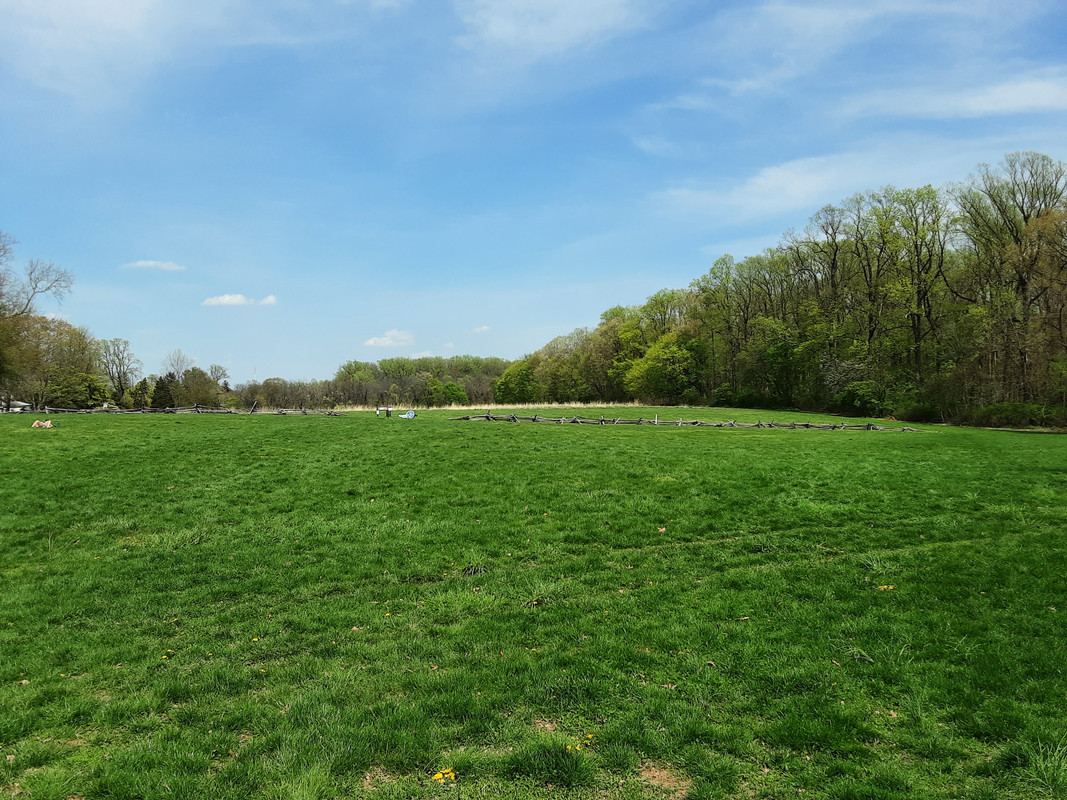
Was waiting for a write up maybe on anniversary date on the Paoli massacre battlefield, but a preview at least
|
| Brechtel198 | 25 Apr 2021 7:12 a.m. PST |
This is where the more important duty of the militia comes in. They didn't 'come in' during the winter of 1777-1778 while the Continental Army was encamped at Valley Forge. The Continentals froze and starved while the civilians, including the militia, did not. |
| John the OFM | 25 Apr 2021 8:01 a.m. PST |
Whatever, Kevin. Have fun.
Tango01 gift wrapped this thread for you, do take it and run with it.
I'm not saying I'm done with it. I'm just waiting for you to paste in your usual Walls O'Text that don't really prove anything.
You're prejudiced against the Militia. We all know that.
So, go do that voodoo that you do so well. |
| John the OFM | 25 Apr 2021 9:03 a.m. PST |
The problem with food at Valley Forge was almost entirely due to corrupt and/or incompetent bureaucrats in charge, and the Continental Congress falling down on the job paying for it.
Blaming it on the militia is ludicrous in the extreme. |
| Ferd45231 | 25 Apr 2021 9:47 a.m. PST |
I believe the most important function of the militia was to keep their local population in line with the party line. Not being disparaging here as I think that is a very important function.. Its like Vietnam, in my experience. The local VC did not usually do a great deal of damage; but they were bloody good at keeping the people in line. Main force VC and NVA (when I was there they were largely one and the same) served like the Continentals. No I am not conflating communists with our revolutionaries. Its just that they had two different functions. H |
| doc mcb | 25 Apr 2021 10:16 a.m. PST |
Again: we can assume that some proportion of men were neutral about the revolution and independence, simply wanting to be let alone to tend their farm and raise their family. The percentage of would-be-neutrals was probably low in the fever of 1776, and quite high as war weariness set in (it was, after all, a VERY long war). But every free man between roughly 16 and 50 or 60 (varied by state) was in the militia (just a few exceptions for ministers and millers). At some point the militia are called up. Which means INDIVIDUALS get what amounts to a draft notice from their LOCAL authority. Can't ignore it, not safely. EACH INDIVIDUAL then had to decide to comply with the orders (and thereby join the fight against the British) OR reject them, thereby labeling himself as a coward and/or a Loyalist. Most complied. This mobilization was as much poltiical and social as military, and was essential to the success of the Revolution. |
| doc mcb | 25 Apr 2021 10:20 a.m. PST |
John, yes, mobilizing militia for field duty always carried a very high cost, economically and socially and politically. It was always a last resort. The Virginia state documents (e.g. the Jefferson papers from his tenure as governor) are filled with anguished attempts to find the least evil alternative. |
| doc mcb | 25 Apr 2021 10:21 a.m. PST |
Ferd, yes, the processes are very similar. |
| doc mcb | 25 Apr 2021 10:25 a.m. PST |
By 1780-81 Virginia was "paying" the workers in its various workshops (leatherwork, gunpowder, musket repair, etc.) solely by granting them exemptions from militia duty, which was deeply unpopular. Those workshops were pretty vital to, e.g., Greene's army. |
| John the OFM | 25 Apr 2021 10:51 a.m. PST |
I can think of no quicker way for the "Federal Government", i e the Continental Congress, to lose the war than to put Continental regiments in charge of "population control".
Would Pennsylvania regiments, answerable to Congress and not Philadelphia, consent to police Pennsylvania? Would Pennsylvania consent?
More to the point, what be the reaction to New York regiments policing Virginia?
"Good King George would never tolerate this mischief!" Way to lose the people. Better to have neighbors oppress neighbors, than foreigners. |
| Brechtel198 | 25 Apr 2021 11:47 a.m. PST |
First, the Continental Congress was not the 'Federal Government' since the colonies were not formed in a federal system, but in a loosely-designed confederation. The Federal Government was formed by the Constitution. Second, what do you mean or intend by 'population control?' Sorry, but that sounds more like '1984' than 1776. |
| William Warner | 25 Apr 2021 11:59 a.m. PST |
An excellent book on the role of militia in the war is "Washington's Partisan War, 1775-1783" by Mark V. Kwasny. It deals with the militia of the middle colonies, Connecticut, New York, and New Jersey, and their role in protecting Washington's rear from a significant Torie threat. It's a scholarly work, but I found it very readable and packed with scenario ideas for gamers. |
| John the OFM | 25 Apr 2021 12:31 p.m. PST |
Kevin. Get a grip. I put "Federal Government" in quotes DELIBERATELY, tongue in cheek, to play on how some people today feel about intrusive government overreaching. The January 6th insurrectionists did not come from nowhere. They were reacting against what they considered government overreach. That's why you saw so many Gadsden flags in the mob. They thought they were being like the militia of 1775-1783. Wrongly, in my humble opinion, but the connection is there. (Personally, I think the Capitol Police should have been armed with automatic weapons…) Part of the British plans when occupying any territory was to encourage the Loyalist population to rise up and take over, so they would not be tied down in occupation duties. . It failed everywhere it was tried, whether upstate New York or North Carolina. Because it was part of the Patriot militia's job to deter that Loyalist attempt at population control. This kept the Continental army from being tied down on occupation duties. You may not like that term, but it was one of the major factors in our winning the War. The British only controlled the territory their army occupied, and only very loosely through their Loyalist proxies.
Why did Cornwallis fail in the South? Why did Burgoyne fail in New York? Because of superior Patriot population control.
Jane McCrea's death didn't help. |
| John the OFM | 25 Apr 2021 12:38 p.m. PST |
A novel by Jimmy Carter (OMG! He's quoting novels! Can Wikipedia be far behind???), The Hornet's Nest, handles the "population control" situation very well, as do some of the later Outlander novels. Are you saying that the "Era of Good Feeling" actually took place 50 years earlier, and the Loyalists and Patriots coexisted like Shriners and Knights of Columbus at a 4th of July cookout?
Hearts and Minds, Bro. Hearts and Minds. |
| John the OFM | 25 Apr 2021 12:40 p.m. PST |
@William Warner. All good books contain scenario ideas.  I'll have to look into that one. I'll have to look into that one. |
| dantheman | 25 Apr 2021 12:42 p.m. PST |
William: Thanks for reminding me of that book. I wanted to read it when I got the chance. I am researching the forage wars of 1776-1777 in NJ. I have to resort to pension records, Smithsonian archive maps, site visits, and contemporary reports. Secondary sources appear inaccurate when checked with those sources. I am hoping Kwasny's book will give an accurate overview. Based on what I read, militia were important in assisting and responding to British and Hessian raids. Sort of a trip wire for General Maxwell and the 'light brigade', who was in charge of the area between the armies. I also agree that militia contributed to 'population control' or whatever you call it. This caused bitter partisan fighting in NJ. Particularly in the areas of what is now Middlesex, Monmouth, and Ocean Counties. |
| Brechtel198 | 25 Apr 2021 1:13 p.m. PST |
Why did Cornwallis fail in the South? Why did Burgoyne fail in New York? Because of superior Patriot population control. They failed because of a steady presence of enough Continentals to accomplish the mission. Without them, the militia, no matter what they did or tried to do, would have failed. It wasn't the militia that gutted Cornwallis army at Guilford Courthouse. It wasn't the militia that outfought Stewart at Eutaw Springs. It wasn't the militia that fought the British to a standstill at Freeman's Farm. And it wasn't the militia that defeated Burgoyne at Bemis Heights. And it wasn't the militia that was the American main effort at Yorktown. |
| John the OFM | 25 Apr 2021 1:41 p.m. PST |
|
| epturner | 25 Apr 2021 2:20 p.m. PST |
Well, Kevin…
It's obvious that you are completely unaware of the Militia of Bucks and Northampton Counties who were on what you Marines might call a LP/OP out there in Crooked Billet. But that's not surprising, since most Doodles, especially in the Service, have very little professional or historical understanding of the capabilities and limitations of the militia. Naturally, it wasn't the militia who fought pitched battles, but they did a vast amount of "behind the scenes" stuff, like patrolling the lines, oh I'm sorry, see Chris Harris' book on Brandywine for that. And McGuire's volumes. They worked as a sort of "internal police", provided deception in what we might call an ISR sense in the modern army. Plus drafts to Continental and State troops. They did quite a bit. Not always uniformly. Not always effectively. Not always when they were Most Wanted. But, kind of like those of us in the Guard and Reserve today, they did their roles to the best of their abilities. How about that, Kevin. It wasn't the militia that won the war single handed, BUT you couldn't have done it WITHOUT them. Just saying. Eric |
| Tango01 | 25 Apr 2021 2:54 p.m. PST |
|
| John the OFM | 25 Apr 2021 3:18 p.m. PST |
Wasn't the purpose of the Cornwallis expedition to return the Southern states to British rule? And how was that to be accomplished, except by setting up Loyalist government? Who would need to be able to defend themselves, since the British army was having to battle the Continentals. Who made it impossible for the Loyalists? By the way, very few local Loyalists had the nerve to show up. Most Loyalists units in the South were in fact from New York and New Jersey. Skinner's, de Lancey's, British Legion, Queen's Rangers, etc.
The Loyalists in the South didn't step up, because they were intimidated by the likes of Sumter, Marion, etc. What was the numerical strength of Burgoyne's army when he surrendered? What was the numerical strength of the American army surrounding Burgoyne's army on all sides, cutting his supply lines? And how many of the 16,000 were Continentals?
Burgoyne too was counting on Loyalists to turn out in droves. Why didn't they? Because, like in the South, they were prevented from stepping forward. Oh, sure the vicious quasi-civil wars continued between Patriots and Loyalists, but the Patriot militia won control in the long run. You praise the Continentals, and rightly so. Nobody here has ever denied that. Not me, not Doc.
But you keep insisting that the militia did not do well in pitched battles. Nor did the Continentals until they got good training, or more importantly had the time to get trained. Not until Valley Forge did they have the time to get that training. It's a miracle that these troops, barely up-jumped militia did as well as they did.
And once they had this training, they were as good or better than the British or German units. Many of them. Half the fun for the GM in designing scenarios is rating the troops. Cornwallis and Burgoyne both failed in their primary duty, which was to bring these regions back to Crown control. Cornwallis in particular. I sometimes wonder what exactly Burgoyne was trying to accomplish, but that's for another thread. So, keep on insisting that the militia were useless in the battle line. That wasn't their purpose or value. |
| epturner | 25 Apr 2021 3:26 p.m. PST |
Wot John said. Except he said it with a smile on his face. Eric
"Pull string, gun go BOOM!" |
| doc mcb | 25 Apr 2021 4:18 p.m. PST |
John, yes, all of that (except for Jan 6). There were many different aspects to "population control", not all of them pleasant. Think of the militia command (in Virginia, each county's court martial composed of all captains and field grades) as a draft board with police power. They were LOCAL and had some knowledge of local circumstances, and were ultimately answerable (socially if not legally) to the local population. The Augusta Court martial record book is full of stuff like "Mrs. Jones' son Robert is exempt from duty during the time his mother must care for an idiot that she now takes care of." The state legislature passed the laws and the local authorities enforced them with a regard for local circumstances. Federalism at its finest! |
| Brechtel198 | 26 Apr 2021 2:02 a.m. PST |
Nor did the Continentals until they got good training… Troops usually don't do too well without 'good training.' Of course, you neglected to define that term… And Trenton, Princeton, Freeman's Farm and Bemis Heights were fought by Continentals who had not yet been trained by von Steuben. The bottom line with the militia, as with the State Lines, is that they deprived the Continental regiments of training and that prevented Washington getting the size he thought necessary to win on the battlefield without having to rely on unsteady militia units. Your undying praise of a broken militia system that undoubtedly prolonged the war is inexplicable as well as being ahistorical. |
| doc mcb | 26 Apr 2021 4:13 a.m. PST |
Kevin, the militia system did indeed "prolong the war" -- until we had won it. If it had just been the Continental Army the war would have been lost by 1777. Tne militia was militarily weak. It was politically and socially strong, or maybe resiliant is a better term. I imagine you would agree that the Continental war effort was close to collapse by 1780-81, with a worthless currency and mutinies, etc. Yet had the entire Continental Army disintegrated, the British STILL would have been no closer to "conquering" the states. Part of that was, of course, that they were fighting a world war, and had inadequate resources, including but not limited to manpower. The Virginia militia was also war weary, but had evolved an effective system for keeping some fair-to-good units in the field; they served in the Yorktown campaign. More importantly, though there was widespread demoralization, there was no real threat of a Loyalist backlash; the few threats that appeared during the 1780 draft (of the militia for the Continentals, executed in early 1781) had been effectively suppressed by the militia system, which could and did call in reliable troops to deal with the isolated draft resistance. We see what happens when the Patriot government disintegrates, in the Carolinas: a state of Hobbesian chaos in 1782. That is the worst that could have happened as a result of the British invasions of Virginia, and it was never close to happening. The small Continental forces under Steuben and then Lafayette were not very effective, but they had the support (though not necessarily the confidence) of the Virginia state government which remained in control of the population and the logistical network. You simply need to broaden your understanding of what is involved in a war effort, especially in a political revolution/civil war. |
| John the OFM | 26 Apr 2021 4:14 a.m. PST |
Your undying praise of a broken militia system that undoubtedly prolonged the war is inexplicable as well as being ahistorical. As is your assertion that they were totally useless. |
| doc mcb | 26 Apr 2021 4:21 a.m. PST |
Kevin, when one's view of a system is based only on the criticisms of its enemies, misunderstanding is easy. You seem to rely on and to accept uncritically the complaints of Continental officers about the military ineffectiveness of the militia; and MANY OF THOSE COMPLAINTS WERE JUSTIFIED. But there are other considerations, political and social and also economic, where the militia's strength and effectiveness (based on LOCAL control and consent) were decisive. |
| doc mcb | 26 Apr 2021 6:19 a.m. PST |
Kevin, I assume that you acknowledge the depth of American fear and distrust of standing armies? And concede the validity of those fears, given Cromwell and (just a few years later) Bonaparte? Hamilton (a man I deeply admire) might have been an American Cromwell, but happily Washington refused to be. Given that political danger, would you agree that the chances of creating a strong Continental army with NO COUNTERVAILING FORCE available were non-existent? Even the financial weakness of the Congress, source of so many of Washington's problems and frustrations, was based on the disinclination of thirteen sovereign legislatures to yield the "power of the purse" as a check on the military. |
| Tango01 | 26 Apr 2021 11:39 a.m. PST |
But… in Mel Gibson movie the Militia won the war!… (smile)
Armand
|
| Bill N | 26 Apr 2021 12:38 p.m. PST |
You have an evil streak Armand. :-) |
| doc mcb | 26 Apr 2021 1:50 p.m. PST |
It was the same in Vietnam. To defeat an omnipresent guerilla movement you must scatter your forces to control (and protect, and tax and draft) the population. But if you do that then the enemy main force can gobble up your detachments. As happened to the British in the Carolinas after Guilford. To defeat an enemy main force, you concentrate; to defeat guerillas you disperse. But dispersing AND concentrating at the same time takes a REALLY big army. It took the VC and the NVA to win in VN, and it took the Continentals AND the militia to win in America. |
| doc mcb | 26 Apr 2021 1:54 p.m. PST |
Btw, professionals beat amateurs at pretty much anything. Marion's raiders were militia but he himself and his cadre were Continentals, and their effectiveness was greatest when teamed with Lee's legion. "Guerilla" is not synonymous with "militia." One is a tactic and the other an institution. |
| John the OFM | 26 Apr 2021 5:23 p.m. PST |
Troops usually don't do too well without 'good training.' Of course, you neglected to define that term…And Trenton, Princeton, Freeman's Farm and Bemis Heights were fought by Continentals who had not yet been trained by von Steuben. Good grief. Now you expect me to define "good training"? At Trenton, the Hessians were surprised. I will never say they were "drunk". That was a tale made up by "scholars" in a moralizing mood. But they were, in wargaming terms, "Disordered" and never had a chance to recover. Do you honestly think that if all three regiments had a chance to stand in order that the Patriots would have had a chance? The Patriot leaders never gave the Hessians a chance to stand. It was the leaders driving men who had a taste of victory, having been forced to retreat across New Jersey, humiliated. At Princeton, the British had 1200 men, the Americans around 4500. With 35 guns! Once again, Washington achieved surprise and won the battle.
I would consider both battles a triumph of troops that were nominally called Continentals. The term implies that they were Regulars, but nowhere as good as they were later. Both Saratoga battles could be called stalemates. With more training, the Americans could have achieved much more. But like Guilford Courthouse, the British army was shattered. And Burgoyne could not retreat because of all the MILITIA showing up on his flanks and rear. It's the CAMPAIGN that was won by the Americans. Again, do not accuse me of denigrating the Continentals. But a title and designation of "Continental" does not automatically make the unit superior. |
| doc mcb | 27 Apr 2021 7:01 a.m. PST |
I do not know a lot about the Philadelphia Associators beyond their nifty uniforms. But though uniformed and perhaps somewhat drilled, they were not Continentals (right?). The heart of Washington's army at Trenton and Princeton were pretty hard-core, but didn't he also have a good many men whom we would not really term "regulars"? |
| John the OFM | 27 Apr 2021 7:40 a.m. PST |
At Trenton and Princeton, Washington achieved both surprise and outnumbering his foe. |
| Brechtel198 | 27 Apr 2021 8:07 a.m. PST |
For the Philadelphia Associators see: The Pennsylvania Associators 1747-1777 by Joseph Seymour They were also known as the Military Association of Pennsylvania, The Pennsylvania Association, or the Associators. |
| John the OFM | 27 Apr 2021 8:12 a.m. PST |
Great book.
There's also an interesting interview with Joseph Seymour on the PCN channel regarding the Associators.
Nice line about Franklin. "I have the utmost respect for him, but he did like to take a bow." |
| doc mcb | 27 Apr 2021 8:30 a.m. PST |
To save me reading the book, am I correct that the Associators were uniformed militia, like the Philadelphia Light Horse Troop? How did they choose their officers? Who paid for their uniforms and weapons? |
| Brechtel198 | 27 Apr 2021 8:40 a.m. PST |
Perhaps you should read the book…? There is also a plate and commentary on them in Military Uniforms in America edited by John Elting. The commentary is on page 104 with the uniform plate on the facing page. The author of the plate is Frederick P Todd. They were noted as furnishing numerous officers and men to the Pennsylvania Line of the Continental Army, and while serving as Associators in the Trenton/Princeton campaign, they were noted as having 'fought well, once they had been blooded.' They were reorganized as the Philadelphia Brigade in late 1776 or early 1777 and were commanded by Brigadier General Cadwalader. After the reorganization, the name Associators did not appear on the unit rolls. They were originally formed 'as two companies of volunteer militia' in Philadelphia on 21 November 1747. There brown uniforms faced with different colors were by order of the Continental Congress for the Continental Army. By August 1775 there were four infantry battalions, one rifle battalion, an artillery battalion, and a unit known as the City Guards which were a type of auxiliary police force. |
| Brechtel198 | 27 Apr 2021 8:42 a.m. PST |
At Trenton and Princeton, Washington achieved both surprise and outnumbering his foe. Outnumbering the enemy is known as 'mass' one of the nine guiding principles of war. Gaining surprise is also one of the principles, as is security. Did you expect Washington to give the enemy an even chance?🤦♂️ |
| Brechtel198 | 27 Apr 2021 8:44 a.m. PST |
It was the same in Vietnam. No, it was not-not even close. There was a tendency among some authors to equate the War of the Revolution with the conflict in Vietnam, and it is ahisorical, an error in logic, and just plain nonsense. |
| John the OFM | 27 Apr 2021 8:57 a.m. PST |
Did you expect Washington to give the enemy an even chance? Is that a serious question? |
| Brechtel198 | 27 Apr 2021 9:01 a.m. PST |
Yes, as you seem to be either complaining or belittling Washington and his troops for winning while outnumbering the enemy. Perhaps you should 'moderate your fury'… |
| John the OFM | 27 Apr 2021 9:27 a.m. PST |
Get a grip.
I'm PRAISING Washington for taking a bunch of troops who had been retreating for weeks and giving them a golden opportunity to do good work and in the process redeem themselves in their own eyes.
Washington gave them a great plan and they indeed did well. The whole Trenton Princeton campaign is a textbook example of a desperate army and a Great Captain doing fine work in all 3 battles. I believe that Washington won the War in this campaign. It took much longer, of course, but it was "the end of the beginning".
It showed tenacity, and that it would take a much greater effort than the British nation was willing to put up with.
It set the stage for the Saratoga campaign, keeping America in the war.
Europe certainly paid attention. Frederick the Great was impressed, and so were the French. I would compare the whole Trenton Princeton campaign to the Tet Offensive in the political effect it had.
After all, this was first and foremost a political struggle. And the army had the opportunity to go into Winter Quarters, rest, lick its wounds, and come back better for the Philadelphia campaign. Bonus question. Compare and contrast Trenton and Germantown. |
| doc mcb | 27 Apr 2021 11:33 a.m. PST |
Let's see: the world's strongest power undertakes a war against an indigenous enemy an ocean away, and faces political opposition at home combined with diplomatic and logistical support given to the enemy by rival powers. The enemy uses both guerilla tactics and also mainforce maneuver units. That sound about right? Doesn't that apply to both the British in America and to the US in southeast Asia? There was a tendency among some authors to equate the War of the Revolution with the conflict in Vietnam, and it is ahistorical, an error in logic, and just plain nonsense. And we are to accept that because you say so? I doubt any others "equate" the two wars, but the similarities are quite obvious. |




 's motivation to paint Napoleonic ships returns!