"Britain's 1814 Occupation of Pensacola and America's" Topic
12 Posts
All members in good standing are free to post here. Opinions expressed here are solely those of the posters, and have not been cleared with nor are they endorsed by The Miniatures Page.
Please don't call someone a Nazi unless they really are a Nazi.
For more information, see the TMP FAQ.
Back to the War of 1812 Message Board
Areas of InterestNapoleonic
19th Century
Featured Hobby News Article
Featured Recent Link
Featured Ruleset
Featured Showcase Article An unusual addition for your Age of Sail fleets.
Featured Profile Article A music video about the victor on Cinco de Mayo!
Featured Book Review
|
| Tango01 | 13 Nov 2019 10:06 p.m. PST |
…..Response: An Episode of the War of 1812 in the Southeastern Borderlands Of possible interest? link
Amicalement
Armand
|
| Keith Hollick | 19 Jul 2026 2:04 p.m. PST |
Nathaniel Millett, Ph.D., Associate Professor, has the right under the Copyright, Designs and Patents Act, 1988 of the United Kingdom, to be identified as the author of the aforementioned work. Similar rights apply in France, the Intellectual Property Code, enacted on July 1, 1992, is believed to be the equivalent. The 2005 article mentioned above has been put in the public domain, and can be accessed via the following link:
link This forms a chapter of a book he published in 2012:
The Maroons of Prospect Bluff and Their Quest for Freedom in the Atlantic World.
This book covers the British involvement on the Gulf Coast from 1814 to 1815. It is a very well researched book. |
| Keith Hollick | 19 Jul 2026 2:21 p.m. PST |
A preamble, some of the events that led to these happenings in November 1814. Captain Woodbine of the Royal Marines made contact with Indians. After a meeting of various elders held aboard HMS Orpheus (1809) on May 20, weapons and other gifts were provided by the British. The presence of the Orpheus in the Apalachicola was reported to Generals Flournoy and Jackson in June. Jackson was concerned that the Spanish had not been maintaining a neutral stance towards the Americans and British, but his aggressive behavior would ultimately push the Spanish governor to align himself with the British. It became apparent that Jackson would be prepared to attack Pensacola. Jackson would force the issue, being well aware of Manrique's position of weakness. Jackson sent a militia captain 55 year old John Gordon, to Pensacola, arriving on July 20, 1814. He had spoken to Governor Manrique, to whom he delivered a letter from Jackson. Manrique's reply was dated July 26. Governor Manrique summonsed Gordon on the day that he received the letter. He considered the letter to be impertinent in its demands to surrender two Indian Chiefs to Jackson. Given that Americans were harming Indians in Spanish territory without the consent of the Governor, he felt authorized to arm the Indians, it being implied to Gordon this would take place. His report dated July 29 was provided to Jackson. It made mention of discovering there was now a British presence at Prospect Bluff, and others confirming that three thousand muskets had been supplied by the British. Based upon what others told him, it was rumored the Indians were being provided with arms and ammunition by the Spanish 'but did not see it myself.' There were further rumors of reinforcements from Havana, with a large British force to arrive in September. It was rumored that six hundred British troops were at Apalachicola, Florida. The evening before Gordon departed, it was rumored Spain had declared war. Jackson forwarded this report on July 30, 1814 to the Secretary of War.[19] In the subsequent weeks, the newspapers in Havana were reporting that 25,000 soldiers of Wellington's peninsular army had allegedly arrived in Bermuda in August. Manrique was in a precarious situation. He took the initiative, and in August 1814 approached the British, inviting them to Pensacola. The British were observed docking the 25th and unloading the 26th. |
| Keith Hollick | 19 Jul 2026 2:27 p.m. PST |
It has been theorized that Manrique was anticipating a substantial British force would be deployed to the Gulf Coast, to which Woodbine and Nicolls were a prelude. The evidence indicates this was promised to him by Nicolls. Rumors were circulating in Pensacola that this would be taking place. Correspondence from Nicolls to Cochrane advised that upon Woodbine's arrival at Pensacola, 'he was received by the Spanish Governor in the greatest terms of friendship, and solicited by the Governor for his assistance in protecting the town of Pensacola from the immediate attack of the Americans'. Notwithstanding the rosy picture presented by Nicolls, relations between Nicolls and Manrique became strained in the following months. Nicolls trained and equipped Creek refugees. The British had armed and recruited 500 Indians and 100 blacks as of September 10. Nicolls set out from Pensacola, for a demonstration of force, in attacking Fort Bowyer near Mobile. (This was Spanish territory that been annexed by United States General James Wilkinson in 1813 just prior to Manrique's tenure.) The attack was a failure, resulting in a loss of face. This defeat sowed seeds of doubt and made Manrique consider whether the British were able to defend Pensacola. Common knowledge of tensions between Manrique and Nicolls were referred to in a communication from Jackson to James Monroe dated October 10. In the prelude to the attack on Pensacola, this division made any concerted effort impossible. Manrique had no desire to antagonize Jackson, the British wanted a more aggressive approach. To this end, Manrique sought to retain control of the defense of Pensacola. In this power struggle, the British threatened to withdraw their forces unless both the harbor and Fort San Carlos were placed under the joint control of Nicolls and Manrique. Protesting his neutrality, Manrique retorted that it was not in the power of the Governor to declare war, as Gordon wryly noted in his correspondence with Cochrane. |
| Keith Hollick | 19 Jul 2026 2:39 p.m. PST |
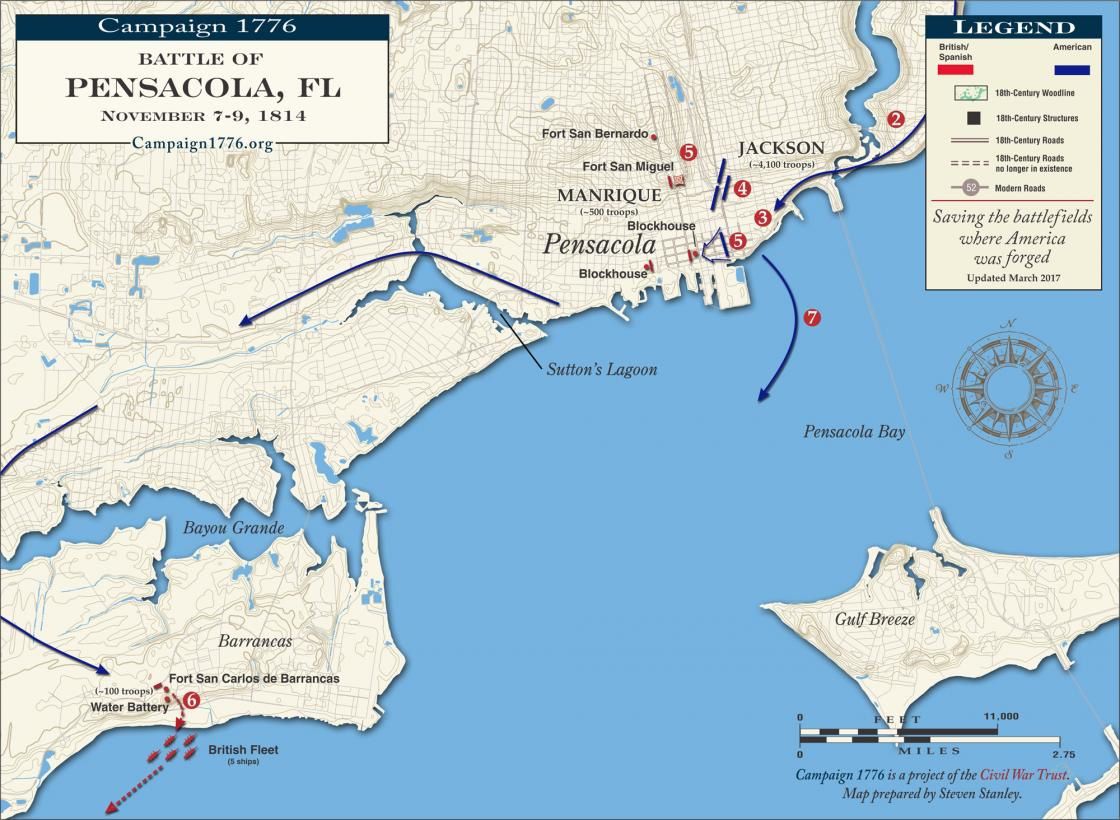
Here's a quick summary of the battle, which makes it one of the less appealing gaming scenarios of the war, in my opinion. On November 6, Jackson first sent Major Henri Piere as a messenger under a white flag of truce, to deliver an ultimatum: to grant Jackson 'possession of the Barancas and other Fortifications with their munitions of war'. However, the messenger approached the city and was fired upon by the garrison. That night, under cover of darkness, Jackson then sent a second messenger, this time a recently captured Spanish Non-commissioned officer of the Pensacola garrison.[59] Manrique, calling Jackson's bluff,[60] rejected the proposal. Manrique was at pains to emphasize there was no longer a British presence in Pensacola. He recounted that the British had requested possession of the fortifications, which he refused them. He protested that he never tried to violate the neutrality existing between Spain and the United States. At dawn, Jackson had 3,000 troops marching on the city. The Americans flanked the city from the east to avoid fire from the forts and marched along the beachfront, but the sandy beach made it difficult to move up the artillery. The attack went ahead nonetheless and was met with resistance in the center of town by a line of infantry supported by a battery. However, the Americans charged and captured the battery. Fort San Miguel and the garrison numbering 268 troops surrendered on November 7. Fort San Carlos, which lay 14 miles to the west, remained in British hands. Jackson planned to capture the fort by storm the next day. On the morning of the 8th Captain Gordon saw 2,000 men and 3 cannon marching towards their fort. It was blown up and abandoned before Jackson could move on it and the remaining British withdrew from Pensacola, along with the British squadron commanded by James Gordon of HMS Seahorse. Nicolls took with him a large proportion of the Spanish garrison and slaves, 363 embarked, who did not return to Pensacola until 1815. |
| Keith Hollick | 19 Jul 2026 2:51 p.m. PST |
This is the simplified US-centric historiography of the battle: Either the British occupied Pensacola (because they are nasty Redcoats), or Spain invited them in and agreed to help. Jackson did not like this, so about 3,000 men out of a total of up to 4,000 men attacked Pensacola. It was a victory. Those cowardly Redcoats, comprising of Nicolls's 100 man company of Royal Marine infantry, and a number of Colonial Marines, ran away. With the Redcoats being turfed out, order was restored. ------------------------------------- It wasn't that simple. Mateo González Manrique served as the governor of West Florida from 1813 to 1815. During his tenure as governor, Spanish Florida was caught in the War of 1812 between the United States and Britain. Manrique attempted to remain neutral in the conflict despite the small garrison of 500 soldiers at his disposal. He was not supported by hose higher up, be they in Havana or Cadiz. Nicolls and Jackson were the rock and the hard place that he found himself between, and with the benefit of hindsight, he made the wrong choice. |
| Keith Hollick | 19 Jul 2026 3:11 p.m. PST |
This was the only instance in the war where neutral Spain was involved in an engagement. Given that history is written by the victors, we do need to turn to the British sources. They wanted to forget it happened. The main account is in a history of the Royal Marine Forces, written by Paul Harris Nicolas, published in 1845. This is largely derived, without question, from a document written by Edward Nicolls in 1817, in order that his expense claim can be reimbursed, having found himself ostracized upon his return to the UK. Nicolls had to put forward his Memorial, and the business case had to paint him in as good a light as possible. If this is not a good story, he won't get paid, so he won't let facts get in the way. Nicolls reckons that he was attacked by a force of 5,000. In loose terms, it is hundreds getting attacked by thousands of Americans, but this number does not stand up. He states there were 700 men in defence, which does seem plausible. He claims to have inflicted 15 deaths and numerous soldiers wounded on Jackson's force. Ironically, older histories have taken these figures as the casualties inflicted by Jackson! To conclude, and to quote verbatim:
'[We] retreated fighting from the place without the loss of a man' I see no evidence of 'fighting', only that he 'retreated' in the face of vastly superior numbers, which was the logical thing to do. As regards being confronted by thousands, yet no casualties, I theorize the following:
Spanish troops fought in the battle, and were quickly neutralized
British marines did not fight in the battle, hence no casualties. The irony is that the British were at war with the Americans, and did not fight. The Spanish were neutral, and did fight. |
| Keith Hollick | 19 Jul 2026 3:14 p.m. PST |
Early on, we have an instance of Nicolls being economical with the truth. That said, it was his duty as an officer to use subterfuge, and to bluff to his enemy the true strength of the forces available. At Pensacola on August 26, 1814, Nicolls issued an order of the day for the 'First Colonial battalion of the Royal Corps of Marines', and at the same time issued a widely disseminated proclamation to the people of Louisiana, urging them to join forces with the British and Indian allies against the American government. Both proclamations were reproduced in Niles' Register of Baltimore. These were a ruse as to the real strength of the British. The "numerous British and Spanish squadron of ships and vessels of war" he described comprised two sixth-rates and two sloops of the Royal Navy (Hermes, Carron, Sophie, Childers), the "good train of artillery" comprised three cannon and twelve gunners, whilst the "battalion" was a company-strength group of 100 Royal Marines infantry, detached from Major George Lewis's battalion. |
| Keith Hollick | 19 Jul 2026 3:41 p.m. PST |
There is a better British account. This formed the basis of a paper Fisher, Ruth Anna (1949).
"The Surrender of Pensacola as Told by the British".
The American Historical Review. Vol. 54, No. 2, pgs 326–329.
jstor.org/stable/1845391 For starters, the possibility of an alternative to the established historiography is a big challenge. The author was a woman of color, publishing an unconventional article during the Jim Crow era, so in my opinion, this was going to be overlooked from the outset. She traveled to London, to consult primary sources, in particular the naval despatches sent from Captain Gordon to Vice Admiral Alexander Cochrane. Gordon's comments are insightful, regarding the deteriorated relationship between him with Nicolls on the one hand, and Manrique. Gordon states that three thousand attacked Pensacola, and that the following day two thousand of them marched to the British positions. 'On the 7th the Enemy
with five guns and three thousand men commanded
by General Jackson entered and took possession of
Pensacola with little or no resistance… On the morning of the 8th Lieut. Colonel Nichols landed
and sent off the Rear Guard of the Indians, and
observing the Enemy march about two thousand men
with three guns towards the Barancas, I weighed,
directing Captain Lockyer to put his orders into
execution, which was done by the time I arrived there
and two hundred Spanish Troops with the Commander
of the Barrancas embarked.'
Secondary source: Fisher
Primary source
J A Gordon to A Cochrane dated November 18, 1814
within ADM 1 – Admiralty, and Ministry of Defence, Navy Department: Correspondence and Papers
Subsubseries within ADM 1 – LETTERS FROM ADMIRALS ETC. – NORTH AMERICA
ADM 1/505
Letters from [Cochrane as] Commander-in-Chief, North America: 1814, nos. 1-140 [to the Admiralty Office London] |
| Keith Hollick | 19 Jul 2026 3:45 p.m. PST |
American casualties were negligible; around seven dead and eleven wounded. (Two officers and nine enlisted men wounded are documented by Joseph H Eaton.) The Spanish suffered fourteen dead and six wounded, according to Frank L. Owsley Jnr. |
| Keith Hollick | 30 Jul 2026 5:20 a.m. PST |
ADM 1/505
letter from Cochrane to Croker dated 9 Dec 1814 I send you here-with Copies of them, to be laid before my Lords Commissioners of the Admiralty
No1 The Hon Captain Percy…
No 2 His subsequent letter…
No 3 Captain Gordon of the Seahorse, acquainting me…[dated November 18, 1814]
No 4 & 5 Letters addressed by Captain Gordon and the Hon Captain Percy
to the Spanish Captain General [Apodaca] at the Havannah. |
| Keith Hollick | 14 Aug 2026 11:00 a.m. PST |
|
|