| McLaddie | 14 Apr 2018 12:53 a.m. PST |
Wolfhag: No one 'drives' the 405 these days. Yes, even at 2am. So, no I don't drive the 405. QED. Interesting article. So you have troops in a 'covered approach' to about 250 yards with the suppression and maneuver elements. Then rushes to 50 yards for the assault. It is not clear whether the examples from 1917 follow the process above. It is not clear whether this was used in WWII. So you want to know how long it would take units to move to within 250 yards and then 50 yards etc. You write: However, it does prove a combat laden Platoon can double time across a 3000m table without suffering any real ill effects in about 40 minutes. And Based on the conclusions of the article (% chance of success) you could come up with an average of success which could be very valuable in a game with turns of 1-2 minutes in length. You can, however, that isn't what you wanted to know. You wanted to know: My discussion on this is mostly limited to tactical infantry movement in a small scale/skirmish battle environment that would historically take about 5-10 minutes. I'm using a scale of 1" = 25m on a 6-9 foot table for combined arms games and 1" = 5m for infantry engagements. So, my question is whether you have access to examples of WWII movement at the platoon level over those time and terrain scales? You want to know what was actually done and the variables involved in movement over those scales under combat conditions. That is what you want to recreate…Not a 1876 or 2001 series of tactical test exercises. |
| VVV reply | 14 Apr 2018 1:58 a.m. PST |
One thing to mention, is you go at the pace of the slowest person in the unit – unless of course you choose to abandon them.
I would expect select units for example commandos, to move faster. Likewise trained troops, the Japanese trained very hard. |
| Andy ONeill | 14 Apr 2018 3:28 a.m. PST |
Motivation levels are much more important than physical fitness in this context.
And you probably do literally leave the most reluctant behind if you're British army ww2. That was kind of the point of the left behind mechanism. |
| VVV reply | 14 Apr 2018 4:49 a.m. PST |
Motivation levels are much more important than physical fitness in this context. Sorry but you cannot do it if you cannot do it. And physical fitness as so many other things, requires practice. As for leaving behind, yes in at some times I am sure it happened. But as a general rule in the British army, I am going to say no. |
| Andy ONeill | 14 Apr 2018 7:07 a.m. PST |
I'm referring to official british army policy of the period. Tabbing across the falklands with 90lbs on your back, that requires extreme fitness. Short dashes in combat with way lighter kit are a different matter. Exhaustion is way down the list of factors most likely to stop an advance in combat. |
| McLaddie | 14 Apr 2018 9:18 a.m. PST |
In simulating human behavior, the group is easier to 'predict' than the individual, large groups more so than smaller groups… groups trained to act as a team even more so. The impact of motivation, fitness, slowest person in the unit and any other soft influences can best be identified and then quantified by statistical analysis. |
| Andy ONeill | 14 Apr 2018 12:06 p.m. PST |
The problem with arriving at a meaningful number is you want a measure of combat movement at a low level. You could probably work out company move rate over a day. What part of that day was in combat though.
Even then, a lot if time there's a lot of people doing very little in many engagements. |
| McLaddie | 14 Apr 2018 3:46 p.m. PST |
Andy: The level that Wolfhag was talking about I *think* was the squad/platoon. He is interested in short periods of times, under an hour. And sure, any number of people may do very little in engagements, but that too will come out in the statistical wash. If there are no descriptions, memoirs, AARs of troops at that scale, then other methods must be used. Guessing, noting all the variables that could happen and studying 1976 exercises for answers isn't the way simulations are developed. As an analogy, you have to have some idea of what Patton looked like if you are going to be able to paint a recognizable portrait of the man. You don't guess, study the faces of his great grandchildren or list how many things might affect the general's profile. |
| Andy ONeill | 15 Apr 2018 1:20 a.m. PST |
I think I know what is required. I just don't see how one would obtain it.
If you consider a fairly common encounter defender and then assault. There are "obviously" going to be very different speeds for pre encounter, approach, set up and assault.
You'd need an aar that broke down movement into each. Or a veteran that took notes on times. That could conceivably have happened I suppose but I've never seen such timings. When I interviewed ww2 veterans, it never occurred to me to ask them about rate of movement in this sort of detail. It's a very specific sort of a thing. Most of their answers were rather vague and recollections could be a bit unreliable on things they didn't think important. I had three totally different descriptions of one specific battle. Maybe there's a more organised study somewhere but I think you'd need an officer on the ground like a Wigram study. |
| McLaddie | 15 Apr 2018 8:00 a.m. PST |
I think I know what is required. I just don't see how one would obtain it. Andy:
If the information needed is unobtainable, then you can't simulate it. You can't paint a portrait of Patton if you can't find a picture/photo of him. IF that is the case, which isn't all that unusual for a simulation designer, then you have to ask different questions to get to the information you want.
If you consider a fairly common encounter defender and then assault. There are "obviously" going to be very different speeds for pre-encounter, approach, set up and assault. Well, probably… I have found 'obviously' can turn out to be wrong when we actually look. I think the issue here is focusing on the question 'how far *should* WW2 Infantry move.' The question is about what infantry is capable of. They have the same 'potential' move capabilities in each of those situations, but tactically won't want to. Players in wargames don't always move their units the same distances every turn for a variety of reasons. You'd need an aar that broke down movement into each. Not necessarily. That would only be the case if you saw movement as a discrete issue in each case [meaning that infantry are incapable moving the same distances in pre-encounter as they could in set-up, approach or assault.]
That isn't a reasonable statement. Or a veteran that took notes on times. That could conceivably have happened I suppose but I've never seen such timings. I think that is because you/we weren't looking for them. I have had the experience of reading the same history several times and only when I went looking for different information did I actually see it in the well-perused account. As you note: When I interviewed ww2 veterans, it never occurred to me to ask them about rate of movement in this sort of detail. It's a very specific sort of a thing. Most of their answers were rather vague and recollections could be a bit unreliable on things they didn't think important. Yes, that is true…and it is something that statistics can address. And then, if THEY didn't think it was important, maybe it wasn't in the situation. It makes me think of Art C.'s Crossfire which forgoes any movement rates…and only has movement from cover to cover. Did officers in a tactical situation as you describe actually think in terms of 'how long' it would take to get from here to there, other than long or short times exposed to fire? The larger then number of 'vague' responses you have, the more reliable is the conclusions are visa vie reality. That is a result that has been tested many, many times. I had three totally different descriptions of one specific battle. Maybe there's a more organised study somewhere but I think you'd need an officer on the ground like a Wigram study. I doubt that they were totally different. Obviously, they will be from different points of view and experiences. What if you had twenty descriptions of that battle? Any number of things would become clearer. The thing that has continually surprised me is that wargamers ask different questions of history than most historians. Because of that, they study history looking for different answers. The result is that a lot of the answers in the historical record simply haven't been looked for, haven't been asked, like your interview of the veterans. The questions determine the answers, just like the question of this thread. So, let me ask this: Considering how you have broken down a WW2 infantry attack: Pre-encounter
Approach
set up
Assault Can we assume that the combatants would break down their actions the same way? If not, how can we group their experiences into those categories. We certainly can, but we would need some parameters for each… and would that address our question? Can we say that the infantry speeds at each of those categories are based less on potential movement abilities, but rather on task, terrain and enemy resistance? In which case, finding the common speeds that infantry moved at in each of those situations isn't about ability to move, but rather task, terrain and enemy resistance which can be sussed out statistically, finding, for instance, the typical movement through different terrain or against different types of enemy resistance. I think it is important to note that military men ask the very same questions and discussed them. How they answered and what they saw as important isn't all that rare. |
| Wolfhag | 15 Apr 2018 8:25 a.m. PST |
Yes, I'm really only interested in a company sized battle. I think the direction the discussion has gone to is not so much a movement rate under fire but the bigger picture which can be considered the "rate of advance"
PDF link Most of my scenarios involve advance to contact which is mostly unmolested (no friction). As you get within range of the defenders they'll open fire and the advance slows (friction). That's when the battle starts. So how far can a team or platoon move? It depends and that's what makes it interesting However, it does not slow down all of the time. A tank column road marches when not under fire is about 20kph. If they are out of effective range they'll speed up and evade using blocking terrain to get within effective firing range. Two columns may move into firing position to engage the defenders but another column may advance at full speed to flank the defenders and not slow down even if taking causalities. So if two columns are static and exchanging fire with the defenders and another is moving at 40kph whats the rate of advance? Another thing to remember is that our games do not duplicate reality. In reality, a company may be told to hold up its advance because the companies on its flanks have their advance stopped or they need to wait for other supporting arms and logistics to catch up. It appears to me there are so many factors outside a small unit engagement to get a real movement "rate". Personally, I think the concept of a quantified "rate of advance" as McLaddie presents has great potential in traditional board games to replace attrition because CRT's. A division sized battle taking place over a 24 hour period could be quantified with a rate of advance Wolfhag |
| McLaddie | 15 Apr 2018 11:23 a.m. PST |
Wolfhag: Interesting in-depth statistical study. Even though the conclusion is: Proposition 10. Are advance rates (consistently and accurately) predictable? Not by current knowledge. The highest proportion of the variance accounted for by the epistemologically acceptable studies typically seems to cluster somewhere around 1/3. So despite great efforts by many distinguished analysts and historians, only weak
general trends and broad tendencies have been found. How many attempts to build a perpetual motion machine have to fail before we decide it is impossible? I think it is
time we seriously consider the possibility that there is a large, irreducible random component in advance rates. If there is, we just have to face up to that and behave
accordingly. Again, if the information isn't available, then you can't answer the question you want. However, I think the recommendation 'to face up to the fact and behave accordingly' has a lot of merit, particularly because, while the variations are wide, they are predictable in variance and grouped, something that could be incorporated into a game system. Another thing to remember is that our games do not duplicate reality. In reality, a company may be told to hold up its advance because the companies on its flanks have their advance stopped or they need to wait for other supporting arms and logistics to catch up. Well, not all of reality, just some parts of it…and a game system could be designed to simulate that aspect of combat… if you wanted. It appears to me there are so many factors outside a small unit engagement to get a real movement "rate". I think you mean a 'predictable movement rate' which is what the study was looking for. They quoted GENICHI TAGUCHI: "The most important quality of process or product design
is its robustness against variation." The corollary to this is not that a system necessarily eliminates variation, but that it recognizes it and deals with it… which is the recommendation of the study. And if that unpredictable nature of combat is something that commanders had to deal with… then it would be fun to see how that can be incorporated into a game system… knowing that officers did plan and their plans did succeed. Even the oft quoted von Moltke saying that no plan survives engagement, he was a methodical, even obsessive planner, so there was an element of predictability about combat… in planning for that unpredictability. Another thing that statistics shows that the unpredictability isn't spread over the entire battlefield an inch deep, but collects in very specific 'joints' of operations to a great degree. That nail and shoe was lost by a very particular horse on a very particular mission. That 'qualified rate' can include a wide variability, but it will have definite parameters set by the evidence and some probabilities of where and how often such things occur. |
| Wolfhag | 17 Apr 2018 12:10 p.m. PST |
I'd agree that before battle advance rate predictions were normally entirely wrong – but for a variety of reasons and the front lines units doing the fighting were not always to blame. Historically, frontline advances were held up because the supporting arms or logistical train could not keep up but that's outside of most tactical games. So I'm going to stick with my design idea of using a somewhat predictable movement rate from history and the manuals and let the enemy, C&C breakdowns, terrain, fog of war and some random environmental events cause the "friction" to slow them down. The main thing is the enemy gets to have a say in how fast the advance is. The attacker must decide on a fast advance with minimum security and situational awareness (road column march)or a slower advance with more security and better situational awareness (tactical deployment with bounding overwatch). If you have a wide enough table you can have "friction" spiking on one flank and another flank units advancing uncontested. I like that. I want to portray friction that interferes with the advance and movement as something that needs to be "caused" and not randomized for some abstracted reason. An uncontested advance can be somewhat predictable. As friction increases, advance rates become less predictable and the advance could stop altogether. Wolfhag |
| Lee494 | 17 Apr 2018 6:52 p.m. PST |
Good Grief Charlie Brown! Just pick a movement rate Already! Cheers! |
| UshCha | 17 Apr 2018 10:35 p.m. PST |
I have to agree with wolfhag here, Predicatable movements (as it is easy for the players to remember and that includes me) but with increasing risk as the speed increases. We have 4 levels, slow, Fast pre programed moves in difficult terrain and Infinite Improability drive (20+ mph). In sight of enemy this one is BAD news. I general I try where possible, to "cause" friction rather than random event imposition . This reduces rules and makes it more belivevable and generates more than enough problems. Too much of any randomisation takes the game out of the range of interesting games. S**t happens in the form of one off evnts but thay to me are not a good parameter to model. |
| VVV reply | 18 Apr 2018 2:56 a.m. PST |
Most of my scenarios involve advance to contact which is mostly unmolested (no friction). As you get within range of the defenders they'll open fire and the advance slows (friction). That's when the battle starts. So how far can a team or platoon move? And if you look at most armies formations of the period, they advance to the battle in column then change to other formations to fight the battle. So lets say we have the march move and the tactical move. Under my rules, the march move is just multiples of the basic move (up to 3 basic moves a turn) when the unit is doing nothing other than moving. Tactical, then the unit; moves once, spots, shoots, charges. My basic infantry move is 25% of effective rifle range. I would like to think that that gives the player the choices that a squad (section) leader would have. You can move but that may mean that the enemy can fire at you. You cannot fire effectively at an enemy you have not seen. You can shoot at the enemy but that may give away your position. You can advance to contact but is the enemy still strong enough to resist your attack? |
| Andy ONeill | 18 Apr 2018 4:22 a.m. PST |
Advance in column? In ww2? |
| Blutarski | 18 Apr 2018 6:08 a.m. PST |
No simple "one size fits all" movement value can possibly hope to fill the bill for a sim-oriented rule set. To do so requires one to ignore a panoply of important terrain, environmental, psychological and tactical factors. B |
| Andy ONeill | 18 Apr 2018 10:56 a.m. PST |
There are quite a lot of factors. I think psychology tends to be more of a stopper than a slower. Certain things excluded. Assuming you have suppression and leadership effects. A unit is usually reticent to move out of cover if it's likely to be moving into trouble. Hugging dirt and hiding are quite attractive if bullets or shrapnel start flying. Terrain….
Well you could lump that into normal, difficult and very difficult for a base or just apply a minus.
Under fire is a lot different from not under fire in that the entire posture of a unit is likely to change. So that's another category.
Tactical. Hmmm. Not sure where you're headed with that. |
| Wolfhag | 18 Apr 2018 11:26 a.m. PST |
Andy,
I'd agree psychology tends to be a stopper because when people are unsure they tend not to take action because they are afraid of the consequences. Advance in a column in WWII? Absolutely as it is in the manuals and you can find dozens of historical examples. It could be to use road movement or when exploiting a gap during an advance. A Regiment may advance in battalion column along three different roads. Like I said, you give up a lot of security for the speed and ease of movement (fewer breakdowns than moving across country too) but you can be ambushed and surprised like the British at Villers-Bocage. Battles like that happened very often from poor route reconnaissance, underestimating the enemy, etc. Wolfhag |
| VVV reply | 18 Apr 2018 12:45 p.m. PST |
Advance in column? In ww2? Absolutely, even happened in Vietnam. A unit is usually reticent to move out of cover if it's likely to be moving into trouble. Hugging dirt and hiding are quite attractive if bullets or shrapnel start flying. One of the points noted in WW2 British/American troops tended to take cover and stay where they were under artillery fire (pinned). Germans liked to move on through and get out of the area of fire, they reckoned that it reduced casualties in the long run. |
| UshCha | 18 Apr 2018 10:59 p.m. PST |
Any good system should allow players to do stupid things like March an infantry in column into an area covered by several machine guns. It should inflict appropriate casualties and not be subject to daft probabilities of escaping unharmed. That way the player learns what the right tactics are. |
 etotheipi etotheipi  | 19 Apr 2018 3:57 a.m. PST |
It should inflict appropriate casualties and not be subject to daft probabilities of escaping unharmed. That way the player learns what the right tactics are. Nah. If you have realistic probabilities of escaping unharmed, then someone won't learn. History is replete with things turning out OK or even smashingly well for people who made really bad tactical calls according to the information they had at hand. And vice-versa. This is one of the biggest problems I have in applying simulation to work. We analyze our failures to death because we want to avoid past screw-ups. And we assume that our successes are due to the fact that we are all morally upright people making good decisions. In certain complex environments, this is the recipe for catastrophic failure later on. |
| Blutarski | 19 Apr 2018 5:15 a.m. PST |
Andy wrote –
"I think psychology tends to be more of a stopper than a slower." That is absolutely fair comment in the case of a unit under fire. But when I was writing my post I was thinking of command psychology – in the sense that a leader's perception of the tactical situation or tactical risk level will govern maneuver decisions. For example: a company leader may well halt his unit in order to send a team ahead to reconnoiter a distant tree line before committing his company across an intervening area of open ground; or a unit suspecting the presence of mines or booby traps will advance at a slow and cautious pace in order to better check the ground. FWIW. - – - "Advance in column? In ww2?" I concede the following example is not from WW2, but, in the Korean War, entire Chinese Communist infantry companies were known to advance through UN lines at night in close order column of fours at the trot when they believed they could exploit gaps in the defense. Risky? Yes. But the potential benefit was to be able to rapidly move a force into the rear of the enemy without it becoming dispersed/disordered. - – - Etotheipi wrote –
"History is replete with things turning out OK or even smashingly well for people who made really bad tactical calls according to the information they had at hand. And vice-versa." I don't disagree. But it is fair to say that such applications of ‘The Law of Unintended Consequences' will be encountered at the fringes of the spectrum of possible outcomes. While the unexpected and the accidental can sometimes dramatically skew events, marching the regimental band across 200 yards of barbed wire entanglement in the face of artillery and intersecting machine gun fire will quite reliably produce tragic results. FWIW. B |
| Andy ONeill | 19 Apr 2018 5:39 a.m. PST |
To clarify.
Justin seemed to be saying that column was a standard formation for advance to contact.
Which is incorrect. Units travelling when they weren't expecting any trouble would travel in column. If that was the best way for a coup de maine then sure. Or when just driving a lorry with a bunch of supplies. In any sort of tactical situation, column is a formation you really do not want to be caught in.
Strangely enough, this is why ww2 units didn't usually advance to contact in column. Did people ignore this and drive down a round straight into the enemy? Sure.
Were there times when opposition was so light that it made no difference what formation the unit in so whatever was faster was best? Sure.
But it's a great way for a couple of machine guns to cut most of your company in two or one tank destroyer to destroy an entire company of t34. This was one of the problems at VB. The unit was travelling as if "swanning" rather than up to contact. No recce was sent ahead and supporting assets were not deployed as they should have been. If you really want to you could read the us army manuals for the period. Google em. One up two back was the standard us formation for battalion or company.
Column was only to be employed when the zone of advance was narrow ( they couldn't fit in anything but column ) and the flanks were secure.
That's not exactly common let alone standard.
(Page 116 of the ww2 us infantry battalion manual.) In fact this is a ww2 infantry discussion, so I'm not entirely sure how travelling in convoy down a road crept in here.
There's little advantage to infantry walking down a road and some big reasons not to.
Roads are the first thing the enemy cover. They would often be registered for artillery. |
| VVV reply | 19 Apr 2018 9:44 a.m. PST |
Justin seemed to be saying that column was a standard formation for advance to contact.
Which is incorrect. Sorry, its what the manuals say – and precisely what I was used to in the 1970's and 1980's. And I agree, read the manuals (I did). Its all there. But then I am not talking about battalions/companies/platoons, just squads. As to why people move down roads (we did, it was faster). Read the accounts of the fighting in Normandy. The Germans were amazed at the Allies coming straight at them with no attempt to flank the German positions. Any rule writer should do their research, I know I did. |
| Andy ONeill | 19 Apr 2018 11:15 a.m. PST |
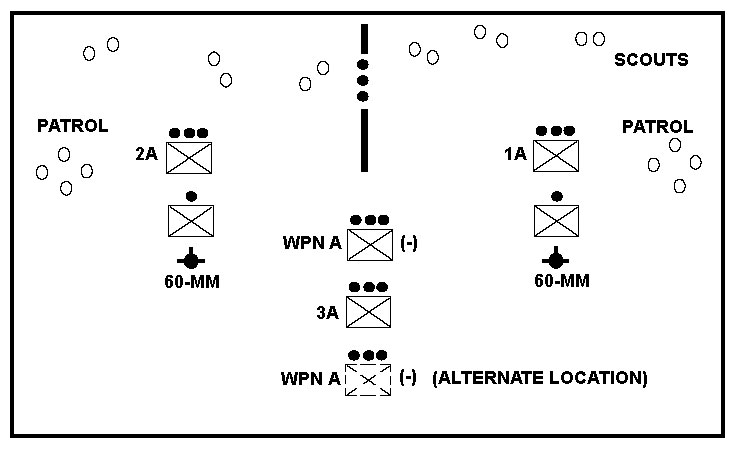
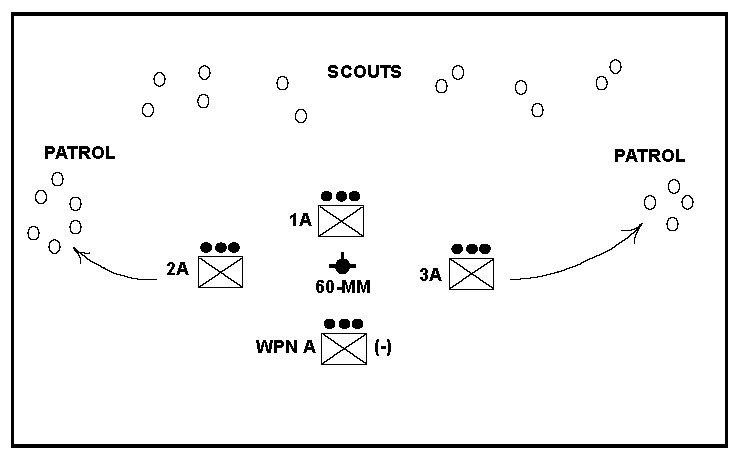
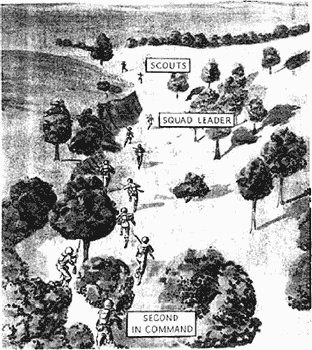
The US ww2 company manual includes a whole load of fairly similar advice to the Battalion but some actual pictures of formations for the advance.
I wonder if they are column? link Page 15.
There are specific instructions to either avoid roads or dash across them due to the fact they were often covered by direct fire or registered for artillery. |
| Wolfhag | 19 Apr 2018 2:21 p.m. PST |
Andy,
Your diagrams are correct and the formations are for when you are advancing and expecting contact. You would not stay in a march column while EXPECTING contact with the enemy. I don't think anyone is advocating that, I'm not. No combat unit would want to be deployed in any type of a march column when EXPECTING enemy contact. They'd be deployed as above. Also, a combat unit NOT EXPECTING enemy contact behind the FEBA or in a rear area would NOT be moving in the formation as above. They'd be in the best formation for speed and ease of movement. Go to Andy's link and do a word search for "column" for details. You'll see this: Retention of the company formation in platoon columns as long as practicable. If practicable, deployment as skirmishers should be delayed until within 100-200 yards of the objective. However, deployment should be completed before coming within view of sentries located on or in close proximity to the objective. (See g (6) below.) I think that's where they deploy into a tactical formation as shown above. All types of movement (including column) involve some type of point and flank security, even a road column march. Also, in a triple canopy jungle with a LOS of less than 25m it would be almost impossible to patrol in the formation above. However, you'd still have a point man and someone on the flank but everyone else would pretty much be in a column – until you have some intel on contact in front, then, of course, you deploy into a better tactical formation. Circumstances dictate tactics. In an "Advance to Contact," you are not in contact so security is less of a concern than speed. Speed means using trails and roads. You will deploy from a column to a tactical formation at a certain point near the FEBA or when expecting enemy contact, artillery, etc. Hopefully, your recon is good and leadership or the player makes the right decision. The way I see it a march column advance to contact is more of a strategic type movement and mostly outside skirmish games. Once expecting contact you deploy as Andy showed. Wolfhag |
| Blutarski | 19 Apr 2018 2:41 p.m. PST |
"Also, in a triple canopy jungle with a LOS of less than 25m it would be almost impossible to patrol in the formation above." An interesting example of small units (platoon/company) tactically operating in column (single file!) comes out of VN. I have read accounts of such units literally having to machete their way step-by-step through vast expanses of dense ten foot tall elephant grass with visibility about ten feet. The work was so laborious that the brush-cutters had to be constantly rotated; only a single path could be practically cleared given the available manpower and the awesome heat and humidity. No flankers could be put out. Progress was measured at a rate of about a kilometer per DAY. Unusual case? Yes. But dense undergrowth, deep snow, very swampy terrain also forced similar tactical channelization – even if not quite so dramatic. Of course, the saving grace here is that most gamers will never choose to play upon such terrain. B Composed while listening to the beautiful strains of "Sweetheart of the Rodeo" by Gram Parsons and the Byrds (1968). Great album! |
| McLaddie | 19 Apr 2018 8:20 p.m. PST |
It should inflict appropriate casualties and not be subject to daft probabilities of escaping unharmed. That way the player learns what the right tactics are. Nah. If you have realistic probabilities of escaping unharmed, then someone won't learn. History is replete with things turning out OK or even smashingly well for people who made really bad tactical calls according to the information they had at hand. And vice-versa. Even with wildly variable probabilities, players will learn--after several games. History is replete with folks who lucked out the first time with bad tactics [like gamers and great die rolls] and were crushed the second time they used the same, previously successful tacitcs. A tough learning curve, but that is learning… This is one of the biggest problems I have in applying simulation to work. We analyze our failures to death because we want to avoid past screw-ups. And we assume that our successes are due to the fact that we are all morally upright people making good decisions. In certain complex environments, this is the recipe for catastrophic failure later on. It also also appears at first glance as a misuse of simulations in both application and the assumptions attached to any conclusions. I've used simulations [and developed them] in training for both educators and business management. [both complex environments and/or tasks] Simulations are a very effective tool in learning how to deal with complex environments… but it has to be used correctly and not saddled with unrealistic expectations. |
| McLaddie | 19 Apr 2018 8:29 p.m. PST |
Circumstances dictate tactics. And I would assume that circumstances then dictate the speed of an advance. So, what circumstances are we talking about? Those can be compared to historical or training events. You could have the total movement rate of a unit then each move affected by meeting those circumstances… those are not uniform on any battlefield and their effects can be variable… producing more of issues that seem to be of concern here. Only one maximum movement rate… influenced by circumstances. With the right circumstances present [or created], the infantry could do those rushes and rapid movement. |
| Andy ONeill | 20 Apr 2018 2:06 a.m. PST |
[Quote]The way I see it a march column advance to contact is more of a strategic type movement and mostly outside skirmish games. Once expecting contact you deploy as Andy showed.[/Quote] Pretty much the way I see it.
Strategic movement is usually outside of the scope of a company game. I would extend that to say you don't really need any rules for it.
Years of software design and development have made me much more pedantic than I used to be. There's also an engineering similar to the theory of application of force. Anything more than enough to succeed is waste. For what it's worth.
I never intended making a point which has also become obvious along the way. |
| VVV reply | 20 Apr 2018 12:09 p.m. PST |
OK my 2p with some links and pictures
link
"Squad column" can be easily controlled and maneuvered. This formation is used for crossing irregular terrain, in narrow covered routes, or for crossing areas exposed to artillery fire. Squad column facilitates immediate action toward the flanks. The disposition of individuals in the column must be adapted to the terrain and enemy action, and may vary from a widely spaced and staggered column suitable for crossing very open country to a column of files closed up behind the leader. (See FM 22-5, par. 258)
And the German way of doing it PDF linkThe squad column is used for approaching the enemy during the fire fight, So forget the idea that the column formation is not appropriate to our games, it was used in WW2 and so is very much part of the game. Same here of course, as a systems analyst in real life. It needs to be right. |
| Wolfhag | 21 Apr 2018 11:07 a.m. PST |
Andy,
I probably overreacted to your post and should have asked for a clarification before attempting to "set everyone straight" (the all too typical response on TMP of which I'm guilty). In the past, I've found your posts informative and accurate. I'll try not to let it happen again. Wolfhag |
| Andy ONeill | 21 Apr 2018 4:10 p.m. PST |
Likewise.
Respect. And yes.
Why does this other guy not see the one true way?
Of course he already has seen the light.
It's just a different light:) |
| McLaddie | 26 Apr 2018 3:50 p.m. PST |
Last Hussar and Wolfhag: This issue went a number of directions during the thread…
Did either of you find ideas that were helpful? |
| UshCha | 26 Apr 2018 5:43 p.m. PST |
So my take on this is that you assess the situation based on the brief of the scenario perhaps this includes the need for speed and the expected level of opposition. Then move to the table and look at the terrain. To make life easier for learners this may have blind markers representing the possible position of the enemy. The player then decides on the mode of movement, based on the terrain, time and risk factors and the engagement commences. This automaticaly creates plausible variation in rate of advance based on the commanders assessment of the optimum speed vs risk. He may of course have got it wrong, but that's what it's all about. |
| Andy ONeill | 27 Apr 2018 2:16 a.m. PST |
@McLaddie.
I found useful information and I definitely appreciate your input. Always do. Your posts are always thoughtful and interesting. I've asked Ezra about movement values. He has contacts may have real world measurements or failing that values used in simulations.
They may or may not be willing to share and they may not have the level of detail gamers want.
Not sure I mentioned who Ezra is.
Ezra Sidran did UMS and UMS2, he's designing the game I'm working on. The AI is also his thing. He did real world real time tactical analysis software for the US army.
link @UshCha.
You really let people play a game where they just remove models? Bit too harsh for my tastes. I think there are a lot of variables involved but yes the commander will either have recce info or just an opinion. He considers that, looks at the terrain and decides on a "mode". EG At VB the CO wildly underestimated the strength and organisation of the opposition and seemingly assumed this was an unopposed advance. Based on whatever he has, the CO decides and of course his unit then follows orders. As any shooting starts they may instead react as situation dictates.
There are a lot of variables which will affect movement at a low level but the company commander ( or higher ) is likely the one decides that initial "mode". Maybe he has no realistic choice but to send some men up a narrow defile which could mean high casualty enfilade fire or even one of Legion 4's L shaped ambushes if the enemy are prepared. Of course often the enemy will be prepared. And, well, that column marching down the road has it easy to those trapped in a narrow terrain enforced corridor. What might be interesting is if that decision was taken prior to a game. Do you go for a coup de maine straight on rush because you think there's 2 men and a dog in that village at the moment.
Do risk taking time for a recce with perhaps the risk the enemy "goes firm" and re-inforces whilst that happens.
Or do you sneak up that seemingly innocuous defile which will offer defilade from your target. The enemy will never have thought of that one… ?
Meaning two games.
The pre maneuver game.
The actual assault. These could be interesting game choices and I think simulate the commander's position. Could be tricky to make interesting as a regular every-game feature though. |
| UshCha | 28 Apr 2018 5:25 p.m. PST |
Andy, not sure what you mean removing figures, the figures are not put on the table until they are either spotted, move or fire. Almost all our games of an evening have blinds on the defender side so elements of uncertainty are always present as are time restrictions. Without such criteria the game would boring. Uncertainty and when to fire to most effect as a defender is what a game is about to me. |
| VVV reply | 29 Apr 2018 1:44 a.m. PST |
One of the approaches to game design I took was to play through scenerios that other people had written. In my case I used the Skirmish Campaigns series. They often limit the number of turns allowed for the gamer.
And yes, I go for removing figures as a easy way to lower the combat power of the unit. Consider the figures as markers of unit effectiveness.
I have been getting the impression during this discussion that that is what some players mean to play, just the combat. So where the enemy is is known, all you have to do then is fight it out and see who wins. Movement then has little to do in the game.
In my games you are looking to find the enemy (even if you can actually see the figures on the table) then meet the game objective, which in some cases might simply be to move to the other side of the table. However other victory conditions could be; kill the enemy, capture an objective or free/take prisoners. |