"Secrets we never shared?" Topic
113 Posts
All members in good standing are free to post here. Opinions expressed here are solely those of the posters, and have not been cleared with nor are they endorsed by The Miniatures Page.
Remember that you can Stifle members so that you don't have to read their posts.
For more information, see the TMP FAQ.
Back to the Napoleonic Discussion Message Board Back to the Napoleonic Painting Guides Message Board
Areas of InterestNapoleonic
Featured Hobby News Article
Featured Recent Link
Top-Rated Ruleset
Featured Showcase Article
Featured Profile Article For the time being, the last in our series of articles on the gates of Old Jerusalem.
Featured Book Review
|
Pages: 1 2 3
| Ottoathome | 08 Nov 2016 12:21 a.m. PST |
When drilling or soldering, or cutting ANYTHING the important thing is HOLDING the work. Trust me, your fingers are not enough. Get yourself SEVERAL small pin-vices from a model railroading supply. The other side of this is that all of our models are in soft metal. This means you can't just torque the vice down. You'll crush or deform the figure. A lot of experimentation must be done to find the right way. Remember you want to distribute the area being held on to as wide as possible. |
| Ottoathome | 08 Nov 2016 12:26 a.m. PST |
Flags and staffs are easy to make using hard piano or music wire which can be obtained in bulk cheaply (far cheaper than a hobby store) from K&S metals. They are on the net. This can be easily cut with simple cutting pliers, big ones. Rememember though to flatten the cut edge which will be very sharp from the break with a dremel tool. One thing I have done is to solder this wire to the hand, after leading it through a hole drilled in the base of the figure. Expoxy it tight to hand and base. THEN cut from brass tubing a sheaf or section as wide as the flag you want to mount. You have to do a little fiddling, but you can find brass tubing that "telescopes" over the piano wire snugly. As I said cut the brass to the width of the color or standard, and wrap the standard around this brass sheath. You can then slide on the color over the protruding wire and remove it if the flag gets torn or faded. You can also change colors for times you want to use the regiment on the other side. |
| Ottoathome | 08 Nov 2016 12:35 a.m. PST |
For replacing broken sabers use milk cartons. They are garbage anyway or recyclable. Take one of those old half gallon cartons with the flat faces and cut out the flat faces. Using a very sharp expensive pair of scissiors (the old style, not the punched out horrors they sell today, cut small thin strips an inch or so or more long. It will take some time to get the method down, but when you do you will have small strips that are FLAT. Drill through the hand where the old sword was and epoxy the milk carton strip into the hole and let dry. The milk carton is either poly ethelene or poly propaline and is built to be tough and durable, and it will last for years and not fatigue off. The finely made and extruded strip stock from Evergreen plastic used in model railroading is perhaps better, but that's styrene and fatigues easily and will soon break. The Polyethele and poly pro is long lasting, can be bent may times and easily straightened and is flexible. it also takes paint much better than the the styrene. It's a lot better than fiddling with pins and wire. When done and painted you simply snip off the sword to the length you want. It also makes excellent material to do halberd heads, spontons, etc. One other thing, if it DOES break off you can esily rebore the hole with a simple hand drill, the stuff is soft and will rout out easily. |
| Ottoathome | 08 Nov 2016 12:48 a.m. PST |
The most challenging thing to model are weapons or flag staffs held above the head in an animated pose. You have every physical principal in creation working against you. Toching the spear, lance or color at any point applies the principle of the fulcrum to the tiny itty-bitty hand holding it to metal fatigue. there are only two ways I know of attacking this problem. Both involve some form of support. The first is say a lancer with the lance down or level as if about to spear an infantryman. In this case cut the lance from the piano wire generously longer than you need. Then make a bend at one end about 1/2 inch or so from the end at 90 degrees. This bent shank you insert into a hole drilled into the flank of the horse and epoxied in. Then the middle of the lance is held by the hand of the rider. It makes a much more sturdy bond. If it's going to be especially long, what I will do is chop off the hand and drill up a hole into the arm, or even across the fore-arm a small bit of flexible steel wire is then used as tether around the lance. For something held over the head, like a cavalryman waving a standard, it's the only method. |
 deadhead deadhead  | 08 Nov 2016 2:16 a.m. PST |
Ottoathome yer a Genius. My immediate favourite is the very first one. How can a tiny piece of brass wire bounce so far and then disappear into a carpet like that? But then the ideas about drilling and holding, securing weapons etc…… So glad this thread got revived. Some gems emerged here |
| 1968billsfan | 08 Nov 2016 1:01 p.m. PST |
deadhead: They bounce into the carpet and then wait for your bare feet to draw blood and disappear into your flesh. |
| AICUSV | 10 Nov 2016 6:40 p.m. PST |
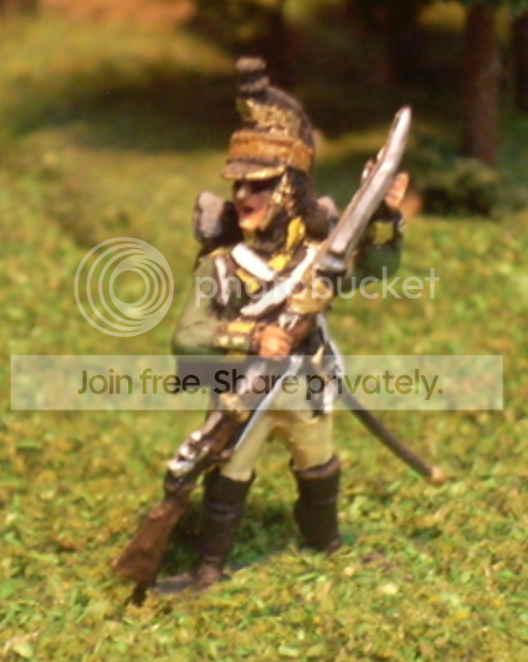
For replacing swords on 28mm figures I have found a bobby pin that is the right width and I will cut that down so it has a tag and comes to a point. I drill a small hole into the remaining hilt and hand and insert the new blade. I've even gone as far as to sharpen and temper the blades, as the pins are steel. The bobby pins make good scabbards as well. Here is a shot o a French dragoon (Image him many years ago with things left over from another project ) with a bobby pin scabbard.
|
| jwebster | 10 Nov 2016 8:43 p.m. PST |
Well keep thinking of more things – thanks for all the tips Otto, reminded me of Dremel tips 1) Use a drop of machine oil when drilling metal. This lubricates the bit so it cuts more easily. For some odd reason, my local grocery store sells machine oil – very thin. I put some in a dropper bottle so that it is handy and easy to apply. You will need to wash figure carefully with soap and water after otherwise oil will prevent paint from sticking. Otto suggested dipping the bit in cold water – another good idea. 2) Don't buy the cheap sets with bits of all sizes. They don't drill properly. Spend a bit more and buy just a few bits of specific sizes John |
| PentexRX8 | 11 Nov 2016 5:19 a.m. PST |
For black clothing, use a dark gray color, such as Vallejo's Black Grey. Wash it with a black wash and you will have an quick and easy shaded jacket or shako. This also works for black horses. For leather equipment, I use regular black. I second the motion to use a light gray, such as Vallejo's Stonewall Gray, for white leather and white trousers. After a wash you can add a thin layer of Off White, or White, which will make it appear pipe clayed. I mount troops that will eventually be based 4-6 on a base on pop bottle caps. This allows for minimal touching of the actual figure while painting. Wash your metal miniatures with Simple Green to remove any foreign substances before priming. I have found that my paint lays better, and if I happen to miss a small crevice the paint will still stick. For red hair, I base it with Vallejo Red Leather, wash it with brown, then highlight it with Reaper Fire Orange. Automotive primer, such as Rustoleum, dark gray is a good substitute for black primers. It covers well, if you like dark figure like me, it speeds up that process, and has great tooth. Plus it is less than $4 USD a can. |
| Knockman | 14 Nov 2016 8:46 a.m. PST |
Following on from 1968billsfan's earlier post, I've taken to using the tongue-depressors/large-lollysticks for painting 15mm, 10mm and 6mm figures. Either secure the figures to the sticks with white glue or double-sided tape, such as carpet tape. And afterwards, once you've used the sticks a few times, they can be cut up, shaped and recycled into allsorts of terrain items. You can get packs of these for not a lot of money from certain online retailers, but don't forget that beauticians use them for wax application too, so check out their suppliers, or just pop in to a beauty clinic and ask :o) (Just don't mention that last bit to my wife.) |
| HairiYetie | 21 Nov 2016 4:05 a.m. PST |
Many years ago some good soul posted a technique he used to make filler that is harder than putty, does not shrink, sets fairly quickly, and is easily sanded and sculpted. Approx 1 part thick superglue with 1 part talcum powder. This is all I use as filler nowadays. I mix the stuff in small batches in the disposable plastic trays that some individual chocolates come in. My wife loves the discarded chocolates! |
| per ardua | 29 Dec 2016 5:52 a.m. PST |
I mostly paint 1/72 -20mm figures. I first permanently glue them onto penny coins. I then pva glue the figure and coin to the top of a 2inch flat topped nail. Which I can easily roll between my thumb and index finger for 360 degree painting. They are then stuck into a discarded block of expanded ppolystyrene. When finished painting just remove them from atop the nail. Voila. |
| deadhead | 29 Dec 2016 6:35 a.m. PST |
Now that is inspired……..the nail for manipulation and the polystyrene to hold them. Voila, vraiment! |
Pages: 1 2 3
|




 goes to sea with the Terrain Mat.