"Gates of Richmond 1862" Topic
87 Posts
All members in good standing are free to post here. Opinions expressed here are solely those of the posters, and have not been cleared with nor are they endorsed by The Miniatures Page.
Please do not post offers to buy and sell on the main forum.
For more information, see the TMP FAQ.
Back to the ACW Discussion Message Board Back to the ACW Battle Reports Message Board
Areas of InterestAmerican Civil War
Featured Hobby News Article
Featured Link
Top-Rated Ruleset
Featured Showcase Article
Featured Profile Article
Featured Book Review
|
The Membership System will be closing for maintenance in 9 minutes. Please finish anything that will involve the membership system, including membership changes or posting of messages.
Please sign in to your membership account, or, if you are not yet a member, please sign up for your free membership account.
Pages: 1 2
| Ponder | 18 Aug 2015 1:43 p.m. PST |
67th, The Library of Congress is your friend. Received your message, but again cannot reply. Please send your email address. JAS |
| Ponder | 18 Aug 2015 1:48 p.m. PST |
On the set of maps I sent you'll note the early fat brigades of 2,000-2,500 in line are about half a mile in length! That would be best approximated by 2x 3" stands and their ZoC. You don't see that on the battle maps mentioned, but rather on the "picket" positions on the overall deployments. Ponder on,
JAS
|
| Ponder | 18 Aug 2015 2:25 p.m. PST |
|
| McLaddie | 18 Aug 2015 5:30 p.m. PST |
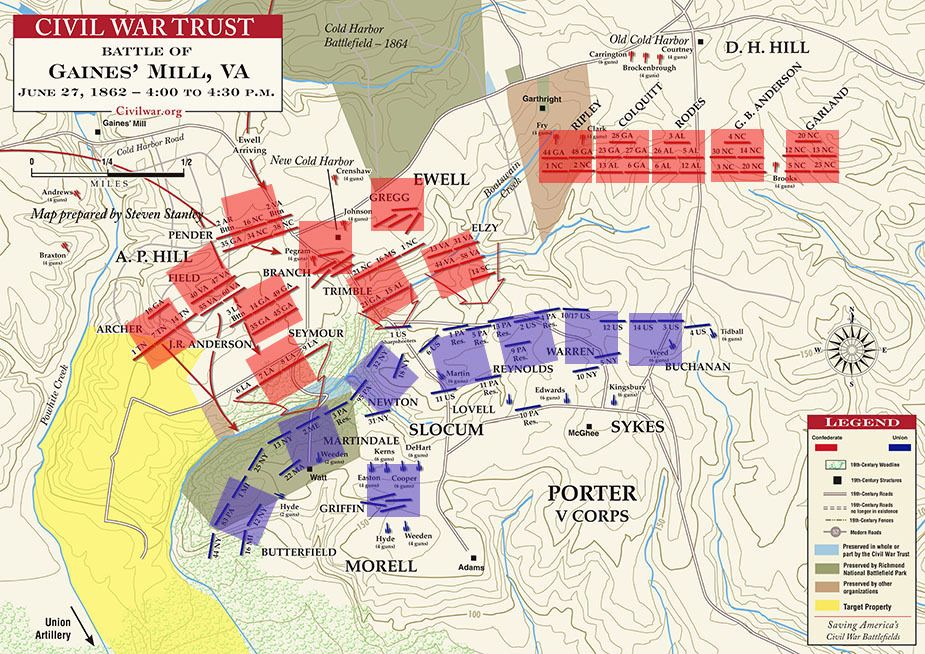
I don't see those kinds of frontages in the diagrams I have of Seven Pines, Gaines Mill, Glendale, or Malvern Hill. So while your suggestions may have merit for other theaters and times, they don't seem to apply to the Peninsula in 1862. Hi JAS: Yes, and no. From what I have seen and read, my response would be: 1. Maps are snapshots in time, often piling up several events onto one map. It can create distortions…and cramming of graphics. [Like stuffing both the names of the regiments and brigades in among the little lines at Gaines Mill.] 2. During a battle, particularly one in close terrain, units will narrow and expand their fronts as needed. 3. Maps have all the problems of any written source. Where did the information come from? The difference is that they look so much more definitive. Here is the map of Gains Mill from the CW Trust: [Note: 1/4 mile is 437.5 yards, 1/2 mile 875 yards ]
Happily, it has a scale key, which many don't. You can see that Union Butterfield and Martindale have that defense in depth on pretty much a 300 yard front with a second line behind. [less than 1/4 mile] But then on the other flank, Warren and Buchanan are spread across more than 900 yards. The same with the Confederates. It isn't surprising that they would be concentrated [in Mass] for an attack, but look at Fields Brigade is nearly 1/2 mile wide and Archer over 400 yards. The map shows an hour's fighting. Here is the next map showing the next hour:
It shows Seymour's brigade stretched across almost 1/2 mile of front.[Maybe 600+ yards?] Yet over on the right of the map D.H. Hill has his division in this very neat formation that easily fits the V&B model. But was Hill's division deployed that way, than uniformly? The last map of the series can be seen here: link How accurate are those maps? What do they tell us about the changes in formation during the battle or why? Nada. The Civil War Trust works very hard to maintain historical accuracy, which is one reason why they have three maps for the five hour battle, but did the map maker really concern himself with accurate frontages, or were they estimates or simply what fit the space? I don't know. I do know that those maps are better than many and any number show wide variations in frontages. I would be interested in reading a write-up of the rules covering your linear-mass suggestions. You could post it on the V&B yahoo group in the files section. Yes, I will do that once I get it typed up from all our written notes.  I wasn't suggesting that this was *The Way* to do it. Only offering it as one solution. I wasn't suggesting that this was *The Way* to do it. Only offering it as one solution. |
| Ponder | 19 Aug 2015 5:07 a.m. PST |
Howdy, Busy this morning, back later. JAS |
| Ponder | 19 Aug 2015 7:17 a.m. PST |
Howdy, I'm not convinced this frontage discussion is a significant issue for V&B, especially early in the war. Seems to me in bigger battles this goes away as an issue. I note in the figures you show above: Field's brigade frontage contracts as they close with the enemy for an attack. Seymour hits Martindale brigade on brigade. If it is an issue, it is likely most significant for larger brigades. A straight forward solution, for example, divide a 6SP brigade into left wing/right wing each with 3SP – this would address the issue with no need for special rules. I can see it as a potentially bigger issue later in the war when a brigade was defending a fortified line with a greater frontage. So, why did McClellan choose to withdraw? That seems to be a BIG question worth study & pondering. Ponder on,
JAS
|
| McLaddie | 19 Aug 2015 7:19 a.m. PST |
Oops. I see I got to typing too fast: correction: What happens should one linear stand by eliminated, can the remaining form a mass stand again? Then the remaining linear stand fights as a linear stand. Yes, the remaining stand can form a MASS stand again with another Friendly linear stand, though if stands from different corps attempt FORMING A MASS STAND, the Corps commander needs to within command range OF THE TWO LINEAR STANDS. |
| McLaddie | 19 Aug 2015 7:27 a.m. PST |
I'm not convinced this frontage discussion is a significant issue for V&B, especially early in the war. Hi Ponder: No worries. I wasn't trying to convince you. Just give reasons why we wanted to use those rules. V&B stands, mass and linear, are simplifications of what were very fluid battlefield formations. Seems to me in bigger battles this goes away as an issue. I note in the figures you show above: Field's brigade frontage contracts as they close with the enemy for an attack. I don't see it that way. It shows Field's brigade contracting, but not why. It also shows Archer's and Seymour's brigades attacking on a 600+ yard front with no more explanation why. If it is an issue, it is likely most significant for larger brigades. A straight forward solution, for example, divide a 6SP brigades into left wing/right wing each with 3SP – this would address the issue with no need for special rules. I think the assumption above is that brigades held a self-supported formation [multiple lines] at all times, so only large brigades would cover wider fronts. I don't see that borne out by even Gaines Mill. There are a number of brigades of various sizes with fronts of 400 to 800 yards. I can see it as a potentially bigger issue later in the war when a brigade was defending a fortified line with a greater frontage. Possibly. Certainly, there was a tendency to spread out as the war [and century] wore on. So, why did McClellan choose to withdraw? That seems to be a BIG question worth study & pondering. Have you ever read McClellan's report and reasons for withdrawing? |
| Ponder | 19 Aug 2015 7:29 a.m. PST |
Howdy, In gaming the Valley with V&B at regimental/battalion level, I use a linear regimental base, but give it the characteristics of a mass stand. This addresses the aesthetic portion of the argument. Only dismounted cavalry gets a truly linear base and characteristics. Ponder on, JAS |
| Ponder | 19 Aug 2015 7:40 a.m. PST |
Howdy, On McClellan: I think he was an intelligent and capable general. I suspect he withdrew from the Peninsula because given the strategic situation and correlation of forces he did not perceive an expectation of victory. Later at Antietam, McClellan did have an expectation of victory and was willing to fight. A significant difference between 62 and 64 was the supply from the Shenandoah to a besieged Richmond. Jackson's success in the Valley looms large. Ponder on,
JAS
|
| donlowry | 19 Aug 2015 8:07 a.m. PST |
In regards to my source(s): Mostly "To the Gates of Richmond" by Stephen W. Sears, which I recently read. I have to admit, 1862 is not the period I'm most familiar with (currently writing about '63). My general view of Little Mac comes mostly from Catton and T. Harry Williams, read decades ago. |
| Ponder | 19 Aug 2015 9:43 a.m. PST |
Howdy, Have you ever read McClellan's report and reasons for withdrawing? Yep, not very informative. In summary, McClellan wrote: "To the calm judgment of history and the future I leave the task of pronouncing upon this movement, confident that its verdict will be that no such difficult movement was ever more successfully executed; that no army ever fought more repeatedly, heroically, and successfully against such great odds; that no men of any race ever displayed greater discipline, endurance, patience, and cheerfulness under such hardships." civilwarhome.com/macsevendaysor.html Ponder on,
JAS
|
| Ponder | 19 Aug 2015 10:39 a.m. PST |
Howdy, The Library of Congress map mentioned earlier:
Not abundant evidence here of extended brigade frontages. Ponder on,
JAS
|
| McLaddie | 19 Aug 2015 11:27 a.m. PST |
JAS: Notice how different the positioning and uniform frontages are from the CW Trust maps. ALL Confederate and most brigades have the same icons with the same frontages on the 1929 map. Do you really think that is reasonable…? What time in the progress of the battle is shown on the map? It seems to be the end of the day if DH Hill is in line. As I said. Maps appear to be authoritative, but they can graphically fudge as much as any historical narrative because both rely on the same sources and have ahistorical restraints to contend with. Maps have to be legible and fit the space on the paper…. |
| Ponder | 19 Aug 2015 12:53 p.m. PST |
Howdy, I'm just wondering what the basis for the frontages shown on the CWT maps is. I've heard snudges of the frontage discussion before, but I still have not seen convincing evidence it is a significant issue to warrant general rules. A much lower bar for scenario special rules – no issue there. My ACW readings are not exhaustive, but you don't see frontages specifically listed in primary source reports. Sometimes you do seem them described in general terms, such as who was on the flanks with a significant geographic feature mentioned where appropriate. Ponder on,
JAS
|
| Rich Bliss | 19 Aug 2015 1:54 p.m. PST |
One thing to consider in this discussion of brigade frontages: The smallest level of unit in V+B is the division, not the brigade. Notionally, the stands are called brigades but they really do not operate as brigades instead, the game is considering divisional actions and frontages. If you have two stands abreast, it could be reprinting two brigades deployed side by side or two brigades deployed with thebsecond in support. Remember, you're the corps commander issuing orders to the divisions. The 'brigade' stands represent the approximate fighting strength and dispositions of your divisions, nothing more. |
| McLaddie | 19 Aug 2015 3:36 p.m. PST |
Rich: That is true for V&B. So, one has to look at the frontage a division could--and did--cover and in turn how the various brigade stands can represent [dare I say 'cover'?] that. JAS:
You don't see frontages specifically listed in primary reports for several reasons: 1. Calculating the frontage of a regiment/battalion in column, line or even skirmish lines was Officer's training 101 and done every day--common knowledge and not something that most everyone felt the need to explain in a report any more than what orders the officer writing the report gave to get the troops into position or how they were delivered.
2. Regiments and Divisions didn't have one frontage during maneuvers and combat during a battle, so which would you report and why? 3. Identifying whose flanks they were on/protecting and which geographic features referenced in establishing they're deployment was also common practice and very important in determining that they were following orders, in the right place, and who/what the unit was responsible for. So, there were something that they often mentioned in reports and some things they rarely ever mention. I'm just wondering what the basis for the frontages shown on the CWT maps is. I am not certain of this, but from those in the CW Trust I have talked to as well as various historians, A lot of historical frontages are calculated using information from #3 AA reports and the SOPs for frontages of different formations described. Having said that, I don't really know any of the sources of information for the maps other than guessing the OR…and there is the rub. You might contact the CW Trust and the author of the maps [His name is on them.] |
| Ponder | 20 Aug 2015 5:19 a.m. PST |
Howdy, I remain unconvinced this is a serious issue for the game. Ponder on,
JAS
|
| McLaddie | 20 Aug 2015 6:14 a.m. PST |
I remain unconvinced this is a serious issue for the game. That's okay. In this context, I'm not sure what would constitute "a serious issue." I simply mentioned our varient because of your comments about artillery and Mass vs Linear stands. Tactically, we found it to be 'an interesting issue.' If you look at DH Hill's deployment at Gains Mill and then the deployment of the entire Confederate line on the second day at Gettysburg, you see two different methods for support. In each case it is a corps commander or army commander's decision, so certainly at the level of V&B. You see the same kind of choices for support made during the Napoleonic Wars. Tactically, the two methods have different benefits and downsides. We found it interesting to portray them. I wouldn't worry about it, particularly if, as you say, you are very experienced with V&B, it obviously hasn't been an issue for you in the past. |
| 67thtigers | 20 Aug 2015 7:48 a.m. PST |
On brigade frontages: Regiments in the ACW still moved and fought in two ranks with "the touch of elbows" with some columns of companies etc. used out of contact. A VnB base is 300 yards wide and is calibrated to be 500 R&F per rank – so technically a "full" regiment of 1,000 R&F plus file closers in two ranks would be the width of a VnB stand. In reality 1,000 men would have detached 10-20% of their strength as skirmishers and another ca. 20% as camp guards, cooks, stretcher bearers, teamsters etc., and so I can see a 3 SP stand still being "linear" even in 2 ranks. That works nicely for Gettysburg etc. where there were few "fat" brigades. However on the Peninsula we can find these "fat" brigades of 5-7 SP. One could consider, assuming your using "effectives" making all stands linear and making demi-brigades out of the fattest (like Lawton's). Could one consider that the typical brigade in the Seven Days will be 4 SP that perhaps we should regard it as a 3 SP linear base plus permanently attached skirmisher. The issue occurs then with 5 SP bases, and mostly in Morell's big division. I think a solution would be to make the extra SP into a 4th 4 SP Bde with Warren's tiny command and thus make Sykes have a standard 3 bdes of 4 SP. This would simplify each division to 3x bdes of 4 SP except Peck (only 2 bdes of 4 SP) with moving 1 SP from Hooker to Richardson. For the rebs you could make all stands 4 SP by adding an extra (7th) bde to Magruder and AP Hill. |
| Ponder | 20 Aug 2015 7:59 a.m. PST |
Howdy, Using your PFD divisional strengths, the Federal army at the start of the Seven Days does not have "fat" brigades (I define as more than 6SP), looks like this: II Corps – Sumner
1st Div Richardson 11 SP in 3 brigades, so 4-4-3
2nd Div Sedgwick 12 SP in 3 brigades, so 4-4-4 III Corps – Heintzleman
1st Div Hooker 13 SP in 3 brigades, so 5-4-4
2nd Div Kearny 11 SP in 3 brigades, so 4-4-3 IV Corps – Keyes
1st Div Couch 11 SP in 3 brigades, so 4-4-3
2nd Div Casey 7 SP in 2 brigades, so 4-3 V Corps – Porter
1st Div Morrell 15 SP in 3 brigades, so 5-5-4
(shifting a SP to 2nd Div)
2nd Div Sykes 8 SP in 3 brigades, so 3-3-3
3rd Div McCall 12 SP in 3 brigades, so 4-4-4 VI Corps – Franklin
1st Div Slocum 12 SP in 3 brigades, so 4-4-4
2nd Div Smith 12 SP in 3 brigades, so 4-4-4 125 infantry strength points in 32 brigades, not counting artillery and not showing cavalry. Using your data, a supported line with 20 percent as skirmishers, gives a 5 SP brigade the V&B frontage. Ponder on,
JAS
|
| Ponder | 20 Aug 2015 8:49 a.m. PST |
Howdy, While I'm at it, artillery. The Union army at the start of the Seven Days: Giving each brigade, "divisional guns" at 4 guns per brigade is 128 guns.
Then each Corps gets a battery of rifled field guns 5 batteries at 6 guns each.
Total 158 guns vs. actual 152. Artillery reserve 5 battalions at 2SP each is 120 guns vs. actual 100 + siege.
Artillery reserve as 1 battalion smoothbore heavy, 1 rifled heavy, and 3 rifled field. Ponder on,
JAS
|
| Ponder | 20 Aug 2015 9:02 a.m. PST |
… and cavalry: 1 Cavalry Division – Cooke
2 brigades (Emory and Rush), 3 SP each
Advance guard brigade – Stoneman 3 SP
1 horse artillery battery, rifled field. Army totals: Infantry 125 SP
Artillery 5 SP corps artillery
10 SP artillery reserve
1 SP horse artillery
Cavalry 9 SP 150 SP total, 75,000 men Ponder on, JAS |
| 67thtigers | 20 Aug 2015 9:03 a.m. PST |
Indeed, one should note that after Seven Pines the following reinforcements were obtained: Richardson's division: +3 SP
Kearny's division: +4 SP
Hooker's division: +2 SP
Morell's division: +1 SP
Sykes' division: +1 SP
Smith's division: +1 SP If playing a campaign you'd have reduced Casey, Kearny and Richardson to 2 brigades after Seven Pines. These largely the same regiments as the same ones McClellan had intended to form a division for Mansfield from in March, with Warren's bde which eventually went to Porter. It was intended to be attached to 1st Corps to satisfy Lincoln's order that McDowell have 4 divisions (Lincoln's count of divisions to assign to corps was short three divisions, and McClellan hence had to transfer a division from W Va (Shields', ex-Lander's) and create two new divisions, the other being Casey's from the provisional brigades used to train new recruits). |
| Ponder | 21 Aug 2015 11:11 a.m. PST |
Howdy, A useful graphic from Aris K. on the V&B group at yahoo (used with permission – thanks). Shows overlay of V&B base size on brigades at Gaines Mill.
Ponder on, JAS |
| McLaddie | 21 Aug 2015 11:48 a.m. PST |
I think that is a great illustration of how V&B represents a battleline. And as long as the troops are in the formations that the Mass Stand represents, [Brigades deployed in depth, self-supporting like DH Hill or Butterfield, it works very well. When you try to use the Mass Stand with Seymour and Buchanan, not so well. Again, not a 'serious' issue, but an interesting tactical question. As both brigade deployment in depth and in a single line with fronts far wider than 300 yards were both throughout the war, the question is why? and how to represent those difference… if one is interested. As V&B has mechanics for both Massed and Linear stands, it isn't that complicated a variation to play with. |
| Ponder | 21 Aug 2015 12:10 p.m. PST |
Howdy, But in the existing V&B rules we have clear, simple mechanisms. Does the adding of chrome, adding additional complication, provide more benefit than pain. I doubt it. Ponder on,
JAS
|
| Ryan T | 21 Aug 2015 2:00 p.m. PST |
The differences in brigade deplyment appear to have had their origins in the different drill manuals used in the Civil War. The Confederates largely used Hardee's, which in terms of the evolutions of brigades offered no changes from Scott's earlier work. In Vol. 3 of Scott's Tactics he assumes a division would be made up of two brigades totaling eight battalions (regiments). Each brigade would always deploy in a single line. If a brigade was to be supported this would be done by a second brigade deployed in line to the rear of the first. In contrast, Union forces adopted Casey's manual in 1862. Casey advocated that if a brigade needed to be supported it would deploy in two lines, the front regiments being supported by the balance of the brigade in line to the rear of the front line. This is not to say that the Confederates did not at times adopt a similar deployment. I believe the difference is that the Federals had a doctrinal reason to do so, whereas the Confederates had to learn such a deployment based on battlefield experience. For the background of the adoption of the different manuals I would suggest Michael Bonura, Under the Shadow of Napoleon: French Influence on the American Way of Warfare from the War of 1812 to the Outbreak of WWII (2012). |
| McLaddie | 21 Aug 2015 4:10 p.m. PST |
But in the existing V&B rules we have clear, simple mechanisms. Does the adding of chrome, adding additional complication, provide more benefit than pain. I doubt it. JAS: I wasn't suggesting that V&B doesn't have clear, simple mechanisms. And whether the additional rules are seen as chrome and/or complications with more benefit than pain is, I think, a a matter of preference…and what you are looking for in the game experience…as it should be. Bill |
| McLaddie | 21 Aug 2015 4:13 p.m. PST |
Ryan T: That is really interesting. That different SOP in tactial deployments could have some really fascinating insights into how both sides fought and battle outcomes. I know that the Confederates did, at times, deploy brigades at depth and that Union brigades deployed in line with anothe brigade behind as support. Even so, I see the deployment preferences in the maps I've seen. Bill |
| Ryan T | 21 Aug 2015 7:28 p.m. PST |
Hello Bill, I first came across the idea that there were differences in tactics between the North and the South in Andrew Haughton, Training, Tactics and Leadership in the Confederate Army of Tennessee (2000). Unfortunately Haughton spends much more time looking at training and leadership than tactics, but the idea seems to be well worth further examination. Bonura spends several pages examining the changes Casey made to the brigade level tactical deployment templates in comparison to Scott. However, I still have not come across any detailed examination of the issue. Equally intriguing is the question of whether there were tactical differences between the armies in the east and the west as well as those from the North and South. At least one writer (I cannot recall who at the moment) has suggested that the ANV was more prone to close with the bayonet in contrast to the AoT's preference for drawn out fire-fights. And then there is the development of ANV sharpshooter units as sort of a "light infantry" as examined in Fred Ray, Shock Troops of the Confederacy: The Sharpshooter Battalions of the Army of Northern Virginia (2006). All in all there is still a lot of room for research into ACW tactical doctrine. Not much to do with V&B, I'm afraid, but grist for the mill of tactical studies. Ryan |
| McLaddie | 21 Aug 2015 9:44 p.m. PST |
In Vol. 3 of Scott's Tactics he assumes a division would be made up of two brigades totaling eight battalions (regiments). Ryan:
FYI. Most all manuals and treatises from the French 1770 studies through to the late 19th used as an example eight battalions to represent a division for instructional purposes. Dundas and Ney, De Vernor and Jomini all use eight battlions as the example, so Scott was just following the conventions with that one. I agree that it is an unmined topic, North and South as well as East and West. I'm not sure about the Sharpshooter battalions as 'shock troops' or anything else. It is difficult to track down many examples where such battalions that were actually raised to be sharpshooters were even used as such. |
| CATenWolde | 22 Aug 2015 9:03 a.m. PST |
Hi, I'll just quickly chime in here and mention that for the past year or so I've been using "linear" stands for the ACW in much the same way as McLaddie – although I think we may be more fluid about allowing two stands to count as massed if they simply move in support distance, rather than counting it as a formation change. I standardize all units in a division as 1000 man 3SP abstracted formations, assumed to number about 2-3 regiments, and do away with the brigade level of organization completely. Hits are simply removed on an alternating basis (front unit always first), and morale is averaged with the weight up/down towards the front base. We've found that this does not cause any sort of complication in the core rules, and introduces very interesting tactical options for the commanders, allowing them much more leeway in how to deploy their men both on the front line and in reserve – for instance, the classic thin, extended line with a smaller reserve for adding depth where needed is now a real possibility on the tabletop, as is "wearing down" the enemy by removing stands and forcing them to fight linear rather than massed, etc. In addition, we feel it simply looks more like a battlefield should (battle line vs battle blocks), but that it an admittedly personal opinion. I know I've seen others mention this variant here on TMP, and I've discussed it both here and on the V&B forum before as well, so I wonder how common it is? Cheers, Christopher Cheers, Christopher |
| donlowry | 22 Aug 2015 9:07 a.m. PST |
I don't know how you'd have to modify V&B to account for it (not familiar with those rules), but a "simple" solution would be to have each brigade represented by two stands (which normally have to be touching at all times). These can be deployed side-by-side to represent the brigade in a single line (Hardee style) or one behind the other to represent a double line (Casey style). |
| donlowry | 22 Aug 2015 9:07 a.m. PST |
I don't know how you'd have to modify V&B to account for it (not familiar with those rules), but a "simple" solution would be to have each brigade represented by two stands (which normally have to be touching at all times). These can be deployed side-by-side to represent the brigade in a single line (Hardee style) or one behind the other to represent a double line (Casey style). |
| Ryan T | 22 Aug 2015 2:37 p.m. PST |
My above reference to sharpshooters was not so much concerned with the early war units raised with the sharpshooter designation. These units very seldom were anything but ordinary infantry regiments or battalions. Ray's study, however, deals with the sharpshooter battalions that were drawn from each brigade in the ANV and trained to act as the brigade's skirmishers. As such they were specifically trained in long range fire with a special emphasis on range estimation. Unlike the bulk of the ACW infantry, these units were able to take full advantage of the potential longer range of the rifle-musket. By early 1864 each brigade of the ANV was to have such a battalion. For a look at what Ray is saying check out his web site at: link If anyone wants to paint up such a unit, a list of ANV sharpshooter battalions (and, where known, their unit badges) can be found at: link Ryan |
| McLaddie | 22 Aug 2015 9:07 p.m. PST |
Ryan: Thanks for that. I'll be reading it. I had read somewhere that the plan for sharpshooter battalions was only partially carried out. |
Pages: 1 2
|




 completes a Confederate river ironclad.