| mysteron | 27 Feb 2013 3:40 a.m. PST |
i hope this doesn't come accross as an anorak type question but I am trying to recreate the flavour of the Panther Batallion as used in Normandy . I know to some a Panther is a Panther. However I would like to know roughly the make up of the Panther batallion as to what type were used . I know primarily it was the A type. There were some Hybrids as well ( Type D hulls with A type turrets) . How many Hybrids were present ? and were repalacemnts sent in the form of type Gs ? . |
| Jemima Fawr | 27 Feb 2013 3:53 a.m. PST |
I've no idea on types, but they didn't receive any replacements in Normandy, so they kept what they started with and what they could repair. It's worth noting that the Panther Battalion was actually I./Panzer-Regiment 6 (3. Panzer-Division), which was on attachment to Panzer-Regiment 130 (Panzer-Lehr-Division), and wasn't therefore formally a part of the Panzer-Lehr-Division. You may therefore in your research, find references to both I./PzRegt 6 and (incorrectly) to I./PzRegt 130. |
| mysteron | 27 Feb 2013 4:34 a.m. PST |
THanks Mark for the pointers |
| historygamer | 27 Feb 2013 5:06 a.m. PST |
Many contemporary paintings of Lehr Panthers seem to show them with no camoflouge – on the base dunkel gelb, with branches secured to them. I think the photos generally support this as well, IIRC. |
| Jemima Fawr | 27 Feb 2013 5:19 a.m. PST |
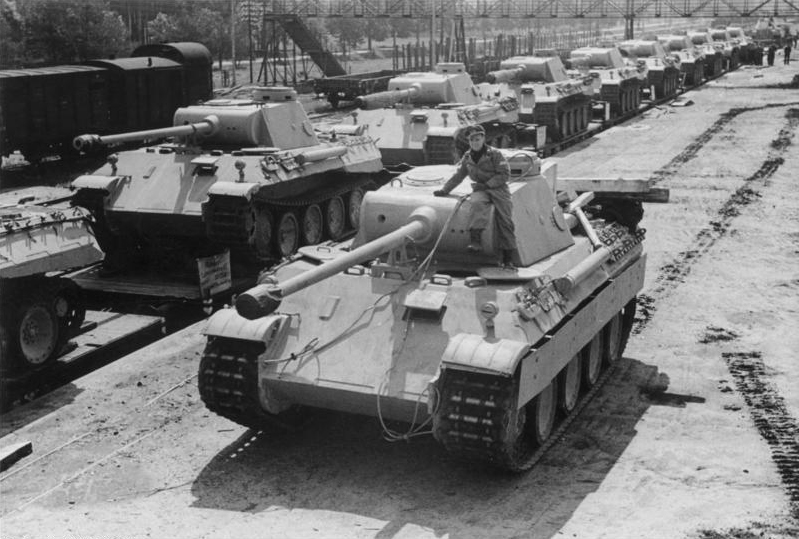
I tend to disagree. That hypothesis was put forward due to a few photos such as this one, taken just south of Bayeux, on on 8/9th June 1944:
However, it can be very difficult to identify camouflage patterns in black and white photos – particularly where the tank is covered in zimmerit and dust and where the photo is over-exposed due to strong, summer light. Here's another photo from the same sequence and it is very noticeable that while the camouflage can't be distinguished on the zimmerit-covered upper surfaces, it is very obvious on the side-skirts, which are devoid of zimmerit:
|
| mysteron | 27 Feb 2013 5:23 a.m. PST |
There has been some confliction about the colours. My 2 Histoire and Collections books both support the Monochrome theory as you state . Except the Dunkel Gelb has a bit of green in it to amke it greenish . According to them this was done on purpose to enable the tanks to blend in. Some other theorists are challenging this by saying Panthers or a least some were painted the Normal Tri colour scheme for Normandy except the dust appears to hide the other colours. Whose to say which is true. To compromise I will end up painting some platoons in the monochrome scheme and the rest in the conventional style . Just in case anyone else is doing a project on the Lehr , I have uncovered a couple of sources that point to at least 2 of the Panthers were Hybrids . One tank was called Chrystal and the other Ursulus. THanks for your input so far |
| Pizzagrenadier | 27 Feb 2013 7:00 a.m. PST |
I read somewhere that the few pictures of the solid dunkel panthers were pre invasion and that it was theorized that they were painted by the time of the landings. The source was a book in French about Lehr and I can't think of the title right now. |
| Jemima Fawr | 27 Feb 2013 7:31 a.m. PST |
It was mentioned in books by Eric Lefevre (Panzers in Normandy) and Georges Bernage (The Panzers & The Battle of Normandy), as well as subsequent derivative works. The photos referenced (one of which I posted above) were actually taken after D-Day and surprisingly close to the front line on 8th or 9th June (I forget which), near a place called Juaye-Mondaye, which is only a few miles south of Bayeux and within sight of the cathedral spires (I know, as I've stood on the spot and the farm buildings are virtually as they were in the photos). In all of these photos, the tanks look quite mottled and look to me like dusty tanks photographed in bright light, which has over-exposed the photo. The trouble is that there are other photos of I./6 PzRegt Panthers taken during the first two weeks of the campaign – at Tilly-sur-Seulles and Lingevres (on 11th, 13th, 14th & 18th June) – which are positively camouflaged, yet they were in constant, intense action throughout this fortnight. It's therefore difficult to see where they found the time to apply the neat, airbrushed camouflage schemes seen on some of these. Like so many of these sorts of discussions though, it's impossible to be absolutely definitive one way or the other. |
| mysteron | 27 Feb 2013 7:46 a.m. PST |
Thats why I find these discussions fascinating and enjoyable . I am quite surprised the Lehr isn't as popular as some of the SS divisions with the diverse equipment. There only appears to be a handful of books about the division. Maybe its something to do with the fact that it is a relativley new division compared to the others. But nevertheless it must be a model collectors dream . As regards the make up of the Panthers it appears the A type is the most numerous with some hybrids. The Gs I am guessing will probably be post Normandy as they had them for the Ardennes , although I am tempted to include a few for variety and also for post Normandy campaigns . I havn't been able to find any pictures of Lehr Panther Gs in Normandy .Only a picture of a 1/35th model G with infra Red equipemnt for Normandy. I am sure Infra red sites were very much late war ie 1945. |
| Jemima Fawr | 27 Feb 2013 7:54 a.m. PST |
From memory and a quick bit of Googling photos, they certainly had As & Ds in Normandy, plus the Hybrids, as you say. |
| mysteron | 27 Feb 2013 8:01 a.m. PST |
Thats a new one Mark . I didnt spot the "D" .Thanks for that So in theory there is nothing stopping me having all types of Panthers within the batallion as long as "A"s are the most numerous. |
| Jemima Fawr | 27 Feb 2013 8:32 a.m. PST |
Actually, I might be wrong there. Having looked again, I notice that the first one I was thinking of is a hybrid 'D' hull with 'A' turret cupola, while the other 'D' was pictured in Fontenay-le-Pesnel and was probably therefore a 12th SS machine. |
| mysteron | 27 Feb 2013 8:43 a.m. PST |
They appear to have a few hybrids . The picture you posted above is one which I think is one of the "better" known ones called "Christel" |
| Martin Rapier | 27 Feb 2013 9:14 a.m. PST |
"I am quite surprised the Lehr isn't as popular as some of the SS divisions with the diverse equipment" If anything it is the oddities of Lehr which put me off, especially the special uniforms, along with them being yet another uber elite panzer divison who all get to ride in halftracks etc. They do however get represented in my games with normal Heer stuff as standins. |
| Jemima Fawr | 27 Feb 2013 10:07 a.m. PST |
Tim, The D, which was the first model built (???) had the old-style straight-sided 'drum' cupola with small vision windows, whereas the A had the curved-topped cupola with prominent periscopic vision blocks and ring-rail, as shown in that first photo. You can see that it's the same cupola as on the rear tank, which is a standard A. These are Ds:
|
| Garand | 27 Feb 2013 10:38 a.m. PST |
There were other differences too, IIRC with binocular sights for the D whereas the A reverted to a monocular sight (at work away from my references, but that was an important change). Also side pistol ports, and I think there was a change in the mantlet side armor as well. One thing about Panthers and production is that improvements were often introduced on the production line as they became available. This is the first time I ever heard of "Hybrid" Panthers…the Hybrids being mentioned here are really just very early A's before the ball mount for the hull MG was introduced, or very late Ds after the dome cupola was introduced. Additionally, older tanks would be upgraded with newer features when they went into depot for overhaul (I've seen photos of old panther D turrets upgraded with the new cupola while being stripped down). A good source for anything panther related is Jentz's Panther Tank: The Quest for Combat Supremacy from Schiffer Books. Damon. Damon |
| historygamer | 27 Feb 2013 5:08 p.m. PST |
A quick look through Zaloga'sD-Day Tank Warfare books shows a lot of German armour – many of which are hard to identify any paint scheme at all. Zaloga said, "Because each unit mixed its own paint, the amount of pigment added to the color paste varied enormously. Panzeer Lehr tanks seem to have been painted with heavily thinned paint which left a very indistict pattern." IIRC, the paste could be cut by gas or water, which also affected its tone as well. Gas was scarce, and water tended to see the paint wash off sooner. |
| Garand | 27 Feb 2013 5:52 p.m. PST |
So a correction on my previous post: binocular gunners sight was retained into the production of the A, as well as side pistol ports. Almost every component in the turret was redesigned, though most of these changes were not visible. The one difference that is visible, however, was the armor behind the mantlet: on the A this was extended, whereas on the D it was less so. The hulls were virtually unchanged, however, when the switch-over occurred. The switch from the drum cupola to the dome cupola also occured, but again Ds would be upgraded with later features when they went in for a rebuild. Damon. |




 shows off the U.S. infantry from the Flames of War starter set.