"Battlefield Manoeuvring - Why Dont We Do It? " Topic
62 Posts
All members in good standing are free to post here. Opinions expressed here are solely those of the posters, and have not been cleared with nor are they endorsed by The Miniatures Page.
Please remember that some of our members are children, and act appropriately.
For more information, see the TMP FAQ.
Back to the Napoleonic Discussion Message Board Back to the ACW Discussion Message Board
Areas of InterestNapoleonic
American Civil War
Featured Hobby News Article
Featured Recent Link
Top-Rated Ruleset
Featured Showcase Article
Featured Profile Article Music video about the 1st Battle of Puebla, from the perspective of a French Zouave.
|
Pages: 1 2
| Trajanus | 27 Oct 2012 3:33 a.m. PST |
If you pick up any 19th Century Drill Manual you will find that the vast majority of is dedicated to moving and changing formation. The combat/shooting part is much smaller and restricted to getting troops to function automatically, so when the shooting starts they don't freeze and can fire, or fire back. The hallmark of a good general in the period was someone who could get his troops across the battlefield in a competent manner so the tactical success and acknowledged brilliance of famous commanders was built on people knowing how to do the moving and formation changes to the max. So why is it then that over the years moving units on the table top has been progressively dumbed down, even in rules that have Battalions/Regiments as the basic unit, to the point where any formation change is a takes a half a turn, or you can move or change formation but not both, or there are no ‘penalties' for formation change at all. In these days, more than ever, instead of wasting time incrementally measuring progress across a table, it seems you may as well just plonk the figures down an agreed distance apart and start rolling dice! Now many will say that's the ‘fun part' but where's the skill? Many events and actions in both the Napoleonic and Civil War periods happened as they did due to commanders getting their timing off, or trying to get units to do things in an A+C sequence when A+B+C was the only possible way of it happening. This is never represented in our games. I'm not suggesting we all go out and eat a Drill Book but there really is a lot we are missing out on that could be gamed, without it getting in to the arcane levels of individual drill manoeuvres. Naval gamers happily incorporate rules for wind direction but we seem content to ignore the equivalents of sailing directly into the wind every time we play! So the question is, if someone built it, would you come? |
| TelesticWarrior | 27 Oct 2012 3:45 a.m. PST |
Trajanus you have just written a very good post, very thought provoking. I hope lots of people come on board with this debate.
Personally, I am more interested in grand tactical big-picture Napoleonics, but If I ever do battalion level gaming I want to do it in the manner you are promoting. |
| normsmith | 27 Oct 2012 3:46 a.m. PST |
I think a lot of rule designers start out (quite properly) making the decision as of what level of command the player will sit at. Assuming there are many formantions in the game, then on that basis, as the army or corps commander, it seems reasonable to assume that individual formations will be sorting themselves out (via unseen commanders) and will be in the correct formation for the immediate need (i.e. conforming to the drill book in which they have been trained). The overall commander (you) will be more concerned with initial positions and then responding to the unfolding situation, which is typically done with reserves. Once troops are committed in action, it is very hard to re-direct them. Of course if you have a single brigade on the table, then as a brigade commander you will be more likely to be involved with the tactical aspects of the game. It would be unrealistic to allow the player too much control over several individual units and several areas of the battlefield at any one time. |
| KatieL | 27 Oct 2012 3:53 a.m. PST |
I think a lot of this has to do with the complexities of information hiding. You don't gain much from sending a brigade on a long-winded march round a hill to sneak up on the side of some other units when they're clearly visible doing it. Another problem is associated with not modelling the communications delays. In order to conduct a bunch of simultaneous actions, commanders in the Napoleonic (and it's surrounding eras) would have to issue orders ahead of time. Factors influencing success then turn into how well they and their subordinates can work as an organisation widely distributed in both geography and time -- are the orders well formed, clear, undestandable… but flexible enough that lower commanders can adapt them? Are the lower level commanders even able to adapt the orders? Do they have the skills? And how do you model that behaviour, given the lack of information hiding. By the time you're in a world where you ARE modelling these things (hidden map based movement, umpires, order queues etc) you're moving a long way from dice-rolling miniatures gaming and way into detailed, complicated simulation systems. |
| 12345678 | 27 Oct 2012 4:19 a.m. PST |
I am not sure that it is accurate to say that the issues that you discuss are never represented in our games; I have certainly been involved in games where they are. I think it all depends on the level at which one wishes to play; if I am playing a game where I am acting as a corps commander with a timescale where a move equals somewhere between 10-20 minutes, the fine detail of manouvres can happily be overlooked as it is neither relevant to my level of command nor a factor given the lengths of the move. On the other hand, if I am playing a game where I command a brigade (or a multi-battalion regiment) with a much shorter timescale per move, then the issues that you raise become vitally important as they are within my concern and are relevant because the timescale is now such that speed of formation changes etc become vitally important factors. |
| Dynaman8789 | 27 Oct 2012 5:11 a.m. PST |
They Can't Hit and Elephant is a rules set you should look at, the card driven nature and unit stats make the manuevering most of the problem. Get some agressive troops against a political hesitant enemy commander and things get really interesting. |
| Timmo uk | 27 Oct 2012 5:28 a.m. PST |
I have played games that have this element and would echo the post above. Without wanting to start a flame war I think the scale of models chosen does have a lot to do with it. I've seen so, so many 28mm Napoleonic/H&M games where there are so many figures on the table, in deep formations, with armies filling the table flank to flank that there is nowhere to move but straight forward. You can predict which units will collide and sure enough a few moves into the game this is what happens. Although such games may look spectacular they don't appear to be very simulating to play. Of course YMMV. |
 Flashman14 Flashman14  | 27 Oct 2012 5:33 a.m. PST |
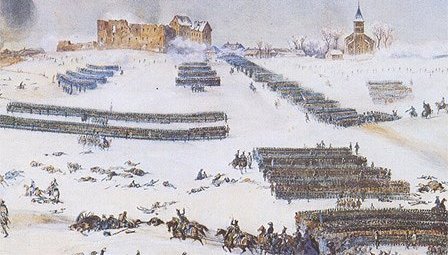
I bet that our table tops are more crowded with terrain than they should be and that only a few players keep the proper distance between units. I'm very much influenced by Empire in this regard and cast skeptical eyes over those fights just jammed with units. Ex. Look at how much space there is between regiments – those front two columns at left could easily form line if they had to:
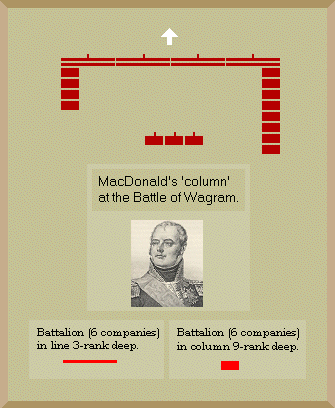
Look at this one – each red line is a battalion! That's a huge formation that is clearly uninfluenced by all the terrain.
All of these formations would be impossible on most tables because of the landscape clutter and we underestimate the conditions of deforestation that created more wide open battlefields – it was probably more North Dakota than Northern Virginia. |
| Rrobbyrobot | 27 Oct 2012 5:44 a.m. PST |
I'm with Flashman14 on this. We used Empire rules with 15mm figures. |
ScottWashburn  | 27 Oct 2012 5:58 a.m. PST |
This is a subject that's been near and dear to my heart for over twenty years. When I started learning the drill for Civil War reenacting and discovered the intricacies and challenges of trying to maneuver a battalion in the field I became dissatisfied with pretty much all the wargame rules sets that I was familiar with. None of them took into account just what was, and wasn't, possible when moving large bodies of close-order troops on the battlefield. Sadly, that's still pretty much the case today. But I have to say it doesn't bother me as much now :) I tried long and hard to come up with a set of rules that DID include all that stuff. Jim Moffet (formerly of GHQ) took a 'formation change matrix' I had developed for training reenactors (You are in this formation and want to be in that formation, here is the order you need to issue to do that) and made a set of game rules based around it. It sort of worked, but during playtesting it soon became apparent that most players did NOT care about that kind of stuff and felt it was an unnecessary complication. It was hard to argue with them. So be it. So now I've accepted that to make a playable, fun game you have to tolerate a hefty chunk of abstraction when it comes to movement and formation changes. There are certainly some things that can be done (Black Powder's rule that once inside of 12" of an enemy, you can pretty much only go straight forward or straight back is a very good idea) and there is always room for improvement. But if you want to have absolutely realistic rules then I suggest you use 'real' soldiers on a 'real' battlefield (i.e. reenacting) rather than models on a table. |
| Murvihill | 27 Oct 2012 6:15 a.m. PST |
People want to refight Leipzig. They don't want to refight the 3rd battalion of the 142nd regiment at Leipzig. The only way to distill the decisions of 500,000 soldiers across a 10-mile battlefield to a game playable by a dozen people is to generalize them. BTW, I played a game where the company drill from line to square took three turns. Dull, dull, dull. |
| rabbit | 27 Oct 2012 6:40 a.m. PST |
Hi, for a lot of people the question is just too difficult. In many cases we, as gamers, no longer even base our (10-20mm) troops in such a way as they can be used to represent a Company or a Platoon (infantry) or a Squadron for cavalry. There is now the habit of basing in blocks of figures, three by 2 or 2 by two, with vast gaps between the figures. Now if that is the way you want to game that is fine, it after all only a game. I only base in a single rank, representing a group of men in a line either two or three ranks deep and in that way I can represent a unit on the battlefield in "Line" formation. Several "companies" of troops behind each other represent a column. Four ranks corner to corner, facing outwards, makes a square. It works for me; it might not work for you. I used to play Quarrie's rules, where game turns were broken down into segments of up to 1/8th of a turn. The question arose "if it takes 1/3rd of a move to change formation and you fire five times in a go what fire effect do you get?" We ate a lot of aspirin! and there were arguments "they have to spend 3/5ths to do that!" "they only get ½ effect because they have…" "they cannot about face, they have to wheel" "my dad can fight your dad!" Once you get more than a few units a side it becomes too much like hard work. In general I have noticed that many gamers fight their army as if it is French, I am guilty of this with my Russians, we have battalions whizzing about the battlefield, often way too close to each other to allow them to deploy (into line). Our artillery batteries take up almost no real estate, regiments of cavalry squeeze through gaps a car would have problems with… It is a good idea, one which the 6 millimetre and smaller gamers might like to explore, as they can represent a battalion formed into companies of 3 ranks quite easily, I just don't think it will run with larger figures in today's basing style. If we assume a battalion can move 150mm (6 inches) in a turn and has to change formation into line, to reach the end of the line from the rear of the column, the companies at the back are going to spend most of a move changing formation… see link
link and wheeling a line through 90 degrees is going to take an age. As discussed above the game has to be playable and enjoyable otherwise there is no point. That's my twopenneth rabbit |
| Spreewaldgurken | 27 Oct 2012 7:41 a.m. PST |
"So the question is, if someone built it, would you come?" Someone did build it. Scott Bowden. It was called Chef de Battalion. They came… they saw… they said 'Whoa… 124 charts and tables…' But I'm not totally sure what you're suggesting. Are you saying that you want the game to represent more pre-clash maneuvering of large formations (such as: "the 3rd division does a long flank march around the woods…") Or more nitty-gritty tactical parade-ground maneuver sort of stuff, playing-out the changing of formations? "Naval gamers happily incorporate rules for wind direction but we seem content to ignore the equivalents" Well, to be fair, a lot of those naval games are a terrible drag precisely because they're trying to model so much of the physics. Movement is tiny and incremental and the games take aeons to complete, if you ever do complete them. "I'm not suggesting we all go out and eat a Drill Book but there really is a lot we are missing out on that could be gamed, without it getting in to the arcane levels of individual drill manoeuvres." I've found that when people start discussing goals like this, however, the drill books are not far behind. I can't count the number of TMP or Yahoo threads on simulation design that I've seen dissolve into endless discussion of drill minutiae. And that usually kills the whole thing for most people. * * * I think that a good game provides people with interesting challenges and difficult choices, all of which have an impact on some imminent action. If the decisions are too many and the actions too few… or if the decisions are separated from the actions by too much time or too many steps, then it gets tedious and boring. Also, a good game sets up most of its friction between the two sides, not between one player and the game system itself. It's fine to have to battle against the game in some cases – and one should be selective about what cases those are. But most people understandably want to battle against their opponent and his army. So Yeah…. getting to the Bang! Bang! relatively soon is indeed important. * * * One last thought: We are limited by Wargame Physics, which are very different from real-world physics. In the wargame world, we have to divide time up into arbitrary segments, and with it, everything else gets divided up, like movement rates per turn, sequence of play, and so on. None of that exists in a real world, but it's very hard to make a wargame without it. So take movement rates, for instance. In a horse-n-musket game, if your time scale is anything much over 1 turn = 5 minutes, then you're going to have textbook movement rates that will carry each unit across the table in a single turn. That, obviously won't "work" in the wargame world. Movement has to be synced with weapon ranges, so that a unit can't march across the enemy's front without getting shot-at, or can't sweep across the enemy's flank before he can react to it. Nobody wants a cavalry unit with a 48" movement rate each turn. So the rates get artificially chopped-down to Wargame Reality, which means: smallish increments. And now, because they're smallish increments, it becomes impossible to do the sorts of broad, sweeping maneuvers that you're talking about. The game becomes a step-by-step process of Action-Reaction, and of course you have to fit all the various actions into the parameters of a turn. What does it take to change a unit's formation, for instance? Well, that has to be measured using the tools you have: turns and inches. Over the years, people have tried to "fix" this, with mixed results. George Jeffries' infamous VLB concept was the most radical option to date. Chris Engle's matrix games tried to moot the whole thing by turning it into a narrative (perhaps the most fun solution, but it hardly pleases the technically-minded gamers). Scott Bowden was so pleased with his solution that he actually trademarked the "Telescoping Time Concept," but of course it was just another elaborate way of measuring-out turns and increments. I'm content to draw a line under the fact that I'm playing a game, and thus I've stepped into a world that has its own physical limitations, that may or may not have anything to do with the physical limitations of the history that the game is about. |
| Trajanus | 27 Oct 2012 7:44 a.m. PST |
a'formation change matrix' I had developed for training reenactors (You are in this formation and want to be in that formation, here is the order you need to issue to do that) Scott,that's something I would love to see! |
| Trajanus | 27 Oct 2012 8:09 a.m. PST |
Someone did build it. Scott Bowden. It was called Chef de Battalion. They came… they saw… they said 'Holy Crap, 124 charts and tables…' Sam, Well yes and no. Manoeuvre was drowned in the detail of everything else in the rules! The trouble was Scott tried to build an entire world of experience. I'm surprised there were not rules covering smells! Its completely unnecessary to go to that extreme level to have some form of portrayal of what a pain shifting bodies of troops around was. Yes we are playing a game but a key element is missing if (as in some rules now available)you say it doesn't matter what formation you start in, just move six inches every turn and you can arrive at the end of that move in what ever formation you like. You could create a Football game where any time your team got within 30 yards of the goal line, you were automatically awarded a successful Field Goal but something of what happens on Sundays would go missing if you did. BTW: For those who have mentioned scale of game, I appreciate the would be Grants and Napoleons out there are not that fussed and certainly those using a base to a Brigade style rules couldn't give a hoot but as I pointed out, battalion and regiment games now seem not to bother either. |
| Poniatowski | 27 Oct 2012 8:27 a.m. PST |
I have built it… I just have yet to see if anyone will come. My biggest hurdle is space and time… My rules are nowhere near as detailed as Chef de'Battalion but give very good results, historically accurate if played so and quick play when… Well, they are Napoleonic, maybe not so quick, quicker than others for sure. I am biased though. My rules use company level tactics in a Napoleonic game… the reasons other rules (not all) forego this is because the battles are so huge it would take forever to play them out without an army of players and a gymnasium… Now, to explain what I have done… there have always been 2 takes on Napoleonic gaming… tactical and grand tactical. In one, you only worry about moving blocks of troops and not maneuvering (the mechanics work that out). In the other you micro manage every unit… There is a key to combining both… I believe that I have bridged that gap. I have a very unique rule concerning "giving and executing" orders that gives a very nice fog of war… in such a way we have even had friendly fire occur. Of course I want to build up my rules set. I am at that crucial point though where it is out for copyright review (finally) and trying to decide on how to offer it to the public… free, digital download, print version.. soft or hard back, etc… I will be at Fall-In! and if you are serious about checking them out, I'll have play test copies available. Enough about that though… The reason I worked on my set of rules is because I wanted both the feel of tactical and grand tactical… the scales ues in other games with blocks of troops really doesn't allow maneuvering at all… at is "assumed" to be taking place in teh area the square base takes up… But we all know this isn't true… each formation takes up a distinctly different footprint… and most games due to scaling, just don't give you the luxory to do this… or see it on the battle field… To me, maneuvering around a bunch of square bases isn't exciting… I want to see the formations.. see them executed… see flanks rolled, etc…. All of this is done VERY WELL in other games using modifiers to reflect the btns current formation… but it just isn't the same…. and on the battlefield… a closed column could "slip between" other units in line, etc… The spacing is just all wrong when it comes to the execution on the table top…. As I said, NOT knocking other rule sets as I find them very fun… I was just looking for something more simple than Chef and as pretty, where you can play Borodino (in a large space) to conclusion in a day of gameing, not a week. My ground scale, figuire scale and scenery scale all make for a very pretty game… but what is most important to me… is that it all makes sense… you see your lines, your squares, your flanks, etc… and… you have to contend with orders… and executing them… that is a mechanic I won't discuss via net. No set has done what I have, as far as I know. I don't claim to know every set of rules out there now or ever before. So, if you want to talk Grand tactical Napoleonics playable at company level in a realistic period of time… look me up at Fall-In! I should be easy enough to find… I am the CD this year. Right or wrong in my approach, I love to talk rules and shop on Napoleonics! |
| TMPWargamerabbit | 27 Oct 2012 10:02 a.m. PST |
We use a simple system. Movement Phase has two parts: First part is the facing & formation phase where all your tabletop units have a "free" facing and/or formation changing sub-phase. Example, the linear single rank of miniatures can change into a column (more miniatures in rear ranks than the number in the front rank). Or…change into a square, or deploy into open order formation…or face right and deploy into line…
Next sub-phase is the actual movement of the miniature units. Pivoting and wheeling is done during the measured movement. Note that no formation or facing changes are done during movement so the unit end their movement in the starting formation or unless wheeled/pivoted, the same facing direction. Only one exception to changing formation during the movement sub-phase. Field artillery (3lb-9lb weight + horse artillery) can spend 2" of their movement distance to unlimber the battery (prep to fire in upcoming mutual artillery fire phase).
System is clean and works well for the last 30+ years of game play. The units have actual column, linear, open order or square formations on the tabletop. No markers are required. They look the formation. We use battalions, cavalry regiments and artillery batteries as the basic units at generally 100:1 miniature scale (can be adjusted from 80:1 to 120:1 for historical scenarios). Turns are 20 minutes in length. Very different from the common/modern rule sets which are on the market today with their large 24/36/or more miniature units. I enjoy the larger miniature units, they look great, but battles above brigade/division level tend to have too much representative action of one unit = 3-4 actual units. Also the painting requirements…. For us, entire corps are typical player's command consisting of three to five divisional/brigade commands which allows possibility of local and army level reserves and tabletop manoeuvring. Generally our tabletops are not as dense (miniature wise) as the typical modern rules table. The morale rules (routs) tend to affect players who dense up their battalions into massive group battering rams. Interested parties can find more information in the group's napoleonic rules library: link
Some examples of the typical formations taken from the rules library material:
WR |
| McLaddie | 27 Oct 2012 10:31 a.m. PST |
Well, the question covers different levels of interest concerning Napoleonics and the ACW. Some want the grand tactical sweep of things, others the smaller tactical engagements, so you have General de Brigade and Black Powder to army level games like Volley & Bayonet and Polemos: Marechal de l'Empire. However, the question of maneuver at these different levels aren't the same. Chef de'Battalion is a bore, not only because of the rules themselves, but because on the battlefield the battalion commander had a rather limited range of decisions, more having to do with formations, rather than battle. Even at the brigade level, most tactical decisions were circumscribed by it's place in the battle line. If the desire is for interesting, varied decisions, the lower levels of command are fairly limited. The larger problem is one of the space and time issues. As Captain CB points out: So take movement rates, for instance. In a horse-n-musket game, if your time scale is anything much over 1 turn = 5 minutes, then you're going to have textbook movement rates that will carry each unit across the table in a single turn. That, obviously won't "work" in the wargame world. Movement has to be synced with weapon ranges, so that a unit can't march across the enemy's front without getting shot-at, or can't sweep across the enemy's flank before he can react to it. Nobody wants a cavalry unit with a 48" movement rate each turn. The solution is to artifically limit movement. So, in a game like Regimental Fire & Fury you have regiments only able to move 300 yards in 10-15 minutes, 400 in quick time, 12 inches and 16 inches respectively. [In reality, troops could and did cover 1200 yards in that time, or 48 inches.] This limit is reflected in the scenarios. Most all the RF&F scenarios have opposing sides setting up 300 yards or one turn of each other, so such movement limits are masked, but so is maneuver… and it is maneuver where most of a tactical situation's 'what-ifs' can be attempted. Thus, most scenarios end much like the real events, and are seen as historically 'reasonable.' The only other option is to have multiple turns of inching your way towards the enemy incrimentally… which is why with a number of games, after hours of play, they have to end just as the two sides come to grips. Other options have been to artificially randomize movement with cards, so with the right cards such 'sweeping' maneuvers can be accomplished at times, it's success dependent to some extent on the other side's cards. Another option has been order chits and simultaneous movement, so that movement and maneuver isn't 'seen' by the opposing player before it is attempted, but again it has to be incrimental, so there's a limited amount of 'surprise'. The two brakes to manevuer on the game table are the real distances troops can travel on a limited table area and how to adapt artillery and infantry fire to such extended abilities to move. I think one of the major obstacles in developing alternatives to the above is the conservative nature of wargamers. They don't want games that are too different from what they've known and enjoyed. So a lot of the differences in game rules, apart from a few exceptions, are cosmetic. The rash of Napoleon at War and Combat Command Civil War type rules are a good example. So, a lot of 'new' ideas are evolutionary, rather than revolutionary, like the use of cards, starting with TSTF and On To Richmond. That isn't a bad thing, just the nature of the beast. To change the way maneuver is handled in any really new form means going back to the issue of time and space and how it is represented on the table. |
| donlowry | 27 Oct 2012 10:40 a.m. PST |
If real commanders could have glued their men to movement stands and used giant hands to move them about, while looking down from 100 yards up in the air, they wouldn't have needed all those drill manuals either. |
| Rudi the german | 27 Oct 2012 10:41 a.m. PST |
That is not new… That exists already in pure form since more than 100 years.
I must look, i still have a german old school ruleset for officers training were the complete moving formation change topic is included so that you can walk away from the table and command your troops in real life. It is writen ca 1890 and printed in "suetterling" lettertype. The rules demand also that you exchange the figures according the action they are taking. Every regiment/ batallion is needed 5 times: attention/ walking/ running- charging/ fireing and working- dinging in. With the differant stages, can than also the preperations and formations be prepresented and the time needed to take them. So please collect every figure 5 times and start train old school.
:)
I played it in around 1976 – 1978 and i am so happy we have today simple movement rules. :))). Have fun |
| Whirlwind | 27 Oct 2012 11:28 a.m. PST |
Because no manual H2H wargame (AFAIK) has solved the basic dilema: if the rules give you the option to perform the evolutions for one unit, then you have to do it for all units. For example, no-one has designed a Grande Armee/Polemos MdE level game where the player can fiddle about putting some individual battalions in this or that type of column, where all the units the player has continue on their brigade bases for all of them. Incidentally, I though it was a bold (and welcome) innovation for Polemos General de Division and FOG: Napoleonics to get rid of this fiddling for games with a Corps per-side too. I'd be quite interested in a game design which had formations as an outcome rather than a player input, except in cases where the player's genera figure was present… Regards |
| Spreewaldgurken | 27 Oct 2012 12:23 p.m. PST |
"Of course I want to build up my rules set. I am at that crucial point though where it is out for copyright review" Copyright review? What's that? |
| Glenn Pearce | 27 Oct 2012 12:29 p.m. PST |
The simple answer is no. The drill books are important for the unit commanders so for a skirmish game you might want to consider this, otherwise forget about it. Yes moving brigades took some skill, but I don't think their individual unit formations were as important as the formation of the brigade. When it does come to individual unit formations there is no proof that had the unit been in another formation the outcome would have been different. I will also add that even if one unit is not in a so called proper formation for the situation at hand it would rarely have an impact beyond the individual unit. Other then a small skirmish Napoleonic battles are not won or lost over this. The real meat and potatoes of most battles is the formation of the brigade. Local fire power, out flanking, support and morale are much more important. Here is where the skill comes into play along with when and where to commit your brigades. |
| Baggy Sausage | 27 Oct 2012 12:40 p.m. PST |
Why? Miniature scale, table size, time to play, etc. |
| Trajanus | 27 Oct 2012 1:32 p.m. PST |
There's been some valid mentions of table size, ground scale etc but there's something else to consider too. One of the better moments in the movie "Gods and Generals" illustrates Joshua Chamberlain fresh from his teaching job, trying to come to terms with getting the newly formed 20th Maine into some sort of order, when he hasn't a clue what they are supposed to be doing himself. While under instruction from a more experienced officer we see him ensconced in his tent by candle light trying to figure out what the hell the manual is supposed to mean and how its supposed to be practised. We are now at a level in many rules where not only time and distance are regarded as irrelevant but training and experience are too; unless they relate to combat performance and morale. Surely these aspects can be accounted for where manoeuvre and evolutions are concerned. If we are accepting of artificial limits to movement distance a reasonable level of delay or uncertainty where Green troops are concerned should also be present. |
| Rod MacArthur | 27 Oct 2012 1:33 p.m. PST |
As someone who has copies of the drill regulations of all the major nations in the Napoleonic Wars, I am all for more accurate tactics in Wargaming, however there is the perennial problem of accuracy versus playability. Despite 50 years of wargaming, I am still looking for a rule set which solves this. Rod |
| Unlucky General | 27 Oct 2012 2:02 p.m. PST |
I think it rather an issue created by wargamers: Wargames rules being written by them. People seem to want large armies or at least large units but do not pay nearly enough attention to the ground they fight over. Just look at the amount of time and money we lavish on figures as opposed to table-top scenery. We cram too many figures on too small an area and then wonder why it always turns into a dull slogging match or dice rolling fiasco. Whilst many game mechanisms make a very good effort at extending the game beyond the confines on the board (flank marches etc) we can always look to playing on a greater table. I don't mean 20'x20' but if we rationalised our armies and formed toward the centre (for example) and allowed space on the flanks and rear, we give ourselves a chance of depth and space. Not for everyone I know but I tend to play smaller scaled games becasue of all the reasons outlined above. I build grand armies with large units and lots of figures also, but the idea of cramming them along two sides of a long rectangle and watching the tides meet a bit of a yawn. I can't help but feel the answers lie with us. |
| 12345678 | 27 Oct 2012 2:27 p.m. PST |
Unlucky General, That is exactly why I downsized to 6mm; effectively, the table quadruples in area, giving much more room for manouvre and flanks that hang in the air. Much more fun than just lining up and slogging it out. |
| 1968billsfan | 27 Oct 2012 6:00 p.m. PST |
I have a rule set that solves all these issues. Please send a money order to an adress in Nigeria that I will provide, and I will send you a copy. It works for any size figure and on table tops that range from 2' x 4' to 100 yards by 60 yards. It works with eith 6 or 10 sided dies. ,., ,,
added note: plaid paint is still available in 6mm or 28mm sizes. 15mm is not available for the next 3 months. |
| McLaddie | 27 Oct 2012 9:14 p.m. PST |
As someone who has copies of the drill regulations of all the major nations in the Napoleonic Wars, I am all for more accurate tactics in Wargaming, however there is the perennial problem of accuracy versus playability.Despite 50 years of wargaming, I am still looking for a rule set which solves this. Rod:
I feel your frustration. I have three recently published rules sets and all three state that they are "a balance between historical accuracy and playability." Yet none of them explain what historical accuracy has been achieved or what that balance is for that matter. It makes it hard to accept that they have achieved it. And strangely enough the games themselves look very similar to wargame rules I already have… So, why don't we start with what constitutes "historical accuracy". It certainly isn't some mythical amount of detail crammed into a game system which produces 'accuracy', so what is it when present in a wargame? We should have some idea of what constitutes accuracy if we are going to achieve it in a design. Then we can talk about 'playability.' What strikes me most often when I really get down to the mechanics of moving troops, communicating orders, controlling armies during the black powder era is 1. how the military men all used similar mechanics, most honed over several centuries, and 2. that they followed the KISS principle, particularly because it was more likely to work in combat. So if they were focused on simple systems, why can't that simplicity aid us in designing wargames to simulate them? |
| Davout1972 | 27 Oct 2012 11:11 p.m. PST |
Alot depends on the topography of the battlefield, and how the scenario ties into it. There was a great magazine in the 70's called Wargamers Digest. It was always full of great scenarios for Napoleonics, although WWII was big with them, too. Anyhow, this one issue had a scenario for an 8x5 table. If you look at it as a rectangle, then the French are enterering on the Left side, at the corners only. The objective is a town in the bottom Right hand corner. The way it worked was that it was supposed to simulate the Maneuver Sur Les Desseries (the bending of the line, and then breaking the joint). About 3/4 down the table was a hill and small wood. The Russians enter at the top Right corner only. They are on a road that runs straight down the right side into the village. This is their Line of Communication, and holding the village is critical. Simple eyeballing would show you the Russians would be in the village as the French arrive in road column. As the battleline developed it would often be at a 45 degree angle from the village. The Northern group would maneuver down the length of the board, attempting to get on the flank of the Russians. As the defensive line bent back, the joint would often be in the vicinity of the hill, where artillery was usually set up, as well as a small reserve from the southern force, behind the wood. This reserve usually would win the day breaking through the weakened Russian line. If you are lucky enough to play a meeting engagement, there should be plenty of room for maneuver. |
| von Winterfeldt | 28 Oct 2012 12:00 a.m. PST |
A very interesting subject, it is more about drill books, like forming a ordre de bataille in two or three lines (as it was usual (exxceptions roove the rule) – for the French.
A player should be rewarded for that – in case the front line troops are supported.
The Prussians and the Austrians had the same system.
One thing which makes manoeuvering very difficult is the table and our reach of arms, which are limited.
6 mm or smaller might be the only way to introduce such "grand" tactical moves. |
| Rod MacArthur | 28 Oct 2012 2:42 a.m. PST |
I do suspect that if you want reasonably accurate battlefield tactics (as per the drill regulations) then the only playable way to achieve it is to limit each player to a Brigade (or absolute maximum of a Division). If you want bigger games then they need to be multi-player games or dispense with accurate drill movements. I personally feel that the trend to basing in two ranks and some rules making units all on the same frontages both cause problems in accurately portraying battalion level tactical manouvres. My infantry are all single based (on a modified "Quarrie" system of 10mm for those in 3 ranks and 15mm for those in 2 ranks, which works for me with my plastic 1:72 figures). I am happy that battalions of different sizes,or representing those in 2 or 3 ranks, occupy different frontages because they did in real life. I find I can make an approximation of troops in columns, lines and squares, although the British squares are too big and both close columns and quarter distance columns are far too deep. Some of these problems are because I like a 1:30 figure ratio. I will only use rules which allow all of this, or which I can modify to work with this. Rod |
| von Winterfeldt | 28 Oct 2012 2:48 a.m. PST |
I agree – frontage width is an important matter for rules, commanders calucalted on this – how they deployed their units – but as I wrote above, it is different if you deploy a whole division just in one line, or in two for three lines as it was usual. |
| Timmo uk | 28 Oct 2012 6:33 a.m. PST |
Rod I too prefer single rank basing and use 1:33. I find this combination works well using 15mm figures and for example, I can easily make the formation Flashman14 details near the beginning of this thread and it wouldn't dominate my average sized table. If you were to try the same with double rank basing and 28mm figures I think it needs something like 4' of table depth allowing for very small intervals between battalions. |
| Poniatowski | 28 Oct 2012 6:36 a.m. PST |
@Whirlwind, as I understand.. players do not like to be "forced" to do anything with their troops as a game mechanic and I struggled with this long and hard… In the end, I decided that the tactics of the day would win out… by this I mean… players have a small set of rules dictating maneuvering, meaning that a player cannot do certain things and is kind of "coerced" into maneuvering/performing as a leader of that time period UNLESS an officer stand is directly attached… which means while that officer is busy commanding said unit directly, the rest of his command suffers in that they MUST continue with their current orders… and can only "react". (this is how we had troops hit with friendly fire). Picture if you will… playing naval woden ships… we all know the ships fought to get the best weather gauge and then lined up to fight… well… did you ever play a game where players would run their ships around all willy-nilly like and follow nothing like the naval doctrine of the time… now picture that on land. My maneuvering rules help educate players and "coerce" them to move and fight like generals fo the tiem period. Here is my introduction, this might help you understand:
I have copyrighted the name, so I can post this much: Tactica Napoleonica Introduction After many years of playing other Napoleonic rules sets, I have found that many of them were too abstracted or too detailed and cumbersome for my likes or had poor figure ratio and ground scales. I wanted a rule set that incorporated as much flavor as possible from the Napoleonic era, but without being too cumbersome or abstract. The end result is a game that contains many ideas or concepts having basic origins from other systems that when combined make for what I consider a very wholsome and fun experience. For you, the gamer, I have tried to incorporate these details and concepts into the troop classes and morale grades that you, as the commander, must put to their best use. You will be given a command which you must then deploy and using the tactics and strategy of the day, defeate your oponent. Can you end Waterloo with Napoleon's defeat or will you change history? These rules are played at a tactical level to demonstrate that there is so much more to grand scale gaming than throwing dice and moving blocks of disproportionate troops on a poorly scaled battlefield. You will have to be concerned with leadership and orders, maintaining morale and most importantly… utilizing the tactics of the day to crush your oponent on ground of your choosing. Most rules for the Napoleonic era do not take into account scale or time very well… and more importantly, what a soldier can do in the time provided to him on the batlefield. If well led, he can accomplish great things even if poorly trained. For this purpose I have chosen a tactical turn length of 6-10 minutes… which was the average length of time required for a full strength batallion to go from column into line. You ar not expected to worry about supply or how far your cannon fire bounces, but rather maintaining command, giving orders and seeing how they develop over time tactically. I believe that with this rule set I have brought new light to Napoleonic miniature gaming, where the play is simplistic, yet historicly accurate and all the while being aestetically pleasing to see and play. And given enough space, you can even play such engagements as Waterloo or Borodino. To play Tactica Napoleonic you will need a handful of six sided dice, several 4' tape measures, markers to represent orders and morale, some casualty caps or rings to mark wounds on stands, enough 15mm figures to have a battle and typically, a 6' x 10' gaming space.
@CCB: copyright review is probably NOT the correct name for it, but basically I have "mechanics" that were "inspired" by other rule sets… they are not the same, but close enough to be recognized. And if I wish to copyright my rules, the changes must be distinct enough to be called "mine".
In today's world of sue happy, cease and desist people who think they can copyright breathing… well. I really like the way my rules work and in truth, they were inspired by MANY other rule sets. I changed everything to be the way I wanted them, making them "my" mechanics… but the original owners might not feel that way…. So, in short, I have a copy right attorney reviewing the rules to see if the changes are "different enough". These rules are 10 years in the making so far. I don't want to make money on them, but I do want to at least break even if they go to print. It was suggest to just release them as free digital downloads. |
| huevans011 | 28 Oct 2012 7:06 a.m. PST |
Poniatowski, I look forward to seeing your rules when they are ready. Is c de B still available for purchase? |
| Spreewaldgurken | 28 Oct 2012 7:38 a.m. PST |
Game mechanics can't be copyrighted. Only specific passages of text are copyrighted. If you're saying that you copied these other games so closely, in each case, that the verbiage is nearly identical, then yes, you have a potential problem. But if you're just saying that you liked the way that Game X did such-and-such, and so you used it, yourself, then that's not an infringement of copyright. I hope your attorney is good enough not to charge you. |
| Poniatowski | 28 Oct 2012 7:39 a.m. PST |
@CCB: Hmmm, I didn't know that and yes… my reviewer is actually a close friend. It is taking so long since it is "pro-bono".. And for the record, NO the verbiage is different enough and the mechanics have ALL been adjusted. It goes like this… at a scale of 1':.015"… I had damn well better have my research in order when someone else saye "hey! You took your movement allowances from MY game!!!" No, I did my research and then tweaked it with a little info I got from going to large re-enactments and talking to re-enactors who participated In Waterloo, etc… It is all about being able to justify what you did and why you did it the way you did… If you will be at Fall-In! next week, look me up… I ALWAYS bring my rules to talk shop with other people. Someday… soon I hope mine will be ready. As much as I don't want to be accused of "ripping off" someone's ruleset, I want those that helped to influence me to be recognized. The rules are playable now and have been in play test for some time. It is a matter of making sure I don't get sued. Writers won't readily admit it, but they got their ideas from "somewhere" and there really isn't an "original" idea out there, just different takes on the same premis on how to do what was done then and how to spin your own take on said rule… Chef is stil out there… I see it at the HMGS East shows all of the time… usually in the discounted bin or flea market. It is still one of my favorites, just too cumbersome. If they made a "Lite" version… that would have killed my rules project long ago. I really regret not getting the Chef – "skirmish" rules set associated with it when it came out. All rule sets have their own merits and flaws. In the end… I want to play… not spend weeks tyring to learn charts well enough to take hours explaining them to the players DURING a game. To each their own though, there are many cool rule sets out there already. |
| ScottWashburn | 28 Oct 2012 9:00 a.m. PST |
Yes, you cannot copyright IDEAS. And a good thing, too! Otherwise someone would have copyrighted the idea of using DICE to resolve things in wargames! :) |
| McLaddie | 28 Oct 2012 9:45 a.m. PST |
Poniatowski wrote:
For this purpose I have chosen a tactical turn length of 6-10 minutes… which was the average length of time required for a full strength batallion to go from column into line. ? A full strength battalion? 6 to 10 minutes? What 750-1000 men depending on the nationality? I just watched this year's British Trooping the Colors and a 600 man battalion did it in one minute, the hard way, an open column to line perpendicular to the column facing. Were you thinking a brigade of battalions? Where you can see the Trooping the Color. The column to line is in the second half of the video. YouTube link
&v=2vyDJCNj2gI&NR=1> Scott W: You have maneuvered a battalion. Has that been your experience in regards to the needed time? |
| Trajanus | 28 Oct 2012 10:33 a.m. PST |
Trooping the COLOUR [Sorry Bill, Our Ceremony – Our Spelling!] :o) should be compulsory viewing for all Horse and Musket gamers. Its a great opportunity to see close order drill every year for free! Just a shame they do it with modern weapons. There again I don't have to carry the dammed things so I'll shut up! |
| Trajanus | 28 Oct 2012 10:56 a.m. PST |
I notice several references to bases and frontages. It has indeed become a modern thing, of which I am also guilty, to go for two rank, square bases with 4-6 figures in 15 & 25/28mm scales. As someone pointed out this kind of thing has been driven by wargamers themselves who became sick to death of constant re-basing and has been encouraged by rules authors now making it an act of faith that "no re-basing required" appears as near the front of new rule sets as the publisher will allow. However, I would argue that the relationship between base frontage, ground scale and ranges need not be a show stopper for including manoeuvre detail in games. There are plenty of other things where players suspend disbelief – unit depth for one – so why not have a major indication and a secondary one? For example FoG(N)uses lines and columns yet each unit is nominally X thousand men. Its deemed that this broadly speaking represents the majority of the troops in that area being in one or the other state. Not new, Naps Battles did it too as I recall. So taking that idea to the Battalion/Regiment level you could devise a method where columns (it would be just columns, a line is a line) always appear the same but have
an indicator to show if they are supposed to be at 1/4, 1/2 or full distance, left or right in front etc. If combined with something like Scott's matrix you could then work out what was permissable as a to/from change and maybe give it a forward movement deduction to suit. One thing I should mention is that although I did crosspost this discussion, I am aware that its a far more complex issue for Napoeonics (unless you want to shed detail) where national doctrine means some nations never had a method for going from formation A-B, or it took them longer to do so than the enemy. The Union and Confederacy may have been reading different books but the sources and outcomes were pretty much the same. People do see value in this kind of thing. For example we have been using Regulation in our games for years. Regulating units having a command figure by them as a marker. Also we always ensure that the flag stand is in the centre of the unit even when in column. The latter has caused many a comment at Conventions when marching units are seen to have no flag at their head. A quick explanation of the reality – forming line to the left or right flank has always been treated with appreciation. People are interested in these things and how they worked. |
| Musketier | 28 Oct 2012 12:47 p.m. PST |
During Trooping the Colour, the switch from open column to line is performed by professional soldiers that rehearsed the drill ad nauseam, on a level square of gravel, using oblique movement (individual traversing step) rather than wheeling by sub-sections, and usually without enemy interference. While I would agree that it's the best approximation we have of close order manoeuvres, and therefore compulsory viewing as per Brigadier Young's orders, I would not expect to transpose its timings to any 18th or 19th C. battlefield. |
| McLaddie | 28 Oct 2012 5:09 p.m. PST |
Musketier wrote:
While I would agree that it's the best approximation we have of close order manoeuvres, and therefore compulsory viewing as per Brigadier Young's orders, I would not expect to transpose its timings to any 18th or 19th C. battlefield.
Why not? 18th through 19th Century soldiers practiced the same thing ad anuseam through out the year, twice to five times a week on a parade ground. Going from column to line with individual traversing step is slower and harder than wheeling by sub-sections from an open column… and most armies had as an SOP doing such operations outside of enemy fire, though there are plenty of examples of them doing under fire well and badly… But 6 to 10 minutes to accomplish it? I don't think so. One to two minutes for a battalion depending on what kind of column they are in. |
| Cerdic | 29 Oct 2012 4:23 a.m. PST |
I would have thought that Napoleonic regular infantry would be better at drill than modern British Guardsmen. Napoleonic troops practised all the time. As far as I know the blokes today only practise for trooping the colour, the rest of the time they are practising for being, or actually are, in Afghanistan! |
| Cleburne1863 | 29 Oct 2012 6:22 a.m. PST |
The simple answer is time. Most players have to fit an afternoon game into what, 4-6 hours? Most do not want to spend 40-60% of their game time moving units around without coming into contact. Good scenario design takes this into account. There are plenty of historical battles where the units can be placed on the table just as they come into contact. Some can be set up where all the units are deployed and ready. Some scenarios can have part of a player's forces in contact, yet some are not, giving the freedom and option of limited battlefield maneuvering. Even for a meeting engagement where nobody is deployed, a good scenario will usually begin with the units close enough together to begin skirmishing or fighting relatively quickly. Conventions, of course, are another story. Set-up time occurs before the player's even arrive to begin the game (or should) and larger games where on-table maneuvering is expected usually have between 6-8, or even multiple days to play. So, yeah, its a time thing. When balancing jobs, kids, other hobbies, who wants to spend 2 hours moving units around the table and not fighting when you only have 4 hours to play? |
| Poniatowski | 29 Oct 2012 7:07 a.m. PST |
@McLaddie, to be more specific… yes, I am VERY familiar with re-enacting and marching… Here is my take… according to written accounts… smoke on the field, etc… I use that time span as the time it takes to get the orders, get the men in place and get them moving… There is a buffer for time there… and here is why… It is VERY easy for a re-enactor to advance care free into the enemy's range of fire/jaws of death… it is completely a different thing when you know you can die. There is a very good account of a French officer who talks about the Poles bravery… and he says something like this… "The Poles are the only troops who I have ever seen who can, in combat array themselves upon the field as if they were in parade"… The translation is simply that when drilling, it is easy to maneuver… in combat it is completely a different story. The re-enactors doing the drilling are no less skilled than the soldiers of old, but they are doing just that… drilling… with no fear of death or dying. I chose 6-10 minutes to represent all of the chaos in the line… getting orders, interpreting those orders as the LO sees fit… etc… remember… the over all army command sees a completely different picture than the line officers. The line officers look after their men, but follow orders from up top… the line officer does what is needed to get the job done, but they are concerned with the micro scale tactics… forming square, exploiting, etc… The army commander moves the chess piece… the line officer "is" the chess piece with limited control over his own actions. The key is having a mechanism that allows Army control and orders represented well, while allowing the microscale "options" to line officers… Therein is the largest issue with table top war gaming… "the hand of god" effect. I am very fortunate that I have players who really enjoy grand tactics, so they are usually only controlling army command and issueing orders… while other players get the orders and must follow through with them. Orders in my game are pretty restrictive to stop individual commanders from doing what they want, willy-nilly like. The btn commander might see something they want to do, but they cannot execute their own direct orders unless they are "attached".. otherwise their commadn wil follow the orders issued from above. Should the btn commander choose to take direct command of a rgt… the rest of his command could suffer from being "out of command"… this gets dangerous. @Cleburne1863…
You are correct sir… it depends on the setting of hwo you play… I totally agree… What sucks is playing a naval game and being the guy at the end of the line who plays for 6 hours and only then, when you finally get to bring your guns to bear… the game is over… and you basically just watched for 6 hours. I do enjoy the maneuvering part quite a lot, but as you said… it is limited based upon the type of game and where it is played. |
| Trajanus | 29 Oct 2012 7:12 a.m. PST |
Cleburne, Time is precious but you don't have to take up half a game in manoeuvre. For me, at regimental level its more about the initial choice of formation, or timing of formation changes, that should have effect on the outcome of the game but are no longer represented in a lot of rules . Tricky manoeuvring and Great Generalship really belongs in army level games. People have already mentioned the differences in levels of command representation effecting what you can get from a game and this is appropriate. I no more want to get bogged down in detail than the next player what I'm questioning is the point of playing games where a big chunk of the required thinking, even for Brigade and Divisional Generals has gone missing. You don't have to be able to recite Hardee or Casey by heart for this, that's the role of your little metal Colonels but as a Divisional commander, you would want to know how your Brigades intended to get to a given point and what problems were likely to occur. Formations and manoeuvring had a bearing on this. In game terms it need not take any more real time to get to a fight but the state of your units may well be different when they get there! |
| McLaddie | 29 Oct 2012 10:32 a.m. PST |
I chose 6-10 minutes to represent all of the chaos in the line… getting orders, interpreting those orders as the LO sees fit… etc… remember… the over all army command sees a completely different picture than the line officers. The line officers look after their men, but follow orders from up top… the line officer does what is needed to get the job done, but they are concerned with the micro scale tactics… forming square, exploiting, etc… The army commander moves the chess piece… the line officer "is" the chess piece with limited control over his own actions. Poniatowski:
It isn't completely different. What the men did on the parade ground they did in battle. The French compliment refers how well the Poles did, not that they did something different. I have read accounts where the Poles and French had timed contests before the 1812 Campaign to see who could
move through a series of formation changes the fastest. The re-enactors doing the drilling are no less skilled than the soldiers of old, but they are doing just that… drilling… with no fear of death or dying. I don't think so. Those soldiers of old 1. drilled far, far more than weekend warriors, 2. with more troops--moving a battalion-strength unit is fairly rare, 3. in maneuvers they knew they would be used in battle, 4. with far more severe discipline in doing it right. A brigade of battalions would all be moving off the directing battalion, which the brigadier would control, and any change in formation would be done very quickly by voice, the order being passed down the line. No interpreting, no delays. For brigades and battalions, as you said, they have restricted options in maneuver. That a necessity, as that is how division and corps commands actually can 'control' their commands. The key is having a mechanism that allows Army control and orders represented well, while allowing the microscale "options" to line officers… Agreed. The actual line officer options is what needs to be clear. Read Napier's account at the battalion level at the battle of Corunna and what he spent his time doing. Most of his time was spent making sure his flanks were attached to the battalions to the left and right of his regiment/battalion and keeping his troops in order. He asked permission of Moore to deploy his grenadier company as skirmishers and whether he could clear the village in front of him. He, like most battalion commanders in a battle line, he had very limited responsibilities. |
Pages: 1 2
|




 completes his initial Union force in 1:72nd scale.