| indierockclimber | 15 May 2012 4:52 a.m. PST |
we have a guest post today by an artilleryman explaining to us what those neat red and white poles on the sides of gun trails are. (note- they really should not be painted that way as they were either in a protective sleeve or kept elsewhere, but who can resist painting that little candy cane?) Anyhow, link is here: link and uses Battlefront models to illustrate how they work! |
| shelldrake | 15 May 2012 4:56 a.m. PST |
Sweet – I always love seeing gunnery articles for wargaming. |
| kevanG | 15 May 2012 5:04 a.m. PST |
ranging rods have been painted red and white since at least napoleonic times…and still are. link |
| Skeptic | 15 May 2012 5:08 a.m. PST |
That's an interesting article! Now, what was the width of each band, by nation and period? For example, if the Germans used metric widths, how wide were they? |
| GeoffQRF | 15 May 2012 5:10 a.m. PST |
and uses Battlefront models to illustrate how they work! Does it work with Flames of War and their telescopic ranges? |
| Yesthatphil | 15 May 2012 5:13 a.m. PST |
Good article, though … I'll nip off to HQ with an urgent message if you like while the rest of you do the 'suicide cone' thing with the misfired round … Phil |
| indierockclimber | 15 May 2012 5:15 a.m. PST |
Kyote you're right- sorry I meant on the gun trails of our models. Obviously the rods themselves should be, but as I understand it, they had protective sleeves on the sides of the guns and/or were stored elsewhere! @ Geoff- FoW has telescopic ranges?? I thought tank guns could only shoot 100 feet! |
| Norman D Landings | 15 May 2012 5:18 a.m. PST |
Great article… thanks for posting! |
 Extra Crispy Extra Crispy  | 15 May 2012 5:29 a.m. PST |
@IRC: Only in V3 and only with the UberPanzerGescheffenland supplement, when using optional rule "Der Big Guns" other wise they shoot their normal "just across the dining room" range as per the army lists. |
| plutarch 64 | 15 May 2012 5:33 a.m. PST |
Very interesting article, and I had wondered what they were for. |
| firstvarty1979 | 15 May 2012 6:55 a.m. PST |
Back when I was in the Army (US) the top post had an attachment point for a special flashlight so they could be used at night also! Ours were usually lost or broken so we'd use a standard Army flashlight and some green duct tape instead… |
| Battlescale | 15 May 2012 7:47 a.m. PST |
You learn something new every day. Great article. |
| kevanG | 15 May 2012 8:45 a.m. PST |
"It always seemed very very odd to me to see what I guessed might be cleaning staves painted as ranging rods on the trails of Pak 40s which certainly weren't, as far as I know, bona fide indirect fire weapons…" I suspect they were used as plain old ranging rods to estimate distances and set out straight lines. You cannot necessarily see the firing station from each gun and you normally need 3 poles to bone through and walk a line by eye |
 John the OFM John the OFM  | 15 May 2012 8:50 a.m. PST |
"Hopefully those with red and white poles on the sides of their tanks or anti tank guns will now be getting out their green and brown paint and start covering over those red and white poles." After I nearly went blind painting them??? Next you will be asking me to take away my Betsty Ross flags from my Continentals! Blame the FoW eye candy gamers' porn supplements. I would have left them OD if I had not seen them painted in the Sacred Texts. |
| ashill4 | 15 May 2012 9:47 a.m. PST |
I guessed that the poles were some sort of aid to range finding but until I read the article I had no idea how one would use them. Very informative and thanks for sharing. |
| firstvarty1979 | 15 May 2012 10:10 a.m. PST |
Yeah, about the only people who would know what they are used for are people who have actually used them. It's not something you would happen upon. |
| donlowry | 15 May 2012 12:36 p.m. PST |
Some Pak 40s were issued to artillery battalions in Volksgrenadier divisions! |
| Privateer4hire | 15 May 2012 3:25 p.m. PST |
Glad this came out. Painting my arty's red & white was on my 'to do' list. Glad I went with green for those segments :) |
| kevanG | 15 May 2012 3:32 p.m. PST |
'Nonetheless, wrt range estimation in the direct fire role AT guns would be expected to undertake, I can't imagine what the poles would be used for?' A ranging rod is a surveying item, i doesnt actually have anyhing to do with weapon range. If you drove into a field and wanted to set up your guns on a 200 yard line with a 50 yard stagger for depth, you would set up two poles at one end of the line and use the red marks to gauge the distances. you measure one and then use the poles to 'project' the distance. When the guns acually arrived to set up, the position for setting up each gun would be a pole in the ground. Obviously. nowadays everyone has GSP, but in ww2….not even a pocket calculator. Old school setting out. |
| Los456 | 15 May 2012 3:44 p.m. PST |
The poles are used for mortars too, you sight in on them and they figure in on centering the bubble for accurate mortar fire. |
| Trierarch | 15 May 2012 5:41 p.m. PST |
But note the important part…
If you are in battery the ranging posts are not on the side of the gun trail. |
| Skeptic | 15 May 2012 6:15 p.m. PST |
@Tim: You can find Rob here:
link |
| flooglestreet | 15 May 2012 9:20 p.m. PST |
We stowed ours on the trails. I served in one of the last split trail 105mm batteries in Viet-Nam (D 1/5). When we get a 'deflection' (a horizontal COUNTER clockwise angle, or more simply the direction we would fire) the gunner would set that reading on his panoramic telescope (pantel) then most of the crew would manhandle the gun until the sight stakes were visible in the pantel. This was a periscope affair with a rotating head. It covered 180 degrees, (or 3200 mils) although the M102 howitzer had a full circle pantel (6400 mils)pantel. There is a vertical line in the pantel and the gunner is supposed to position that line so that there appears to be an equal distance between the near (stake) the far (stake) and the line. Near Far Line (National Football League was the mnemonic) The gunner did this by moving the cannon barrel. When its dead on, the cannon is pointing in the right direction. There are 6400 mils in a circle and a mil is a segment of arc such that a change of 1 mil will move the strike of a round 1 meter for every thousand meters of range. In other words, an imaginary isosceles triangle with a cannon at its apex angle will have a base of 1 meter if its 2 equal sides are 1 kilometer long, 2 meters if the sides are 2 kilometers long and so forth. In the states, red is also the color for artillery.
|
| flooglestreet | 16 May 2012 8:04 a.m. PST |
You got it Tim. The gun is a crew served weapon also part of the male anatomy. Contrary to statements from other quarters, both are good. Zardoz is the personification of Harassment and Interdiction, thats what we do most. |
 Legion 4 Legion 4 | 17 May 2012 9:32 a.m. PST |
Yes, that is a good article and made better by the models. I remember seeing our mortars and FA using those. I remember learning what flooglestreet was explaining when we went thru mortar familiarization training. Amazingly accurate a long way before GPS … |
| firstvarty1979 | 18 May 2012 6:54 p.m. PST |
GPS and the aiming stakes used by artillerymen have two completely different functions. A GPS can tell you where you are, and the stakes, once emplaced, provide a known reference for direction/azimuth. For location-finding in the pre-GPS era, we had to use a map, or if we were in luck, we had a "PADS" vehicle that would provide it to us. |
| Legion 4 | 19 May 2012 8:30 a.m. PST |
|
| firstvarty1979 | 21 May 2012 10:14 a.m. PST |
For Desert Storm, they gave us a LORAN en.wikipedia.org/wiki/LORAN device, which provided location information. The problem was it gave it in LAT-LONG, not the military's version of UTM Grid link , so it wasn't very helpful. I received the job of coming up with a formula for determining our grid coordinates from the latitude and longitude the LORAN provided. I got some very quizzical looks from our Battery NCOs when I attempted to teach them that…! If only we had had the Internet back in those days, it would have solved a lot of problems for me! I think my math was a lot better then… link |
| VonBurge | 21 May 2012 10:28 a.m. PST |
I had a LORAN in Desert Storm too. But fortunetly for me I also had the 1:250,000 aviation type maps that had both Lat-Long and UTM printed on them. So I could manually plot one and get the other without calculations. The good thing with the desert was that we really did not need to be super accurate. +/- a couple of KMs was normall close enough to do what I had to do and go to where I had to go. However being an Artillery guy, you probabally needed a bit more precise than us maneuver dudes! :) |
| number4 | 24 May 2012 7:45 p.m. PST |
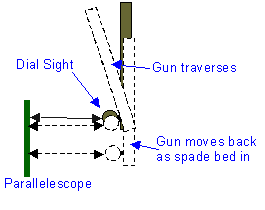
"If you are in battery the ranging posts are not on the side of the gun trail" Actually they are quite often. They are set out 50 and 100 yards if front of the gun to provide a reference point for aiming off in featureless terrain such as desert. The preferred reference point would be a landmark – a tall building, prominent tree etc. Failing that the British used a prism parallelescope behind the gun – basically a mirror on a tripod where the gun layer used the reflection of his own dial sight.
Sticking red and white striped posts out in front of an antitank position was probably frowned on :) |
| VonBurge | 25 May 2012 5:33 a.m. PST |
I'm not sure the ATGs would have theirs in stuck in the ground at all. Likely a crew member during engagement area development (long before the battle) went "down range" and used these poles to help get exact ranges measured to key features (target reference points). That would greatly help improve the accuracy of the ATGs shots later in a battle as the enemy moved through/near those target reference points. I don't know much about indirect fire and sighting in batteries, but I know correct range estimation is a big deal in direct fire. Cheers,
VB |
| VonBurge | 25 May 2012 2:12 p.m. PST |
It's called stadia I believe. The number of those red and white bands that fit within set marks on the sight or binoculars when viewed gives a pretty accurate range. Surveying used to be done heavily with this technique before lasers were common. A map would be great too, but that would depend on whether you had one or not, and if you did how accurate it was. I imagine maps were hard to come by in many situations. Cheers, VB |
| VonBurge | 25 May 2012 9:29 p.m. PST |
Yep. That's how you'd use the poles to get ranges. And as noted something you'd likely not have time for in a hasty defense. I'm guessing every full band that appears between marks on the reticle/sight would be something like 200m. So for example it looked like you had about five and a half bands between the marks then you'd know the range was about 900m. I don't know if they we ranging poles or cleaning rods myself, but if they were really red and white then the stadia method for range determination is what I think they would have been used for. I imagine that it's possible that they might have benn dual purpose, both ranging and cleaning poles. Cheers, VB |
| Gunner Dunbar | 30 May 2012 12:04 a.m. PST |
I Served in the Royal Australian Artillery until 2000, we had aiming posts and were trained to use them, but very rarely deployed them, we used a device called a collimator, and a recognizable landmark in the distance, ours were kept in the vehicle in a canvas bag as well.
link |




 Whether you are firing indirect with mortars, etc. or calling-in mortars, FA, naval gunfire or CAS … it's good to know exactly where you are … That's what I was refering to about GPS …
  But again I was a Grunt not a Redleg !