"Open Faced Bascinet" Topic
10 Posts
All members in good standing are free to post here. Opinions expressed here are solely those of the posters, and have not been cleared with nor are they endorsed by The Miniatures Page.
Please avoid recent politics on the forums.
For more information, see the TMP FAQ.
Back to the Medieval Discussion Message Board
Areas of InterestMedieval
Featured Hobby News Article
Featured Recent Link
Top-Rated Ruleset
Featured Showcase Article
Featured Workbench Article wodger  begins his series on how to paint a 15mm DBA army well, in a reasonable time frame. begins his series on how to paint a 15mm DBA army well, in a reasonable time frame.
Featured Profile Article
Featured Book Review
Featured Movie Review
|
| rampantlion | 26 Apr 2012 12:05 p.m. PST |
Just a quick question for you armor experts out there. Was the open faced bascinet really worn by itself in battle. In particular I am referring to the early 14th century and take the Robert the Bruce equestrian statue for example. That statue has translated into several Robert figures with this helm as the primary helm. A lot of figures available for early 100 years war show the same thing. This early bascinet was often worn under a great helm of sorts I thought and wearing an open faced helm seems to expose a vulnerable area of the body (the face). I can seem the great helm going away when the visored bascinet becomes prominent, but without any face protection I wonder. Is there any written record of knights fighting specifically with open faced bascinets or could this just be historical conjecture? Thanks – Allen |
| Cyclops | 26 Apr 2012 12:28 p.m. PST |
I've read several times (sorry, no sources to hand) that some thought better visibilty and ventilation were more important than protection. No point in protecting the face if you can't see your enemy and are over heating. Personal choice really.
You can see a similar evolution with Classical Greek headgear, moving from the all enclosing Corinthian to the more open types such as Boiotian, pilos etc. |
| Garand | 26 Apr 2012 1:31 p.m. PST |
Yes, my impression is it was indeed worn in battle. Keep in mind the bascinet was not an exclusive form of armor only for knights: lots of commoners would have worn them too, and if you're an archer or crossbowmen FREX, having a visor might be very counter intuitive for what you do, not to mention awkward, clumsy or hot. Damon. |
| rampantlion | 26 Apr 2012 2:09 p.m. PST |
Damon, I agree that other troops than knights wore them as well, but no other troop type than knights seemes to have used full face protection in the early 14th century/late 13th century that I am aware of, and with the bascinet being new on the scene at about this time period was it worn by the "common" troops this early or just knights? That may well be due to the expense of such a helmet? Later in the century it does seem to become more en vogue with the common soldiers. Agent Brown, just to play devil's advocate, full closed helms from face mask through barrel helms, then sugar loafs and other great helms had been worn for quite a while and they could surely see out of them and breath or few of them would have survived? I tend to think that since it could attach to the mail and was smaller, it was just a more efficient and possibly more comfortable helmet to wear (if indeed it was worn with some face covering (houndskull, etc..) or for additional protection under a great helm still. Not necessarily disagreeing, just taking other possible viewpoint. Allen |
| DeanMoto | 26 Apr 2012 3:53 p.m. PST |
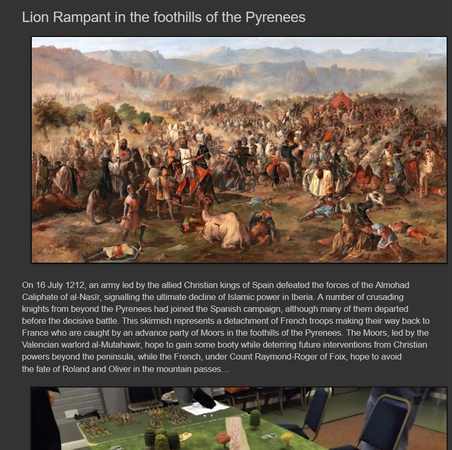
I would like to follow on with Agent Brown's comment on evolution of design, the barbuta was related to the bascinet; and visor-less
This late-14th C. artwork shows all the helmets sans visors
Disclamer: I'm not an expert |
| goragrad | 27 Apr 2012 2:28 p.m. PST |
Actually, from a bit of internet browsing (wiki, myarmoury.com) and from past reading, it appears that the visors evolved in complexity with time. Originally as the bascinet was worn as additional protection under the great helm they had none. As the great helm dropped from usage the bascinet was given increasingly sophisticated visors. These visors were usually removable and apparently were not always worn. Indeed, I recall reading of instances where leaders didn't wear any helm so as to increase their ability to be recognized and rally their men. It is rather easier to be heard when not muffled by a visor. DeanMoto, Oakeshott felt the barbuta was influenced by/derived from the 'rediscovery' of Classical armor and was a recreation of the Corinthian helm. Not sure if that has been discredited. Not sure what the second picture was (it isn't showing). However, the artist may have wished to show the faces of the knights (as with the statue cited in the OP) rather than show them all with visors. P.S. I also am not an expert and most of my research was research was some years ago. Although I did just happen to have a copy of Oakeshott to hand. |
| DeanMoto | 27 Apr 2012 6:46 p.m. PST |
I was afraid of that; I posted at work and wasn't sure if the firewall was blocking the image; but here it is again:
|
| just visiting | 27 Apr 2012 8:45 p.m. PST |
What you are referring to as an "open faced bascinet" is not always such; the helmet worn under a "great helm" was not a bascinet like the later pig-faced or houndskull visored helmets. In the above picture there are two kinds of helmets depicted: the bascinet and the arming cap. The bascinet is not worn under a great helm and is either visorless, as these are, or with visor attached. The arming cap is the one with the mail coif attached to the lower rim. Often the arming cap and its mail coif was the only head protection; the great helm being dispensed with at will. Just like the later pig-faced bascinet, for the same reasons, was often used without the visor: for personal preference, be it greater visibility or comfort…. |
| Swampster | 28 Apr 2012 2:30 a.m. PST |
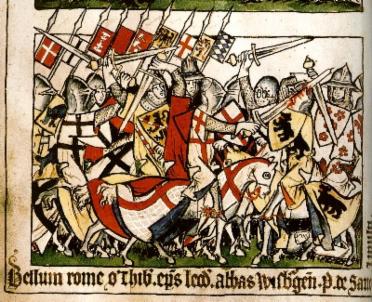
The Codex Balduini Trevirensis link showing Heinrich VII's journey to Rome depicts the knights travelling wearing bascinets but in combat most are wearing a larger helmet – a transition between helm and visored bascinet. A few do wear bascinets as well as other helmets such as kettle hats.
|
| rampantlion | 29 Apr 2012 7:12 a.m. PST |
Interesting comments everyone, thank you all for the input. I was at the Frazier Museum in Louisville yesterday (which is the only Britishroyal armories location that is actually outside the UK I am told), and while there we watched a two handed sword combat demonstration. Many of the attacks and defenses end up with the combatants in close quarters and grappling with one another. This led to many a strike to the face with elbow, pommel, hilt, etc…This only reinforced my thoughts that it is foolish to uncover the face unless it is really necessary. Some may have felt it necessary to fight with an open faced helm, or they could not feel comfortable about seeing the enemy or breathing, but it sure seems that it could be counter-productive to me. Admittedly, I have never worn a set of armor so I speak from a position of ignorance on this, it was just a rambling thought of mine! Allen |
|