"The wrong horse shoe?" Topic
84 Posts
All members in good standing are free to post here. Opinions expressed here are solely those of the posters, and have not been cleared with nor are they endorsed by The Miniatures Page.
Please don't call someone a Nazi unless they really are a Nazi.
For more information, see the TMP FAQ.
Back to the Napoleonic Discussion Message Board
Areas of InterestNapoleonic
Featured Hobby News Article
Featured Link
Top-Rated Ruleset
Featured Showcase Article An unusual addition for your Age of Sail fleets.
Featured Workbench Article
Featured Profile Article For the time being, the last in our series of articles on the gates of Old Jerusalem.
Featured Book Review
|
Please sign in to your membership account, or, if you are not yet a member, please sign up for your free membership account.
Pages: 1 2
| Flat Beer and Cold Pizza | 08 Feb 2012 10:09 p.m. PST |
Here's a BBC article I found rather interesting: link |
| Le General | 09 Feb 2012 12:26 a.m. PST |
|
| Cerdic | 09 Feb 2012 12:29 a.m. PST |
I saw the first part of "Bullets, Boots and Bandages" last week. A good little programme, I thought. |
| Martin Rapier | 09 Feb 2012 4:55 a.m. PST |
Although rather over-egging the pudding. As David Chandler pointed out nearly 40 years ago, it wasn't the retreat in winter which destroyed the Grand Armee but the advance in summer. Lack of winter horse-shoes wasn't much of a problem in summer. An interesting point though. |
| Le General | 09 Feb 2012 10:41 a.m. PST |
Yes it is easy to say they should have taken winter horse shoes. But they should also have taken winter clothing. (Hitler forget the winter clothes and boots as well) I wonder if the French generals asked for winter horse shoes to be sent out once they realised they were going to need them. Also of course Napoleon was not planning a long march to Moscow and back. He though a couple of quick battles with Alexander would fix it. |
| Robert le Diable | 09 Feb 2012 12:21 p.m. PST |
There's an anecdote in one of the many accounts of the 1812 Campaign (I think it's one of the more recent; last ten/fifteen years) telling how a Russian soldier looked at the shoes on a dead French horse, or found a cast shoe lying in the snow, and said something like "they are finished". |
| Gazzola | 09 Feb 2012 4:46 p.m. PST |
I don't think Napoleon or Hitler forgot the winter clothes, boots or horse shoes. That's thinking in hindsight because we know what happened. But at the time, both commanders were confident their campaigns would not last long. Imagine the problems of having to transport both Summer and Winter supplies/equipments etc. It is far too easy for us to say now that they should of but at the time, they had confidence in their plans and were sure the campaigns would be over quickly. It is a bit like football fans saying that the manager should have had a certain player or players on the team and if they had, they would have won the match instead of losing it. But a manager has a plan and makes his descisions on that plan, and of course, as well know now, not all plans work. |
| DJCoaltrain | 09 Feb 2012 7:10 p.m. PST |
After Borodino Napoleon should have declared victory and marched back home. Then he could have kicked the propaganda boys into action. |
| Widowson | 10 Feb 2012 12:44 a.m. PST |
He should have re-established Poland and waited to see what the hell the Tzar would do about it. Then he should have "modified" the Continental System and found another way of getting at the British – like marching into Spain and kicking their butts. I always liked that part. Napoleon is trying to hurt Britain with the Continental System. The Tzar is in open breach, so Napoleon invades Russia. MEANWHILE, a British army is close to hand in exactly the opposite direction. Remember the British? The reason for the Continental System? LOL |
| Gazzola | 10 Feb 2012 4:27 a.m. PST |
DJCoaltrain & Widowson Again, you are both saying what he should have done, based on hindsight. Napoleon obviously believed that the Russians, after standing and fighting, as he had expected them to do from the very beginning of the campaign, and, in his eyes being defeated at Borodino, would now want to end the war. His following actions and advance to Moscow were based on that. It was, of course, the wrong thing to do and he underestimated the Russian resolve to continue the war. But unlike us, he didn't know that at the time. As for the British, had things gone to plan I'm sure that Napoleon would have dealt with them next, should they have remained in Spain. Russia was the more immediate and difficult problem. |
| Trajanus | 10 Feb 2012 12:27 p.m. PST |
Sorry I don't buy it. Numbers lost on the way to Moscow and the decision to proceed past Smolensk were more important. |
| Gunfreak | 10 Feb 2012 12:50 p.m. PST |
I think cossacks and the russian army at the heals of the french, killed a few 1000% more people and horses then bad shoes |
| HistoryPhD | 10 Feb 2012 5:46 p.m. PST |
By the time the Grand Armee needed winter horseshoes, there weren't enought horses left to bother with. A bit of an exaggeration, of course, but not by much. |
| Gazzola | 11 Feb 2012 5:31 a.m. PST |
I wouldn't take too much notice of what the progamme says, Napoleonic period wise, since the presenter/military historian Saul said Napoleon marched to Moscow, the Russian capital. But Moscow was not the capital during the Napoleonic Wars, it was Petersberg, If he got that wrong…. |
| huevans011 | 11 Feb 2012 6:21 a.m. PST |
I always liked that part. Napoleon is trying to hurt Britain with the Continental System. The Tzar is in open breach, so Napoleon invades Russia. MEANWHILE, a British army is close to hand in exactly the opposite direction. Remember the British? The reason for the Continental System? But… the British Army isn't what really counts, is it? Just ask Nelson. |
| 1968billsfan | 11 Feb 2012 9:45 a.m. PST |
Please, will the Napoleon Apologetics face some reality. The earlier 1807 campaign (cf: link should have given any sensible person an idea of the difficulties of campaigning in eastern Poland and western White Russia. The lack of supplies and prosperious cities to plunder was very clear at that time. Napoleon's "supply" plan, ability to concentrate quickly (from knowing the roads, having good intelligence, and having good roads), fast movement and very limited targets for the defender to defend… were not in plan in his invasion of Russia. He didn't rethink what was very clearly and insisted that these things (which didn't match his view forward of his future victories) had to be ignored. He ignored the distances. He ignored the Czar's openly stated (to the nappie guy as well has the Russina nobles and people) that the Czar was willing to retreat to Siberia in order to keep fighting. Surprise, Surprise. Napoleon fought his war with his methods and these did not match what was needed. He go his ass handed to him and lost the veteran core of his army. He lost his entire empire because that lost core of his army is what won him battles and is what kept him in power. Sorry to the nappie lovers, but that is what is called real stupid. I find it funny that some talk so much about "if they only had studs on their horseshoes, everything would be okay". Sorry, that is a minor detail and such people are ignoring "the elephant in the livingroom". I guess he left Egypt because the troops had 15 oz. water bottles rather than 18 oz. waterbottles…… |
| spontoon | 11 Feb 2012 10:44 a.m. PST |
I'm sure regimental farriers would have had ice nails in their stores. They can't all have been stupid. Since a horse needs shoeing rather often they would have been done at least once before winter! |
| Gazzola | 11 Feb 2012 1:29 p.m. PST |
1968billsfan I think you are missing the point completely. I don think anyone is saying that if Napoleon's cavalry had the 'correct' shoes all would have been well. It might have saved some horses, which Napoleon's cavalry could have done with. The main point is that he expected the Russians to stand and fight, as they eventually did at Borodino. He did not expect them to keep running away. This was because he made the mistake of thinking they would not give up Moscow, the heart of Russia, unless they wanted the war to end. Most of the Russian generals and troops felt the same and hated their runaway tactics and allowing Napoleon to walk unopposed into Moscow. Their views on such tactics, of course, probably changed when they did win in the end. But they, like Napoleon, did not have the luxury of hindsight. Any fool can say what should or should not have been done, after the event! |
| 1968billsfan | 11 Feb 2012 3:31 p.m. PST |
During previous campaigns in Western Europe, Napoleon had solved the problem of feeding his armies by letting them "live off the land" – either by pillaging or buying up supplies as they advanced.But aware that such an expedient would not be possible in "the wastelands of the Ukraine", he planned to take his supplies with him. This was a logistical operation of quite staggering proportions, requiring a wagon train of no fewer than 26 battalions – eight equipped with 600 light and medium wagons each, and the rest with 252 four-horse wagons capable of carrying 1.36 tonnes (a grand total of 9,300 wagons). To pull these wagons and to transport his cavalry and artillery he had gathered 250,000 horses, all of which required 9kg (20lbs) of forage a day. And yet the figures did not add up. ….and the great man couldn't figure this out????? …..after fighting across Poland in 1806 and having people tell him that going further east into white Russia it was even poorer going untill getting into the region of Moscow? ….after hearing the Czar saying that he would continue fighting even if he was sitting in a peasant hut?
…. Russian is very spread out. There is no "central heart of Russia", the taking of which would destroy the ability of Russia to continue the war. Please consider that the actual governmental center was Petersburg. Please consider that major cannon foundaries were at Tula and other places 50 -100 miles away from Moscow. Please look up where the iron smelting of Russia (they were the world's largest manufacturers at this time) was- mainly in the Urals. Please take a look at where the bulk of the troops were raised- you can look back at the inspectorate era. Taking Moscow would make little impact on raising troops. Please look at Charles of Sweden's invasion and fate- N. had copies of this, studied it and had it with him as reading material.
Gazzola, I respectably disagree, that I am missing the point completely.
Napoleon was very very good as a general and having control of a military-establish and mobilized country, he as unbeatable as a general if he had his large army, the core of which had been trained for 2-4 years, and usually opposed by troops, who had 3-6 months of training and little combat expereince and culling. Even after the "grand army" had been destroyed, in the 1813-1824 and Waterloo campaigns, the strategy had become to avoid ANY battle where Napoleon was commanding (retreat rather than face him) and attack only his subordinate corps with others in command. Yes he was a great general. But YES, he only put himself in command of army groupings where he had the best forces, the Imperial Guard and an overwhelming corp and numbers. Part of the allies wanting to avoid a dicisive battles with N. commanded armes was to avoid his skills as a general. PART OF THE ALLIES WANTING TO AVOID A DECISIVE BATTLE WITH N. COMMANDED ARMIES
was to avoid battling with the best and largest and most experienced portions of the French. N. was not dumb and always kept the bulk of the best battle-winning forces under HIS personal control. Of course, if you fought N. directly, you were into the French's best buzzsaw. Why not lop a couple of arms and legs off of the French capabilities and forces by destroying the weaker units that he didn't control? Napoleon made it easy for the allies to find out where it would be easy to chop off and destroy a part of the French army. Repeatabiliy. Just kill what N. was not directly commanding. All the "good stuff" would be elsewhere as Napoleon's camp guard. I think what N. did was to decide how he could win such a war, and then went on to try that. So he set himself up for a large battle, during a short campaign, where he could ignore having to travel with a horse-supplied army over distances and bad roads where horses would break down. What the dumn F___er, didn't bother with, was that the other side did not have to play the game that he was going to play. Sorry, it was a war and Russian did not have to follow N.'s rules. N.'s successes under different groundrules in western & central Europe, as well has his dominance and power over any opposision (political or personal), warped his reasoning. I think, he thought that the world HAD to arrange itself to be subservent to his ego and god-like qualities. (a.k.a. he had become nuts). Sorry, nut-case, you lose. "Had Napoleon arrived in Moscow in two months, and with only half his original 400,000 men, he would still have required total supplies of 16,330 tonnes, which was almost double the capacity of his supply trains. Instead he advanced with just 24 days rations. Clearly he was gambling on a rapid victory and a campaign that would not last longer than three weeks. It was wishful thinking |
| Gazzola | 12 Feb 2012 3:57 a.m. PST |
Calling a great commander like Napoleon a nut case expresses how sad and biased you really are. I thought you were putting up a pretty decent argument until then. I would suggest you read Alexander Mikaberidze's article Mutiny of Generals on the Napoleon-series website. The Russian generals wanted to fight and save Moscow, the Russian soldiers wanted to fight and save Moscow. On your basis they were all nut-cases as well! |
| Connard Sage | 12 Feb 2012 6:19 a.m. PST |
"Beware the Napophile, my son!
The jaws that bite, the claws that catch!
Beware the Premier Empire bird, and shun
The frumious Bonapartist!" |
| 1968billsfan | 12 Feb 2012 6:28 a.m. PST |
Hmmmm, reportedly he went to bed every night with a copy of Charles XII invasion of Russia on his night stand. And then he went and did the exact same thing. Somehow his "star" was going to overcome reality. To me, that does sound like someone who rejects reality. After chasing the Russian army across Poland, Lithanian, Beleo Russian and the western part of Russia and failing to catch it, he still expected that the Russians would come to terms? N. ignored what he knew about the Russian strategy and insisted that they would have to fight according to his terms. On the Russian side there was B.de Tolly's March 1810 "The defense of russian western frontiers", Chukenvick and Chernyshev's papers etc.. He was so wrapped up in his delusion that he had to win, that he ignored the condition of his army and its distingration. He ignored strong forces (Bennington and Chichogov) on his strategic flanks and only opposed them with weak and hollow forces of unwilling allies. These later cut him off from his line of supply and captured his major bases such as Minsk. All of this was avoidable, except that N. chose to ignore reality and insisted that fate would favor him. (Does this remind yo any of Hitler in 1945?). I think history's ignoring N.'s megalomania and narcissism stems from the facto of who wrote much of the history. French venerated his power and conquests as a nationalistic principle and could see no bad in their hero. N. himself wrote much of the description of his decrees and battles and always twisted things (if necessary) to glorify himself, shift blame to others and even claim credit that was due others. Much of the English language history of the Russian campaign comes from Wilson, who was trying to accomplish British national goals and was not there as a neutral recorder of history. His best result would be for the Russian empire to lose its army and become feeble by using its last strength to destroy and capture N., thereby leaving a giant power vacumn in Europe and the middle east for Britian to move into. |
| Gazzola | 12 Feb 2012 8:15 a.m. PST |
1978Billsfan I don't think the positive or the negative aspects of Napoleon has been ignored by history, as much as some people want it to be. He was, after all, just a man. And nearly every book I have read, have discussed and criticised both his successful ventures and his failures. And some, like yourself, try to throw the blame solely on Napoleon's shoulders. Very, very easy to do in hindsight. I'm not sure I agree with you about Wilson. Perhaps he was just being too truthful, or truthfull as he experienced it. After all, he was there? And most of the views on the Russian tactics employed in the early part of the 1812 campaign, including that of the Russians themselves, was that they wanted to stand and fight and not keep running away. The Russian general Bagration is a perfect example when he said 'My maneuvre is to seek and attack'. Both sides made mistakes as Alexander Mikaberidze states 'The 2nd Western Army was maneuvering in the scortching heat, without food and fodder…' It wasn't just the French making mistakes. But it is easy for someone, especially today, to state that it was Napoleon's fault because a certain commander didn't do this or that or food ran out or whatever. I'm surprised he hasn't been blamed him for making it snow! And luckily for the Russians, after the shock of Borodino, they reverted to the tactics of run to fight another day, which, as we now know, worked. Had it failed, then who knows what people would have been saying about the Russians. |
| Gazzola | 12 Feb 2012 8:24 a.m. PST |
Conard Sage Most 'Bonapartists' I know are not frumious. They are far too used to people desperately trying to blame or attack Napoleon in any way they can. They are also far too busy laughing at such attempts to get angry or upset. The biggest joke is that some people think you can't admire anyone who may have made mistakes and failed, as in 1812, along with all the incredible successes. It is all part of what places certain men above others, and, of course, is why we have such a wonderful period of history named after him. |
| 1968billsfan | 12 Feb 2012 3:08 p.m. PST |
I think that Wilson would be a very interesting figure to study. I have to assume, that since he was being paid to further British interests, that his actions and bias were in that direction. If they were not, then he should have been withdrawn and replaced. He was trying to have both the French and the Russians anniliate each other to leave Britain to cheaply pick up the pieces. If he was doing anything else then that, he was not serving Britain's interests. Naturally, he did everything he could to encourage the Russians and French to destroy each other. His statements, advice to the Russians, support of fractions within Russia and propaganda to the world (to sway popular opinion) were directed to that end. If you understand that, then you have a key to understand why he would be expressing and trying to further the view that the Russians should wipe themselves out to destroy Napoleon and his army thousand of miles away from Paris. I am retired from several big corporations and the style and flavor is instantly recognizable as Office Politics 101. Also, I don't think Borodino was any shock to the Russians. I think it is clear that their strategy was to withdraw slowly before the French, keep their army in being and suck the French into an untennable situation. The Russians had a lot of experience in how hard it was to get an army (within their own country) to the WEST through these regions, they must have been gleeful thinking about how the French would destroy themselves without a battle trying to march east against an enemy or pre-positioned magazines. Napoleon had some personal bitter experience from the earlier campagin leading up to Eylau and Friedland but the arrogent dummy (crazy?) refused to learn from it and was too impressed with his own omnipotence to learn or realize that the other side might have learned from that as well. ((Actually, a lession the Russians had learned on multiple fronts over the previous several centuries!! The problems of the Friedland campagin were caused by the desire to keep close to Prussia and keep her in play as an ally!!). Borodino was only necessary to cool down the hot-headed who wanted to get to grips with the French. They had to fight a battle, the French had to fight a battle on the Russian's terms (another straight out frontal attack to avoid the Russians running away like at Smolsk etc etc). A larger French army in Moscow would have eaten themselves into starvation more readily than one reduced by battle. |
| Gazzola | 12 Feb 2012 3:49 p.m. PST |
1968billsfan I can't really debate with you that much on Wilson. I haven't studied him enough but I think he felt that the Russians should have gotten to grips with the French as often as they could, in the same way that the British did in the Pensinular. However, I don't think, had the French and Russians fought each other at every opportunity and not just when the French army was considerably weakened on the retreat, that it would have helped Britain? After all, after losing most of his army, Napoleon went on fighting for a few more years and right up to 1815. To be honest you remind me of a football fan who throws the blame on a manager for not using the right tactics or players, AFTER the game is over. Beforehand, you wouldn't have a clue what to do or say. And really, it is basically a waste of time trying to debate anything with someone who calls the great man a nut and a dummy. I think it was Chandler who said Napoleon was a great man surrounded by pigmies – well I think he could have added that he is also critcised by pigmies. But, I doubt anything will change your views, so I am afraid we shall have to agree to disagree. |
| Bottom Dollar | 12 Feb 2012 4:25 p.m. PST |
Why didn't Napoleon use the Guard at Borodino? Perhaps he already knew he had made the wrong decision and he was in deep doodoo. If he had taken St. Petersburg, he could've turned it into a French fortress and said, "Now I don't care if you come to terms with me or not." It would've required a fortified frontier through Estonia, Latvia and Lithuania, but the Poles would've been excellent helpers in the projected defense. |
| Le General | 12 Feb 2012 4:33 p.m. PST |
Even if N had used the Guard at Borodino and really won the battle, the result would still have been the same. He would have occupied Moscow and still had to leave before winter came. |
| Bottom Dollar | 12 Feb 2012 4:49 p.m. PST |
Le General, I agree with that point. It suggests that by Borodino, Napoleon had already anticipated what the result was going to be. His overall strategy in 1812 was to repeat Tilsit, but with the Russians signing off on the "defeated" line. He went for the wrong city, IMHO. |
| 1968billsfan | 12 Feb 2012 5:16 p.m. PST |
"…..basically a waste of time trying to debate anything with someone who calls the great man a nut and a dummy." With all due respect, your saying "the great man" indicates that you have the principle in your mind that N. is beyond any reproach or analysis. Beyond reason. N. made a real stupid decision to push on ahead into Russia. I will repeat that he wasn't working with a full deck in the head when he made that jump. Also, I am in awe about your football analogy. I agree that hindsight is wonderful…but if your dear N. made a bad and foolish decision, and there was a lot of information that he disregarded, the fact that it turned out wrong, does not mean that he was right. I'm guessing that you think that inconvient facts about results have to be ignored, turned around into opposite results and used to prove N.'s brilliance. In mathematical proof terms, you are taking that as the first, unalterable assumption and then anything else that follows cannot violate that first law. GET OFF IT. Napoleon made a terrible series of decisions and got his  handed to him. handed to him. As to your entry above: The British did not get to the French at every opportunity. The advances to the rear in Corruna and into the lines are not exacting taking the French head-on. My opinion is that the French lost the real core of their expereinced veteran army in Russia, most of their ability to rebuild upon experienced cadres, a hell of a lot of horseflesh (their calvary was never a force after 1812), as well as the terror factor to coherce money, material, troops and willing support from their conquered peoples. I'm sorry but if not for this, France would never have been defeated in 1813-1814. Please look at the wavering of the Austrians during this time and the eventual changing of sides (Saxony and even Bavaria). The core of Russian troops injected into central Europe was the stiffening that shifted this balance of power. It was not the slow follow-up of Wellington over the Pyrrenies. Chandler is not the final word on Napoleon. By the way, in reference to "………he is also critcised by pigmies", I am not a pigmy. Sorry, but "great men" make mistakes that even an idiot can recognize. |
| Bottom Dollar | 12 Feb 2012 5:46 p.m. PST |
1968billsfan wrote: "…N. made a real stupid decision to push on ahead into Russia. I will repeat that he wasn't working with a full deck in the head when he made that jump."
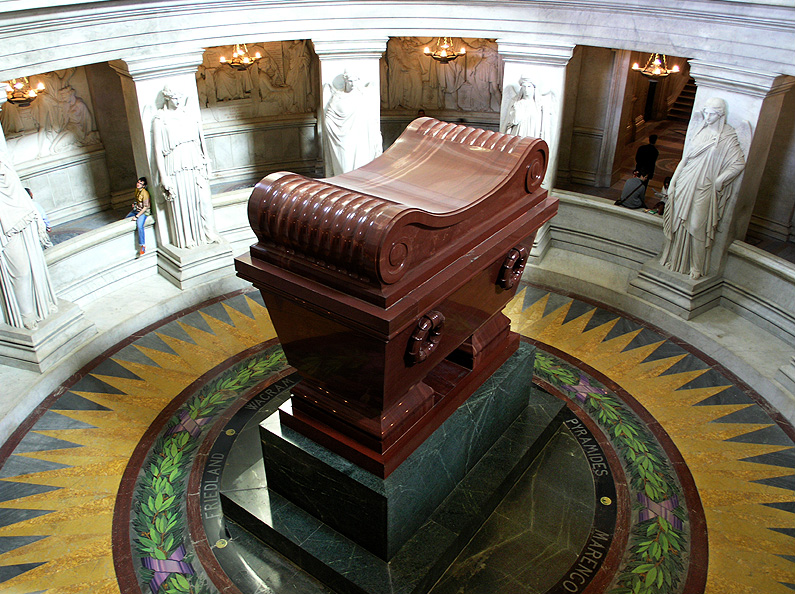
I disagree. I think he realized his miscalculation after he had committed to the central thrust towards Moscow. He was playing with a full deck and b/c he was he had time to organize another new Grand Army in central Europe. Let‘s not forget that Napoleon didn't shoot himself in a bunker under Paris and there's good reason his final resting place is rather well marked out.
|
| Bottom Dollar | 12 Feb 2012 6:07 p.m. PST |
All that being said, perhaps Great Britain had the better longer term strategy. They certainly had the organizational skills, financial acumen, military power, tactical know-how and sheer grit and determination to win with it. "Perfidious Albion" ! Contemporary Brits KNEW HE WAS GREAT which is why they never relented. |
| Bottom Dollar | 12 Feb 2012 6:44 p.m. PST |
I do think James Madison was an admirer of N. |
| Gazzola | 13 Feb 2012 4:11 a.m. PST |
1968billsfan Again, everything you are spouting, is said with the luxury of hindsight. You are trying to make out that you know better than Napoleon. But you know what happened, so to offer other solutions is all too easy to do, by idiots pigmies and whoever. I do accept he made mistakes as any man/commander would and have done over the years. I thought I had made that clear. Just because I completely disagree with your views, it does not mean I see Napoleon having no faults or not making mistakes. Perhaps you prefer to think that, rather than accept that someone disagrees with you? It is clear we both disagree on events of 1812 and obviously on Napoleon himself, so lets leave it at that. I can live with it. |
| 1968billsfan | 13 Feb 2012 6:34 a.m. PST |
Right. We can respectfully agree to disagree. |
| 1815Guy | 14 Feb 2012 7:40 p.m. PST |
Wot Trajanus said! Napoleon expected to demonstrate around the borders of Poland/Russia and expected the Russians to fall in with the continental system. Alexander, however, had grown up since Tilsit! When Nap invaded Russia he wanted to defeat the two Russian wings in detail, but each would not fight him without the support of the other. Nor could they agree which General should command the combined forces, so they each kept withdrawing – the one strategy that had a chance of victory. Nap couldn't just ignore these two huge enemy forces and head for St Petersburg, which the Prussians might capture anyway if it was such an easy catch. Kutusov finally settled the command issue, and the Russians had to put up a fight before Moscow, the religious capital. Napoleon finally gave the Russians their "evens odds" battle that they wanted but in doing so did not have the force to destroy the Russian army in the way that he had expected or needed to. The Russians therefore withdrew beyond Moscow, still a large and organised force, but the campaign was not at all over as far as they were concerned. They still had a large force under arms in the area of Moscow and more troops on the way. If Nap had not lost so many men on the way to Borodino – including garrisons and flanking operations to North and South he might have had enough troops to finish the war at Borodino. Just imagine a flank march arriving at the Russian rear halfway through the day…… So no, it wasn't for want of a horseshoe the battle was lost. It was the sheer size and scale of Russia, and the fact that Russia had been bloodied but the army not defeated. Could Napoleon have survived politically if he had left his army established at Moscow? Quite a difficult question that. After Maloyaroslavets his options were even more limited….. so if his army was in such good shape why not force the issue there a second time rather than retire over the bones of his veteran dead at Borodino? So.. if there is one rule in history that you should not ignore (after dont with the British) it has to be "keep out of Russia if you know whats good for you". Good thread this, civilised discourse with lots of good opinion and comment. |
| 1815Guy | 14 Feb 2012 7:45 p.m. PST |
"My opinion is that the French lost the real core of their expereinced veteran army in Russia, most of their ability to rebuild upon experienced cadres, a hell of a lot of horseflesh (their calvary was never a force after 1812), as well as the terror factor to coherce money, material, troops and willing support from their conquered peoples." Well said. Napoleon could often only see th emilitary solution to political problems. He HAD to keep the myth of invincibility alive to furnish his armies with allies – which in 1812 included Prussia and Austria of course. |
| 1968billsfan | 15 Feb 2012 5:45 p.m. PST |
N. was not igorant of the wastage of troops and horseflesh on a campaign. The distances in Russia were unusually large, and there was not the opportunity to rest and recover after 30-60 days of losing weight on the men and horses. These were known facts. N. knew them. He had campaigned to Elyau and Friedland in 1806 and knew that even over those short distances,what the effects were. My view is that he knew all this, could very well predict beforehand what he would have left after even a moderately opposed march to Moscow (let alone on the way BACK in WINTER) and still insisted on plunging into Russia and Moscow. Doing this even when the numbers didn't add up, is either stupid (N. was not stupid) or crazy. Crazy being in a condition where N. knows the facts, but finds them inconvient and is so used to bullying and dominating his environment that he feels he can ignore them. In modern terms, "its 200 miles across the desert to the next gas station, I have 3 gallons of gas and get 22 miles a gallon. Drive on!!" The Russians were well aware of the giant costs of moving armies across Beoloruss, Lithanian and Poland from east to west (across controlled territory no less), because they had to do it repeatedly every time they sent an army to centeral Europe, starting in the Seven Years War. Every western nation was aware of the problem, because the long time of Russian time of intevention in a war was a well known part of the equation of war. N. decided that he could ignore it. (Stop Sun!, N. commands it!!!). The Russians were not exactly shy about explaining this fact to whomever might lisen. They did not try to make it a state secret. Alexander and his dipolmatic corp made the difficulties of invading Russia quite clear to everyone- as if they needed relearning this. It was part of their defenses. "The best source on alexander's own views… is the record of a long convernsation he had in Helsinki in aug 1812, while on the ways to his meeting withBernadotte….he himself would never make peace so long as a single enemy soldier remainied on Russina soil, enve if that meant standing firm on the line of the river Volga, after being defeated in battle and losing Petersburg and Moscow. …" (D. Lieven "Russia against Napoloeon" quoting a Finnish dipolmat ref 2 chapter 7). In diplomacy, it is normal and expected to explain things to an adversery to keep them from doing stupid things, that will hurt them (maybe fatallly) but also be bad for you. N. had explainations from his previous fighting against the stubborn Russians, their skill at retreating, the long distances, the attitude of the Russian people and leaders and declarations from Alexander himself. Still, the extreme narcissist and nut case decided to have a go. Go figure. I say he had a screw loose. |
| Bottom Dollar | 15 Feb 2012 8:19 p.m. PST |
So, in both cases, why didn't Napoleon commit the Guard at Borodino ? |
| 1968billsfan | 16 Feb 2012 3:44 a.m. PST |
#1. The Guard was Napoleon's personal bodyguard. It protected his body and would only be used if there was a clearcut, absolutely required, end-of-war victory to be had. Notice that the guard was about the only unit that came out of Russia in formation. They got first choice of any supplies. #2. The Guard was Napoleon's ace-in-the-hole in every battle. The threat of it being employed restricted the opponent's freedom of action, since it might be deployed. It was worth more that way than being engaged and accounted for and maybe worn down. #3. The Guard was the training ground for the army and the in-situ staff college. Veteran NCO's would be transferred into the guard (and paid at an officer's rate), absorb the current and most correct procedures, be developed in personal loyalty to Napoleon, and then go back to the standard units as officers to stiffen and improve them. And sort of serve as a barrier to the start of any negative ideas towards Napoleon. It worked. #4. The Guard was personally loyal to Napoleon and the army and not as much to "France". "France" might be defined by various people as their view of how the government, Jacobin views, royalist Vendee views, politcial fraction views, or other army general's views should be supported. The Guard would take Napoleon's side in any possible or potential fractional debate. It would win convincingly if there were any fighting to be done in a coup attempt. Nobody even thought about trying or could think about a plan, which would have to answer the question of defeating the Guard. Napoleon kept it happy, in his hip pocket and very close to him. |
| Connard Sage | 16 Feb 2012 3:54 a.m. PST |
#1. The Guard was Napoleon's personal bodyguard. It protected his body and would only be used if there was a clearcut, absolutely required, end-of-war victory to be had. Who were the Guard in the Peninsula under Bessieres bodyguarding then? |
| Poniatowski | 16 Feb 2012 5:39 a.m. PST |
I think Gazzola is correct… I have done a lot of reading and my friends in the Ukraine who are history fanatics seem to reach the same conclusion. Napoleon did not hope, but planned for a quick and decisive victory… and then, he planned on it being a CIVIL victory… meaning he expected that after the victory, he would be able to push on and enter Moscow as the victor and with civility. This type of treatment would be common place in what he deemed "civilized" Western Europe. Since a lot of the Russian court had taken on the "French" way of court, it was logical that he was expecting this. It was almost illogical for him to think otherwise. Well, it obviously didn't happen as he thought though and that made his plans to appear more and more to us in today's age to look like some desperate gamble on his part. It is simply this… Napoleon expected a huge battle (the bigger the better)… one battle to determine the outcome of the war… he expected to be the victor, enter Moscow and be treated as the conquering hero by the nobility and he and his army would then resupply, possibly even stay on until spring and then return home after "policy" was set up in a defeated Russia. I think if any gamble had been played, it was Napoleon's view that the Russians would try to emulate Western European nations in their defeat and that their desire to act as "civilized French courts" in defeat. This was not the case… The army did not surrender and the nobility relocated. This left no law and order so to speak in Moscow and then the Poles started the pilliaging and it went downhill from there. |
| von Winterfeldt | 16 Feb 2012 6:38 a.m. PST |
"I think history's ignoring N.'s megalomania and narcissism stems from the facto of who wrote much of the history. French venerated his power and conquests as a nationalistic principle and could see no bad in their hero. N. himself wrote much of the description of his decrees and battles and always twisted things (if necessary) to glorify himself, shift blame to others and even claim credit that was due others. Much of the English language history of the Russian campaign comes from Wilson, who was trying to accomplish British national goals and was not there as a neutral recorder of history. His best result would be for the Russian empire to lose its army and become feeble by using its last strength to destroy and capture N., thereby leaving a giant power vacumn in Europe and the middle east for Britian to move into.
" Exactly, otherwise it is well established, already by Fabry at early 20th century that the Russians did analyse Napoleons's art of war and found his weak spot (logistics) and his hunt for early victories, then they sent a spy to Paris and did know as much as Napoleon about the French Army – for that one could read Lieven. Napoleon ignored all warnings, one can read The Illustrious Dead by Talty about Thypus – creating already havoc in Poland Poland offered yet another impediment. Napoleon's surgeon warned that the country was a large foci of typhus and that the Polish peasantry was rife with this disease. While orders were issued forbidding soldiers from fraternizing with the Poles under penalty of death, these orders largely went unheeded, as his army, now running out of food and supplies, began raiding nearby villages. These forays inevitably brought soldiers into contact with the Polish population and soon the Grand Armée was replete with epidemic typhus. Then of course due to their edge in intelligend ce the Russian army just refused to play into the hand of Napoleon – who had the immagination that they would go for an early battle, that he will gain a glorious victory (as usual) and then the Russian Emperor would be on his knees and ask for peace terms. After Smolensk – Napoleon should have realized that the campaign was not going according to his plan – the only problem – Napoleon had only one plan which he was unable to modify. Good books to read are those of Mikaberidze – Borodino, Berezina as well as his series of memoires translated from Russian into English. In fact – there are great books – even in English – to obtain a better than the usual general winter view. As for the Guard, not comitting at Borodino – in my opinion he was already aware that he would need it in the retreat. |
| Poniatowski | 16 Feb 2012 7:19 a.m. PST |
@vW,
Well said!!!
I think also that the lack of committing the Guard also stemmed from the fact that he wanted them fresh for his parade into Mascow as the victor. There was a matter of ego and appearance. He did not want to enter with a depleted force and appear weak, even after a victory. I agree that he believed he could win the battle and war with regular troops quickly and keep the elites fresh for what might come… I don't want to say he viewed the regulars as expendable, but he knew he would loose more of them if the Guard was not committed… the greater the loss, even with victory would prove to be less of a logistics nightmare for the return journey, while keeping an elite smaller army that was fresh would help ensure less trouble if more battles should arise. The Guard carried a stigma and they were feared. One good unit is worth a handful of the others any day. |
| Bottom Dollar | 16 Feb 2012 4:04 p.m. PST |
A lot of interesting information and book recs. Thanks. I would think that the Russians receiving intelligence on Napoleon's plans/intentions in advance would be a better explanation for Napoleon's failure than an explanation which stated it was Napoleon's ego or lack of sanity which was the cause of failure. I think Napoleon knew he was human, or as his career progressed he came to know it, and it was that growing humility combined with his inherent greatness which made him even more dangerous to and more feared by his opponents. |
| 3rd Div | 17 Feb 2012 8:35 a.m. PST |
Interesting piece on the impact of typhus on the Grande Armee in Russia: //entomology.montana.edu/historybug/napoleon/typhus_russia.htm
Regards,
Dave.
|
| DJCoaltrain | 17 Feb 2012 9:58 p.m. PST |
Gazzola 10 Feb 2012 3:27 a.m. PST DJCoaltrain & Widowson Again, you are both saying what he should have done, based on hindsight. Napoleon obviously believed that the Russians, after standing and fighting, as he had expected them to do from the very beginning of the campaign, and, in his eyes being defeated at Borodino, would now want to end the war. His following actions and advance to Moscow were based on that. It was, of course, the wrong thing to do and he underestimated the Russian resolve to continue the war. *NJH: I believe it was the resolve of the Tsar to live that prompted the Russians to continue the war. If he had settled with Napoleon, he would have been assassinated fairly quickly. But unlike us, he didn't know that at the time. *NJH: I prefer to think that Napoleon understood the military and logistical challenges of the campaign. However, he fatally failed to grasp the Byzantine nature of Russian politics, and their penchant for regicide. As for the British, had things gone to plan I'm sure that Napoleon would have dealt with them next, should they have remained in Spain. *NJH: The British were not going to be "dealt with" in Spain by Napoleon. If Napoleon had been able to do that, he would have already done so before 1812. Russia was the more immediate and difficult problem. *NJH: Russia was annoying Napoleon, but not an immediate nor difficult problem for France. He should have ignored Russia, or do as I said. Fight a battle, declare victory, and go home. He could have waited for the Russians to come looking for revenge and fought on his ground, on his terms. Plus, he gets to play the sympathetic role of savior of Europe. Propaganda can be useful. Cheers |
| von Winterfeldt | 18 Feb 2012 3:07 a.m. PST |
Also a big problem, I think underestimated by Napoleon, his dual function as head of state and commander in chief, being so far away from home – on a just recently established herititary monarchy.
His political system was very unstable without his presence.
He neither understood the logistical challenges, nor the military and political challenge.
Also it is very western style history to find it difficult to admit that he was outwitted and outfought by the Russians.
The Russian Emperor could afford to leave the army and retire to St. Petersburg, his army fought on with dogged determintation, Napoleon couldn't do so.
Why should the Russian Emperor have any inclination to come to peace terms with Napoleon, in the end – it would be another armistic – to prepare for the next military round.
So – they only solution was – for once – to get rid of him and defeat thim, this was achieved in the long run. |
| Gazzola | 18 Feb 2012 3:49 p.m. PST |
DJCoaltrain I think your notion that Russia was 'annoying' Napoleon slightly baffling? You don don't organise and take into an opponents country 500,000 men if they were merely
'annoying'. Your suggestion that Napoleon could not have solved the British problem is also baffling. Napoleon sorted the British problem in Spain in 1809 when personally involved, resulting in the British army having to escape by sea at Corunna. There is no reason why he could not have done the same again, only this time, not give someone else the task of finishing off the job as he did in 1809. Again, everything you say is based on hindsight. You know the results of what did happen. That is all too easy to do and done far too often by armchair experts. You could say he should have married the Russian Princess instead of the Austrian lady and he could have then taken care of Wellington without the fear of Russia becoming more aggressive while he was doing so. But again, that is also said with hindsight. |
| Gazzola | 18 Feb 2012 4:08 p.m. PST |
Poniatowski Hindsight is again being used by some 'experts' attending this site, for the reasons why Napoleon did not employ the Guard at Borodino. But perhaps he also felt that after defeating the Russians at Borodino, albeit certainly not as decisively as he would have wanted, that the Russians may have felt they been beaten or forced to retreat yet again, and Napoleon had not even had to employ his best troops. I'm sure they would have been very relieved that he did not do so. Only those involved in the actual campaign, and not those 'reading' about it hundreds of years later, know the real reason why. They can only guess why and jump to negative reasoning because the campaign was a failed one. But I suppose it does give a good reason for those who enjoy knocking Napoleon to let their imagination work overtime. After all his victories they probably need it. But on a good side, it keeps everyone talking about the wonderful period of history we all love. |
Pages: 1 2
|




 receives a gift from his wife…