| Jeroen72 | 03 Feb 2012 1:21 p.m. PST |
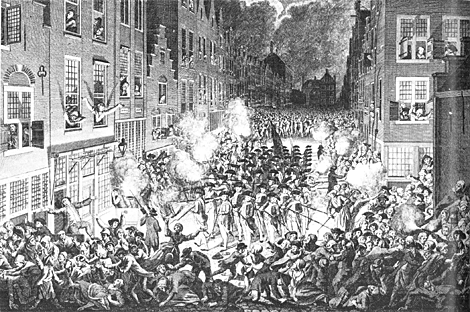
Hello all, I'm looking for some rules that allow me to fight some 18th century riots and possibly street fighting. Imagine the 1770 "Boston massacre" or the 1784 Rotterdam shooting where a Patriot "Schutterij" company fired into a Orangist mob:
If possible including "verbal" abuse, harassment and thrown objects…well, everything..ermm..riotty. Do these rules exist or do i have to be creative and make something up ;) Thanks, Jeroen |
| Sundance | 03 Feb 2012 1:44 p.m. PST |
I've never heard of any rules like that, but sounds like fun! |
| yoakley | 03 Feb 2012 1:51 p.m. PST |
Little Lambent Meteors is such a game. i have it as a pdf download.
cannot remember where, but the author is part of this club;
jimwallman.org.uk/clwg |
| yoakley | 03 Feb 2012 1:52 p.m. PST |
just remebered where it came from;
link |
 timurilank timurilank  | 03 Feb 2012 2:45 p.m. PST |
We do not use special rules for such events, but do place consideration to the broad differences of leadership styles. We use our standard rule set, but the rioters may be lead by a firebrand that could incite the "mob" to have them perform uncommon efforts, while he, in command of the security forces, may well be raised far above an experience level. Give the security forces key areas within a city to control, but leave the objectives for the rioters as random. This would create a situation were both sides achieve their objectives having a win-win situation for both. Leaders of the rioters would most likely be competitive, so those not reaching their objecives would be "beheaded". Just some ideas. Cheers, |
| Etranger | 03 Feb 2012 4:18 p.m. PST |
Aren't there a set of rules for Gangs of New York type games? They might have suitable mechanisms. |
| epturner | 03 Feb 2012 4:46 p.m. PST |
The latest issue of Wargames Illustrated had a scenario for the Boston Tea Party which might work for you… Eric |
| Dennis | 03 Feb 2012 4:48 p.m. PST |
The "Gangs of New York" rules you are probably thinking of are "B'hoys" available from long-time gamer the Virtual armchair General here: link Dennis |
| Paul Y | 03 Feb 2012 5:54 p.m. PST |
Irregular Miniatures have rules and 15mm figures for riots and but I have no idea what they are like.
irregularminiatures.co.uk (select '15mm' from bottom of the page, then check menu at left side of page).
Cheers
Paul |
| corporalpat | 03 Feb 2012 6:25 p.m. PST |
Do the rules yourself, that way it is sure to be what you envision. Be sure to include a hefty dose of role play, and watch out for those brickbats! |
| 21eRegt | 03 Feb 2012 9:24 p.m. PST |
I played in a "Storming of the Tuileries" at Origins back in '93. One side was the mob, the other the Swiss guards and some cavalry. Beautiful set up that I believe Duke Siegfried did for the Emperor's Headquarters in Chicago. There were quality dice to be rolled. The mob used a d4 with a 4+ needed to hit while the Swiss rolled a d8. Or something like that. Fun if kind of like an Alamo game. Only one possible outcome. |
| dglennjr | 03 Feb 2012 10:30 p.m. PST |
Why not try a skirmish or man-to-man type of rules (black powder and hand-to-hand) that would either work as it is or add in some additional home rules. Some of the ones that I play that come to mind includes: -Brother Against Brother (Black Powder Skirmish)
-Gutshot! (Wild West) David G.
gamerarchitect.blogspot.com |
| PaulCollins | 04 Feb 2012 12:57 a.m. PST |
In addition to B'hoys mentioned above, there is also Gangland from Wessex Games which would work, I think. The Riot rules by Irregular are pretty applicable, too. |
| Supercilius Maximus | 04 Feb 2012 3:18 a.m. PST |
One thing to factor in would be how competent the troops are at performing in a restricted area, or a narrow thoroughfare. The British Army had a tactic called "street firing" or "street fighting" (other armies undoubtedly had something similar) in which the leading rank, or ranks would fire and then drop back to the rear to reload; the succeeding ranks would then follow in turn. Depending on the circumstances, the unit could do this while advancing, retreating, or just standing still. The importance of performing this tactic properly – and the problems inherent in getting it wrong – were illustrated perfectly at Concord Bridge in 1775. Of the three British light companies defending the bridge, one knew the tactic and had practised it, and did tolerably well; the CO of the second company knew of the tactic, but his company had never practised it and he was forced to explain it to his men as they were performing it, which quickly turned into chaos; and the third company had no idea whatsoever what was going on and fell back in disorder. By contrast, during the Gordon Riots in London in 1780, the Foot Guards performed it to perfection and dealt with a vastly superior number of rioters. |
| Jeroen72 | 05 Feb 2012 3:14 a.m. PST |
|
| dglennjr | 07 Feb 2012 2:17 p.m. PST |
The British both could effectively "advance by fire" or "withdraw by fire". You can see an example of 'advance by fire' in the movie 'Zulu'. David G.
gamerarchitect.blogspot.com |