| Kaoschallenged | 23 Dec 2011 9:11 p.m. PST |
Found this site with some Philippine Army Air Corps pics including the P-26 and B-10 That I found interesting. A lot of nice artwork too. Robert link
|
79thPA  | 23 Dec 2011 9:20 p.m. PST |
|
| rvandusen | 24 Dec 2011 4:40 a.m. PST |
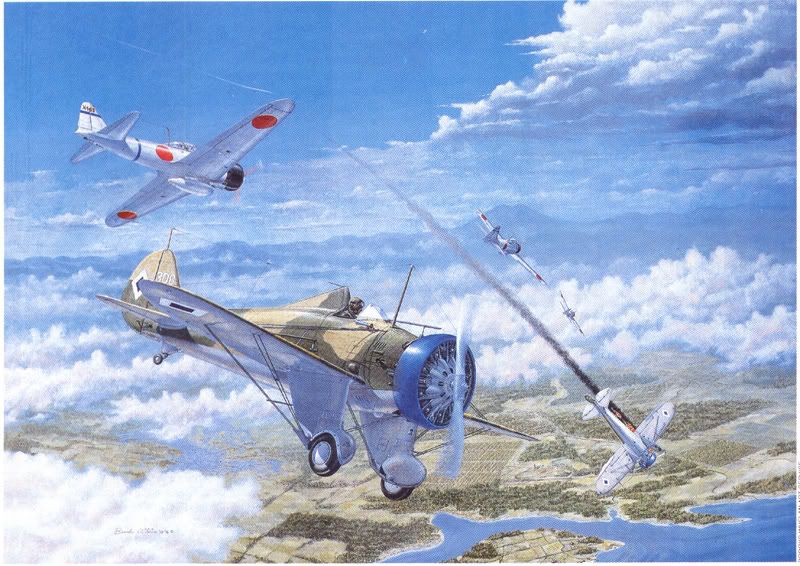
That is a nice link, thanks. The artwork is very nice. I think the painting of the Japanese bomber falling victim to #307 is the first Japanese bomber lost over Clark Field a few days after the initial bombing. |
| Oddball | 24 Dec 2011 5:39 a.m. PST |
Thanks for the info. I was doing some early research for a Check Your 6! scenario book on the PI, Malaya and Java when I came across the actions of the P-26 fighters. Brave men to fly against the Japanese Zeros in that aircraft. |
| Allen57 | 24 Dec 2011 7:28 a.m. PST |
Hi Robert, Great site note the link at the very bottom to another site with more info. Now if we could only get the 3D sculptors to turn out some P26s and B18s. Al |
| Tgunner | 24 Dec 2011 7:47 a.m. PST |
It was a brave man who flew ANYTHING against a Japanese Zero in 1941-1942. The allies just didn't have anything that could really match the Zero in a fair fight. The units who did the best were Navy and AVG units flying F4Fs and P-40s. Those guys learned how to use their planes strengths to their best effect and used superior tactics: the Thatch Weave for the Navy or the AVG's dive attacks. |
| Jemima Fawr | 24 Dec 2011 10:14 a.m. PST |
Al, If you're after them in 1/285th, Scotia-Grendel do the Boeing P-26 and Glenn-Martin B-10. The B-10 in particular is a lovely model (I only just painted three of them yesterday): link Heroics & Ros also do them in 1/300th. They also do the P-35, which was also used in the Phillipines. Nobody does the B-18 yet, however. |
| svsavory | 24 Dec 2011 10:39 a.m. PST |
Great photos, thanks for the link. |
| Allen57 | 24 Dec 2011 2:32 p.m. PST |
Thanks Mark but I am a 1/600 guy. |
| Kaoschallenged | 25 Dec 2011 6:40 p.m. PST |
Thanks. You are right Al. I'm hoping some P-26s and B-18s will be made. I have sent Roe and Arun the 3-views. Robert My 1/600 Aircraft Wargaming Yahoo Group
link |
| Kaoschallenged | 26 Dec 2011 10:53 p.m. PST |
AIRCRAFT IN THE PHILIPPINES 1 DECEMBER 1941
FAR EAST AIR FORCE
HEADQUARTERS AT NIELSON FIELD MANILA TYPE AND MODEL BOMBERS
B-17C 35 B-18A 18 A-20A 0 A-27 9 B-10B 12 FIGHTERS P-40C 0 P-40B 0 P-40 E 107 P-36A 0 P-26A 16 P-35A 52 MISC. (INCL. OBSN. CARGO ETC) 24
34 TOTAL 277 INFORMATION FROM
"U.S. ARMY IN WORLD WAR II"
"THE FALL OF THE PHILIPPINES" CENTER FOR MILITARY HISTORY
UNITED STATES ARMY
WASHINGTON D.C. 1989 Read more: link |
| Kaoschallenged | 27 Dec 2011 2:42 p.m. PST |
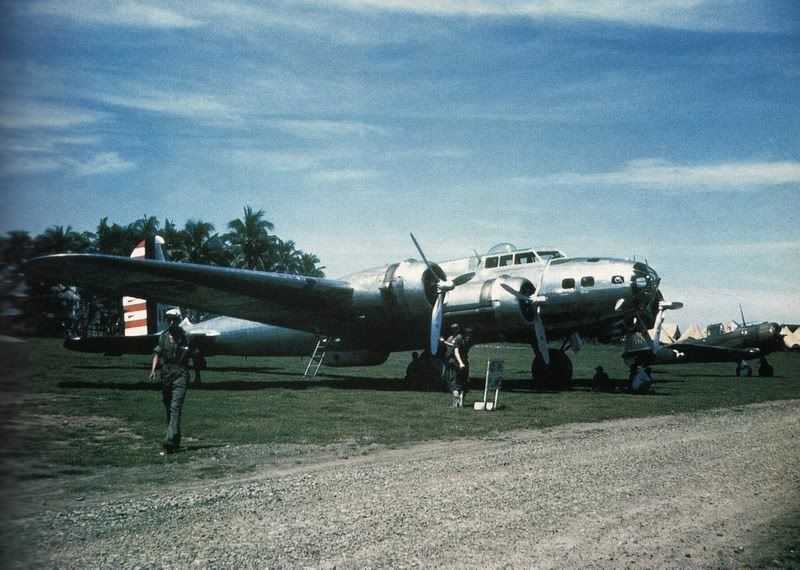
Nice shotb of a B-17 at Iba Airfield. Robert
|
| Bertie | 29 Dec 2011 2:00 p.m. PST |
Allen,
I got my Peashooters in 1:700 from White Ensign. Maybe some still around.
I plan on trying to kitbash a B18 from the Skywave Dakota… should be doable.
Cheers,
Bertie |
| Bertie | 29 Dec 2011 2:12 p.m. PST |
Al,
I got my 1:700 Peashooters from White Ensign. I'm not sure if they are still available.
I plan on trying to kitbash a 1:700 B18 from a Skywave Dakota…should be doable.
Cheers,
Peter |
| Kaoschallenged | 31 Dec 2011 10:57 p.m. PST |
Jesus A. Villamor
Home of record: Manila, Philippine Islands Villamor was one of seven children. He studied commerce at De La Salle College (now DLSU-Manila) in Manila, hoping to pursue a business career. He joined the Philippine Army Air Corps (PAAC) Flying School in 1936 and was sent to the United States for training, and after three years, began flying B-17's as part of the US Air Force's Strategic Bombing Squadron. Upon his return to the Philippines, Villamor was assigned to lead the 6th Pursuit Squadron (now 6th Tactical Fighter Squadron) shortly before the Japanese invasion of the Philippines in December 1941. When his overwhelmed unit was finally destroyed, Villamor continued his war against the Japanese as an intelligence officer. On December 27, 1942 Villamor slipped past the Japanese Navy aboard the submarine "Gudgeon." Establishing a chain of direct communication from the Philippines with General Douglas MacArthur in Australia, he coordinated the activities of various guerilla movements in Luzon, Mindanao and the Visayas. Awards and Citations Distinguished Service Cross See more recipients of this award Awarded for actions during the World War II (Citation Needed) – SYNOPSIS: Captain (Air Corps) Jesus A. Villamor (ASN: 0-888072), United States Army Air Forces, was awarded the Distinguished Service Cross for extraordinary heroism in connection with military operations against an armed enemy while serving as Pilot of a P-26 Fighter Airplane in the 6th Pursuit Squadron, Philippine Army Air Corps, attached to the FAR EAST Air Force, in aerial combat against enemy Japanese forces on 10 December 1941, during an air mission over Air Batangas, Philippine Islands. Captain Villamor led six ancient P-26's in interception of some fifty-four attacking bombers and the harassing tactics of the Filipino flyers minimized damage to their Batangas field. Captain Villamor's unquestionable valor in aerial combat is in keeping with the highest traditions of the military service and reflects great credit upon himself, the Philippine Army Air Corps, and the United States Army Air Forces. General Orders: Headquarters, U.S. Army Forces in the Far East, General Orders No. 48 (1941) Action Date: 10-Dec-41 Service: Army Air Forces Rank: Captain Company: 6th Pursuit Squadron Division: Philippine Army Air Corps
Print Print this citation
Distinguished Service Cross See more recipients of this award Awarded for actions during the World War II (Citation Needed) – SYNOPSIS: Captain (Air Corps) Jesus A. Villamor (ASN: 0-888072), United States Army Air Forces, was awarded a Bronze Oak Leaf Cluster in lieu of a Second Award of the Distinguished Service Cross for extraordinary heroism in connection with military operations against an armed enemy while serving as Pilot of a P-26 Fighter Airplane in the 6th Pursuit Squadron, Philippine Army Air Corps, attached to the FAR EAST Air Force, in aerial combat against enemy forces on 12 December 1941. In defense of the Philippine Islands against Japanese aerial attack, on this date Captain Villamor engaged and shot down one enemy fighter. Captain Villamor's unquestionable valor in aerial combat is in keeping with the highest traditions of the military service and reflects great credit upon himself, the Philippine Army Air Corps, and the United States Army Air Forces. General Orders: Headquarters, U.S. Army Forces in the Far East, General Orders No. 48 (1941) Action Date: 12-Dec-41 Service: Army Air Forces Rank: Captain Company: 6th Pursuit Squadron Division: Philippine Army Air Corps link |
| Kaoschallenged | 02 Jan 2012 1:59 p.m. PST |
Although outmatched by the Mitsubishi A6M2 Zeros of the 3rd Kokutai, Boeing P-26A Pilot, Lt Godofredo M. Juliano of the 6th Pursuit Squadron, Philippine Army Air Corp,
tries to help out squadron mate Lt. Jose Mondigo over Batangas. Mondigo bailed out only to be immedielty set up by the Zeros while helplessly dangling from his chute.
Seeing his countryman's plight Juliano flying No. 306, dived on the enemy fighters and
drove them off while avoiding being shot down himself. Art of Flight, Aviation History Magazine, May 1998 |
| Kaoschallenged | 23 Jan 2012 9:05 p.m. PST |
Though pre-1939 I thought this was interesting :) . Robert "On 6 December 1938 a four-engined German airliner, a Focke-Wulf Fw 200 Condor with registration D-ACON, ditched in shallow waters off of Cavite due to double engine failure, apparently caused by faulty switching of fuel tanks. It was on a promotional tour, on it's first return leg back to Germany from Tokyo. It was not originally planned to fly to Manila but was invited by the German Consul in Manila to show off to the Filipinos and other foreigners. All the crews safely escaped. The constabulary and policemen guarded the aircraft. The aircraft was also inspected by 10th US Navy district, the commander of the Cavite Naval yard and the PC provincial commander. The Germans complained and lost three briefcases "with very important documents on board.". Two small girls drowned when they went on a raft to visit the wreckage until their bodies were found by fishermen. despite the security measure people flocked to see the German plane paying 1 peso each to fishermen to row them to and from the plane.
The aircraft was a total lost due to salt water and many souvenir hunters removed whatever they could. Atlantic Gulf and Pacific Company pulled the plane to dry land.It was eventually dismanted and put aboard a ship back to Germany. The accident may have helped influence Goering's fortunate decision to discard plans for a four engine bomber and thus sorely restrict the range of the Luftwaffe's bomber forces." link link |
| desert war | 23 Jan 2012 11:32 p.m. PST |
very few zeros were used in the invasion of the Philippines. it was mostly an army thing with most of their fighters being earlier ki-27 Nates fixed gear planes though still better then the p-26 with some KI-47 Oscars thrown in while most of the navy planes were the A5M Claude open cockpit fixed gear airplanes a little better then the p-26, the only Zero group used was the elite group Saburo (sp?) was in with just a hand full of Zeros. Japan did not have that many Zeros at that time and most were on the 6 big fleet carriers. Even some of the light carriers still had the A5M at the time. At the Coral Sea Battle about half of the Shohos fighters were still A5Ms and some sources say as late as midway the Zuiho (covering the transports) had 12 A5Ms instead of Zeros. Don't get me wrong this in no way makes the Philippine aircrew any less brave for flying the p-26 and p-35, but there is a myth that every Japanese fighter was a Zero and that they had swarms of them. |
| svsavory | 24 Jan 2012 5:54 p.m. PST |
I just built some pre-painted 1/144 scale Nates that I plan to use against P-40s. I've read that the P-40Es in the Philippines had problems with guns jamming, so I'm thinking of adding a die roll to account for this. |
| Kaoschallenged | 24 Jan 2012 9:18 p.m. PST |
Would anyone know what colors and marking the B-10s of the PAAC wore in 41-42? Now that I have my B-10s from Shapeways in 1/600 I would like to paint up a couple from the PAAC. Robert |
| Kaoschallenged | 27 Jan 2012 3:39 p.m. PST |
Here is an other excellent thread about the PAAC with photos and the information I was looking for :). Robert
link |
| Kaoschallenged | 27 Jan 2012 11:50 p.m. PST |
Great shot of a P-35,P-26s and ZB3A Kesystone Bomber. Robert
|
| Kaoschallenged | 28 Jan 2012 5:12 p.m. PST |
|




 's first experience with 1:4800 scale naval models.