| Trajanus | 24 Aug 2011 3:41 a.m. PST |
OK guys, could be a tricky one here. Oblique Fire – defined as, shooting by a Regiment/Battalion in line of battle, facing to its front but having the individuals turn left or right to fire to one side. Now this is a standard drill maneuver we are talking about with in a formed body not each man turning as he likes. Drill books are quite specific, the Front Rank man must not move his feet from the normal firing stance and so can only turn from the waist. Second Rank men should turn but should only move their corresponding foot by eight inches to allow for not clobbering front rankers. I would assume that for three ranks the back rank doesn't fire, which is generally the case anyway, other wise it would be chaos. Wargames rules tend to tackle this in two ways. They either allow something like 30 – 33 degrees from the perpendicular from the edge of each stand or say 'to hell with it' and only allow fire dead ahead from the base width(s). So – do we have any practical examples of its use – may be few and far between, as to a man in combat fire is fire and it may have happened without note, as its standard drill. What do our reenactment pals do and what sort of angle do they think is practical bearing in mind the books don't actually mention one! |
| John the Greater | 24 Aug 2011 5:32 a.m. PST |
Firing on the oblique is limited to about 15 degrees, anything more than that you would wheel the unit. Reenactors tend to fire at greater obliques because,… well we are not as well trained as the original cast. Rules tend to be either more generous (up to 45 degrees) or too limited (no angle of fire at all). 30-33 degrees seems OK even if it is twice what the regulations call for. |
| Billy Yank | 24 Aug 2011 5:33 a.m. PST |
Was it done? Yes. How effective was it? Probably not very. Once the first shots were fired, I think most everyone was simply firing as fast as possible into the smoke ahead of them. If you are asking how it should be treated in a rules set, my homegrown rules allow a unit to fire at any enemy unit that has a stand directly ahead of one of the firing unit's stands, that allows for some oblique fire, but not beyond the length of the unit. I think it works well and it's simple. V/R Billy Yank |
| Surferdude | 24 Aug 2011 5:39 a.m. PST |
Most ahead only shooting allows the target unit to be hit if only partially in zone which models oblique fire well IMHO. The set we are using at present Nap@War allows this. |
ScottWashburn  | 24 Aug 2011 6:06 a.m. PST |
A 30 degree fire zone is probably reasonable. But as Billy Yank mentions, this is only going to work with controlled vollies and the historical record shows that the fire quickly became independent no matter what the officers might have wanted. With individual fire it will mostly go straight ahead although I suppose if the only enemy target in sight was off to the side you might still get a certain amount of oblique fire even independently. |
| McLaddie | 24 Aug 2011 6:39 a.m. PST |
If you look at actual positioning of artillery in the Napoleonic and later 19th Century wars, oblique was used. Artillerists were just as aware of the advantages as any WWI machinegunner. Tousard, Ayde, Marmont etc. etc. all speak of oblique fire. Fortifications were designed on the principle. So yes, it was used. Bill H. |
| Ligniere | 24 Aug 2011 6:54 a.m. PST |
McLaddie,
My understanding is that positioning a battery front obliquely to it's target in order to increase the fire potential is different to the infantry firing obliquely and not directly perpendicular to their own front. The latter being done to engage with a target that is not immediately in front of them. But I dare say an artillery battery could and would fire obliquely to their own front when necessary. If that makes sense….. ;-) npm |
| Beeker | 24 Aug 2011 7:14 a.m. PST |
Of possible interest here may be a reference in Nafziger's "Imperial Bayonets" to Ney's training of batallions and regiments for assaults on formed lines, starting from a front facing, line position (parallel). I don't have it here – so anyone familiar with it please do correct me – but the sense I have is that Ney wanted to train lines to break into advancing echelons of peletons quickly and then reform so that the line did not 'face-' the enemy but was angled sufficiently so that 1) fire could be directed obliquely into the enemy line.. and 2) the end of the line closest to the enemy could immediately form into an assault column to pierce the line. This probably speaks to the notion that forward facing oblique fire (front to front) is relatively ineffective while 'facing' obliquely (front to flank) was considered to be very effective. Just throwing this out there! Cheers!
Beeker |
| AICUSV | 24 Aug 2011 7:14 a.m. PST |
Oblique Fire – by a battalion or regiment I believe would have been very limited, but by a company or platoon is a different story. In gaming terms – I could see if the rules stated a unit may only fire straight ahead and a 5 stand unit faced off against a 6 stand, there could arise the issue of; the 6th stand firing. After years of re-enacting I have come to the conclusion that rules should be written using "the base" the maneuver element. That is all movement,ranges and such are measured from individual bases. A lot of rules simply state that it takes a % of a units movement to change face or formation, or that ranges are measured from the center of the firing unit. I understand why this is,but think it would reflect better actual conditions if each base was treated as a company of platoon. Each base would have to be assigned a position in line and required to maintain that position (IE the first base would always have to be the first base). Change of face or change of formation would all be by movement allowance of the bases. From a line to column to the right, no problem, but to the left would require first facing right and then counter marching ( yes I know there are other ways to do this, but the result is the same). From column to line ahead or front, each base would have to be measured and it would take as long as as is required for the last stand to reach its position. Once players got the feel for the "drill" the actual rules would could be quite simple. |
| MajorB | 24 Aug 2011 7:19 a.m. PST |
After years of re-enacting I have come to the conclusion that rules should be written using "the base" the maneuver element. That is all movement,ranges and such are measured from individual bases. A lot of rules simply state that it takes a % of a units movement to change face or formation, or that ranges are measured from the center of the firing unit. I understand why this is,but think it would reflect better actual conditions if each base was treated as a company of platoon. Each base would have to be assigned a position in line and required to maintain that position (IE the first base would always have to be the first base). Change of face or change of formation would all be by movement allowance of the bases. From a line to column to the right, no problem, but to the left would require first facing right and then counter marching ( yes I know there are other ways to do this, but the result is the same). From column to line ahead or front, each base would have to be measured and it would take as long as as is required for the last stand to reach its position. You know, that is quite an interesting idea. |
| Trajanus | 24 Aug 2011 7:35 a.m. PST |
If you look at actual positioning of artillery in the Napoleonic and later 19th Century wars, oblique was used. Artillerists were just as aware of the advantages as any WWI machinegunner Sorry Bill, misunderstood my question I think. Yes, I'm aware of the concept of oblique fire in general, my question was purely concerning its use within Regimental/Battalion Drill. |
| Trajanus | 24 Aug 2011 7:46 a.m. PST |
Oblique Fire – by a battalion or regiment I believe would have been very limited, but by a company or platoon is a different story.In gaming terms – I could see if the rules stated a unit may only fire straight ahead and a 5 stand unit faced off against a 6 stand, there could arise the issue of; the 6th stand firing. That's the kind of situation I'm thinking of. Or on in a more extreme case if 5 faced off against 9, centre to centre, what about the 2 stands over, either side? How much of their fire should be allowed to have an effect. In the real world would the Battalion commander order fire by company for the battalion, with separate commands for the outer companies to fire oblique to right and left? I note the 1863 US Regs says that fire by files was expected to be most common so what to do there? Order fire by file and expect each company commander to decide where in the line oblique to right and left becomes a requirement? |
| von Winterfeldt | 24 Aug 2011 8:14 a.m. PST |
Exactly, the most common fire was fire a will, oblique firing is then not possible, in my view oblique fire is very dangerous to the own men, they must be perfectly aligned -maybe a good show on the drill ground but not in reality. |
| bgbboogie | 24 Aug 2011 8:23 a.m. PST |
There is a reference to the Battle of Gettysburg where the US regiment could not fire due to friends covering part of its front, and that they could only fire to the front. I would from this statement say it was not general done, not that it wasn't done. M |
| Allan Mountford | 24 Aug 2011 8:29 a.m. PST |
I think it was the Prussian Regulations that had one angle for firing to the left and another angle for firing to the right. For no other reason than simplicity I would have a maximum of 15 degrees left and right. This still provides a 53 metre chord length at 100 metres range. - Allan |
| TKindred | 24 Aug 2011 9:43 a.m. PST |
At Olustee, the CS units fired by the oblique along the entire front, concentrating their fire first upon one portion of the federal line, then the other. Afterward they concentrated upon the center. Oblique fire is not at all dangerous to the firing unit, as the men ARE trained to do this, and they have their file closers watching to ensure proper fire discipline and position. The real troops were VERY well trained during the ACW period and many regiments could and did execute complex drill and changes of front, etc, quickly and while either moving and/or under fire. |
| spontoon | 24 Aug 2011 9:48 a.m. PST |
Only do it to the left! Otherwise you tend to burn your next file with your vent-flash! |
| ScottWashburn | 24 Aug 2011 9:51 a.m. PST |
AICUSV's idea of forcing units to manuever like the real battalions did is an interesting one. I worked with my friend, Jim Moffet, a few years back to cook up a set of ACW rules that did exactly that. (Jim did 90% of the work, I just contributed a "Formation Change Matrix" which described all the possible manuevers). It sort of worked, but most casual players didn't like the idea that their troops couldn't just move wherever or however they liked. |
| Trajanus | 24 Aug 2011 9:55 a.m. PST |
most casual players didn't like the idea that their troops couldn't just move wherever or however they liked No change there then! :o) |
| twowheatons | 24 Aug 2011 10:05 a.m. PST |
Spontoon – i've been winged a few times. My preference is to be in the rear rank. |
| Edwulf | 24 Aug 2011 10:37 a.m. PST |
Pretty useful if your target is a little to your left or right. I don't see how it would be less effective than a volley fired head one. The same number of balls will still find their mark. HOW often it was needed I don't know. |
| Ligniere | 24 Aug 2011 11:07 a.m. PST |
It's also an important issue when you have a line opposed to a column – the column being on a narrower frontage. If all of the muskets in the line were to hit the column, or at least attempt to hit the column, a large number of the files would have been forced to angle their muskets. Alternatively, and what I believe is probably more realistic, is that they simply fired blind without attempting to aim towards the target – in the smoke and din of battle who knows what they could or could not see in terms of a primary target – the noise of a volley, perhaps, being as demoralizing as the actual impact on the head of the column in some cases. npm |
| MajorB | 24 Aug 2011 11:16 a.m. PST |
If all of the muskets in the line were to hit the column, or at least attempt to hit the column, a large number of the files would have been forced to angle their muskets. I think that's another fallacy. Assuming the column is in fact a column of companies then less than two companies of the line facing them will be able to fire at them even if some use oblique fire, bearing in mind what others have said above about the maximum angle for oblique. |
| Ligniere | 24 Aug 2011 12:01 p.m. PST |
Margard,
I totally agree – and that is why there is no way I would permit a full unit frontage to bear onto the head of a column, unless it can be physically shown to be practical. But there's a problem here too, as reality and the wargames table are often at odds. A wargames unit in column is rarely, if ever, equivalent to the frontage of a true column, whether company or double company [likewise with the frontage a wargames unit in line]. Most wargamers will always endeavor to put as much fire onto the target as possible, and will even angle a line to get a better shot at a column if permitted in their rules. Introducing oblique fire opportunity makes this more possible – and as Trajanus mentions – this was a drill book maneuver – but drill and actual battlefield practice are sometimes very different things. But if it was possible, we have to assume that it could and would be done and is therefore viable on the wargames table – whether or not this was actually the case on the battlefield. The simplest solution is to prohibit any oblique fire, and limit fire to that perpendicular to the unit facing, and equal to the common frontage between the firer and the target. But that approach does seem to favor the narrow attack column over the greater width of the line – and players would soon decide that line made no sense, and everyone would be charging around the field in columns ignoring fire altogether. Not good either……. npm |
| McLaddie | 24 Aug 2011 1:02 p.m. PST |
Trajanus: Yes, I did misunderstand. If we are talking about an infantry battalion or several in line. If it is a matter of part of the line wheeling to gain the oblique, then yes, it was done all the time. If it is a matter of an entire battalion or several remaining perpendicular to the enemy formation, then firing obliquely would be limited, as not all guns could bear on a smaller target, particularly a battalion or larger column 1/5 to 1/10 the wideth of a battalion in line. Physically impossible, but obviously if there were other targets, this is where firing by platoon could maximize hits on all possible targets. Here is what the British Rules and Regulations of 1807 says: Firing in Line p. 113 6th. Oblique firing by battalion is advantageous on many occasions; as when it is proper or time does not give an oblique direction to part of a line, or that their fire in this manner can be thrown against an opening of a defile, the flanks of a column, against cavalry or infantry that direct their attack on some particular battalion or portion of a line. It is obvious that moving the line to face the enemy at the oblique is preferred or else it is a target of opportunity that can be reached by oblique fire. Physically, and reinactors can verify this, each man facing obliquely to fire can only be done to about twenty degrees off the perpendicular in most cases at a target not to the front of those soldiers. Anything beyond that is not physically possible, particularly when loading is taken into account. Face too far to the right and you are laying the musket on the shoulder of the man next to you, left and you are elbowing him in the head. Of course, open files would help with a line firing obliquely, but that would also place more distance between the firing men and the target. Hardee and Casey also address this IIRC, as well as other regulations, but I don't have time at the moment to look them up. Bill H. |
| MajorB | 24 Aug 2011 1:13 p.m. PST |
If we are talking about an infantry battalion or several in line. If it is a matter of part of the line wheeling to gain the oblique, then yes, it was done all the time. But presumably they wouldn't wheel to gain the oblique if by so doing they exposed their own flank to other enemy units? |
| Ligniere | 24 Aug 2011 1:24 p.m. PST |
Margard,
But presumably they wouldn't wheel to gain the oblique if by so doing they exposed their own flank to other enemy units? That's similar to what Colborne did with the 52nd at Waterloo to hit the Imperial Guard Chasseurs in the flank – of course Colborne didn't seem to mind exposing his flank to the enemy, he'd done the same thing at Albuera, but in that case had been handled rather badly by the Vistula lancers and the 2nd Hussars. npm |
| McLaddie | 24 Aug 2011 5:48 p.m. PST |
But presumably they wouldn't wheel to gain the oblique if by so doing they exposed their own flank to other enemy units? Well, yeah. Like most maneuvers and tactics, it was a judgment call. ;-j Bill H. |
| McLaddie | 24 Aug 2011 8:07 p.m. PST |
That's similar to what Colborne did with the 52nd at Waterloo to hit the Imperial Guard Chasseurs in the flank – of course Colborne didn't seem to mind exposing his flank to the enemy, he'd done the same thing at Albuera, but in that case had been handled rather badly by the Vistula lancers and the 2nd Hussars. Actually, it was Stewart and not Colborne who 'did it.' Colburne wanted to place the 3rd and 31st in column at either end of battalions in line, just as Myer did with his brigade later in the battle… to protect against cavalry. Stewart was in a rush to engage the French that he countermanded the orders and 'clubbed' the 3rd in the process. He's the one who ignored the cavalry threats. He was known for being rash and excitable in battle. Bill H. |


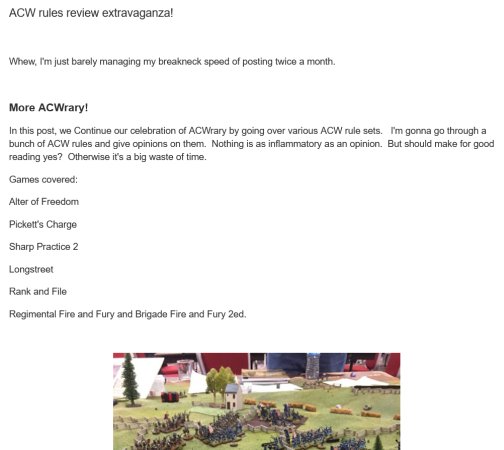


 completes his initial Union force in 1:72nd scale.


