| Edwulf | 03 Aug 2011 7:54 p.m. PST |
I know the union had some ethnic based regiment like the 56th New York (English) the 79th New York (Scottish) and more Irish units than I can count. I know there was an Italian unit (New York again) and a couple of German units from Pennsylvania. Did they have anymore? Jewish? Dutch? Spanish? French? Russian/ slavic? What about the confederates did they have many "foreign regiments" did many foreigners fight for them? Were there any ethnic based confederate units? |
| doc mcb | 03 Aug 2011 8:17 p.m. PST |
There were a fair number of Jews in the Confederate Army -- and Judah P. Benjamin was Jeff Davis' best cabinet officer -- because southern society was much more tolerant of Catholics and Jews than the north. But I don't believe there were any UNITS, just individuals scattered throughout. The nearest might be the Louisiana Tigers, who were mostly Irish wharf rats from New Orleans. I think maybe there was a hispanic cavalry regiment in Texas. |
| SECURITY MINISTER CRITTER | 03 Aug 2011 8:31 p.m. PST |
There were also Cherokees that fought for the south, but no idea how many or their organization. |
| doc mcb | 03 Aug 2011 8:40 p.m. PST |
Yes, there were regiments of Indians on both sides. |
| Edwulf | 03 Aug 2011 8:58 p.m. PST |
Were they irregular? I assume they fought on their own manner and dress with maybe a few items. Did they have regimental numbers or titles? |
| Rhino Co | 03 Aug 2011 8:58 p.m. PST |
A butt load of German units from NY:
52ndnysv.com/nygermanunits.html The Union Eleventh Corps, composed of large numbers of German-speaking volunteers was smashed. |
| vtsaogames | 03 Aug 2011 9:09 p.m. PST |
Note the XI Corps went west with the XII Corps and did quite well. Elements of the XI Corps were merged with the XII Corps to form the new XX Corps, which marched to the sea with Sherman and then came up through the Carolinas. So the 'bad' corps became part of Sherman's veterans. |
 enfant perdus enfant perdus  | 03 Aug 2011 9:33 p.m. PST |
The 15th Wisconsin was almost entirely composed of Norwegian immigrants, the balance being Danes and Swedes. The first all-German (or nearly so) regiment to enter the Union Army was the 9th Ohio who referred to themselves as "die Neuner" but were known to their "English" comrades as "the Ninth Prussians". Their former adjutant, August Willich, later raised the 32nd Indiana (First German). |
| Balin Shortstuff | 03 Aug 2011 9:58 p.m. PST |
I recall finding a Union unit made up of Chinese (really!) but it was so long ago I couldn't cite source or size of the unit, probably very small. I was looking on behalf of an Filipino acquaintance that was interested in ACW reenacting but was worried about fitting in. |
| McLaddie | 03 Aug 2011 10:29 p.m. PST |
Approximately 25% of the Union army's ranks were filled by men who were born abroad. Immigrant soldiers were less prevalent on the other side; only 9% of the Confederate armies were foreign-born. In absolute figures, Germans outnumbered the war's other foreigners. More than 200,000 German-born citizens served the Union in the Civil War. Second in number to the Germans were the Irish. Some 150,000 of their numbers served in the Federal army. There were other nationalities who served. There were mixed regiments like the 39th New York, many of its soldiers fought in the 1848 uprisings. The 39th was made up of several independently raised companies in New York among them were the Garibaldi Guard; Italian Legion; Netherland Legion; Polish Legion;
Hungarian Regiment; First Foreign Rifles. Three companies consisted of Germans, three of Hungarians, one of Swiss, one of Italians, one of Frenchmen, and one of Spaniards and Portuguese. May 31, 1863, the regiment was consolidated into four companies: A, B, C and D; new companies were organized in the field from recruits: E December 8; F December 14; G December 19; H December 30, 1863; I and K in January, 1864. Companies A, B, C and D were mustered out in New York city June 24, 1864, those not entitled to be discharged having previously been transferred to other companies; and the regiment, six companies, E, F, G, H, I and K, retained in service. At least one regiment carried a flag into battle that was also carried by a Hungarian Regiment in their 1848 Revolution. I believe it was the 39th regiment that carried the red, green and white Hungarian Banner during the ACW. The three most prominent and most-written about native Hungarians of the Civil War are Alexander Asboth, Julius Stahel and Charles Zagonyi. Alexander Asboth was appointed minister to Argentina by President Andrew Johnson in 1866. Because surgeons were unable to extract the bullet lodged in his cheek, he was in constant pain and his senses of sight, smell, taste and hearing were impaired. Despite his discomfiture, he strived valiantly to mediate an end to the devastating war which pitted Argentina, Uruguay and Brazil against Paraguay. He finally succumbed to his wounds on January 21, 1868, and was buried in the British Cemetery of Buenos Aires. His remains were reinterred at Arlington National Cemetery in 1990. Eugene A. Kozlay organized the 54th New York Infantry Regiment and was its colonel from November 1861 to March 1863 and again from March 1864 to April 1866. For gallant and meritorious services, he was brevetted brigadier-general on March 13, 1865. A prominent politician before the War of Liberation, colonel Nicholas Perczel commanded the 10th Iowa Infantry. Mór Perczel, one of the leading generals of the Hungarian army in the conflict against the Hapsburgs, was his older brother. For their participation in the war, both brothers were executed in effigy by the Imperial authorities in September of 1851. Just a sample… Many German regiments were organized by regions, so that Rhinelanders served in one regiment while Swabians in another. Bill H. |
| Oh Bugger | 04 Aug 2011 2:19 a.m. PST |
"Were there any ethnic based confederate units?" The Alabama Emerald Guard and I think the 4th Virginia were Irish. |
| Femeng2 | 04 Aug 2011 3:34 a.m. PST |
There was also a NEw York French unit. Gardes Lafayette. |
| Cleburne1863 | 04 Aug 2011 5:02 a.m. PST |
As a matter of fact, the 15th Wisconsin's regimental history is written in Norwegian. The translated copy is hard to find and expensive! |
| doc mcb | 04 Aug 2011 5:03 a.m. PST |
The Ospreys on Indians in the CW are pretty good. |
| zippyfusenet | 04 Aug 2011 5:23 a.m. PST |
Confederate Indians in the Indian Territory were formally organized into units with commissioned officers, such as the First Cherokee Mounted Rifles, raised by Stand Watie who was commissioned a Confederate General and commanded the Indian Brigade. Pro-Union refugees from the Indian Territory were organized as regiments of Kansas Volunteers. I only know of the Confederate Indian Brigade being comitted to a major battle at Pea Ridge. Most of the Civil War in Kansas and Oklahoma comprised raiding and guerilla warfare. Many men on both sides never bothered to enlist, but fought as bush-whackers and bandits, to defend their homes or burn the other fellows'. |
| zippyfusenet | 04 Aug 2011 5:32 a.m. PST |
Definitely no Jewish companies or regiments. Some individual volunteers from assimilated Sefardic and German Jewish families in the Atlantic port cities, north and south. Us Poilisher Yidden have a long, strong anti-militay tradition. "Fight for the Keysor? He'll have to catch me first!" There were some Jewish individuals among the German, Polish and Hungarian revolutionary immigrants who supported the Union. |
| Dn Jackson | 04 Aug 2011 6:00 a.m. PST |
The 10th Tennesse (CS) was an Irish unit. Their flag is in the capitol building in Nashville. The obverse is the first national and the reverse is the famed green field with a harp and sun bursting from the clouds. The 1st VA Battalion is usually listed as Irish though I haven't been able to find much about it. There were two books I read 20+ years ago that would be a greta starting point, "Foriengers in Blue" and Foreigners in Gray" |
| Old Slow Trot | 04 Aug 2011 6:49 a.m. PST |
And one Reb,Max Frankenthal(a.k.a. Fronthall)was honored for heroism during the war. |
| TKindred | 04 Aug 2011 7:51 a.m. PST |
A good read: "The Jewish Confederates" by Robert N. Rosen
link
|
| AICUSV | 04 Aug 2011 8:53 a.m. PST |
The Federal service recognized the following types of troops;
American (native born Anglo-Saxon Protestant)
Irish (foreign born non-Protestant, English speaking)
German (foreign born non-English speaking)
Colored (non-white)
39th NY was listed as a "German Regiment". This listing was done for logistical reasons. Rations, clothing, and pay varied among the different classifications.
Examples, German regiments received different rations; beer instead of whisky and sour kraut. Colored received less pay and I have seen contacts for shoes noting of the pattern for Colored Troops. It appears also that some were issues knitted sack coats as opposed to the standard woven material.
Irish – here the only difference I can locate is the one of religion. Read an account of a Capt. Beerwirth, who was a German born non-English speaking foreign volunteer Officer, who was assigned to the 69th PVI (an Irish Regiment). The ground for his assignment was that he was a Roman Catholic. Note: When the 69th PVI was taken into service, as part of Baker's (later the Philadelphia) Brigade, it was only 8 Companies strong. Two "American" companies were assigned to the Regiment to bring up to strength. These two companies became "Baker's Guard" and were detached to Brigade HQ until the reorganization of the Brigade following Balls Bluff. The last Sergeant Major of the 69th was Italian. As far as asians serving I have only from accounts of two individuals in the Federal service. The 71st PVI did have a group (6 or 8 guys) from Jamaica in the ranks. Individuals need not have been of a particular ethnic back ground in order to join a regiment. The classification of regiments appears to had been applied after the regiment was raised and based upon the majority of the members. This not to say that some regiments didn't have restrictions. For the most part, guys joined units that their friends joined and where they were comfortable with the other men. A few hundred yards away from my home is the grave of a sergeant of one of the US regular cavalry units (I think the 3rd), he was black. So the restriction of non-whites to CT units did not always hold true. |
| Bill N | 04 Aug 2011 9:57 a.m. PST |
Larger scale "ethnic" units in the Confederacy were fairly rare. A couple have been mentioned above. When you move down to the company level it may have been more common, especially in units recruited in part from cities or larger towns. For example I believe the 17th Virginia had one or two Irish companies recruited in the City of Alexandria. |
| basileus66 | 04 Aug 2011 10:00 a.m. PST |
Apparently, several Carlists inmigrants fought with the Confederacy. I've read in a website that a body of Carlists fought in the Tennessee 2nd Division in West Woods, under the command of a former Carlist general, Echegaray, who was slain later in other combat. The same website claims that the 35th Tennessee regiment had a sizeable body of carlist volunteers. I do not put too much faith in the reliability on the article though. It's author is a rabid Carlist, whose sources are more than questionable. Take it with a pinch of salt. |
| donlowry | 04 Aug 2011 11:02 a.m. PST |
AICUSV: Very interesting info! Those classifications actually make some sense. It wouldn't do to assign a German-speaker to an English-speaking regiment, nor vice-versa. Understanding orders would be a real problem. The Catholic-Protestant division might have to do with what kind of chaplain the regiment had. The special shoe pattern for "Colored Troops" might be needed for men who had gone bare-foot for most of their lives (their toes tend to spread out more than those of people whose feet have been confined to shoes most of their lives). Lower pay for Colored Troops, however, was plain old discrimination. |
| Pan Marek | 04 Aug 2011 11:34 a.m. PST |
Absolutley true that there were Irish regiments in the Confederaqte Army. Also true that there were Jewsserved individually in that army. But the assertion that the Soyuth was much more tolerant of Jews and Catholics than the North? For that, you'll need to provide some source. That Judah Benjamin was a part of the CSA government proves little in this regard. |
| HammerHead | 04 Aug 2011 1:27 p.m. PST |
I belive the 39th NY were Italian with its distintive feathered headgear & `zouave type apperance` I would think many `foreign` people were in the south and would have joined the ranks, probabily not in a distintive `unit`.Someone has mentioned the Irish,and native Indians wore standard uniform N&S but kept thier hairstyle there an Indian featured in Cold Mountain film.Some were officers. |
| Oh Bugger | 04 Aug 2011 2:30 p.m. PST |
The 1st Company of the Emerald Guard wore a dark green uniform at least initialy. It does seem that the CSA Irish regiments carried harp and sunburst standards like their USA equivalents. |
| Bottom Dollar | 04 Aug 2011 2:48 p.m. PST |
Speaking of ethnic foreigners fighting in the ACW… link He was a fighter no question in my book and led a very interesting life. |
| doc mcb | 04 Aug 2011 5:01 p.m. PST |
But the assertion that the Soyuth was much more tolerant of Jews and Catholics than the North? For that, you'll need to provide some source. I'm no expert, but I've always understood that to be the case. A quick google yielded this: link "The Jewish racial question was not a social or political issue in the antebellum South: whatever anti-Semitism Southern Jews encountered was primarily economic or religious. Jews suffered office holding disabilities under constitutional religious tests in Maryland until 1826 and in North Carolina until 1868. Jews were widely suspected as financial speculators. In 1846 John C. Calhoun complained that Jews were "notoriously a race of brokers, bankers, and merchants." "Race" in the vernacular lacked its scientific connotations other than to suggest that Southerners looked upon Jews as a class. Such categorical denunciations of Jews became more commonplace during the Civil War and Reconstruction. In 1862 a public meeting in Thomasville, Georgia, called for the "banishing" of the town's Jews. Yet across the South Jews gained racial acceptance. Along with its code of race the South held a code of hospitality. The demonizing of the Jew was directed against the mythic Shylock and Christ-killer rather than the local Jewish merchant, who was more often welcomed as a neighbor and honored as a citizen. In Raleigh, Charleston, Richmond, and New Orleans Jews intermarried with leading gentile families." So, certainly not saying the South was completely tolerant, but RELATIVELY so compared to the north. Possibly because the sharp line was white:black, as opposed to dozens of types of hyphenated-Americans in the north. When I was in college (Rice University, in Houston), we read a sociological study of the effect of Jews who rose to the top in New York and Washington -- wealthy businessmen, cabinet officers, supreme court justices -- yet were not admitted to the prestigious country clubs and other social institutions of the northern elite. I told the prof I was puzzled, because when I was growing up in east Texas (small town, 40,000 population, segregated until I was in high school) the only time I ever went to the country club, which my family couldn't have afforded, was as a guest of my next door neighbor Bobby Cohen (father a physician). We (the prof and I) discussed the extent to which northern and southern patterns are different -- and also rural/small town versus big city, too. This looks interesting, too: link |
| Bottom Dollar | 04 Aug 2011 6:29 p.m. PST |
OK: Here's my serious point,  |
| roughriderfan | 04 Aug 2011 7:24 p.m. PST |
I believe that there was a Chinese national in a New York regiment "john Tommy???" who was mortally wounded at Gettysburg serving there – served in Sickles Excelsior Brigade |
| lobobebo | 04 Aug 2011 7:59 p.m. PST |
Did any of these groups wear distinctive uniforms. I know the Garibaldi Guard wore cock feathers in their hats. Did the other nationalities in the 39th? |
| Edwulf | 04 Aug 2011 9:04 p.m. PST |
I've read that the "highland" unit had a tartan kilt for full dress. |
| HammerHead | 05 Aug 2011 2:22 a.m. PST |
Edwulf, 79th NY they had tartan trews an I`ve read they munited I`ll munity if my partner gives me mush more to do today LOL |
| Edwulf | 05 Aug 2011 4:44 a.m. PST |
Maybe they mutinied because someone suggested the kilt. I believe the kilt was worn by one or two officers on the day they marched off. |
| Dn Jackson | 05 Aug 2011 5:51 a.m. PST |
Here's a web site of a unit that does Garibaldi Guard, the 39th NY. I believe the entire regiment dressed the same, and weren't dressed as zouaves.
garibaldiguard.com Other than that I can't think of any really distinctive dress. The 79th NY Highlanders were dressed in kilts and glengarrys for parade, but probably wore standard Union blue in the field, with only a handful wearing tartan trosers. Most of the distinctions will be in the flags they carries. The Irish harp and there's a German NY unit with a distinctive white background flag. The 79th was, I believe, a fairly small unit when the war started and had to recruit 'natives' i.e. protestant Americans born in the US to get up to strength when the wartarted, so it quickly lost it's Scottishness. |
| TKindred | 05 Aug 2011 6:39 a.m. PST |
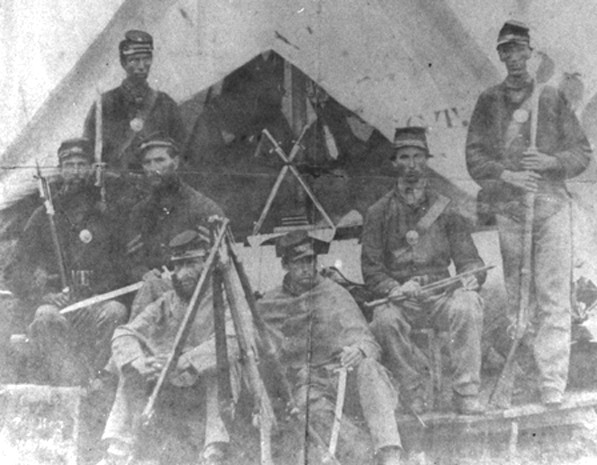
Here's a pic of some men of the 7th Maine Infantry showing a couple of Penobscot indians with them. The 7th had a couple dozen in the ranks. Note also the M1841 rifles with sword bayonets, and the use of the M1855 rifleman's belt & cap box, with the regular cartridge box worn with a sling.
|
| Pan Marek | 05 Aug 2011 8:29 a.m. PST |
McB- Whereas you've provided some good information about attitudes in the antebellum south, you've not provided any examples regarding the antebellum North. Then, you again firmly state that the South was more tolerant of Irish/Jews than the North. How do you know given the lack of a comparison?
The only example you can cite is your relatively recent personal example in Texas. That's just an anecdote, and again you compare it to a "sociologic study" you read in college (when was the "study" done? When were you in college?). More importantly, have you ever spent time in the North for more than a few days? And don't throw that question at me- I was born in the South, went to college in the south, and was stationed in the South in the Army. MY anecdotes most certainly don't match yours. |
| Scott Mingus | 05 Aug 2011 8:30 a.m. PST |
The 6th Louisiana (of the famed Louisiana Tigers) was known as the "Irish Brigade" when recruiting. Almost the entire roster is Irish surnames, and many still spoke Gaelic. Good book by Joe Gannon entitled Irish Tigers. Well worth a read. |
| Bottom Dollar | 05 Aug 2011 9:34 a.m. PST |
doc mcb, apologies for my disjointed, insubordinate ramblings. I wasn't under the impression that either the North or South were overly anti-Semitic. I suspect that much had to do with what kind of Jew you were. Many Jews today, and probably during mid-19th C. are very Americanized, meaning they hardly think of themselves as being anything but American. Whereas, the more orthodox probably see themselves as being a more distinct, separate community. If there was anti-Semitic discrimination it was probably directed more at the latter than the former. Were there orthodox communities North and South ? |
| doc mcb | 05 Aug 2011 10:10 a.m. PST |
I was at Rice 1964-70, and read the book -cannot remember title or author -- in probably 1969. I've already said I'm no expert on this, but I do think that the ante-bellum South overwhelmingly thought in terms of Black and White, with Jews and RCs on the white side of that great divide. The north, with relatively few blacks (the mass migrations to the north came after 1865 and indeed mostly after 1900) and a lot of difficult-to-assimilate immigrants in their big cities, I think was much more concerned with distinctions within the white population. I'll bet there was more discrimination against Irish in New York than in the south. Not sure how you'd measure that. |
| Bill N | 05 Aug 2011 10:17 a.m. PST |
Pan-One difference between north and south could have been how they came in. A few individuals coming in and trying to assimilate probably had a much easier time of things than a larger number moving in who retain their language and other cultural markers. Frankly I wouldn't read too much into regional variations. For example contemporary accounts of Irish canal and railroad workers from the first half of the 19th century in Virginia and Maryland sound very similar to descriptions from further north. |
| Pan Marek | 05 Aug 2011 10:20 a.m. PST |
Very simple. Read books about racial/ethnic attitudes/tensions in BOTH the North and South. Meanwhile, don't make comparisons about same with factual support for only one side of the equation.
Finally, don't compare early 1960's attitudes of anywhere with attidues of the 1860's. |
| Bottom Dollar | 05 Aug 2011 11:06 a.m. PST |
Were there any Jewish regiments ? None that I know of. What happened if members of the orthodox community were drafted/conscripted ? Were they exempted ? Weren't Quakers exempted ? I don't see it as a major issue in understanding cultural/ethnic composition of ACW units. Most Jews who served in the ACW were probably very "Americanized" and probably were seen and saw themselves as American, North or South. I grew up in a community with a lot of Jews. I went to public school and had a lot of Jewish friends. They were American and apart from celebrating Hannuaka while everyone else celebrated Christmas, they were ordinary Americans. Now there is also an orthodox community in the town. They send their kids to Yeshiva, not public school, very often they dress differently, are very kosher, etc… they are a separate community within the community. I suspect there were are similarities with American Jews in the 19th C. |
| Bottom Dollar | 05 Aug 2011 11:19 a.m. PST |
On a personal note, you gotta give props to Jews, even orthodox. They got good family values and while the culture at large bends and sways according to fashion, they don't. Now I painted a house for an Americanized Jewish couple, they weren't kosher or anything. The owner was a great cook and he fed me lunch and dinner. Now one day, he made me lunch. It was gefilte fish. I ate the entire serving, but I wouldn't recommend it or ask for it again :) |
| Pan Marek | 05 Aug 2011 11:25 a.m. PST |
The overwhelming origin of antebellum Jews was northwestern europe (particularly Germany). In Louisiana, there was also a sephardic (mainly Portugese origin) population in NO.
Interestingly, when the huge wave of Eastern European jews began to arrive in the late 19th century,there was initially
considerable tension between the acculturated Jewish community and the newcomers- who were condsidered uncouth and weird due to their language, dress and poverty. There were also theologic differences. More orthodox, and the Hasidim were all from the east. |
| Pan Marek | 05 Aug 2011 11:26 a.m. PST |
Bottom Line-
You're coming dangerously close to the "some of my best friends are…." argument. |
| doc mcb | 05 Aug 2011 11:30 a.m. PST |
I think perhaps I would compare the antebellum south (and to some extent after 1865 as well) to a bi-polar system -- everybody's on one or the other of two sides -- and northern society more as like a multi-lateral system, with far more than two "sides". In international relations, bi-lateral tends to mean fewer conflicts but if one happens it will be really big; multi-lateral can produce a larger number of conflicts but usually smaller ones. It isn't a perfect analogy, I know. But if blacks have been "indelible immigrants" as Boorstin called them -- then the part of the country where they were concentrated would reasonably be expected to have different patterns of ethnic tension than the part where they were a much tinier portion of the population. Boorstin (and this was the "triple melting pot" idea of other historians, too) argued that Russian and Polish Jews would become American Jews, and Irish and Italian Catholics become American Catholics, but skin color could not be changed. So while pretty much every immigrant group goes through a transition period when they are perceived as "alien" and hence dangerous, blacks had a much harder time getting out of that category (even though they typically hadn't been real immigrants in a long long time). This is very broad-brush, of course, and I'm not really committed to it as a proposition to be proved. Like any such generalizations, the exceptions may outnumber the "rule." |
| doc mcb | 05 Aug 2011 11:47 a.m. PST |
But Pan, what if some of his best friends really ARE? Funny thing, one of my three closest friends throughout high school and college was Jewish, a fact that I was unaware of until near the end of 12th grade. He was a young Communist, very nearly, and I was a young John Bircher, and we shared a passion for politics and for arguing about everything. We were our high school classes' only two National Merits, and went off to Rice together. He became an editor of the student newspaper -- this was 1967-68, heighth of VietNam, which I supported and he strongly opposed -- and I would regularly write long letters criticizing his last editorial. Only reason we weren't roommates was we were assigned to different residential colleges, but I remember several occasions when I'd be in his dorm room with him writing an editorial and me already composing a rebuttal, and both of us reading what we were writing to the other. What we shared was a love of debate and a fascination for history and politics, and the fact we were on opposite sides actually was a key to our friendship. But we'd been doing this a couple of years before I realized, from a teacher's comment, that he was Jewish. It had simply never come up (and of course made no difference anyway). So yes, "some of my best friends" . . . . |
| AICUSV | 05 Aug 2011 11:54 a.m. PST |
Other than the well known ethnic uniformed regiments already mentioned. There were a couple of German regiments from up state NY ( I have forgotten there numbers) that did start out in German styled uniforms. One of them By the Brunswick area of the state had black uniforms of the Brunswick pattern ( I think they even had them made in Germany). From what I can recall none of these regiments actually wore these uniforms in Federal service. Unit I'm trying to find out more about, is one that I found just was short reference too. The 1st Hawaiian Heavy Artillery – raised 1863 to guard Pearl Harbor. I can just picture these guys in sack coats, fatigue caps, and grass skirts. |
| Bottom Dollar | 05 Aug 2011 12:19 p.m. PST |
Yeah, one of my best buddies growing up was a Jew. A couple of years older than me, very funny, very smart. He wasn't religious, not kosher or anything, he was an American, but he still saw himself as Jewish. We grew up on the school yard together, football, stickball, basketball he was a good athlete, fast, tough and a DB too. He loved the Dallas Cowboys, the Yankees and the Knicks. He idolized Everson Walls, Tony Dorset, Dominique Wilkins. We war gamed a lot D&D, Risk type stuff mainly with another buddy who was a Korean guy who was adopted by a Jewish American family they weren't observant or anything. He wasn't into sports like me or the other guy, but he loved wargaming and karate and is a tenth degree blackbelt. The other guy recently bought a house directly behind mine which is great. He's got kids and a wife now. One these days I'm gonna talk him into some war gaming :) |