| Oberst Radl | 05 Jul 2011 8:22 p.m. PST |
I'm painting units of pike-armed Moscow Opolchenie for my club's Russian campaigns (club website -- link I appreciated all the information provided earlier to another member's questions: TMP link After following that thread, I had some remaining question about the units' clothing. First question: I presently intend to paint these fellows' clothing with drab brownish-grey, greyish-brown colors, perhaps throwing in some straight tan or brown. Is that incorrect? Second question: Would their hats be black, or some other color? I've ordered figures from Front Rank that seem to have fur hats, and will order others from Essex that say they have felt hats. Third question: Is black the correct color for their boots? Last question: Would the Opolchenie's clothing have a consistent color across all the figures in the unit, or would it vary figure by figure? Thanks for any replies. |
| Femeng2 | 06 Jul 2011 4:51 a.m. PST |
1. As the clothing's color fades, mixed coloers is OK.
2. The ones at the Borodino reenactment were the same fabric as the rest of the uniform – basically burlap.
3. ALmost all should be black, but as they wore non-issue items, some brown would be acceptable.
4. Again, they wore street clothes, so nothing would match. THis is not to confuse them with the Militai jagers, whom were middle class, dressed well and had fowling pieces. Nor the foot-cossack companies, who were dressed as, well, Kazachii. |
| summerfield | 06 Jul 2011 6:13 a.m. PST |
Dear Radl
I think most of your questions will be answered in my book on the Russian Opolchenie. 1. Smocks would be grey, grey brown to light brown. Some officers would be in their old uniform or as much as possible in current infantry uniform so the officers where possible would be Russian Green. 2. The hats would be a variation upon the colour of the uniforms. 3. Black or brown leather. Some may not be wearing boots. 4. There would not be consistency in colour among the foot Opolchenie. Stephen |
| Oberst Radl | 06 Jul 2011 6:14 p.m. PST |
Thanks Femeng2 and Dr. Summerfield, that really helps. Dr. Summerfield, I will buy your book. |
| pwhobby | 07 Jul 2011 8:01 a.m. PST |
I did mine with brown tones and violet:
link
I used HAT box cover art for reference. Figures are F-Rank and Steve Barber, all with muskets cause I use them more as conscript squad then pikemen.
Ciao |
| fuzzy bunny | 07 Jul 2011 10:46 a.m. PST |
|
| rabbit | 07 Jul 2011 1:13 p.m. PST |
Herr Oberst Radl, Firstly are you interested in all Opolchenie or just the infantry? There were cavalry units too. There are 4 series of Russian Uniform Cards, covering the 1812 period I believe the "author/illustrator" was Oleg Parkhaev. Go here for all 128 images, (in groups of 4) link You want groups 17 to 24 for the Opolchenie. You can sometimes get these on ebay, and there is a set on the US (dot com) site as I type (no I am not the seller.) You can see there are numerous different styles of uniform, fur hats, felt or cloth hats, Czapka styles as well as flat cloth caps. If the hat is of fur, I vary the colour of the fur, mostly browns but the odd black or white one thrown in. If the hat is of cloth, I usually go for the same colour as the coat. I often vary the trouser colour and less so the coat colour. If I want a more "uniform" appearance I tend to paint a St Petersburg (green with flat cloth caps with a red cap band) or Moscow unit, (brown or grey with fur hats). See also this TMP link for appropriate figs TMP link ps, your link does not work for me rabbit |
| fuzzy bunny | 07 Jul 2011 2:05 p.m. PST |
Rabbit, what a wonderful resource!!! I had a bit of trouble getting the plates to open but once they did, fantastic. Thanks again. Try this link I think that's the site. Will |
| Oberst Radl | 07 Jul 2011 2:48 p.m. PST |
pwstudio, those are fantastic figures! Thanks rabbit for the links. |
| pwhobby | 08 Jul 2011 1:41 a.m. PST |
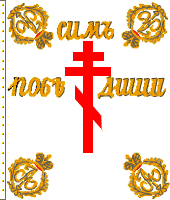
Thank you Radl, if you like you can use this 2 flags:
link They are speculative, but based on russian "holy banners" Ciao PS: nice link rabbit. |
| rabbit | 08 Jul 2011 3:10 a.m. PST |
Lovely banners, thanks they would go well with Steve Barber's figure of a banner bearer, although you would have to scratch build a staff one of the few images on Steve's website. there are too few opolchenie flags so lots of this stuff is guesswork. I have a Russian book on the 1812 army and iy has a few but most need to be photoshopped. rabbit |
| Oberst Radl | 08 Jul 2011 7:21 a.m. PST |
Thanks again pwstudio, got 'em on my hard drive. This is a really helpful thread. I'm going to do 3-4 battalions of Moscow foot militia, and maybe 1 of St. Petersburg. Others are doing the cavalry. |
| DELETEDNAME | 08 Jul 2011 7:58 p.m. PST |
Petersburg opochenie infantry was all uniformed, as shown in the cards. Re-uniformed in green in Prussia in early 1813. 1st Druzhina (called "Мещанская" or Philistines) was from the city and its nearest environs and was composed of volonteers – bourgeois and foriegn residents – armed with Brown Bess muskets – well-provided with boots, gloves, packs, etc. The commander was the colonel commanding the former Petersburg city garrison (recently re-named as an internal secuiry battalion). 2nd through 15th Druzhiny were typical serf opolchenie, each mostly drawn from a specific part of the Petersburg governate (region). 16th Druzhina was composed of late arrivals and the excess numbers over the establishment of the other 15 Druzhiny. All were issued firearms. 17th and 18th Druzhiny were actually from Vologda and Olonets governates (respectively), composed largely of Native Peoples and forresters/hunters. Although some arrived to Petersburg with their own arms, they were issued standard Model 1805 jäger rifles and Model 1808 muskets. They had an excellent record as light infantry and were kept with the army all the way to Paris. A Druzhina was essentially a battalion (nominally 800 x ratnik or private). Actually fielding seems to have been about this at first, but with losses thereafter. Each Druzhina received one of the Petersburg opolchenie flags.
The inscription was "сим победиши" – roughly "by this [cross] shall we vanquish [the foe]". Each Druzhina had about 5 NCO's assigned from the regular army unit that trained it (1st Marine regiment or Voronezh infantry) and about 20 senior soldiers from the former Petersburg garrison (recently reformed as an internal security battalion). These would retain ther army uniforms. The 1st through 15th Druzhiny were formed, initially, into brigades of 3 Druzhiny. These were sent out in two detachments (2 brigades, then 3 brigade), each with a religious section and an icon. The 16th through 18th Druzhiny followed as a third detachment. The two Petersburg cavalry regiments were raised as volonteers, and were quite stylish, as can be seen in the cards. They also stayed through to the end of the campaign. There were additional units raised in Estonia, Livonia and Courland among ethnic Baltic populations:
-- 2 small (~100 men or less each) units of mounted Estonian marksmen – one nominally noble, the other nominally bourgeois
-- 8 "burgher companies" as home foot guards in Riga city
-- an 8-company Livonian mounted "Cossack" regiment
-- a battalion sized light infantry unit (~650 men) of forresters and hunsmen from Courland
-- a company sized light infantry unit (~200 men) of forresters and hunsmen from near Dorpat and Pernau in Estonia
But these would not be, sensu stricto, Petersburg opolchenie. |
| Oberst Radl | 08 Jul 2011 9:46 p.m. PST |
Wow, Deletedname, that's fantastic information! The 17th and 18th seem very colorful indeed, and I might make some of those too. Downloaded your banner for the 1 battalion of St. Petersburgs I may do. |
| seneffe | 11 Jul 2011 3:04 p.m. PST |
One point has me stuck- did the Opolchenie have drummers or other musicians like the Prussian Landwehr or other militia? I've never seen an illustration and indeed in the actual unit strengths quoted in Dr Summerfield's book- drummers etc are not recorded IIRC. So its possible they had no musicians at all, but even quite primitive marching column manoeuvres would have been difficult without them. I've swapped Opolchenie heads onto Landwehr drummers and given them the same drab coat colours as the rest but kept them red swallows nests. That's my best guess but grateful to know if anyone has actual info. |
| summerfield | 11 Jul 2011 3:23 p.m. PST |
Dear Seneffe
Interesting comment that I need to look at. I have always assumed that you would need a drummer to beat time for marching and signalling.
Stephen |
| seneffe | 11 Jul 2011 3:57 p.m. PST |
would be very interested to hear the result of your researches. |
| Oberst Radl | 11 Jul 2011 7:18 p.m. PST |
Yes that's a great question. FWIW, I have Front Rank Moscow Opolchenie, marching with pike on shoulders (forget the code). Anyow, the arms are in the right position to hold 2 pieces of wire over a metal cylinder glued to the rearward leg, to make a drum. That's what I was going to do. |
| pwhobby | 12 Jul 2011 2:43 a.m. PST |
Here: link
I cannot see pics 17-18-21. Did you know where can I find them?
Ciao |
| rabbit | 12 Jul 2011 1:37 p.m. PST |
I too would expect that an infantry unit would either have a drummer or a bugler / hornist to deliver instructions. Don't forget that there were Jager Opolchenie units though I doubt that these units were particularly adept at skirmishing (Mine don't attempt it) Unfortunately, none of the major players make a Russian Opolchenie drummer or a proper standard bearer. You can however use Prussians… Calpe Landwehr with flat hats will do for St Petersburg Opolchenie, alongside Front Rank figs as will Warlord Games Landwehr. Warlord does a nice command group with a drummer figure supporting a wounded standard bearer. @pwstudio, 31 of the cards appear here
auction They are not as good as the ones on the Imperial site but better than nothing. These can sometimes be bought off ebay but they are not common For Moscow, or any of the units with fur or high hats or a Czapka, it means head chopping. As the flat hat (Furazhka) was seemingly a replacement for a shako, and seems to be the ubiquitous hat of the peasantry as well as the nobleman and as the officers of Opolchenie units may have worn a version of their uniform prior to "retirement"; you may want to scatter the odd St Petersburg Opolchenie figure in a Moscow unit and use a Prussian Drummer or Standard bearer to complete your command elements. I do not know how uniform the uniform of these guys was. Pictures of such units in the field appear to show a great deal of uniformity, but that could be artistic licence. Contemporary prints of Cossacks in Paris for example show huge variations. Rabbit |
| summerfield | 12 Jul 2011 1:49 p.m. PST |
Dear All
Please find the organisation of the St Petersburg Opolchenie Cohort on my website showing that they had 2 drummers per company and a Drum Major as part of the staff.
link
Stephen |
| summerfield | 12 Jul 2011 2:01 p.m. PST |
Dear Rabbit
The uniform of the Russian Opochenie was based upon the national dress of the region. Many only had the belts and ammunition issued possibly a hat. Richer regions were able to supply a uniform. The best example as shown in my book is the 1st Cohort of the St Petersburg Opolchenie dressed in green. The flat "Landwehr" cap was used in other regions. It is to get the appearance of non-conformity in units. Remember the Landwehr Cross was modelled upon the Opolchenie Brazen Cross. Hence the title of the book. Cossacks of the various hosts, Tartars, Khirgiz, Bashkirs etc… wore on campaign what they had available. Most figure manufacturers show them as being uniform in appearance and with Western European faces and not the character, and wild hair. Much of this comes from the late 19th century depictions. The contemporary depictions get the character of these frontiersmen.
link An facinating area that some day I might revisit. Corrently looking at the 1813 Streifcorps of Prussian Cavalry. It is interesting Abensburg where the 2e Imperial Guard Division was soundly defeated by Streifcorps of Cossacks, Austrian Hussars and Prussian Freiwilligen Jager. Arguably the best cavalry the French had [Grenadiers a Pied, Chasseurs a Cheval, 1st Guard Lancers].
Stephen |
| seneffe | 12 Jul 2011 3:14 p.m. PST |
Thankyou. Interesting- the link is the first documentary indication I had seen of the existence of drummers. Uniforms? My guess as above is ordinary dress with maybe swallows' nests. |
| summerfield | 12 Jul 2011 3:29 p.m. PST |
Dear Seneffe
Artists are insistent to give Landwehr Swallow nests. This seems to be a 20th century invention by Bourdier (1969). I would suggest the same for Russian Opolchenie. The problems of not being able to identify a drummer then becomes obvious. Swallow nests cost money and there was barely enough to give them some clothes.
Stephen |
| seneffe | 13 Jul 2011 5:22 p.m. PST |
Stephen- could well be. But in your list the St Petersburg Opolchenie even had the luxury of a drum major. Admittedly that proves nothing directly about dress but it shows a degree of aspiration on the part of the unit. Purely conjecture but I imagine if worn at all they would be more likely worn by units from the more prosperous urban areas, maybe also units raised later when the initial rush to mobilise had eased a little. Or perhaps I just like the idea of a small splash of colour….. Never seen anything on the dress of the Smolensk Militia BTW. Obviously it was only partly organised before the French overran the area- so probably even more irregular and 'civilian' than others. But I've never seen an indication of what they were ordered/planned to wear. |




 explores the Master & Commander starter set for Black Seas.