
"Artillery Rate of Fire?" Topic
8 Posts
All members in good standing are free to post here. Opinions expressed here are solely those of the posters, and have not been cleared with nor are they endorsed by The Miniatures Page.
Please use the Complaint button (!) to report problems on the forums.
For more information, see the TMP FAQ.
Back to the Napoleonic Discussion Message Board
Areas of InterestNapoleonic
Featured Hobby News Article
Featured Link
Featured Showcase Article
Featured Workbench Article
Featured Book Review
|
| Louie N | 08 May 2009 3:15 p.m. PST |
I understand factors such as training, fatigue, urgency, and number of crew all play a factor, but for those you that may know/understand. How long does it take, to reload and fire a Napoleonic artillery piece? I'm looking for a basic rough estimate for historical curiosity. I was reading a Osprey book and there was line that stated "the artillery then blasted the town for an hour." That got me thinking of how many shots would that be for any given cannon. Thanks |
| Connard Sage | 08 May 2009 3:16 p.m. PST |
|
| quidveritas | 08 May 2009 3:51 p.m. PST |
So true. You already answered your own question. You can fire off ammo lickety split -- a good crew and a light gun might get off 10 or even 15 rounds a minute. but . . . if you want to reposition and aim the gun after each shot, it takes longer. If you want to see what you are shooting at you have to wait for the smoke to clear. If there was no urgency, I suspect one or two shots a minute might be a good place to start. mjc |
| Connard Sage | 08 May 2009 4:02 p.m. PST |
a good crew and a light gun might get off 10 or even 15 rounds a minute.
Unlikely, that's a ball out of the muzzle every 4-6 seconds. Consider the actions that a muzzle loading cannon requires…
Doh. I've been dragged into another 'angels dancing on the head of a pin' argument |
| summerfield | 08 May 2009 4:16 p.m. PST |
Dear Sir
You might be able to serve a gun quickly but each time a gun is fired it recoils. This could be 10-20 feet depending upon ground, charge, weight of piece and elevation. This would mean the gun would have to be relayed each time. A gun on carriage weights 1-2 tonnes. Think about pushing your car 20 feet repeatedly 15 times in a minute. Normally you would swab out the gun after each shot and this takes time. I refer you to my books (2007) Napoleonic Artillery and (2008) French Artillery of 1824 which gives the contemporary French drill. I doubt you would be able to fire more than 4 rounds per minute from gun of 2m long. The short the bore the quicker you can fire but likely to recoil more as being lighter. Two rounds per minute were obtainable for up to 8-pdrs and 1 round for 12-pdrs. Having served guns and the problems associated, the rate of 15 rounds per minute is amazing. Muller (1780) remarks upon the high rate of fire from prototype 3-pdrs in the introduction. Remember that you need to see what you shoot at and gunpowder produces a huge amount of smoke. Stephen |
| Kilkrazy | 09 May 2009 10:08 a.m. PST |
Naval artillery could fire about one to two rounds per minute, depending on crew quality. The recoil was reduced by cables which were also used to draw the piece back to the gunport after reloading. Shooting ranges were short, often under 500 yards, and the targets were much larger, so aiming was less of a problem. OTOH the guns were heavier, ranging from 9lb to 36lb, which may have reduced the ROF. General Hunt, head of artillery of the Army of the Potomac in the ACW, taught his crews to fire once every two minutes. Obviously it was possible to fire faster, but he considered accuracy more important than ROF. |
| 10th Marines | 09 May 2009 11:55 a.m. PST |
The sustained rate for a 12-pounder field piece was one round per minute. The sustained rate for smaller calibers was two rounds per minute. During emergencies the gun crews would fire as fast as they could, which was a function of training and expertise. Sincerely,
Kevin |
| Major Snort | 09 May 2009 2:02 p.m. PST |
The British conducted several experiments in the early 1800's to determine the maximum rate of fire of infantry and artillery. The artillery crews, serving a 6 pounder, achieved the following rates of fire: Experiment 1 (Hyde Park) 13 rounds in 115 seconds
Experiment 2 (Hyde Park) 13 rounds in 102 seconds
Experiment 3 (Jersey) 14 rounds in 117 seconds The sustained rate of fire in action would obviously be considerably less than this. A good example being Macdonald's battery at Salamanca. This unit was engaged from an early stage, being deployed on the Lesser Arapile, within 800 yards of the French, firing the round that disabled Marmont. They fired 492 rounds in total (not from each gun)from their 6 guns over the course of several hours, including a period when they fired canister rapidly at Bonnet's advancing division. The sustained rate of fire was considerably less than one round per minute. |
|


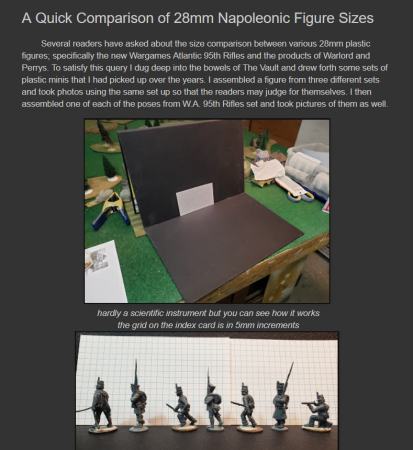


 paints the Dogman from the Flintloque starter set.
