| huevans | 19 Aug 2008 5:34 p.m. PST |
Just wondering what enamel shades guys use to paint musket stocks and also whether guys are trying to represent the wood grain of the gun stock in 28mm? Any suggestions gratefully, etc…. |
| Defiant | 19 Aug 2008 7:31 p.m. PST |
I use enamels on my 15's – not as much detail obviously as in 28mm. I use Humbrol paints but also Modelmaster, I tend to use different colours for different battalions for aesthetic reasons. I use military Brown, leather, rust etc…they work well and I use them for horses as well. |
 Der Alte Fritz Der Alte Fritz  | 19 Aug 2008 11:14 p.m. PST |
On 28mm and 30mm figures I paint the equipment black. Then apply burnt umber or some similar dark brown. Then I depict the wood grain with an old Ral Partha Paint color called Dunkel Brown – sort of a carmel color. I didn't used to do this, but after seeing the technique on other figures I gave it a try and found that it doesn't take a lot of extra time. |
| Martin Rapier | 20 Aug 2008 1:31 a.m. PST |
I use Humbrol, paint shades are the same in acrylic or enamel. Rifle stocks I do with Humbrol Natural Leather folowed by a heavy wash of Windsor & Newton peat brown ink. Makes them look like polished wood without picking out the grain. |
| Andy ONeill | 20 Aug 2008 3:39 a.m. PST |
I don't do woodgrain but I highlight.
Colour depends on the type of wood.
I seem to recall using "brown bess" in humbrol enamels many years ago.
Dark brown base, lighter warmer brown highlights, glaze over with burnt umber to link the two. If you paint stripes for woodgrain they are always way too wide if you paint one per stroke.
If you want woodgrain, paint it early.
Slap on a dark brown colour.
Then paingt the woodgrain with a light warm cotrasting brown.
Use an old or cheap brush with no point.
Lightly load, wipe off most paint on a piece of paper then deliberately "split" the bristles by dabbing the point on your sheet of paper.
Then flick across the wood in the direction of the grain.
One swipe should do it. You will not get ot right first time – so practice on something else first.
The loading is the key. Alternatively and laboriously.
Two colours mixed and a whole buncha figures.
(Easier with faster dryiong acrylic actually ).
Over dark basecoat, paint a light line on each.
Then return to the first one and paint a dark line almost completely covers the first.
Do em all.
Light line almost completely covers dark….
Repeat until you are tearing your hair out. Anyhow the principle of this is that it is easier to paint up to an "edge" than draw a fine line on it's own and get it regular with both side right. |
| donlowry | 20 Aug 2008 5:06 p.m. PST |
On my 15s, painting with acrylics, I use Vallejo's "Mahogany." I don't add grain (tried it once but it wasn't worth the effort at that scale, so stopped). |
| julianmizzi | 20 Aug 2008 11:46 p.m. PST |
For my 15's using Acrylic , I
* paint musket GW Scorched Brown
* Paint over musket using Brown INK
* Paint black for the base of the musket barrel.
* Paint in the barrel leaving a black shadow using GW boltgun metal
* paint musket metal hoops and firing mechanisms gold. For Enamels,
* Paint the barrel brown
* With Oil paint , small mixture of Raw Sienna / burnt Umber and turpentine for thinner – coat the musket.
( The differing ratios of sienna & Umber gives variety to each musket )
* gently wipe off excess oil paint from musket till u obtain a result your happy with .
* let dry . |
| julianmizzi | 20 Aug 2008 11:47 p.m. PST |
doh – for enamels , first point should have been paint musket not paint barrell . Further point , You can paint oils over acrylics but will have trouble painting acrylic over oils ! |
| vojvoda | 22 Aug 2008 9:06 a.m. PST |
Any images you guys?
VR
James Mattes |
| sma1941 | 22 Aug 2008 9:08 a.m. PST |
Just a note here – the most commonly used rifled muskets; the Enfield and Springfield, did NOT have brass bands holding the barrel to the stock. Many modern recreated muskets have brass bands as a cost saving measure. No musket or smoothbore (in general issue) had a brass lock plate. So watch that brass or gold – switch to gun metal or sliver. |
| julianmizzi | 11 Sep 2008 11:07 p.m. PST |
Heres a close up of how my painted muskets look using inks picture |
| Steve the Wargamer | 12 Sep 2008 4:35 a.m. PST |
Black undercoat, dry brush white, Vallejo "woodgrain" over the top… |
| baner1 | 12 Sep 2008 9:07 a.m. PST |
I don´t know how to paint musket stocks with enamel,
much easy to do it with aclylic.I paint wood grain with three layers,using Valejo model colour:burnt umber148-
beige brown135-add a bit of ivory to beige brown and do the last highlight
picture
Hope this help. |
| Cardinal Hawkwood | 02 Oct 2008 5:01 a.m. PST |
I thought Prussian muskets woodwork was painted black…Duffy mentions it somewhere..if they did it I bet a lot of others did as well.. |
| Marc the plastics fan | 07 Oct 2008 8:53 a.m. PST |
CH – that is interesting, but I wonder how many gamers would want to just have black muskets, rather than a lovely warm brown? |
| Bob Faust of Strategic Elite | 07 Oct 2008 9:07 a.m. PST |
I don't paint wood grain or the green lines in splinter B camo because it doesn't look realistic to me at that scale. If you were close enough to see the wood grain in a rifle stock or the green dashes in the camo, and then had the person wearing/carrying the item move away from you until he was far enough away to be the size of a 28mm model in your vision, you wouldn't see any of that detail. Eyes either. It's a trendy effect, but I've never been one for following trends. |
| Cleburne1863 | 08 Oct 2008 3:27 a.m. PST |
I once had a friend wear a Wehrmacht splinter camo poncho and made him stand far enough away from me so that he was the same size as a 1/35 scale figure I held at arms length. You could still see the brown/green lines at that distance. |
| 1stJaeger | 08 Oct 2008 6:47 a.m. PST |
CH: I doubt the stocks were uniformly blackened already in the XVIIth I like Baner's colour a lot (but then again I like his painting style in general) :-)) Agree with Faust23! It is trendy, not realistic! Cleburne: that would still be bigger than a 28mm, wouldn't it! I believe it is possible to see the lines on the poncho though! The colours (field and stripes) would be different on purpose, whereas the grain on the wood is almost the same colour! I would not paint it! Your muskets might look like tanned zebras afterwards! Cheers Romain |
| Supercilius Maximus | 08 Oct 2008 8:59 a.m. PST |
<<CH: I doubt the stocks were uniformly blackened already in the XVIIth.>> Actually, British troops in the Monmouth Rebellion, Glorious Revolution and Augsburg/Nine Years' War conflicts had blackened musket stocks. I think they'd gone to brown by the WSS. |
| Supercilius Maximus | 08 Oct 2008 8:59 a.m. PST |
Sorry, that should be ENGLISH troops; not sure whether the Scots did or not at this time. |


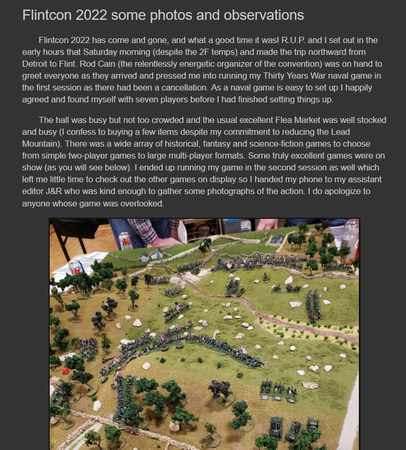


 gets in his first game of the convention.
