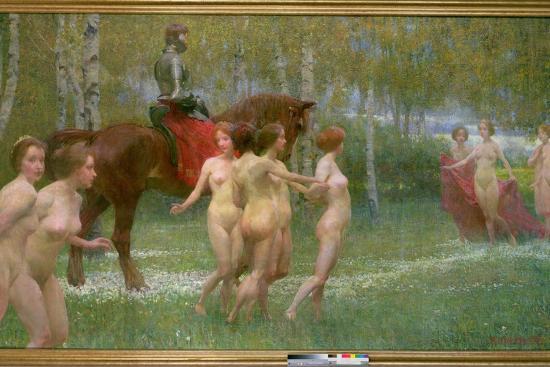
will be complicated to paint their uniforms while they are in action*
In the Burgundian camp, around the time of the Battle of Morat in 1476, there were two thousand girls of ill repute and in the army of Charles V going to Italy "there were four hundred courtesans on horseback, beautiful and brave as princesses, and eight hundred on foot, also well-fitted"
The number of prostitutes in the armies has varied. If the Duke of Alba, in the 16th century, when he governed the Low Countries, tolerated as many women as the soldiers wanted to have, in the 16th century it seems that for a long time only eight were allowed per company. We also read, in Barante, that in 1465 a superb company of horse archers, commanded by Captain Mignon, had crossed the city of Paris in good order, well equipped, lacking nothing and followed by eight girls of joy riding in the wake of their Company with their confessor."
Charles III, Duke of Lorraine, in an ordinance of 1587, prescribed "that no man of war coming to the service of his army may take with him any private woman, unless she is his lawful wife; otherwise that all women that there will be in this army are public and common to all, and that in each company there may not be more than eight women and; those common to all, under penalty of being whipped and deprived of their clothes; and if it is proven that some soldiers or officers have such women for their private use, let them be chased away and that from now on they will be ineligible to be able to have war duties, besides that they will be punished at our pleasure."
Let us add that sometimes women were not enough and that the Pope's army which entered France, at the time of the League, and which was famous for its unbridled dissolution, was also followed by a herd of goats!
Such promiscuity was bound to lead to an unheard-of spread of skin and venereal diseases.
But women were recognized as a necessity for the soldier. It was for this reason that they were tolerated in the army to avoid the collective ruts of the "unbridled soldiery". But then how can we explain that at several times they were enlisted; how above all can we explain the punishments that were sometimes inflicted on these unfortunate women and the severe sentences taken against the soldiers found in their company?
These punishments were multiple and their study is quite curious
It is the exposure of the woman in an iron cage, in a public square, it is the violent expulsion, but pure and simple, from the camps and garrisons, or preceded by the whipping or the passage by the belts.
The whipping was in honor in the sixteenth century. Strozzi, promulgated in 1570 (December 10) an ordinance in crude style (which we transcribe as is while asking to excuse his free language):
"No soldier will be able to hold more than one cad (servant) and no  , on pain of the surplus cads and s being whipped… Anyone found with girls of joy following the Bands will be broken, and the said naked girls will be flogged with rods."
Louis Arnaud.
Médecin Aide-Major de 1ère classe.
La France médicale
*however…yellow sign or not
link
Beaucaire: a mark on the left arm (a tattoo or ink or…? See Toulouse below).
Berne: red cap.
Bristol: striped hoods.
Castres: a man's hat and a scarlet belt.
Florence: gloves and bells on the head (in the hair?) and high-heeled slippers.
Languedoc: a cord belt.
Leipzig: yellow cloak trimmed with blue.
London: striped hoods.
Mantua: white cloak and badge on chest (what on earth did it look like?).
Marseille: striped tunic.
Milan: black cloak.
Nîmes: a sleeve of a special colour.
Pisa: a yellow headband.
Strasbourg: black and white sugarloaf hat.
Toulouse: a mark on their sleeve.
Venice: yellow scarf.
Vienna: yellow scarf.
Zurich: red cap.
(…) As to the badge in Mantua, we have a 1516 record from London where a prostitute was punished by being made to wear a yellow H (for harlot). Perhaps a Latinate equivalent (P)? Interesting how yellow and stripes are also seen as being godless."
Here we do see that yellow scarfs and trims has been a sign of prostitution in Italy, but in Northern Europe it was not the case. The other thing that is quite apparent is how non-uniform the laws are. So the fact that yellow scarfs were a sign of prostitution, really doesn't say anything about Denmark, let alone particular cities.
So to conclude…
There were no laws on the books about yellow dresses or head gear in the danish kingdom at any point in the medieval or renaissance period – as far as I can find. However in the late medieval period, sex workers was required to wear cheep clothing and red and black caps. What they actually wore, is anyone's guess.
If anyone know differently, please let me know. Do anyone know any historical sources that link yellow dresses with prostitution in Northern Europe in the middle ages? If I am wrong I would love to know.
by Sidsel
Blog, Clothing history, Female, History, Medieval, Reenactment, Renaissance





 receives a gift from his wife…