
"Japanese Barrage Mortar" Topic
4 Posts
All members in good standing are free to post here. Opinions expressed here are solely those of the posters, and have not been cleared with nor are they endorsed by The Miniatures Page.
Please use the Complaint button (!) to report problems on the forums.
For more information, see the TMP FAQ.
Back to the WWII Discussion Message Board Back to the WWII Aviation Discussion Message Board
Areas of InterestWorld War Two on the Land
World War Two in the Air
Featured Link
Featured Workbench Article
Featured Profile Article Paul Glasser previews the upcoming expansion set for War at Sea.
|
Please sign in to your membership account, or, if you are not yet a member, please sign up for your free membership account.
| Kaoschallenged | 16 Jun 2013 8:56 p.m. PST |
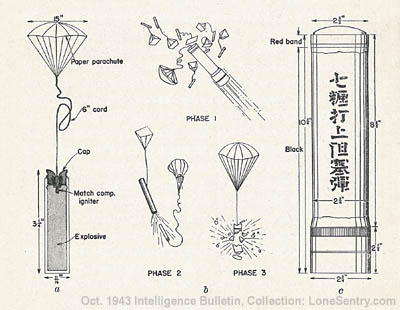
In addition to the Long Aerial Mine there was this deployed by the Japanese. The Japanese Barrage Mortar. Robert "Japanese Barrage Mortar: Deny the Air by Jake Holman Jr. Last week we featured the Brandt compressed gas mortar, a surprisingly effective quirky weapon of World War I. Jump forward to World War II and we'll examine another odd mortar, this one fielded by the Japanese throughout the Pacific theater. It was the Barrage Mortar, an uncomplicated piece of tube artillery with devastating aspirations beyond its simplicity. Coming in two calibers, 70 mm and 81 mm, the barrage mortar was a simple smoothbore tube and wooden base, jammed into the ground with an 18 inch steel spike.With it's muzzle orientated up, the mortar was ready to be fired. But how did it work? And what was the ammunition used? Muzzle loaded, the mortar expelled a round skyward. But instead of arcing down onto enemy formations as its primary purpose, the barrage mortar was designed to destroy aircraft in flight. The mortar round was a form of cannister or cluster munition. When the round reached its maximum range, around 3,000 feet, a cap on the round would seperate, ejecting seven high explosive mines.
The three inch mines, each made of a steel casing, would then be pulled from the canister by a small silk parachute. Each mine had its own paper parachute that caught the air and slowed it's descent, as well as igniting its fuse.Fired into the path of low-flying, oncoming aircraft, the parachute mines would be ignited by a delay fuse attached to the drogue parachute resulting in an explosion that was supposed to harm oncoming aircraft. There is no evidence any aircraft was damaged or brought down by the barrage mortar.The larger 81mm mortar round operated in a similar fashion, with its submunitions on a delayed fuse exploding 12 seconds after the parachute deployed A secondary purpose of the barrage mortar was as an anti-personel weapon, floating down onto the enemy and exploding overhead."
link
link
|
| redbanner4145 | 17 Jun 2013 5:48 a.m. PST |
Great,now the next time some idiot in a game asks can he fire his mortars at the airplanes we'll have to let him. |
| Lion in the Stars | 17 Jun 2013 12:38 p.m. PST |
Great,now the next time some idiot in a game asks can he fire his mortars at the airplanes we'll have to let him. Did you buy the AA ammunition for them?  |
| Kaoschallenged | 17 Jun 2013 6:34 p.m. PST |
LOL. Let him and see his expression when they don't work LOL. Robert |
|



 takes on quite a substantial project.
