Tango01  | 20 May 2013 8:16 p.m. PST |
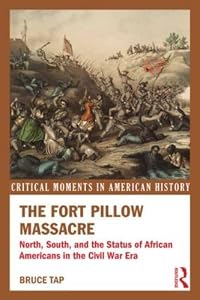
This sounds as an interesting book: "The Fort Pillow Massacre: North, South, and the Status of African Americans in the Civil War Era"
"On April 12, 1864, a small Union force occupying Fort Pillow, Tennessee, a fortress located on the Mississippi River just north of Memphis, was overwhelmed by a larger Confederate force under the command of Nathan Bedford Forrest. While the battle was insignificant from a strategic standpoint, the indiscriminate massacre of Union soldiers, particularly African-American soldiers, made the Fort Pillow Massacre one of the most gruesome slaughters of the American Civil War, rivaling other instances of Civil War brutality" Question: Were there other military actions like this one were the African-American soldiers suffered a massacre after their surrender? Thanks in advance for your guidance. Amicalement
Armand |
| Dan Cyr | 20 May 2013 8:21 p.m. PST |
Yes, note the murders after the battle in western Virginia at Saltville in 1864. There were other mass killings of black Union troops when prisoners in LA for example, as well as other locations. The southern command worked hard to keep the events as quiet and covered up as possible out of fear of retaliation. Dan |
| TKindred | 20 May 2013 9:29 p.m. PST |
I am still not convinced that Fort Pillow was an intentional act of murder. I have no reason to doubt Forrest's report that black troops, having surrendered, at a later point tried to take back their weapons and continue the fight. At that point, it was THEY who had violated the rules of war and, as such, were beyond the pale of normal treatment as POW's. It was the federal government who took it to heart to label that situation a "massacre" and then use it for political currency as propaganda. |
| FABET01 | 21 May 2013 3:05 a.m. PST |
Soldiers attempting to escape is not a violation of the rules of war. It's is in fact, his obligation. Under the Leiber code, adopted by the US in 1863, a soldier may be killed during the attempt to escape, but may not be executed after as punishment. |
| Cleburne1863 | 21 May 2013 3:08 a.m. PST |
It depends what you mean by intentional. Did the Confederate officers give orders before the assault to kill every black soldier and take no prisoners? Probably not. Did they keep killing black soldiers, and quite a few white ones (I think only 1 white officer survived) after they had surrendered? No doubt in my mind. To me, that is a massacre. I just finished the section on The Crater in Edwin Bearrs new book on the Petersburg Campaign. In that instance, it appears there were orders to take no prisoners among Mahone's brigades in the last counterattack. They had heard that the USCTs were giving no quarter (and they weren't), so the orders came down to do the same. |
| Billy Yank | 21 May 2013 6:28 a.m. PST |
In the aftermath of Olustee/Ocean Pond, Confederates bragged that they killed virtually all of the black wounded. It must be remembered that no quarter for uniformed black soldiers and their officers was the default position of the Confederate government for most of the war. Billy Yank |
| Tango01 | 21 May 2013 10:44 a.m. PST |
Thanks for your guidance guys!. Amicalement
Armand |
| TKindred | 21 May 2013 10:57 a.m. PST |
Soldiers attempting to escape is not a violation of the rules of war. It's is in fact, his obligation. Under the Leiber code, adopted by the US in 1863, a soldier may be killed during the attempt to escape, but may not be executed after as punishment. This is correct. However, according to numerous reports, the black soldiers who had surrendered didn't attempt to escape, per se, but rather attempted to recover their arms and continue the fight. THAT is absolutely forbidden by the rules of war. Once surrendered, you have a de facto agreement between yourself and your captors that you will not attempt to reenter combat and they, in turn, must make a reasonable effort to provide protection, shelter, sustenance and medical care. Once you break that agreement, the captors MUST consider you a risk to their safety, and untrustworthy. At that point, the black soldiers could be considered no different than partizans, and beyond the pale of the rules of war. |
| vtsaogames | 21 May 2013 11:10 a.m. PST |
It seems that Black soldiers at Fort Pillow must have taken up arms again at a much higher rate than White soldiers, since they had a much higher rate of fatalities. Since there were numerous other times that Black soldiers were killed after surrendering, it casts some doubt on Forrest's version. He did go on to lead the Ku Klux Klan post war. |
| 79thPA | 21 May 2013 11:16 a.m. PST |
I think there is plenty of reason to doubt Forrest's version of events. It's like the Japanese high command blaming Nanking on a "few" rogue soldiers. |
| coopman | 21 May 2013 11:31 a.m. PST |
Author Shelby Foote didn't think that this was a massacre. His research being way better than mine, I will cast my vote with him. |
| Cleburne1863 | 21 May 2013 12:49 p.m. PST |
Yeeeeahhh. Foote was an author first and foremost. I'd take the research of actual historians over him almost any day. And I like Foote a lot. |
| Chris B | 21 May 2013 12:53 p.m. PST |
Reports by officers on both sides here: link |




 bases them up.