| Jemima Fawr | 15 May 2013 9:33 p.m. PST |
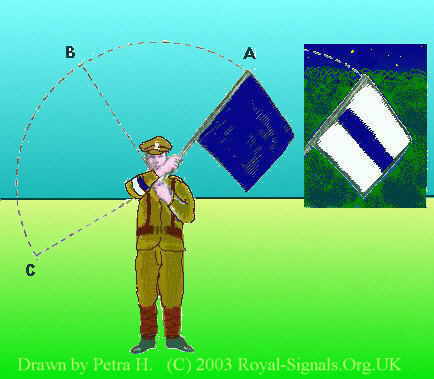
I've got a WW1 British Army flag-signaller waiting to be painted, but I have something of a dilemma: The figure is modelled with two signalling flags, but everything I can find states that the British Army signalled with a single flag (either dark blue for use against a light background, or white with a dark blue stripe, for use against a dark background). The same sources go on to state that two-flag signalling was the Royal Navy's preserve (their flags were smaller and were diagonally-split red/yellow). So does anyone know if the British Army ever used two-flag signalling in WW1, WW2 or between the wars? If so, what were the flag colours? |
| Kaoschallenged | 15 May 2013 10:27 p.m. PST |
|
| NY Irish | 16 May 2013 4:22 a.m. PST |
When I learned semaphore in the Boy Scouts (not very useful in the 80s) we used two flags, red and white diagonal split. Is that American only? Civilian? |
| Etranger | 16 May 2013 4:23 a.m. PST |
Airfix had a British signaller with 2 flags so it must be right, mustn't it? |
| NY Irish | 16 May 2013 4:26 a.m. PST |
Imperial War Museum has a card set from WWI that shows two flag semaphore signaling link |
| Jemima Fawr | 16 May 2013 8:36 a.m. PST |
Robert, Yes, those are demonstrating the official British Army single-flag method. I also saw some film of an amphibious exercise in Dorset, circa 1938, where a signaller was using the stripey single flag. NY Irish, I think that counts as proof that at least some Army units used the naval two-flag method (if possibly unofficially), so thanks very much indeed. I wonder if they used the red/yellow RN-type flags or the blue/white Army-type flags or something else altogether? |
| NY Irish | 16 May 2013 9:20 a.m. PST |
Again the Imperial War Museum: link
I don't know if these are naval or land use, but I think they belonged to the signaler on the HMS Warrior. IWM has a second card set for the WWI era; the caption reads: Set of First World War period semaphore signalling self-instruction training cards, for British Army use. The set, entitled 'The Semaphore Simplified', was published by Gale and Polden Ltd Wellington Works, Aldershot. |
| monk2002uk | 16 May 2013 10:04 a.m. PST |
The British army 'Training Manual – Signalling Part II (1914)' has illustrations of signallers with two flags. Robert |
| Jemima Fawr | 16 May 2013 10:10 a.m. PST |
Cheers Robert, I don't suppose it shows or mentions flag colours, does it? |
| monk2002uk | 16 May 2013 12:13 p.m. PST |
"The flags are 2 feet square; they are of two colours, white with a blue horizontal stripe for use with a dark background, and dark blue for use with a light background." Robert |
| Jemima Fawr | 16 May 2013 1:04 p.m. PST |
Cheers Robert, so they were using the same flags for both methods. I thought that might be the case, but wanted to be sure. |
| number4 | 16 May 2013 7:32 p.m. PST |
It's no coincidence that those are the colors of the Advanced Signaler qualification badge that I had on my uniform.
|
| Kaoschallenged | 16 May 2013 7:36 p.m. PST |
Just Blue and what Mark. If you look at alot of the Royal Signals insignia the only colors are blue and white. Robert |
| Jemima Fawr | 17 May 2013 6:21 a.m. PST |
However, the Royal Signals and Royal Engineers (according to their official history) only used their own, patented single-flag method, as discussed above. From further reading, it would appear that they were the 'keepers of the sacred flame' as far as signalling went. WW1 brought about a sudden and urgent need for other units to adopt signalling methods and for some reason they seem to have preferred the RN's two-flag method (or something closely resembling it) rather than the single-flag method already used by the Royal Signals/Royal Engineers. I think this was down to the simple fact that the Royal Signals method required the signaller to understand Morse, whereas the RN method simply transposed flag positions for letters. With infantry battalions doing their own thing (initially, at least), it wouldn't therefore, necessarily be automatically the case that infantry battalions and other units would use the Royal Signals pattern signalling flags, hence why I wanted to check. |