| Warboss Nick | 08 May 2013 4:11 a.m. PST |
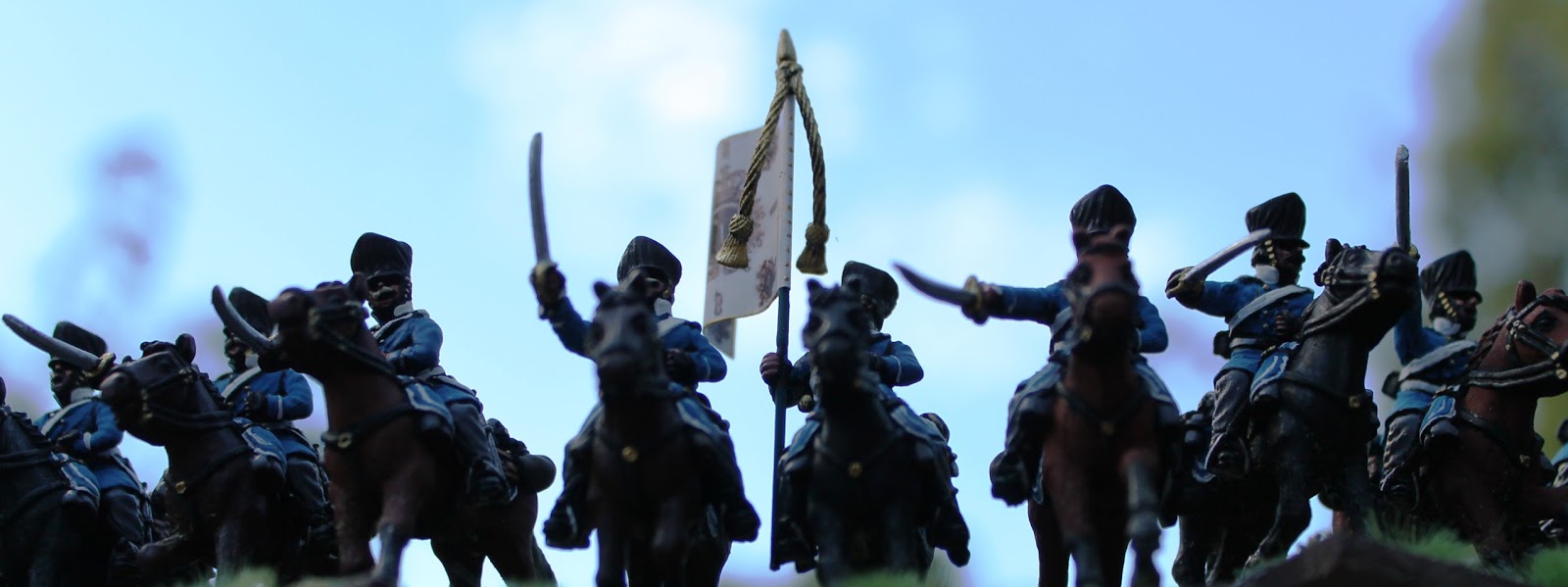
I'm fairly new to Napoleonics and in the process of putting together a prussian brigade with cavalry support. When reading about cavalry I got the impression that prussian dragoons filled more of a heavy cavalry role than french dragoons and did not fight dismounted. Am I right in that assumption? (and if not where do I get dismounted 28mm models?) Thanks a lot in advance! |
| Sparker | 08 May 2013 4:25 a.m. PST |
Yes, Prussian Dragoons in the late war period were rated as Heavy Cavalry with a shock role.
Although after his losses in Russia, Napoleon rebuilt his Heavy Cavalry arm with veteran Dragoons withdrawn from Spain, so the French Dragoons had pretty much a shock role in Western Europe 1813-14 too… |
| Keraunos | 08 May 2013 5:04 a.m. PST |
throughout this period, dragoons would fight on horseback, unless there were no horses the idea of dragoons riding up into battle and then dismounting to fight was pretty much gone by this time. - so earlier in the wars the french had regiments of dismounted dragoons, but they were mounted once the horses wee found (from Prussia, basically), although they took a while to become any good. so you really don't need dismounted prussian dragoon figures – and would only need french ones if you were using one of the earlier armies that had them (I think one of the plastics ranges does dismounted figures within its dragoon box). they are more of a completist thing to have than anything else, and you will do fine without them. |
Frederick  | 08 May 2013 6:04 a.m. PST |
Agreed – actually, in most of the major armies over 1813-14 dragoons fought as battle cavalry – and for big battles would be unlikely to dismount |
| summerfield | 08 May 2013 6:14 a.m. PST |
Dear Nick
It depends upon definition. Light Cavalry
Cavalry armed with sabres and/or lances
Heavy cavalry
Cavalry armed with a straight heavy sword (pallache) Light cavalry
Mounted on smaller horses of 14-15 hands
Medium cavalry
Medium horses of 15-16 hands
Heavy cavalry
Heavy horses of 16 hands The Dragoons would come out as light cavalry (sabre rather than Pallasche that they gave up in 1811) and medium cavalry. They were more likely shock troops and were little different to the Prussian Cuirassier who post 1814 received cuirass. Stephen |
| Runicus Fasticus | 08 May 2013 10:02 a.m. PST |
Keraunos
The plastic set you refer to is the Perry Brothers French Dragoons. The dismounted figures are best suited for a skirmish game as they are in heavy riding boots. The Dismounted French dragoons of 1806 would have had shoes and leggings with the heavy boots in the supply trains till horses were found to mount the regiment. Warboss Nick In 1813 and 1814, The Prussians assigned some cavalry to their infantry brigades. These would act as scouts ,messengers ,and skirmishers when needed. They would also go into battle and support their brigade when needed. From my little bit of research it looks like this was usualy about 2 squadrons of regular cavalry and maybe 2 squadrons of landwehr depending on the brigade. This was always changing to meet the needs of the campaign. Do you have a certain Prussian Brigade in mind and what time period …I might have the OB and let you know what cavalry units would be there. Runicus Fasticus |
| matthewgreen | 08 May 2013 11:39 a.m. PST |
As I recollect the post-reform Prussians had a single manual for all types of cavalry, and distinction between the different types in battlefield role was minimised. I think cuirassiers were nevertheless reserved for shock duties, but that dragoons were used as general purpose cavalry, along with hussars and uhlans, with whom they were often brigaded. |
| Sparker | 08 May 2013 2:13 p.m. PST |
I wouldn't put too much emphasis on who was brigaded with who – French Cuirassier Divisions often had Lancer Regiments under command to bear the brunt of outpost duties and watching the flanks, but I don't think that makes Cuirassiers light horsemen! |
| huevans011 | 08 May 2013 3:46 p.m. PST |
As I recollect the post-reform Prussians had a single manual for all types of cavalry, and distinction between the different types in battlefield role was minimised. I think cuirassiers were nevertheless reserved for shock duties, but that dragoons were used as general purpose cavalry, along with hussars and uhlans, with whom they were often brigaded. My view also. The mixed brigading and the conversion to a light cavalry sabre suggest strongly that they were no longer considered strictly shock cavalry, like the Kuerassiers |
| 14Bore | 08 May 2013 4:56 p.m. PST |
From Peter Hofschroer's Prussian Landwehr and Landsturm 1813-1815
I CORP Reserve Kavallerie – Oberst v. Jurgass
Brigade of Oberst Graf Henkle v. Donnersmark
Nr 2 1st Westpreuss Dragoner Regt – Oberst v. Wuthenau 601 men, 14 jag
Nr 3 Littauisches Dragoner Regt – Oberstlt v. Below 597 men, 174 jag
9th Brigade – Maj Gen v. Klux – Nr 6 Neumark Dragoner Regt – Oberstlt v. Borke 579 men, 67 jag
Cavalry Brig of Oberst v. Treskow (ad int)
Nr 4 2nd Westpreuss Dragoner Regt – Oberst v. Treskow 612 men, 54 Jag
Nr 1 Dragoner Regt Konignin – Oberstlt v. Brockenhausen 646 men, 148 Jag
Nr 5 Brandenburg Dragoner Regt – Oberstlt v. Lottum 601 men, 98 Jag
I use them as you see above, the Cavalry Regt's in Infantry Brigades stepping up against Cavalry or as breakthrough or saving grace against infantry. |
| Keraunos | 08 May 2013 11:13 p.m. PST |
from what I have seen of the actual battles in the liberation period, the Prussian brigading of cavalry was more of an organisational thing than a tactical employment plan,
the cavalry always seem to end up being grouped together for an effective massed mounted force on the field itself as per standard doctrine of the later wars. happy to be presented with evidence to the contrary., but I've not found it yet. interestingly, in 1806, they also had cavalry brigaded with their divisions, hussars, dragoons and fusiliers forming a light brigade within each division, and cuirassiers a heavy division.
but this was stripped off on the day of battle – notably by blucher. Bressonnet even reports (partly because the lights had all been sent off into an advance guard) that Prussian cuirassier squadrons were detached at auerstadt to perform scouting duties on the flank. I suspect that the success of the Prussian hussars 50 years earlier had blurred the distinction between fighting and scouting cavalry for them. |
| summerfield | 09 May 2013 1:58 a.m. PST |
Dear All
In 1813-14, it must also be remembered that each Prussian cavalry regiment had at least a company of Freiwillger Jager attached and these would be classed as light cavalry. Often these were detached to form the flying columns.
Stephen |
| Sparta | 09 May 2013 11:12 a.m. PST |
Kearunos – again I agree totally with your evaluation of the prussian cavalry. I believe that the prussian 1813 brigades in combat were infantry formations like the other nations, with the cavalry staying back in reserve on the corps level. |
| seneffe | 09 May 2013 4:41 p.m. PST |
Even in 1806, several Dragoon regts were mounted on lighter 'Polish' horses (actually cheap light animals bred all over eastern Europe and western Russia). I think (lwu) that only Regts 1,3,5 and 6- the latter two double strength- were still mounted on the larger and more powerful 'German' horses, which however all the Cuirassiers still rode. In 1812-14, the situation had got much worse due to post 1806 French requisitions and very few mounts suitable for heavy cavalry remained in Prussia- all of which were concentrated in the Cuirassier regts. Everyone else, Dragoons included, made do with 'Polish' mounts. So, I'd say that the 1812-14 Dragoons were definitely general purpose cavalry- closer to light than heavy on the whole. |
| Sparker | 09 May 2013 7:27 p.m. PST |
A couple of arguments here don't bear close scrutiny, or at least lead to some rather counter intuitive conclusions: 1. The function of cavalry can be determined by the way its allocated to higher formations. Problem – French Cuirassier divisions included Lancer Bdes. 2. The function of cavalry can be determined by the size of the horse allocated. Problem – these exigencies applied even more to the French, including their Cuirassier Regiments, which notoriously were smaller than British Light horse. The driver here was availibility, or lack of, not function! So unless you accept that French Cuirassier Regiments, shock cavalry par excellence, were also operating in light cavalry role, you are going to have to rethink your criteria, or abandon all pretence of a consistent approach to this question. My remains takin actual operation employment as the evidence of function, which is why I cling to my original post that Prussian Dragoons were considered Heavy/Battle/Shock cavalry. |
| seneffe | 10 May 2013 5:23 p.m. PST |
Cling on by all means- it's only wargaming. Couple of points though which might bear slightly closer scrutiny….. The French Cuirassier divisions to which you refer above actually only included Lancer detachments during the 1812 campaign- not before or after. More importantly, the establishment records show that only one or two companies of lancers were attached- ie a squadron at very most- not a brigade as you suggest above.
The Chevaux-Legers Lanciers regts from which these small detachments were drawn were only converted from Dragoons the previous year and in 1812 were still in the process of being rebuilt almost from scratch- having transferred almost all of their men and all of their horses to the Dragoon Regts still in Spain, so Lancers were only ever a token element of the French Cuirassier Divisions, though they fought well enough. Once brought up to Regt strength from 1812-15 they served in Lt Cav Brigades and Divisions not with Cuirassiers any more. Horse size/breed. At times during 1812-14 the French Cuirassier units were on average mounted on horses of smaller size than quoted for some British light Regiments. Notorious might be overdoing it a bit though. Actually- I've only been able to find one British light regiment for which this is conclusively the case- the 10th Hussars in 1813. This was the Prince Regent's own favourite regiment- on home service since 1809. As you will also know though, the prescribed mount sizes of all British line cavalry 'heavy' and 'light' were the same from 15.1 to 15.3 hands- so all were about French Cuirassier horse size.
But the French/British comparison is a bit of a red herring. Though not notoriously larger than French Cuirassier mounts, the horses of all British line cavalry were uniformly on the large side by continental standards. The variation in mount sizes between cavalry units and the consequent functional differences between them was much less apparent in the British army than most others. But this is about the Prussian Dragoons. The fact is that they were mounted like Hussars and Uhlans and could be brigaded with them- making reserving or concentrating the Dragoons for decisive shock action quite difficult. The Cuirassiers received all the available larger horses and were always as far as I can see brigaded only with their own kind. The case for the Cuirassiers as heavy cavalry is obvious, that for the Dragoons much less so in my view. |
| huevans011 | 10 May 2013 8:30 p.m. PST |
Sparker, the function of cavalry is determined by its function. The lancer squadrons were attached to the Cuirassiers in Russia as a foraging element and this was the first and last time this was done. Regardless of how the French cuirassiers stacked up against the extremely well mounted British horses, they were well mounted by Continental standards and better mounted than any other type of French line cavalry. Cuirassiers were kept in independent formations and were only used as battlefield shock cavalry. This distinguished them from other types of cavalry. So the point remains that the Prussian dragoons seemed increasingly to be used as generic all purpose cavalry, culminating in their being absorbed into brigades with hussars, ulans and landwehr regts in 1815. |
| Musketier | 11 May 2013 9:55 a.m. PST |
There certainly is a trend towards the universal cavalryman in the post-1808 Prussian army, much as for the infantry. However with rather more than enough hussars, lancers and Landwehr cavalry for outpost duty, the Dragoons would mostly be spared such deployments and be husbanded as battle cavalry – especially in Blücher's 1815 army which didn't have any cuirassiers. |
| seneffe | 11 May 2013 12:33 p.m. PST |
Musketier- if the Dragoons in Blucher's 1815 army were intended to be husbanded as battle cavalry, it is then perhaps surprising that the Dragoon regts were all mixed in with light cavalry units and fought alongside them. The 2nd and 5th Dragoons were brigaded with Uhlans and Hussars in 1st Cav Brigade I Corps; the 8th Dragoons was brigaded with Hussars in the 2nd Cav Brigade IV Corps. I've never seen any indication that the Dragoons were spared outpost, foraging and other mundane duties. The Dragoons were senior in the army list to the Hussars and Uhlans, and of course had the tradition and title of one of the heavy branches of the old army- but beyond that there's really not much practically to distinguish them by 1812 onwards. |
| Sparker | 11 May 2013 3:44 p.m. PST |
Very well, it has come to this. I am ever reluctant to quote the Hoffie, as some say that one only needs to mention his name and he will appear, but needs must when the devil drives: As the 18th C progressed the distinctions between the Cuirassiers and the Dragoons became blurred. The Cuirassiers became lighter in that they gave up their armour, and the Dragoons gradually dropped their mounted infantry role, concentrating on being line cavalry….Of course, the cuirassiers still tended to be seen as the 'heaviest' cavalry, being on the largest mounts, the Hussars and Uhlans as light, and the dragoons as somewhere in between; but the main differences were gradually eroding… Peter Hofschorer, MAA172, p.12 I think its reasonable to assume, given the above, (and in this matter I think the Hoffie is reliable), that in the absence of Cuirassiers, Dragoons would assume the heavy role, faut de mieux! (And, for me, they are absent, as in 1815, since Calpe don't make 'em yet!) |
| huevans011 | 11 May 2013 4:56 p.m. PST |
Why would Hoffie be reliable on this point without producing any examples or proof of his point of view? |
| Sparker | 12 May 2013 3:45 a.m. PST |
Well to be fair to the bloke (now I never thought I'd be writing that!) the Osprey format doesn't lead itself to extensive citations and references, and frankly, until this post started, I wouldn't have thought it that controversial to suggest that Dragoons were used in the Heavy role, particularly in the absence of Cuirassiers. In terms of evidence, he refers to the changes in emphasis in the various iterations of the Cavalry regs which ultimately, post Reform, aim toward the 'Universal' cavalryman alluded to above, although he states that point wasn't reached until 1914. |
| Gozzaoz | 12 May 2013 4:27 a.m. PST |
I'm sure my question may be answered somewhere in TMP.
But what is the issue with Peter Hofshoerers version of the truth. I may be way out of line here but is it that he disagrees with the blindly accepted British version of the truth? Correct me please! |
| huevans011 | 12 May 2013 8:08 a.m. PST |
Sparker, I would agree that in 1813 the dragoons may have been intended as a stand-in for heavy cavalry, as they were brigaded separately. By 1815, this had changed and they were brigaded with hussars and ulans. This suggests that they were simply seen as another type of generic cavalry. Then there is the fact that they were given light cavalry equipment – shako and sabre, instead of straight, heavy sword and helmet. If we want to continue this chat, we should try and check how the dragoons were actually used in 1815. Are there any accounts of them charging en masse in dragoons-only formations? Did they do duty on the picket line, etc? Kuirassiers were ALWAYS brigaded separately in the Prussian army, including 1815. |
| Sparker | 12 May 2013 7:44 p.m. PST |
I'm sure my question may be answered somewhere in TMP.
But what is the issue with Peter Hofshoerers version of the truth.I may be way out of line here but is it that he disagrees with the blindly accepted British version of the truth? Correct me please! Several issues with the Hof monster, many of which touch on legal proceedings which may still be ongoing, so I'll tread carefully… My main beef is that in his otherwise excellent trilogy about the German contribution to the Waterloo Campaign, he accuses the Duke of systmatically attempting to 'do down' the Prussian contribution to victory… No problems with that – his opinion. But as a professional historian, his complete failure to even mention Wellington's Waterloo Despatch, in which the Peer fulsomely praised the Prussians and ascribed the outcome plainly to their 'timely intervention', smacks either of gross incompetence, or a deliberate attempt to ignore the obvious primary source simply because it didn't align with his thesis… Upon being approached about is on this forum, his immeadiate response was to inquire about my sanity. It subsequently emerged that this was his habitual response to criticism. I won't mention the lawsuits, google is your friend… …the blindly accepted British version of the truth? Where would I find that please – I don't think I've come across any account that has ever taken that line written since about 1870! |
| Sparker | 12 May 2013 7:52 p.m. PST |
Then there is the fact that they were given light cavalry equipment – shako and sabre, instead of straight, heavy sword and helmet. Yet another canard I'm afraid – the Prussian 1811 Cavalry Sabre was not a 'light cavalry' weapon, nor indeed a 'heavy' weapon, merely an attempt to rationalise production, and serve as a GP weapone, for issue to ALL Cavalry Regiments, designed to incorporate the point of the Pallasch with the curve of the sabre:
|
| Musketier | 14 May 2013 9:19 a.m. PST |
The brigade structure seems overrated as a reference: Belonging to a particular cavalry brigade didn't prevent a regiment of hussars or Landwehr cavalry from being parceled out in single- or two-squadron penny packets to the infantry brigades for a whole campaign. The more pertinent questions are: What was the troopers' background, and how where they employed in battle? On the first point, the "new" dragoon regiments were not recruited and trained from scratch. Rather, we find that in the 1807/08 reshuffle, veteran front-line Dragoons were considered "compatible" with Cuirassiers: CR 5 combined with DR I to form the new DR 2, half of DR VI became new CR 2, and DR XIII was absorbed into new CR 1. With Prussian cavalry severely downsized, those men would still have formed the core of the regiments a few years later.
As late as 1811, upon creation of the Normal-Eskadron to demonstrate the new drill, cuirassier and dragoon drafts were lumped together as its Dragoon company, while hussars and uhlans made up the Hussar company. As for employment in the 1815 campaign which I was referring to, dragoons were not entirely spared outpost duty (DR 2 holding the Thuin sector) but once battle is joined, we find them in full-regiment charges (DR 2 at Bois de Fleurus against the Empress Dragoons, DR 5 at Waterloo) or at the core of charges by larger formations (DR 2 again under Blücher at Ligny), while Hussars and Uhlans screen the advance, deal with enemy cavalry pickets, chase infantry skirmishers or play a supporting role in major charges. – No doubt Papa Blücher would have liked a brigade of Cuirassiers for shock effect, but in its absence he used the next-heaviest cavalry he had. |
| huevans011 | 14 May 2013 3:55 p.m. PST |
Interesting points, Musketier. But I would also inquire whether the ulans and hussars were not charging side by side with the dragoons, as opposed to screening the charge. Sparker, the sabre is a specific light cavalry weapon, being identical is design to the British and Austrian light cavalry weapons and quite distinct from a cuirassier sword. The curve allows it to slash as well as thrust and this makes it more useful for outpost duty and skirmishes. Heavies normally charged in massed formations giving point. They had no skirmish function whatsoever. The Prussians had a specific dragoon straight sword which was withdrawn in 1811 (?) and replaced with the sabre. |
| Sparker | 14 May 2013 8:55 p.m. PST |
Yes indeed Hue, and my point above was that the 1811 sabre which replaced the Heavy Cavalry Pallasch was issued out of production rationalisation, and not because of any change in function. I am not sure if it was also issued to cuirassier regiments prior to or before the Dragoons, but if not it would simply have been a question of availibility. It was an improved GP model designed to incorporate the best points of both types of blade and was rolled out to ALL cavalry regiments eventually. My point being what sword any particular group of Regiments were equipped with post 1811 was merely a question of logistics, not function or role. |
| Warboss Nick | 16 May 2013 3:10 a.m. PST |
I never expected that what I thought was a simple question for those familiar with the period and the prussian army would turn into such a lively discussion. Even more so many thanks for the numerous and detailed answers! Runicus: I am looking at the 3rd brigade at Ligny but plan to play various scenarios. The reason I asked was the tabletop teaser scenario "Plunder an pillage" which has dragoons fighting mounted and dismounted for the attacker. |
| huevans011 | 16 May 2013 4:53 a.m. PST |
Sparker, my understanding is that the cuirassiers kept their cuirassier straight sword and it was not replaced by a curved sabre model. The curved sabre issued to the dragoons is very specifically a light cavalry weapon. It was normally issued to hussars and light dragoons. The exact same pattern equipped the British light cavalry and the Austrian hussars. |
| von Winterfeldt | 16 May 2013 5:37 a.m. PST |
According to Jany : Der Preußische Kavalleriedienst vor 1806, Berlin 1904 "However the Dragoon Regiments were mounted not anly longer on heavy but on light horses with the exception of two regiments since the 7YW."
P. 9 Footnote **, on page 26 Only the regiments Czettritz (Nr. 4) and Bayreuth (Nr.5) retained German remounts for 2/3rds of the strength, all Dragoon regiments retained German saddles.
So – I would class Prussian Dragoons in line with huevans011 arguments as light cavalry from 1808 onwards.
As for dismounted dragoons in 1813, in in case I remember correctly – only a fraction of a squadron were armed with carabines – othterwise for a specific scenario – the Freiwillige Jäger squadron would be more suitable to act as mounted and dismounted skirmishers, there they should have been all armed with a carabine. |




 returns to Flintloque to paint an Ogre.