| Ironwolf | 06 May 2013 1:53 a.m. PST |
"1776 the Continental Congress authorized the raising of three artillery regiments at Washington's request. The regiments were to contain 12 companies, each of six sergeants, six corporals, six bombardiers, six gunners, and 28 matrosses. The company was led by one captain, one captain-lieutenant, one first lieutenant, and two second lieutenants." So my question is how many guns per company?? Was the number of guns per company the same for British, German and French artillery units? How many of you use Horse & Limber miniatures on the table for your artillery units? What about Matrosses on the table to drag your artillery units around?? |
| MajorB | 06 May 2013 2:02 a.m. PST |
"each of six sergeants, six corporals, six bombardiers, six gunners, " - so presumably having six guns. |
| Ironwolf | 06 May 2013 2:18 a.m. PST |
Major Bumsore,
I was assuming the same thing. But I found a couple other sources that listed three and four guns in a company. So I'm guessing six is whats listed on paper. But 3 – 4 guns is what a company might be able to put in the field? Which brings me back to my post on here. To get information from some very knowledgable researchers on here. lol |
| gunnerphil | 06 May 2013 3:22 a.m. PST |
I think that the answer might be, that Congress meant there to be 6 guns to a company. But it would then depend on what was available, so often only 3 or 4. |
| Supercilius Maximus | 06 May 2013 4:22 a.m. PST |
In the British service, a "company" of gunners usually served a "brigade" of four guns – at least in the larger calibres (12pdrs, 18-pdrs and howitzers). The smaller calibres (6-pdr and 3-pdrs) tended to be distributed in two-gun sections to either a line infantry brigade (3-4 battalions) or a single Grenadier/Light Battalion. This wasn't a hard-and-fast rule, but seems to have been the norm for the AWI and French Revolutionary Wars. Whilst it is likely that six was the number of guns Congress had in mind, be aware that:- 1) some of the NCO ranks, especially the sergeants, were specialists and they would be involved in matters other than directly manning the guns; 2) groups of men would be detached to man the guns in forts and other military establishment (the 18th Century being what it was, such detachments were seldom drawn from a single company, to spread losses/manpower reduction etc); 3) some NCOs would be detached to look after vehicles etc in the artillery park – the artillery was also in charge of ammunition for the whole army, for example – and to train up new recruits for their own units, and other non-artillery units that might have to man cannon (you didn't want these guys handling large quantities of black powder until they were sufficiently savvy); 4) the company would retain some men as "spares" to replace losses in action (and from sickness/desertion/etc) during the campaign/mission; 5) shortages of manpower would mean a company was often under official/paper strength anyway. |
 John the OFM John the OFM  | 06 May 2013 6:57 a.m. PST |
There is a huge difference between "authorized" and "available", particularly in the AWI.
I have never worried about artillery organization, going instead by what the scenario required. Whenever possible I use limbers. They hinder deployment, crowd the roads and look cool. What's not to like? Matrosses and similar bricole bearers are just part of the 3 or 4 figures I put around the gun. Sorry I can't be more artistic or original.  |
| number4 | 06 May 2013 9:37 p.m. PST |
The correct answer is: NONE. In the 18th century, artillerymen were formed into marching companies, trained and equipped as infantry. The guns themselves were a separate entity, being held at the Artillery Park for the most part, except for the light battalion guns which "lived" with their parent infantry brigade. Gunners were trained to operate every type of ordnance and served on rotation between garrison duty, the park and the infantry gun detachments as needed. At the commencement of a campaign, the artillery companies were marched to the gun park and drew their assigned pieces which could be anything from six pounders to mortars. Bricoles were not issued to our used by either British or American artillerymen until the 19th century. Continental artillery doctrine and procedure was modeled on and identical to the British RA during the Revolutionary war and immediately after. Note that even a "light" six pounder weighs 1900lbs with empty side boxes, so can be pulled by men with drag ropes – but not very far or very fast – and that's on flat, level ground. Given there's no train of artillery (just civilian contractors) in this era, big guns are essentially fairly static once in position. The light battalion guns however were designed to be moved by manpower alone on the battlefield (much like a heavy machine gun of WWI); weighing in at around 500lbs (plus ammo chests), these are a lot handier and more mobile but the same comments about rough terrain apply. |
| Ironwolf | 07 May 2013 4:27 a.m. PST |
I'm not sure what Bricoles means? When I looked it up all I could find was reference to billards? lol Thanks everyone for the comments. To finish out my 15mm AWI I need a few more light guns and crew. In place of using limbers with horses. I was thinking basing some extra figs on a stand and using them as Matrosses to drag the guns around. But I'm thinking if I'm able to field two guns per Brigade (3 – 4 battalions)along with Matrosses per gun and a supply wagon per brigade. That should round out my AWI for gaming. |
| Supercilius Maximus | 07 May 2013 5:27 a.m. PST |
<<I was thinking basing some extra figs on a stand and using them as Matrosses to drag the guns around.>> That tended to be the principle form of movement – over and above simply running them back after they had fired – when the guns were in action anyway. |
| number4 | 07 May 2013 1:08 p.m. PST |
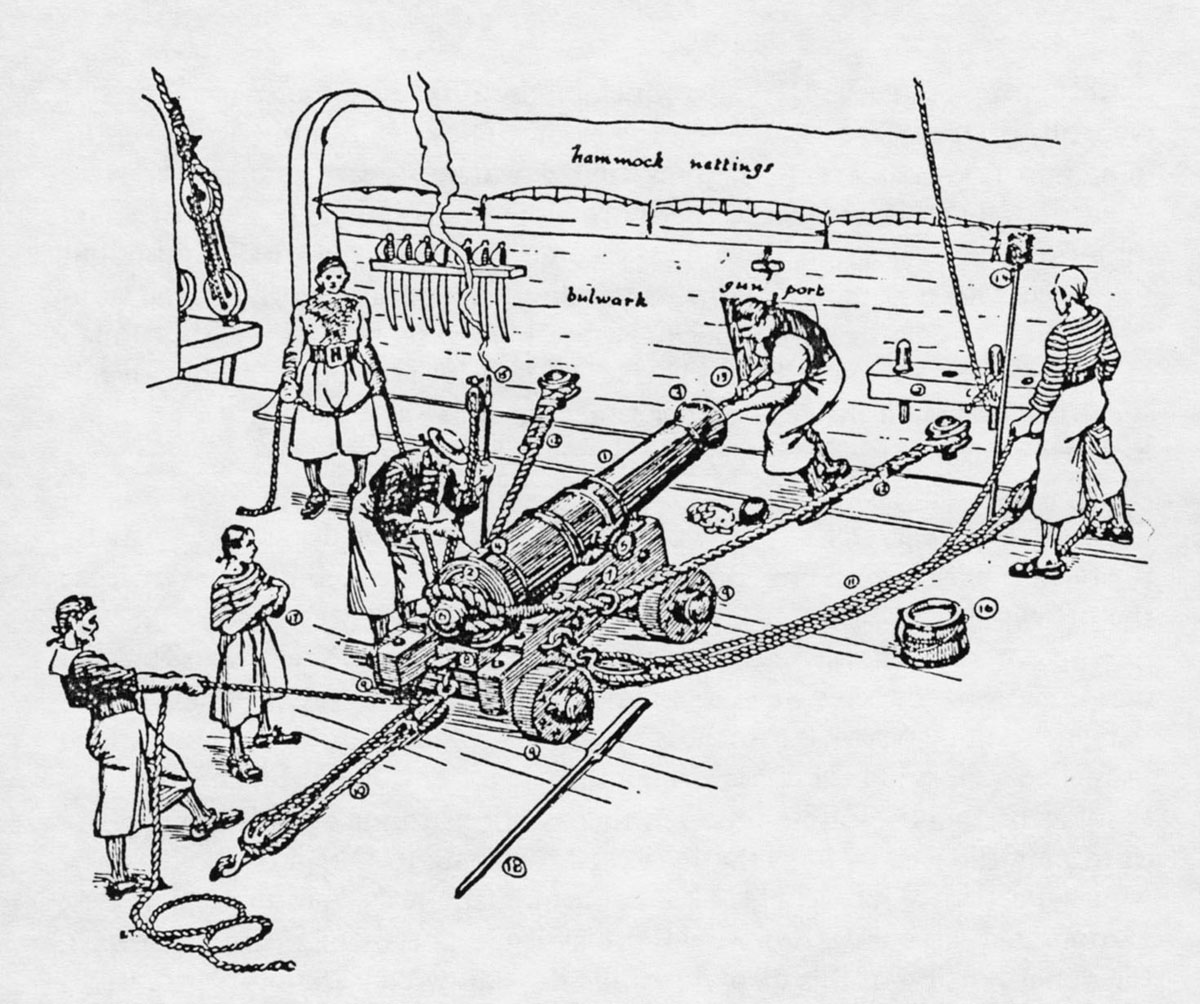
"A bricole is made with a leather strap a trace rope an iron ring and a hook and serves to pull the piece backward and forward. Bricoles cannot be called drag ropes which are used for a similar purpose in the English service but to which they have not the least resemblance neither can they be called straps nor these being only component parts of the bricole…." Louis de Tousard, 1809
An American Artillerist's Companion: Or Elements of Artillery' page 110 |
| Ironwolf | 09 May 2013 2:15 a.m. PST |
Number4, thanks for the explaination. My webfoo was failing me when I tried to look it up. So would the bricoles been used to adjust the aim of the canon by moving the entire piece? Or was it used to reposition the canon back to its original position after it fired? Just curious since they were not used in the AWI. Supercilius Maximus and John the OFM, thank you gentlemen, as usual you always provide the best answers to my AWI questions. |
| number4 | 09 May 2013 9:33 a.m. PST |
Aiming was done by elevating screw or simple wooden wedge (quoin) in the vertical axis and traversing left and right with a handspike in the trail. (This is left in place while the gun's in action, not carried around as a prop by gunners). The Bricole was a European alternative to the drag rope, used to move the piece back into battery and manhandle it short distances. Having worn one of these things, I can tell it it serves to put all the strain and weight on one hip while the broad band across your chest deprives you of any oxygen you might otherwise breathe….. |
| Ironwolf | 10 May 2013 1:46 p.m. PST |
I saw a demostration of a ACW reenactment group fire live rounds from a cannon. So from your discription the AWI cannons were aimed in similar fashion. After they fired the gun, it moved backwards a few feet. The men then ran up and rolled the gun back into its former position. So I was thinking the Bricole was some type system to roll the cannon back to its original position. Similar to what is used to run the guns out on ships during this time. From your discription is sounds like a harness. Now my question is if you were being overrun how easy was it to get free and flee?? lol |
| Supercilius Maximus | 10 May 2013 3:05 p.m. PST |
This isn't my area of expertise, so I could be wrong on this, but I think the bricole was more for moving the gun from one position to the next* (eg to keep pace with advancing infantry you were supporting) rather than the relatively short distance needed just to recover from the firing recoil, which I would imagine just involved rolling the piece back by pushing against the spokes of the wheel and giving it a good old shoulder. This may have been why the British just used good old drag ropes, which served to do either. (I think this movement was called "prolonging" and I have always mentally associated the bricole with "prolonged" movement – I may be completely wrong though.) |
| number4 | 10 May 2013 7:24 p.m. PST |
From your discription is sounds like a harness. Now my question is if you were being overrun how easy was it to get free and flee?? Very easy. This is what they look like link You would hook up to one of the iron rings on the carriage to move it as & when. In fact those hooks tend to slip off when you don't want them too! Drag ropes are left hooked up to the wheels at all times, and appear to have been held by matrosses. Shipboard guns have a block & tackle system fixed to the hull sides.
Prolonging is a different animal altogether; this is attaching a rope to the limber and pulling the the piece away while continuing to load and fire in retreat.
|
| number4 | 10 May 2013 7:35 p.m. PST |
This is the nearest thing to a period photograph we will ever have. This painting in in the UK royal collection and was made in 1778, depicting army maneuvers at Warley Camp, England. It's called The Mock Attack, and you can see the light guns deployed between battalions. Note that there are three matrosses either side of each gun wheel – these are the drag rope men.
|
| Supercilius Maximus | 11 May 2013 3:36 a.m. PST |
<<Prolonging is a different animal altogether; this is attaching a rope to the limber and pulling the the piece away while continuing to load and fire in retreat. >> Thanks, I think I've seen this term misused quite a lot, in that case. I need to re-read my Caruanas….. |
| Ironwolf | 12 May 2013 10:36 p.m. PST |
Number4, thanks for the explainations. I had the Bricole totally wrong! I was thinking it was some type of block & tackle system mounted to the terrian to move the gun forward or backwards. lol I also have misused the Prolonging in gaming terms. We've always considered Prolonging to be the same as the Matrosses using the ropes to move the guns from one location to another. So for our games, we need to have regular movement for our guns with matrosses. Then a slower movement for Prolonging? |
| number4 | 13 May 2013 9:42 p.m. PST |
Personally I have never seen any reference to prolonging during the AWI by Brits or Americans (the French may have done so); remember both sides are still contracting or temporarily requisitioning the horses to draw guns, vehicles, and baggage, as well as the conductors and teamsters to guide them. These civilian contractors are not subject to military discipline and understandably less than interested in risking their valuable animals and even more valuable selves on a battlefield…… There is also the problem of ammunition being carried in the two large side boxes on the gun carriage of British and American pieces – these are dismounted for action, so if you do lash your gun trail to a wagon or limber, there is still a heap of other equipment the gunners have to move. Prolonging only becomes really viable once you have the artillery train become part of the army (such as the Corps of Artillery Drivers, formed in 1794) and the horse artillery type limber with it's mounted ammunition chest. The ACW folks discussed this a while back TMP link |
| Ironwolf | 13 May 2013 10:11 p.m. PST |
Number4,
I could not recall reading any reference to AWI crews prlonging guns in the field, as you've described. But I tend to skim read and then focus on the details when I come across an item I am researching or curious about. It seems during the AWI artillery was not used on a large scale. Like it became later on in the wars of europe and ACW. Or thats the excuse I'm telling myself why I had not picked up all this information from the reading I've done. hahahaha Cause really my understanding of artillery used in the field during the AWI was simple. The armies artillery park rotated the guns to the Brigades to support the infantry battalions. Civilians with horses hauled the guns to the battle. Once they were set up with the infantry brigades. The civilians with horses went to a safer location. The crew and Matrosses used drag ropes to haul the guns around the battle field, along with the infantry to support them. Short of a siege, they did not have horse and limbers like artillery did in the ACW. Now I realize there were certain situations where the above was not always true, but generally that is my understanding of AWI artillery. The link on TMP to the ACW board discussing this was very informative. Thanky. Rusty |
| Brechtel198 | 03 Jun 2013 3:57 a.m. PST |
Number 4, Great picture of the gun carriage and limber with the prolonge attached and stowed for travel. Where did you find it, it looks original? B |
| Brechtel198 | 03 Jun 2013 4:02 a.m. PST |
I've seen three dates for the development and use of the bricole by Prussia, Austria, and France. The French artilleryman Gribeauval usually gets credit for it, but that might just be for the improvement of it and the introduction of it into the French service. There are also instructions in the period French and American artillery manuals on its use. It is definitely not a drag rope. The prolonge was introduced by Gribeauval in the 1760s and there ended up being two 'sizes'-one for foot and one for horse artillery (after horse artillery was introduced into the French service ca 1792). When the gun company went into position the prolonge was usually, if not always, attached from the limber to the trail of the piece and stayed that way for immediate use if necessary in action. The prolonge was used for both advance and retreat and was useful when crossing obstacles, such as a ditch. It's introduction in the mid-1760s in France predated the French introduction of a militarized artillery train in 1800 by Napoleon. B |
| Brechtel198 | 03 Jun 2013 1:45 p.m. PST |
'Aiming was done by elevating screw or simple wooden wedge (quoin) in the vertical axis and traversing left and right with a handspike in the trail. (This is left in place while the gun's in action, not carried around as a prop by gunners).' Aiming, called 'pointing' during the period, was also done with a sight, the different nations having developed different sights for the purpose. If the gun tube had a front sight, it was sometimes treated with phosphorous for night firing. And sometimes a simple chalk line was drawn down the center of the top of the gun tube for pointing. Some nations used the elevating screw and for field artillery the quoin was on the way out as being both obsolete and inaccurate. The Prussians developed a screw quoin in the 1740s to elevate and depress the gun tube and this was copied by the Austrians and Russians. The French had an elevating screw under an elevating plate which the breech of the gun tube rested on. B |
| Brechtel198 | 03 Jun 2013 1:47 p.m. PST |
Besides having hired civilian 'drivers' and gun teams, the horses during the War of the Revolution in both the British and American armies were harnessed single file and not in teams with either four or six horses (depending on the caliber of the field piece) harnessed in pairs with the near (left) side horse being ridden. The US Army ca 1800 was the first nation to use artillerymen as artillery drivers, the European nations, Britain included, used a separate organization for the horses and drivers, the artillery train. B |
| Brechtel198 | 03 Jun 2013 1:54 p.m. PST |
'In the 18th century, artillerymen were formed into marching companies, trained and equipped as infantry.' They were equipped as infantry if they were foot artillery, but when horse artillery was developed, beginning in the 1750s, they were uniformed and armed as cavalry. They were also trained as artillerymen, not infantry. The Continental Army eventually had four artillery regiments. The artillery was organized in companies in the Continental and US Army, but these were artillery companies, not infantry companies. The term 'battery' for a company-sized artillery unit in the US and French armies wasn't used until after 1815. During the period, the term 'battery' denoted any artillery in position, regardless of the number. The Prussians, Russians, and Austrians did use the term 'battery' for their artillery companies, and the British used 'brigade' for what eventually was foot artillery, and 'troop' for horse artillery when it was developed in 1794. Continental artillery regimental organization is shown for 1776 and 1781 in Wright's The Continental Army. When Gribeauval began his reforms ca 1765 in France he completely reorganized France's artillery arm, including manpower, and the artillery sent along with Rochambeau's Expeditionary Force to North America in 1780 was armed with the new system, both field and siege artillery. A French gun company in their field artillery manned a 'divison' of field pieces. B |
| Brechtel198 | 03 Jun 2013 1:59 p.m. PST |
'Prolonging only becomes really viable once you have the artillery train become part of the army (such as the Corps of Artillery Drivers, formed in 1794) and the horse artillery type limber with it's mounted ammunition chest.' The use of the prolonge was dependent on the gun teams that pulled the field piece. The older 'system' used during the War of the Revolution wasn't really conducive to the use and purpose of the prolonge. Gribeauval developed it in the 1760s to be used with four or six horse gun teams harnessed in pairs and ridden by the drivers, one for each horse pair. The French horse artillery arm, which was first organized in 1792, used the same equipment that the foot artillery companies did, including the Gribeauval limber. That limber did not have an ammunition box attached to it. The coffret, or ammunition box was attached to the trail of the field piece and taken off in action and put on the limber. By 1800 all French horse artillery companies had their gunners individually mounted. See the illustration you posted. The ammunition box (coffret) is on the limber when the piece is emplaced and in the overhead view of the gun carriage you can see the recesses on the gun carriage brackets where the coffret was placed when the piece was limbered up and either ready to displace or when displacing. By the way, do you have a copy of the 1794 edition of Theodore d'Urtubie's Manuel de l'Artilleur?
B |
| Old Contemptibles | 03 Jun 2013 3:01 p.m. PST |
This is what I always thought the distinctions were. Prolonging was the act of quickly attaching a gun by a handy rope attached to the limber, drawn by horses and is used when there was not the time to properly hitch up the gun to the limber. Manhandling was exactly that. The crew physically moving the gun. Limbering was the proper way of hitching up your gun to the limber and caisson for the limber team to pull them. Which was the fastest way to move long distances but required more time to set up. Do I have this right? |
| Brechtel198 | 03 Jun 2013 3:11 p.m. PST |
Sounds good to me. For long distances the field piece was attached to the limber. For shorter distances on the battlefield the prolonge was used, and there were specific dimensions to which the prolonge was constructed. I don't see, though, the prolonge being used in the War of the Revolution. Using drag ropes or bricoles turned the gun crew into a 'man-team' to manhandle the piece on the battlefield for short distances. The bricole was more efficient. B |