 Panzerfaust Panzerfaust  | 22 Apr 2013 4:49 p.m. PST |
The myth being that Lee was a great general. Having just read Bevin Alexander's book "How the South could have won the Civil War", which in a nutshell pins the blame for Confederate defeat on General Lee….
I wondered what TMP had to say about the book: TMP link An all too predictable and unfortunate response. Seemingly no one who responded at the time had actually read the book. My challenge is: Now that some of you have presumably read the book, what is wrong with Mr. Alexander's analysis? What I came away with is the notion that after the battle of Antietam Lee should have been relieved of his command (perhaps "promoted" to a desk job) while McClellan should have faced a court-martial followed by a public flogging. Obviously the respective administrations cannot be expected to have Omnipotently known that Lee blundered his army into what should have been a hopeless situation and that he was only saved by the fact that he faced a criminally incompetent foe. In Alexander's Civil War Lee ignores the advice of his generals, especially Jackson, and passes up ample opportunities to outmaneuver the Union army. Instead he chooses to launch frontal assaults against superior forces resulting in unsustainable losses. Is Alexander wrong? Was Lee actually a brilliant general who would have won the war had he only had one more chance to send his army on a suicidal frontal assault? (sarcasm intended) |
 John the OFM John the OFM | 22 Apr 2013 4:59 p.m. PST |
I am no fan of Lee, but I hardly think that Antietam would have been the battle to kick him upstairs for. i thught he did quite well there. |
| Billy Yank | 22 Apr 2013 5:08 p.m. PST |
Well, Lee wasn't perfect, but who does Mr. Alexander think is going to take his place? Joe Johnson? Not a chance as long as Davis was president. Jackson? While a great corps commander, he sure wasn't ready to lead the ANV. Longstreet? He proved multiple times that he couldn't be trusted with independent commands. We are running kinda thin on decent Confederate generals… Billy Yank |
| mad monkey 1 | 22 Apr 2013 5:13 p.m. PST |
Hindsight is always 20/20. |
| Panzerfaust | 22 Apr 2013 5:14 p.m. PST |
I think Alexander's answer would be emphatically, Thomas Jackson. He is of the opinion that Jackson had the right strategic vision for prosecuting the war, take it to the north, threaten or capture a major city such as Philadelphia or Baltimore. Plus Jackson had the tactical know-how to achieve victories without using up the army in the process. |
| Panzerfaust | 22 Apr 2013 5:19 p.m. PST |
Right, I would agree, it is very easy for arm chair generals to get it right. However, I think he makes a strong argument that Jackson not only knew a better way but tried on many occasions to convince the Davis administration or gen. Lee to do it his way. The only time he was given a chance (outside of the Shenandoah campaign) was at Chancellorsville. |
| Ron W DuBray | 22 Apr 2013 5:32 p.m. PST |
All the battles that the south won can be placed squarely on the fact that the leadership of the north was criminally incompetent and had no clue how to fight with the weapons at hand. It took years for commanders to learn how to fight with them and to stop making frontal assaults on in placed forces. All of Europe was still making the same mistake up till the end of WWI. |
| pzivh43 | 22 Apr 2013 5:46 p.m. PST |
I have not read the book, so I can't offer an opinion on Mr. Alexander's opinions. However, if your paraphrase captures his main point, I'm not impressed with his logic. Seems based on having the perfect knowledge that all commanders lacked (and still do). Lee's campaign plan was bold, based on his knowledge of the timidity of Union commanders, and the fact that he had beaten the tar out of the Yanks all summer! I do think his major flaw was his utter faith in his men's ability, and his tendency to keep at a battle when he should have changed his plan (Antietam and 3rd day at Gettysburg). Mike |
| SonofThor | 22 Apr 2013 5:48 p.m. PST |
How long did he beat the Yankees before they found the right General? No, I haven't read the book but I'll definitely check it out. |
| Panzerfaust | 22 Apr 2013 5:53 p.m. PST |
The campaign resulting in the battle of Antietam is of course only one chapter in a book that spans the entire war. I chose to emphasis this battle as perhaps the worst example of Lee's generalship. He may be excused perhaps for splitting his army in the vicinity of the enemy due to the known timidity and sluggishness of McClellan. But can he be excused when he then re-assembles his army with its back to the Potomac river with essentially no escape, only one ford that could easily have been lost. He admitted after the war that he did not know the layout of the river at this place. Had he faced a competent opponent his army would have not just been defeated and forced to retreat, but destroyed or captured. |
| Sysiphus | 22 Apr 2013 5:57 p.m. PST |
Have not read the book mention, but another with a similar hypothesis. That author went with Lee certain the South could not win, bled the A of Va. to death at Gettysburg. |
 Parzival Parzival | 22 Apr 2013 6:03 p.m. PST |
Jackson wanted to equip his men with pikes. He also got himself shot by his own men, by accident, yes, but he shouldn't have put himself in a situation where it was likely. I'm as impressed with Jackson as anyone, but I don't think he was the panacea others do.
In fact, I don't think winning the war was ever possible for the South, generals or no generals. They simply didn't have the industry or the efficient transportation structure or the government structure to win the war. Their only hope was at the start— seizing Washington D.C. immediately following First Manassas. Had they pulled that off, the North might not have developed the will to stand behind a captured president (or even one who fled), and sued for terms. And even that's iffy.
In the end, all wars come down to logistics. Lee knew it and Grant knew it. Lee probably was aware that logistics favored the North from the very start; his only choice, then, was to try and keep the fighting spirit of the South high and the morale of the North low— to break the will of the Northern people to support the war through constant defeats. The only way to do that is fight battles and win them. But when the logistics don't favor you, the battles you can win begin to fade. It really comes down to whether Lee was wrong to send the assault on Cemetery Ridge. You can say, "Yes," but the truth is his assault almost succeeded. Had that gamble worked, the way would have been open again to Washington— and the outcome of the war might have been very different. Lee had a strategic goal, and tried to achieve it. He failed. Was he wrong to try? I don't know that he was, except in hindsight. The war was won and lost at the fence line of Cemetery Ridge. Grant arrived and knew it, and knew how to press the inevitable. I think Lee knew it, too, but did his duty to delay the inevitable. But it's hard to fault him with the loss, simply for trying to take the only path to victory that then existed— the path through the line on Cemetery Ridge. |
| Sundance | 22 Apr 2013 6:05 p.m. PST |
This is one of the perenial arguments re: the Civil War – that Lee lost because he was no good, that is. Obviously, he was as good as some Union generals, if not better. Maybe not as good as others. Does it matter? Was Rommel better or worse than Patton, Montgomery and all the rest? Does it matter? No. |
| Panzerfaust | 22 Apr 2013 6:09 p.m. PST |
I think the main thrust of Alexander's book is that Lee never 'beat the tar' out of the Yankees. What in fact he did was push them back while losing a quarter of his army each time! The Union forces could absorb such punishment, and did, and recover and come back for more. The Confederate's did not have that luxury. When you add up Seven Days, Antietam, and top it off with Gettysburg it equals doom for the rebel cause. Add to that the many missed opportunities when the Union army may have been, should have been, outmaneuvered and captured or at least soundly beaten you get an overall picture of failure. This made all the more pronounced when right at his elbow Lee had the man, Jackson, who had figured out a winning formula. Lee's idea was to find the Union army and attack, in the event he ordered frontal assaults. This may have worked in the Mexican war, in the era of smooth bore muskets, but no longer. And after the carnage of Malvern hill Lee had no excuse not to know better. Jackson's formula was to maneuver his army into a position that forced the Union force to attack him and be ready to follow up with a counter attack on the enemy flank once the tide had turned. Not rocket science, war 101. Jackson understood the value of knowing the territory chosen for the battle and using it to maximum effect. Lee seemed little concerned with this, even at Fredriksburg, where not far away was a much better position that would have allowed for a devastating counter attack. |
| GROSSMAN | 22 Apr 2013 6:10 p.m. PST |
Yankee swill propaganda that is. |
| Shagnasty | 22 Apr 2013 6:26 p.m. PST |
Lee was the best the South had and if he wasn't good enough then the Confederacy was doomed, as others have suggested. |
| raylev3 | 22 Apr 2013 6:44 p.m. PST |
That's the problem with counterfactual history -- there can be no proof, only opinion. |
| doc mcb | 22 Apr 2013 6:51 p.m. PST |
Recall that many, perhaps most, of the army commanders on both sides knew each other pretty well, from West Point and Mexico and the peacetime army. Lee understood his enemy to be the MIND of the Union army commander and, also, of Lincoln and northern opinion. He made his share of tactical mistakes, to be sure, and his strategic vision was too focused on Virginia, but I think he came pretty close to winning it through sheer war weariness on the part of the north. There was a point in early 1864 that Lincoln feared he'd fail reelection. The fault for Confederate defeat lay more in Davis and Bragg. |
| doug redshirt | 22 Apr 2013 7:07 p.m. PST |
The only chance was to go to war in 1850. The problem was that the idea of separation was still an idea that many in the Southern leadership couldn't stomach. But no infrastructure or public will in the North for doing in 1850 what it did in 1860s. |
| Spreewaldgurken | 22 Apr 2013 7:11 p.m. PST |
"He is of the opinion that Jackson had the right strategic vision for prosecuting the war, take it to the north, threaten or capture a major city such as Philadelphia or Baltimore." Did any southern invasion of the north ever accomplish anything other than lots of southern casualties? When your opponent outnumbers and out-supplies you drastically, why on earth do you want to make it even easier for him by fighting him nearer to his own bases? (Not to mention making it easier for the Lincoln administration to silence dissent and whip up enthusiasm against southern invaders.) |
| Panzerfaust | 22 Apr 2013 7:28 p.m. PST |
I'm sure Alexander would argue that Lee's ventures into northern territory failed, but that was due to his tactics or lack there of. It does not follow that invasion of the north was either impossible or undesirable. The Davis administration chose a defensive policy and in the event Lee went somewhat beyond his orders when moving north. Someone else, Jackson, wanted to do to the north what Sherman later did to the south, bring real pain and destruction to northerners. Jackson had proved that he could march circles around Yankee armies and bring to bear superior numbers against portions of a larger enemy. Doing the same thing in enemy territory would have been more difficult for the reasons you state, with the additional problem of moving and fighting on ground that you do not have good maps of (a problem the Union suffered constantly) There is the presumption that a decisive defeat of a northern army on their soil would have political consequences beyond the purely military. Even better would be a humiliation of the Union government by forcing their evacuation of Washington. Of course these are big what ifs. |
| Field Marshal | 22 Apr 2013 7:34 p.m. PST |
Jackson could never have been the commander. Why? His style of command was not conducive to such large armies.He never told his subordinates what his plans were. He was a prickly character who didnt seem to get along anyone but his preacher. lee was needed as a guiding hand for him to function and even then his failures in the Seven Days and lethargy at Second Bull Run goes some ways to dispel his ubermensch reputation.
While I am very wary of the Lee was perfect camp he was a very good army Commander and he did have his faults. There was noone else capable of the command. the CSA army was a bunch of high strung personalities that Lee was able to effectively control most of the time.
As for the invasion of the North theory, do you think Lincoln would have folded? He was just as strong willed as any of them if not moreso. All my own opinion of course. |
| Sparker | 22 Apr 2013 7:42 p.m. PST |
Indeed. And I'm not sure that Pickett's Charge is in the same pigheaded Douglas Haig 'we've attacked a 100 times this way before, its bound to work eventually' league. If the attack on Culps Hill had gone in at the same time, and if Heths Division had joined in, both contingencies that Lee ordered, then it might have succeeded. For sure, a lot of Ifs. But life's like that when, for economic reasons, your time is running out and you have to take the offensive against a larger army on good defensive ground…. |
| Panzerfaust | 22 Apr 2013 7:49 p.m. PST |
In several books I have encountered the seeming mystery of Jackson's inaction during the Seven Days battles. With a little more investigation I believe the explanation is that he was physically exhausted and ill and during one of the battles, do not recall which one, he was almost catatonic. Apparently his staff squatted around him for a while wondering what to do. They then proceeded to kick his boot, then poke him to try to wake him up. When this failed they even picked him up and walked him around but to no avail. Apparently Lee was totally unaware of any of this at the time and assumed that Jackson had done all he could in support. I wonder if he would have been forgiving of Jackson had he known? It's certain that Jackson himself would not have been forgiving of such from a private soldier under his command. |
| doc mcb | 22 Apr 2013 8:35 p.m. PST |
Jackson went without sleep for nearly a week. Ask anyone who has been through Ranger School what that does to your attention span. |
| Toshach | 22 Apr 2013 10:37 p.m. PST |
Thank God Lee lost when he did. If the southern states had succeeded in seceding the world would certainly be a very different place. And not, from my point of view, a better one. |
| wrgmr1 | 22 Apr 2013 11:44 p.m. PST |
Lee was a strategist, if not a particularly great tactician. He was brilliant at some times, others not so. He was much better than what the north had to offer up until Grant, Sherman and Sheridan came along. Longstreet and Jackson were good tacticians. Both were capable corps commanders, but would be out of their depth with army command. Davis had no real choice other than Lee after Johnson became incapacitated. An earlier post suggested that it is all a matter or logistics. I agree to a certain extent in that the industrial north could out produce the south, in all areas. Had Lee's theory of taking the war to the north and taking Washington succeeded, the war may have turned out very differently. Circumstances, dictated that at Gettysburg Lee was hampered by lack of reconnaissance. His cavalry was not doing it's intended job.
Had Lee good knowledge of where his opponents forces were and what reinforcements they were getting he may have made different decisions. This is conjecture. Your original statement that Lee lost the war is ludicrous. Given the state of southern arms production, manpower and medical services, it is amazing he did as well as he did. Eventually northern logistics and perseverance prevailed.
It took Lincoln awhile to find the right mix of generals who would fight, but once he did, the south was doomed.
Those generals used that logistic superiority to their advantage and wore out Lee and the army or Northern Virgina.
All you have to do is read about the last 12 months to see how desperate a position Lee was in. Sherman used his army to cut the heart out of the south. It was never to recover. Lee had nothing to do with that. It is my opinion that Davis is the one who lost the war for the south. He declared it. |
| Patrick R | 23 Apr 2013 2:33 a.m. PST |
Lee is the excellent battlefield general who wins battles, but loses the war at the same time. He's up there with Hannibal, Pyrrhus and Napoleon. They all won many battles, but they all failed at the strategic level. Now Lee had the good sense to bring the fight to the Union and hoped to deliver a knock out blow that would win the war, but he was running against the clock, with each passing day the Union's strength grew and the South could only grow weaker. Lee lost the race against the clock. And like the examples above he kept on fighting victoriously, against the odds until he had painted himself into a corner and lose all chance to ever win the war. He was up against some dire generals at first, but as has been said before he never knocked the stuffing out of the Union. Once Grant came along he had already squandered the one chance to settle the war in his favour. I think it's unfair to say Lee was incompetent. He did make mistakes and ignored sound advice at times, but even Lee isn't perfect. Did he lose the war ? I think he lost the chance to win it for the Confederacy, but the Civil War was more than Lee fighting in Virginia and Pennsylvania, there was the Naval blockade and the West. |
| Dynaman8789 | 23 Apr 2013 3:49 a.m. PST |
No better way to drum up attention then to title a book "How the South Could Have Won the Civil War". As my history teacher and Civil War nut told us, the North was fighting the war with both hands tied behind it's back, at least early on – if the south had seriously threatened the North the gloves would have come off. |
| John Michael Priest | 23 Apr 2013 3:54 a.m. PST |
The South from the very beginning. Every Confederate state but South Carolina provided at least 1 white regiment to the Federal Army. Southern leadership suffered from a myopic almost provincial, compartmentalized view of the war. From the very start, the Federal government had an overall strategy to win the war, the Anaconda Plan. Lee, like his father, was gambler who did not handle defeat well. His audacity cost lives and during the Maryland Campaign, quite a chunk of his army did not cross the river into Maryland. He fought at Sharpsburg, according to a post war letter to Mrs. Jackson, because he could not go back into Virginia whipped. He lost at South Mountain and had to retreat, something he had done before. |
| Joe5mc | 23 Apr 2013 5:22 a.m. PST |
Lee's invasion of the North did accomplish something very important. It allowed his army to forage on enemy territory. The South proved rather poor at keeping its own armies supplied, even before the Union armies started carving it up. When Lee sat and played defence, his army starved. |
| Spreewaldgurken | 23 Apr 2013 5:35 a.m. PST |
"Jackson, wanted to do to the north what Sherman later did to the south, bring real pain and destruction to northerners. Jackson had proved that he could march circles around Yankee armies and bring to bear superior numbers against portions of a larger enemy" Jackson only accomplished those feats on southern territory, with superior local intelligence, and with the northern forces unable to use the transportation network or to reinforce quickly. Can you imagine how an outnumbered southern force would have fared, deep inside the well-developed north, cut off from all reinforcement or friendly bases, while the enemy can use rails leading from every direction, and telegraph, to reinforce every point in its path, or behind it? I think Jeff Davis deserves a bit more credit than he gets, for shooting down so many of the wild-eyed southern plans for northern invasions that were submitted to him over the years. He knew better. He permitted too many of them, as it was. "Lee's invasion of the North allowed his army to forage on enemy territory. When Lee sat and played defence, his army starved." Yet he consistently won on defense, and lost on offense. Hungry or not, the army performed better on its home soil. |
| Dn Jackson | 23 Apr 2013 5:40 a.m. PST |
"Obviously the respective administrations cannot be expected to have Omnipotently known that Lee blundered his army into what should have been a hopeless situation" Lee didn't 'blunder' into Antietam. He made a calculated risky decision knowing who his enemy was. In doing so he forced the largest surrender of American troops until Bataan in 1941. 14,000 troops captured. He had to stay at Antietam to finish the surrender procedures. Hill arrived in the nick of time having just finished paroling the Federal prisoners. had the Lost Order not been found Antietam never would have happened. Hind sight is always 20/20. |
| 67thtigers | 23 Apr 2013 6:05 a.m. PST |
"Lee didn't 'blunder' into Antietam. He made a calculated risky decision knowing who his enemy was. In doing so he forced the largest surrender of American troops until Bataan in 1941. 14,000 troops captured. He had to stay at Antietam to finish the surrender procedures. Hill arrived in the nick of time having just finished paroling the Federal prisoners. had the Lost Order not been found Antietam never would have happened. Hind sight is always 20/20." Hind-sight is also sometimes blind. We tend to forget Lee ordered Jackson to abandon the siege of Harper's Ferry and concentrate at Sharpsburg with a view to rescuing McLaws cut off command. As to the "lost order" – it mattered very little. McClellan had already worked out from other sources the divided nature of Lee and was handed SO191 on returning from seeing off the assault on the Catoctin Mountain gaps and found no need to issue new orders to assault South Mountain the next day because he'd already ordered it. |
| Frederick | 23 Apr 2013 6:31 a.m. PST |
I think that wrgmr1 has it exactly right – the biggest problem for the South was that Jefferson Davis did not have a realistic or coordinated strategy – until very late in the war, Lee was a theatre commander, not the Confederate States Chief of Staff I think Lee did pretty well with what he had at hand – while I am a big fan of Stonewall Jackson, I think it was probably good for his reputation that he died young |
| wminsing | 23 Apr 2013 7:46 a.m. PST |
I think the main thrust of Alexander's book is that Lee never 'beat the tar' out of the Yankees. What in fact he did was push them back while losing a quarter of his army each time! The Union forces could absorb such punishment, and did, and recover and come back for more. The Confederate's did not have that luxury. When you add up Seven Days, Antietam, and top it off with Gettysburg it equals doom for the rebel cause. Add to that the many missed opportunities when the Union army may have been, should have been, outmaneuvered and captured or at least soundly beaten you get an overall picture of failure. This made all the more pronounced when right at his elbow Lee had the man, Jackson, who had figured out a winning formula. But it this a failure of Lee's generalship, or the the inability of the commanders and command structure he inherited to successfully pull off what Lee envisioned? Lee's plan at the Seven Days battle arguably SHOULD HAVE destroyed the Army of the Potomac; but his field commanders fumbled it and the AotP lived to fight another day. Lee had just assumed command and such a failure really isn't surprising. Later battles might find more of the blame resting with Lee, but it's also true that a lot of the battlefield failures the author appears to attribute to Lee are actually the result of his subordinate commanders not following their orders. Quite a few 'frontal assaults' (on both sides) were not intended to be assaults at all, and only ended up that since the officer on the spot blundered directly into the enemy and decided to press on. -Will |
| Dan 055 | 23 Apr 2013 8:07 a.m. PST |
My opinion of Bevin Alexander is "those that can't do, teach" and those that can't even teach write revisionist history. |
| RebelPaul | 23 Apr 2013 8:18 a.m. PST |
I haven't read the book yet, but I would like to. I have always felt that Lee was not much of a strategic thinker. He was more concerned with the fate of his beloved Virginia than that of the entire Confederacy. Before Gettysburg, James Longstreet suggested the Army of Northern Virginia be broken up and elements of the ANV sent to Tennessee, where Confederate fortunes were not going well. Lee opposed this plan in favor of attacking the North again. Jefferson Davis supported Lee's plan. After the disaster that was Gettysburg, Longstreet again raised the issue of sending troops to Tennessee. This time. Davis approved Longstreet's plan. Longstreet's successful attack on the second day of Chickamauga, meant the Confederacy could hold on Tennessee for a while longer. |
| Last Hussar | 23 Apr 2013 10:07 a.m. PST |
"How the South could have won the Civil War" By being the North? A third of the man power, no heavy industry and reliant on Britain and France for trade. they were never going to win. |
| donlowry | 23 Apr 2013 10:19 a.m. PST |
He is of the opinion that Jackson had the right strategic vision for prosecuting the war, take it to the north … I have to agree with Klumpen-whatever that this was not a viable strategy in the long run. Lee was very lucky to get his army safely back to Virginia after Gettysburg. If the Federals had had sense enough to put a corps or two south of his Potomac crossings "Falling Waters" would mean what "Appomattox" means today. Incidentally, Lee obviously agreed with Jackson's idea (hence the Antietam and Gettysburg campaigns and Early's raid on Washington), so having Jackson in command instead of Lee would not have changed things in that regard. Lee wanted to emulate Napoleon and lamented that his amateur generals could not understand and/or execute his designs. But he should have been emulating Washington, keeping his army intact as a threat. Maybe Joe Johnston had the right idea after all. |
| Bill N | 23 Apr 2013 11:11 a.m. PST |
Given the carnage suffered by commanders in Jackson and Ewell's division during 1862 I have difficulty believing Jackson would have been that concerned with preserving the resources of the ANV. Given the difficulty Jackson had with many of his subordinates I also think it doubtful that he could have exercised the tact needed to command a force like the ANV. Also I think one point overlooked in discussing Lee's performance was that the AoP was actually a fairly good fighting force even in 1862. |
| Sir Walter Rlyeh | 23 Apr 2013 1:30 p.m. PST |
A gentleman might surmise that Mr. Alexander dwells far north of the Mason Dixon, as opposed to residing within one of the more civilized States, and where one might ad that dueling has not gone completely out of fashion. A gentleman might further surmise that had Mr. Alexander been living at the time of our Lord and Savior, Judas Iscariot would still be an apostle in good standing, whilst Mr. Alexander would be thirty pieces of silver the richer for his kiss. |
| OSchmidt | 23 Apr 2013 1:48 p.m. PST |
As I said on another part of TMP about WWII Naval, specificlally Halsey's alleged blunders at Leyte, I really have no patience with people like Anderson who make a career of trashing the great. My response to him would, if I were to speak to him "Could you have done better?" As many have said here 20/20 hindsight is wonderful but it has the same problem as all "What-If's" of History. It comes down to a simple matter of "If we had ham, we could have ham with our eggs, if we had eggs." Leave "the greats" their greatness. They came by it honestly. |
| Sparker | 23 Apr 2013 2:20 p.m. PST |
Well said OSchmidt, very true. Unfortunately trashing the feats of long dead heroes seems to be the only way our current crop of revisionist historians, with no Service experience themselves, appear to be the only way they can convince the marketing men to fund their books… "Why didn't General X, who had read despatch Y only 2 hours previously, not send formation P to location Q where undoubtly they would have been in position to outflank Z.." Because they were making decisions under fire, under stress, and a hasty move could have caused thousands of deaths, you ignorant jumped up pencil neck git! |
| vtsaogames | 23 Apr 2013 2:47 p.m. PST |
"The fault for Confederate defeat lay more in Davis and Bragg." That's how I see it. One more dent in Jackson's reputation: the gap in his line at Fredricksburg which was penetrated by Meade. True, he then threw in a counter-attack that thumped Meade and Reynolds, but his corps had been in position for days and didn't notice the gap. Jackson's corps lost way more troops at that battle than Longstreet's did. Longstreet dealt out most of the losses to the Yankees. Talking about Lees' failures fades when looking at the other possible choices: Joe Johnston, Beauregard, Bragg and the late promotions, Kirby-Smith and Hood. Those are the full generals of the Confederacy, the ones who Davis turned to again and again. |
| baltojake | 23 Apr 2013 3:56 p.m. PST |
Dan055 said it better than I ever could!!!
John Miller |
| The Gray Ghost | 23 Apr 2013 4:17 p.m. PST |
Bevin Alexander is the author of thirteen books on military history, including Macarthur's War, Sun Tzu at Gettysburg, How Wars Are Won, How Hitler Could Have Won World War II, How America Got It Right, and How the South Could Have Won the Civil War. He was an adviser to the Rand Corporation for a recent study on future warfare and a participant in a recent war game simulation run by the Training and Doctrine Command of the U.S. Army. His battle studies on the Korean War, written during his decorated service as a combat historian, are stored in the National Archives in Washington, D.C.
He is a specialist on military strategy.
His book, Lost Victories, was chosen by the Civil War Book Review as one of the seventeen books that have most transformed Civil War scholarship.
He was commander of the 5th Historical Detachment in the Korean War, and received three battle stars for service in the combat zone, 1951-1952. He also received the Commendation Medal for his work as a combat historian.
He was formerly director of information and editor of the alumni magazine at the University of Virginia.
He is a retired adjunct professor of history at Longwood University and is Himself a graduate of The Citadel, Charleston, South Carolina 1949 |
| Sparker | 23 Apr 2013 7:21 p.m. PST |
Thank you Gray Ghost. I apologise unreservedly to all for any inference that I made in my earlier post about revisionist historian applying to Mr Alexander personally, in view of his impressive Service and Combat record. (Dontcha hate it when people confuse you with the facts!) |
| McLaddie | 23 Apr 2013 8:40 p.m. PST |
Having not read the book, I can only speculate from other's comments. If Mr. ALexander focuses on the Eastern Theatre in his book, he has missed the part where the South lost the war int the West, not the East. That is where the real blunders were made. Whatever one thinks of Lee, Antietam isn't a blunder. The famous loss of Lee's entire deploy with the cigars pretty much put the hurt on his campaign. He couldn't just run for it because of how spread out his army was, and Jackson was still besieging Harper's Ferry which had important supplies etc. And of course, Lee did have McClellan figured out. After Antietam McClellan was fired, not Lee. Gettysburg was a bigger blunder having larger consequences, and Lee offered to resign after that one. Lee never had command of the entire Confederate war effort until far too late. Davis held those reins and he is the one who screwed the pooch. If Alexander doesn't focus on that, he has missed the whole boat in my opinion. Lee knew that the only way the South was going to win was to 1. Get official recogniztion from Europe and/or drive the Union's will to win so low by Southern victories and the inability of the Union armies to protect Northern territories, the North would give up attempting to conquer the South. In either case, the South had to take the war to the North to accomplish either. Lee says this in discussing the objectives of both the 1862 and '63 Eastern campaigns. The election of 1864 was a debate on whether to continue the war or not, and that is even after the major victories in the west during 1863. To focus on Lee and Jackson doesn't cover why the South lost. What the two men could have done to win or did do to lose it alone, is a real weak approach. Davis insisted on directing the war, having been a Mexican War veteran, a West Point graduate and Secratery of War for the US before the ACW. He simply didn't do the job well. If anyone should have been fired early on, it was Braxton Bragg. |
| vtsaogames | 24 Apr 2013 10:39 a.m. PST |
Yes, the war was lost in the west. Proof of this is the appearance of 60,000 veterans from the western army along the east coast in late 1864, changing the balance there. My take on the original Confederate generals: Joe Johnston, competent but almost as cautious as McClellan, and deeply entwined with anti-Davis politicians. Beauregard, basically competent in the field but full of wild schemes when not in the immediate presence of the enemy and even more involved with anti-Davis politicos. A.S. Johnston, in way over his head as department commander, though his death at Shiloh covered him in glory. Lee was head and shoulders above this group, though not quite the godlike character of legend. Edit: Ah yes, I forgot Bragg. The man could design a good plan – like his concentration for the 1862 offensive in to Tennessee and Kentucky. But he became thoroughly indecisive in the presence of the enemy. His worst failing was his inability to manage his officers and his troops. His generals twice petitioned Davis to remove him. He made the Army of Tennessee into a snake pit. This ham-strung Joe Johnston and Hood later on. The two promotions: Kirby-Smith was a good brigade commander who parlayed his light wound at First Manassas into four stars, way above his level of competency. He would ham-string Bragg during the invasion of Kentucky and Taylor afterwards as department head. Hood was a brilliant brigade commander, a very good division CO, so-so in corps and a disaster in army command. Lee said of him "he has too much of the lion and not enough of the fox". As corps CO under Joe Johnston, Hood was a disloyal chap, writing slanderous secret reports to Davis about Johnston, and nipping Johnston's one real attempt at a counter-attack in the bud. |


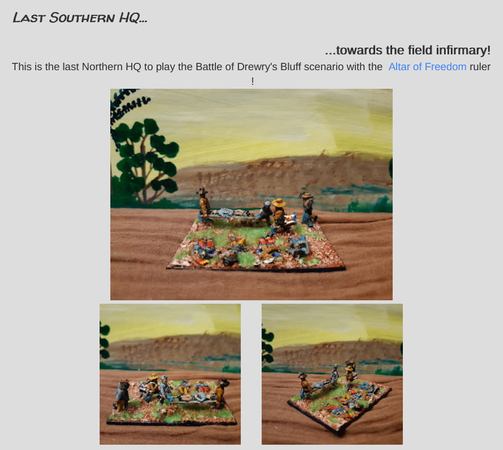


 completes his initial Union force in 1:72nd scale.


