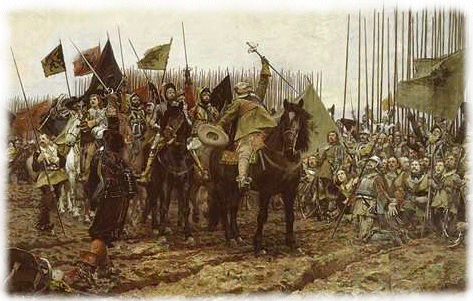
Interesting topic here.
"Neither the money nor the officers have done nothing. The German Empire succumbs to the Swedish in front of the wave which threatens to ruin the Catholic cause … just one decision can change the course of the war, and the Count Duke of Olivares take it. The Spanish Tercios broke the Swedish blockade on Flanders and open the Noret way for the Imperial Armies.
The Spanish Tercios were grouped in Italy to advance to the Habsburg South dominos, the allied armies of the two monarchies and the Catholic League, are preparing to take down the banners of the Nordic Protestantism.
Forces at stake:
CATHOLIC Army
Imperials: 5.000 Infantry – 7.000 riders
Spanish: 12.000 infantry – 3.000 riders
From the league: 3,000 infantry . 3.000 riders
PROTESTANT Army.
Weimar: 5.000 infantry – 4.500 riders
Horn: 2.300 Infantry – 4.000 riders
Kratz: 3.000 infantry – 800 riders
Würtemburg: 16.300 infantry
In this battle faced head to head two tactics: That applied by the Swedish King Gustavus Adolphus of Sweden (apparently for British authors, well above the Spanish) and the tactics of the Spanish troops.
According to a Spanish diplomat of the time: "Flanders can not be preserved if Germany is lost." And this is what got the Spanish Tercios when they swept the Swedes from the battlefield.
Four important factors to take into account.
1) The Spanish Tercios (from 1500 to 3000 men on paper, but rarely fulfilled these amount in campaign) were much less flexible than the Swedish brigades and were more heavy so limited with their redeployment cohorts and their movements became dangerour slow. For their part, the Swedish brigades of about 200 men demonstrated their flexibility in adapting of circumstances change as Breitenfeld did when he form a new front after the Saxons scape exposing one of its flanks.
2)The Swedish cavalry tactics were also higher than the Spanish. Gustavus Adolphus had instructed his riders to charge doing a superlative use of the sword. But the Spanish employed the famous "conch" (caracola), which consisted of taking a circle formation Approaching the enemy to few meters and unloading their guns and then return back to recharge. The Spanish made little use of their sword.
3) Gustav Adolf paper cartridge design reduced the load time of the musket, this consisted of the bullet, a few grams of gunpowder wrapped in paper and tied at one end with a thread (though each cartridge was designed earlier by Leonardo Da Vinci). On the other had the Swedes had their entire infantry equipped with muskets wheel, a mechanism that rose to three downloads per minute, but of course it was a weapon more delicate and less resilient and very expensive, so only officers of other armies the time could afford it. The incessant heavy fire of the Swedes was one of the reasons for their victories.
4) Advances in the field of artillery promoted by Gustav Adolf. This improved the design of the gun carriages and pipes (cast in one piece) giving a more stylized way and reducing their weight. The also standardized the calibres of their artillery pieces and they innovate with the horse artillery , that had light pieces giving you more mobility to this weapon. The Sweden had more lighter guns more easy to charge, move and fire…"
Oht.
From
link
If you want to read more, you can used.
translate.google.com/#es/en
Of course, any help you need with the idiom I'm at your disposal.
Hope you enjoy!.
Amicalement
Armand




 begins his series on how to paint a 15mm DBA army well, in a reasonable time frame.