| Archeopteryx | 26 Mar 2013 10:49 a.m. PST |
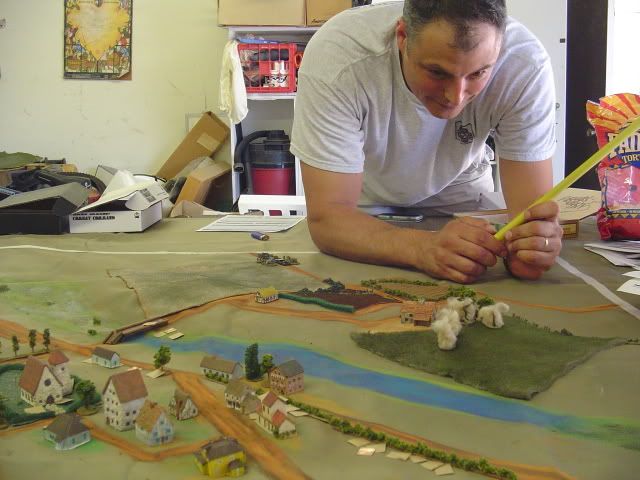
I have been musing about creating some models for "blinds" in IABSM to make these more aesthetically pleasing. I remembered that Rommel dressed up a lot of Volkswagens to look like tanks in 1941 to fool the Brits and thought a few 'fake' tanks might do it… Has anyone else thought of doing this?.. Might be a good use for some of those more idiosyncratic miniatures produced by various manufacturers – the Battlefront feldpolitzai set, Peter Pig's 'Germans having lunch' or their very nice Citroen sedan. |
| Huscarle | 26 Mar 2013 10:53 a.m. PST |
That sounds like a good idea. |
 John the OFM John the OFM  | 26 Mar 2013 10:56 a.m. PST |
What are "blinds"?
I have scanned the rules a few times, and can't figure out what they are. |
| Archeopteryx | 26 Mar 2013 11:02 a.m. PST |
They are units that may or may not be real, usually represented by large bases without miniatures marked with the national insignia – you move blinds before you come into contact at the outset of a game – they simulate the fog of war before the enemy are properly eyeballed. You always have more blinds to move than actual units to create uncertainty. |
| John the OFM | 26 Mar 2013 11:11 a.m. PST |
What annoys me about so many rules is that they assume you know what they are talking about almost immediately. Sure, if you bought 3 of their last games, but… They are not alone in this. |
| Grandviewroad | 26 Mar 2013 11:11 a.m. PST |
You could just make some fake tents or camo nets to lay upon tank models you own, or atop supply trucks. I think cheese cloth makes great camo netting. There are pics of the British 'fake tanks" around the 'net. You could also make "Quaker Guns" in gunpits. |
| Archeopteryx | 26 Mar 2013 11:24 a.m. PST |
Ahh John you are right…. as Winston himself said "jargon can be used to destroy any kind of human contact or even thought itself"… I'll try to speak in plain English next time ; James |
| snodipous | 26 Mar 2013 11:42 a.m. PST |
I haven't gone as far as to model anything on my blinds, but I use poker chips that are flocked on one side, with a number corresponding to the unit (or corresponding to nothing, if it's a dummy) on the underside. It looks better to my eye than a big piece of card with graphics printed on it, but I have had people ask what kind of miniatures game we are playing when we are just pushing around flocked disks with no miniatures on them for the first few turns. |
| Last Hussar | 26 Mar 2013 11:44 a.m. PST |
I thought about putting a couple of figures on a 15cm by 5 cm blind, but it makes difficult to store. |
| Archeopteryx | 26 Mar 2013 12:09 p.m. PST |
Yeah, i think we can make them fun. In the real world you will get a report of suspicious movement, or see dust tracks, or an incomplete recce report. That could be: - A refugee column
- A Tiger tank
- A party of local revelers
- A parachute drop by SOE
- A submarine captain and crew on the razzle
- A herd of cattle
- Patton and the Third Army I think we could make this part of the action a lot more good looking. |
| Some Chicken | 26 Mar 2013 12:43 p.m. PST |
What are "blinds"?
I have scanned the rules a few times, and can't figure out what they are. . John – from the many posts of yours I have seen and enjoyed, I took you to be someone who would be more likely to read thoroughly than scan. That is one illusion shattered. Assuming you have v.3 of IABSM (the edition subtitled "the other World War II miniatures game") you will find the concept of Blinds explained on page 5 under "The Basics". If you are still on the second edition, see page 10, chapter 2 titled "Blinds". In the unlikely event you are referring to the first edition, it's time to get with the program and keep up! |
 Extra Crispy Extra Crispy  | 26 Mar 2013 1:01 p.m. PST |
I use hidden movement markers (what some people call "blinds") in my Flames of War games. The marker is a washer (for 6mm half-scale games) or a CD for full scale. All German markers are Tigers (yes, even in 1939). US markers are Shermans, Soviets are T-35s (great excuse to have lots of those models), etc. I make little dioramas out of them. Beats being attacked by the 4th Mechanized Index Card brigade… |
| War Panda | 26 Mar 2013 1:09 p.m. PST |
|
| John the OFM | 26 Mar 2013 1:16 p.m. PST |
John – from the many posts of yours I have seen and enjoyed, I took you to be someone who would be more likely to read thoroughly than scan. Learn to live with disappointment, Grasshopper. |
| Ben Avery | 26 Mar 2013 1:18 p.m. PST |
'Assuming you have v.3 of IABSM (the edition subtitled "the other World War II miniatures game") you will find the concept of Blinds explained on page 5 under "The Basics". If you are still on the second edition, see page 10, chapter 2 titled "Blinds".' I was just going to point this out to John and suggest reading once rather than scanning a few times… |
| kevanG | 26 Mar 2013 1:32 p.m. PST |
"What are "blinds"?
I have scanned the rules a few times, and can't figure out what they are." LOL……, if you hadn't scanned, you would have read h full descriptions in the first 3 pages of rules text. |
 aegiscg47 aegiscg47 | 26 Mar 2013 1:37 p.m. PST |
My group and I still use the large ovals with national insignia on them and while it works well, it's not very aesthetically pleasing. The one problem I can see with the one man stands above is that the blinds represent an "area" where the actual unit could deploy and is meant to keep your opponents guessing as well as giving the owning player some choice as to where to set up their units. I suppose that you could point out to your group that the actual unit could deploy within so many inches of the single figure, but the larger ovals seem to let everyone visualize it better. It would just be a lot of effort to make a nice looking series of ovals with figs and terrain. |
| ubercommando | 26 Mar 2013 1:52 p.m. PST |
The ovals look like those tear off cardboard lids from tissue boxes. I like the idea of blinds but given their size you have to cram an entire platoon into that area. I play a house rule that you can deploy your troops within 2" of an identified blind. |
| Timmo uk | 26 Mar 2013 1:55 p.m. PST |
Yes I do it for all my TFL games. I wrote an article, called "What a blinder", about ideas to make more aesthetically pleasing blinds. It was published in one of the TFL specials, Summer 2010 I think. If you are going to make nice looking terrain then I think just using card markers compromises the overall aesthetic especially since some units may be on a blind for a significant amount of the game. All you really need to know is where the centre point of the front edge of the blind is. You can just measure the deployment area from that point. So having established that you can do anything you like or can think of to mark that point. In my Napoleonic games I use a line of skirmishers to mark the front edge of the blind. They might be slower to move than a slab or card but they look a lot better and go someway to depicting what the commander of the era might see. Mix in some light cavalry or even some poorer skirmishers than the units they will be replaced by when the blind is revealed – that can be a shock for your opponent. WW2 in Normandy you could use dead cows, AB make them in 20mm. For my Sudan games my blinds are rocks so the Mahdists literally spring up out of the ground but equally you could use dust clouds or a group of vultures. For WW2 you could use a pile of jerry cans, oil drums, road signs drop canisters or discarded parachutes for your para's blinds or just bushes. The list is literally endless and a chance to do a bit of modelling and have some creative fun. TFL wanted to run a competition for the most creative 'blind' but it never got off the ground sadly. |
| Just Jack | 26 Mar 2013 2:19 p.m. PST |
It's funny this came up. The only serious disagreement/issue I've ever had playing wargames was because of 'blinds.' We'd played IABSM several times prior, and had always used poker chips (with the name of the unit or 'dummy' written on the bottom of the chip) as blinds and never had problems previously. We were playing in 10mm, multi-based so that a whole airborne platoon with Big Man, 3 rifle squads, and a bazooka team were on six bases. I placed my standard-sized poker chip square in the middle of a road between two shelled out houses, which were no more than five inches apart. My opponent ran a blind right up to them, so that both were auto-spotted and placed on the table. He was very giddy until I started placing my platoon in the two shelled out houses. "What the @#$% are you doing!?" I replied I was placing my troops (his were in a field). We must have argued for 45 minutes, with both of us getting increasingly worked up at the other's intransigence. He was calling me a cheating @#$% and my only reply was "you're outta your @#$%'in mind if you think I put that blind there so that I could set a rifle platoon in the middle of the @#$%'in street." This was clearly a matter not to be resolved by a simple roll of the dice (our usual method for clearing up misunderstandings). Ultimately he conceded and we finished the turn. As I was reshuffling the cards (IABSM being a card-based game), I asked him if he wanted to keep going. He replied that he wasn't sure his derriere could take any more violating (that's the censored version). I swear if he was a bit younger he'd have taken a swing at me. The kicker: I was playing against my Dad! Of course we had many great games after that, but six months later I still couldn't joke about it without him getting hot. Jack |
| Last Hussar | 26 Mar 2013 3:48 p.m. PST |
Jack – personally I think you are right. If you look at the rules it gives a size 6½" wide
and 4" deep for blinds, and says with in 2 inches of the area covered. If you are using a point marker rather than an area blind that is effectively with in 5 inches by 4 inches. Men advancing are going to use all the cover. What I'd like to do is find a sillouette picture of a section advancing, and have it in a stand, so the blind is vertical Best hidden blind I ever had was in a small copse of trees well forward of the village I was defending. For some reason Sunjester ignored it, assuming it would be clear. Hello Ambush fire! That section quickly retreated once revealing themselves. As the Germans rushed forward to try and catch them in the open, the second section opened up. |
| Just Jack | 26 Mar 2013 4:08 p.m. PST |
Last Hussar, I agree ;) On me being right, that is. It doesn't happen very often though, so I won't let it go to my head. We never did play with the 'every terrain feature is a blind' for the defender. I like the idea but it really seems like it would work better with an umpire and/or map movement, and we were perfectly happy with blinds (and dummy blinds) on the table. Jack |
| Lion in the Stars | 26 Mar 2013 4:25 p.m. PST |
I'm probably going to use a mix of items. Some objects under camo netting, some dust clouds. Depends on whether I plan on a moving blind or a stationary one. For a Samurai game, I'm going to use a bunch of spare command stands (with all the large banners). |
| Mark 1 | 26 Mar 2013 5:26 p.m. PST |
I use the term "chits", which might be made from poker chips, or card stock, or whatever you like. I have played games where each "chit" represented a platoon or similarly-sized unit. Most often, the gamer I play with who does this uses Scrabble letter-blocks in varying colors. Each player has his own written OOB with the units identified as "A, B, C" etc., and a set of uniquely colored scrabble letters. We each then place our scrabble letters on the table, and off we go. We have had several conflicts, though, when a player's chit is replaced with several game-pieces that just happen to be in a perfect formation to defend against that surprise attack you have just sprung on their flank. When I game-master, I take a different approach. Each stand is represented by a chit. In my case I use squares of paper or card-stock in reasonably neutral colors (often just cut paper grocery bags). These chits have an identifier on top (national symbol, or player's initials, or just A vs. B vs. C), and the unit written on the bottom. Each side also gets a number of blank chits to use as they see fit. You place the chits, and you move the chits, and you react to the chits, as you would with the actual stands and models. Each chit is replaced by the stand or model as that unit is spotted under the game rules. There are many fewer hard feelings. It does detract from the visual impact of the games. No doubt about that. But the psychological impact of seeing all those chits out there, seeing them move and shift about, and not knowing what they are, or how many of them are even real, and the ways it affects your thinking … it makes for an entirely different game! Far more intellectually challenging, to me at least. There is an old military adage: Time spend in reconnaissance is seldom wasted. But recon makes no sense at all in most miniatures gaming, where the players are omniscient as to forces deployed against them, and have a God's -eye view of the deployment and maneuvers of those forces. Rather, recon is just a meaningless prelude to battle, when you run a few light vehicles out into view just for the fun of watching them die. But replace each stand with a chit, and add a bonus of about 20-30% extra chits as blanks, and suddenly you worry about revealing yourself to the 10 unknown chits to your front when you finally do get the chance to fire at the one model you have spotted, and you start to understand why armies build armored cars and why scouts crawl around in bushes. Also when you see 8 chits moving up behind a ridge on your flank, and wonder if you should pull a unit out of your line to go chase ghosts and dust-devils, you start to understand why commanders tend to build their defenses in depth, set up outposts, and keep a reserve. None of which makes sense if you can see how many units the enemy has, of what type, and where they are on the board, at every moment in the game. But all of which gives you greater insight into the challenges of tactical command. -Mark
(aka: Mk 1) |
| Etranger | 26 Mar 2013 5:35 p.m. PST |
When I get around to making some, all my German blinds for 1943 onwards will be Tigers or 88mms, even if they're really a few Volksgrenadier on bicyles…. |
| Last Hussar | 26 Mar 2013 6:37 p.m. PST |
Jack, the way we play is we mark the location of defenders units on a map. Only those locations can spot- We can usually work out range band, but if need be the attacker turns his back. If any defender moves or fires, we put a blind on. If the attacker makes a successful spot on a location with troops we put a blind on. If a blind is spotted or fires then it is revealed. Attackers get dummy blinds, defenders don't. |
| Martin Rapier | 27 Mar 2013 2:23 a.m. PST |
I have used 'blinds' for years to stand in for hidden (or dummy) units. I just use playing cards, these have the advantage of being readily available and are already uniquely numbered. For a laugh I sometimes perch infantry or vehicle bases on top of them, the real (or non existant) contents actually being revealed once they are properly spotted. If you have a fleet of King Tigers (ahem), this is quite a good way of getting them on the table. I did make up some ovals of cardboard for IABSM, but they have no great advantage over playing cards with toys on top. |
| Archeopteryx | 27 Mar 2013 5:06 a.m. PST |
grey panda, I really like your 'ghosts' lots of good ideas folks. |
| Archeopteryx | 27 Mar 2013 5:15 a.m. PST |
|
| Just Jack | 27 Mar 2013 7:11 a.m. PST |
Archeopteryx, Thanks, but I'm glad I don't have any more like that ;) Jack |
| Mark 1 | 27 Mar 2013 8:28 p.m. PST |
…the way we play is we mark the location of defenders units on a map. I have played a few games that way over the years. The strength of that is the rather complete rendition of "hiding" that it provides. The weaknesses:
1 ) A substantial record-keeping burden. My games typically have more than 10 units per player, more than 25 units per side. You need a pretty big map to get 'em all placed clearly. 2 ) What happens when the defender wants to redeploy some of his forces? Maybe I've spotted my opponents moving up, and need to get my reserves rolling early. Or they are coming from a direction I am not well deployed to face, and I have to shift some of my front-line guys. Or maybe I see only a blind, but it is advancing on one of two routes I did not have enough forces to cover, in anticipation of using my mobile reaction force to keep me safe. I have found that "optimizers" can really become unpleasant gaming companions in some cases. You're taking a blind shot at the church tower? No, my OP isn't there, it's in some other building. My last arty concentration could only have spotted you from the tower? Well, yeah, they WERE there, but they moved after that. Honest! It can make hard feelings when you leave so much wiggle room. Some players simply can't resist optimizing their deployments at the moment that they have to put down their game pieces. Sometimes it is deliberate (almost like rules-lawyering), sometimes they honestly didn't give a single thought to where the individual stands were deployed until now, and of course now they aren't going to deploy them intentionally badly!
Here is an example from a game. My Italian forces have deployed to block a Red Army retreat at Loboikivka in July of 1941. Russian commander might have a lot of suspicions at this point, but he has almost no information on the real forces blocking his path.
My gaming buddy James, as the Russian commander, feels the bite of artillery as his first units crest the hill. And he sees some chits re-deploying (moving) to the right along a hedge. He can see something is going on. But he doesn't know what. Are those tanks, or other AFVs? Or infantry? Or blanks? He doesn't know. But he DOES know that he is under arty fire, and he strongly suspects I have an OP on top of the grain elevators, and if he put some fire on them, I can't change my mind later and say the OP was somewhere else. (BTW it was in the church tower. The chit on the top of the grain elevators was a blank.)
All of the hard feelings that can be generated by "excessive wiggle room" are avoided by giving players chits to place and move as if they were real stands and models. At least that is what I have found. -Mark
(aka: Mk 1) |
| Archeopteryx | 28 Mar 2013 4:23 a.m. PST |
mark, excellent post. I agree. |
| Andy ONeill | 28 Mar 2013 10:06 a.m. PST |
You could always consider some way of resolving placement so the side with initiative has more leeway on placement.
When we do attack defence, the defending player map deploys.
No blinds to see. |
| Last Hussar | 29 Mar 2013 12:14 p.m. PST |
Mark – if the defender moves those units go on blinds. What I do on the map is circle the location with the platoon in, note it as such, and mark the individual units with an 'x' and a note if something that isn't a rifle section. Yes, you do need a map, but I don't find it that much of a problem. |
| Abwehrschlacht | 29 Mar 2013 5:05 p.m. PST |
There's some interesting stuff in this thread. I play Rapid Fire which has observation rules, which I don't really use as I have no blinds available. I don't use them as all they appear to do is disallow fire against a unobserved target, but having no blind markers I can still physically see the opposition, even if my force can't which skews my reaction to them. I am thinking of making some blinds, however, to add to the depth of the game, but, if the dummy comes under fire (as in Mark 1's example) how do you go about assessing damage on it, if it is a real unit and not a dummy? In Rapid Rire, infantry, artillery and AFVs are all handled differently when it comes to assessing damage, so this may give away what the blind is supposed to represent. How do I get around that problem if the unit has not been observed and revealed? |
| John Thomas8 | 29 Mar 2013 5:16 p.m. PST |
Shooting at blinds? Probably not to be done. It's a blind, you're not supposed to know what's under it so firing at it should be disallowed. Spot it first, then shoot it. If you "stonk" it with arty, then damage should be via the arty against X (inf, tanks, etc) tables. |
| Mark 1 | 29 Mar 2013 9:40 p.m. PST |
Shooting at blinds? Probably not to be done. We do it. Perfectly allowable in our approach. But … as suggested, it can only be done by way of area fire. …if the dummy comes under fire (as in Mark 1's example) how do you go about assessing damage on it … If it is indeed a dummy, then it might have the unusual characteristic that it can't be killed. It is quite unsettling to throw all kinds of firepower (with good dice!), and not see those chits go away. Eventually, though, you are likely to decide that you are boxing with shadows, and ignore it. Just hope it isn't a King Tiger you have chosen to ignore! Or, if the owning player wants to be tricky, when the shooter throws good dice he can decide what unit type to mimic and put a "suppressed" marker next to the blanks that would have been suppressed, or even remove one the blanks that would have been killed. Keeps you guessing. …if it is a real unit and not a dummy? Same deal. The owning player goes to the rules tables, the shooter tosses his dice. The owning player puts down his suppression markers or removes destroyed units. Or if it was a vehicle, he might put flame markers on it. There is a minor level of art to managing your blanks to keep your opponents guessing. But that is an enhancement, not a necessity. Just like actual units creating dummy positions to mask their deployments, veterans probably do a better job. But for anything other than area fire … Spot it first, then shoot it. That's the rule if you want to engage a chit with direct fire. -Mark
(aka: Mk 1) |
| Abwehrschlacht | 30 Mar 2013 2:08 a.m. PST |
Thanks for that. I actually realised that after I'd written it RF doesn't allow speculative fire anyway and a unit has to be observed to be fired at. |
| Last Hussar | 30 Mar 2013 4:00 a.m. PST |
I need to bring up speculative fire with my usual opponent. In IABSM its obviously a poor shot, possibly at +1 range band (so no long range fire). Not sure if allow fire at blinds in the open, but possibly at a defined area- house etc, even if no blind in it. Our blinds are laminated, so we can write on them. Just note on the back what damage has happened. |




 snapped some photos of games he didn't get a chance to play in at Council of Five Nations.