| Last Hussar | 16 Mar 2013 3:35 a.m. PST |
For 1 model = 1 tank, should a hit on a tank be just Kill/KO, or perfectly ok (Maybe with a morale thing for the next turn) Many rules allow for either graduated hits, which need to be kept track of (sights damaged, shoot at -1), while BKC makes it very hard to get a 1 shot kill (bearing in mind they state the rules can be used for 1:1), and instead you need to take multiple shots. My understanding is that a damaged tank was often abandoned, as crews felt them to be death traps if they couldn't shoot/maneuver properly. |
| UshCha | 16 Mar 2013 4:01 a.m. PST |
I guess the first thing is as say a company commander you do need to understand what level of resolution you want to take a game and why. We play 1 to 1 tanks and typicaly 2 to 4 man teams. You would not want too much detail like this as the generalship aspect would be massively downgraded by this much detail with little improvement in overal impact on the battle plan. What crews do is so varied as to be difficuklt to generalise. In the Arab Israli war of 67it was not uncommon for tanks to be towed under fire but one crew witht the other crew still in. There is a VC in afganistan where a driver severly wounded drove his mates out of harms way. It is possible to do whatever you want and have at least anecdotal evidence to support it. What you do need to ask dead or abandoned does it matter to the general. He just has to decide on how to deal with one tank less. |
| Katzbalger | 16 Mar 2013 4:50 a.m. PST |
Heck--there were instances where non-penetrating hits caused crews to bail in WW2, so you know right there that the gamut of possibilities is quite large. And there's stories from the Arab-Israeli Wars where crews (or at least the surviving members) stick with their disabled tanks, still fighting. I'm working on a set of home rules right now and am including a penetration effects table becasue the game is 1:1 unit scale and it adds to the tension/fun. For mine, you roll a d6 for the effect of a hit (with + based upon how much your pen roll beat the armor stat), but the game isn't meant to be really serious. Rob |
| nickinsomerset | 16 Mar 2013 5:09 a.m. PST |
Depends on how much detail you want and how much kit you are using! An AP round may not always penetrate but could cause other damage – turret damage – no traverse, gun damage, sights damaged, comms damaged etc. Some rules allow for this. On Telic One HQ 7 (UK)Armd Bde kept tabs on all AFVs which were recorded as either M (Mobility) Kill or K Kill. The VC was for L/Cpl Beharry a Warrior driver with the PWRR, up in Al-Amarah, Iraq Tally Ho! |
| Wartopia | 16 Mar 2013 5:33 a.m. PST |
We use something we call Friction Points to track morale for all troops.. These can be "rallied off". So that RPG that bounced off your hull might not have inflicted serious damage but it freaked out the crew. FP limit movement and firing ability to represent pinning and suppression. AFVs can rally these off easier than infantry but it still takes effort. For actual vehicle damage we use hit points and very simple critical hits to add color to the game. For our 1:1 gaming we don't use many AFVs to maintain balance with the infantry. Hit points represent steady destruction. In most cases 2-3 penetrations will kill an AFV by reducing HP to 0 and it's always possible to do that in a single shot based on how our shooting system works. HP can't be removed in our modern/near future games but can be fixed in our sci-fi games. When a shot penetrates there's a chance for a critical hit which can be extra friction points, mobility kill, weapons kill, or instant destruction. These can't be repaired, even in our sci-fi rules. Kill/OK only works fine for higher level games. We use that for our 6mm games in which each vehicle represents a platoon. For our small unit gaming we enjoy the drama of fewer AFVs which can suffer specific damage (that tank is tracked but still dangerous!). But we never go deeper than mobility kill or weapons kill. Too much detail for us with too little payoff imo. |
| Klebert L Hall | 16 Mar 2013 5:56 a.m. PST |
I'd probably use KO / Mobility Kill / Morale check / no effect as the possible results.
-Kle. |
 Editor in Chief Bill Editor in Chief Bill   | 16 Mar 2013 6:19 a.m. PST |
There was a case in the Arab/Israeli Wars where a Sherman took a turret hit, lost the ability to traverse the turret, but the tank stayed with the unit – and had two tank kills in later action! |
| Ron W DuBray | 16 Mar 2013 6:33 a.m. PST |
I have seen AFV run/drive for cover after taking fire, wildly firing back all the way. This might be classed as a morale test fail. It was also very disruptive to us poor souls on the ground near its flight. :) running hard to not get run over. |
 John the OFM John the OFM  | 16 Mar 2013 8:12 a.m. PST |
I think it's a big mistake thinking that a jammed turret turns your PzIV into a StuG.
This came up a few years ago and Allen and a few other tankers knocked it ofut of the park.
The incident the Editor cites is famous because it is so rare. Like a "Char D1 taking out a Tiger in Tunisia" rare. It should not be in our rules as a common thing. |
| Korvessa | 16 Mar 2013 8:30 a.m. PST |
"We can still ram them!" Sergeant Guppy
link |
 Legion 4 Legion 4 | 16 Mar 2013 9:39 a.m. PST |
For 1 to 1 models [6mm]… *Critical Hit = NO Vehicle save roll) ; NO crew save roll … *Minor Hit = roll save(with possible modifier(s) for Vehicle Armor Rating and/or type of weapons hit … Critical Hit = NO crew save roll … Minor Hit = if Vehicle fails save (including modifiers if applies), crew rolls save … When Plt takes 1/3 to 50 % … roll for unit moral … Depending on the Army historically and/or Leadership Rating = Trained, Veteran, Elite or Green … At least that's the way we do it … |
| thosmoss | 16 Mar 2013 9:48 a.m. PST |
ASL offers another interesting condition called "Brewed Up" (if memory serves). The tank is unresponsive, and gets two decreasingly likely chances to pass a Morale check to come back into play. Meanwhile, players can continue to pump shots into the target, not knowing if it's already killed. |
| Wartopia | 16 Mar 2013 10:32 a.m. PST |
ASL offers another interesting condition called "Brewed Up" (if memory serves). The tank is unresponsive, and gets two decreasingly likely chances to pass a Morale check to come back into play. Meanwhile, players can continue to pump shots into the target, not knowing if it's already killed. That is very cool! |
| chriskrum | 16 Mar 2013 10:52 a.m. PST |
I favor either killed or okay at all levels. The simple fact is that most tanks once damaged did not stick around for the fight. If they had damaged guns or a stuck turret or a penetration the killed or injured a crew member they would retreat. While it's not reflected in the scenarios we normally play there was always a larger strategic consideration: Tanks and their crews are valuable--it's important to recover them and their vehicle. A damaged vehicle that presses forward is almost a guaranteed loss. Crews also almost always bailed when their vehicles were immobilized (and for good reason). The vehicles were recovered after the battle when possible. If the vehicle couldn't be recovered you at least had a crew for the replacement. The exceptional accounts are truly exceptional. They should be scenario driven. I don't know of a wargame that has a mechanic (d6, d10 etc.) that can actually model the rarity of those events. |
| Abwehrschlacht | 16 Mar 2013 11:51 a.m. PST |
If IIRC there was a KV1 that was damaged in the early stages of Barbarossa on one of the main thoroughfares used by the Germans but the crew stayed in and radioed information back to artillery for some pretty accurate battery fire. I think it was a week or at least a few days before they were discovered? |
| Milites | 16 Mar 2013 12:14 p.m. PST |
Mobility kill, fire power kill, total kill, catastrophic kill (same as total but more effect on morale of friendly troops). I believe German troops, during Kursk, were ordered to stay and fight in their tanks, even if immobilised. |
| (Jake Collins of NZ 2) | 16 Mar 2013 1:49 p.m. PST |
I'd really like to see some operational research on this issue. I think its a fantastic question you ask Last Hussar, but I'd like to go beyond anecdotes. |
| chriskrum | 16 Mar 2013 2:54 p.m. PST |
The incident during Barbarossa was exceptional, which is why it was reported by Raus of the 6th Pz division. The KV was immobilized on the only road on their route of advance (I think it was mechanical, not through enemy fire). It essentially functioned as a super heavy pillbox. The Germans only had Pz35ts and 37mm AT guns, absolutely nothing to deal with it. They tried to bring up their AA guns but the KV picked them off. I think it held them up for three days until an engineering team used demolition charges on the KV. The thing to note is that the KV wasn't immobilized by enemy fire so the crew never felt that they were damaged by an effective enemy. They were broken down in an ideal choke point with clear fields of fire and waited in ambush. During the night the locals kept them supplied with food, etc. Still, brave guys, they had to know how it was going to end. Then again, they were fighting to protect their families from the Germans. |
| Wartopia | 16 Mar 2013 4:48 p.m. PST |
To Collin's point, what is current US military doctrine? IIRC during the Thunder Run into Iraq a disabled Abrams was abandoned and destroyed rather than slow down the column. |
| Lion in the Stars | 16 Mar 2013 6:04 p.m. PST |
I really like the way Heavy Gear Blitz handles damage: Light (minor mobility impairment), Heavy (major mobility and minor system damage), Critical (major mobility and major system damage), burning wreckage. And it's possible to Overkill a vehicle straight to burning wreckage with a solid hit. |
| chriskrum | 16 Mar 2013 6:14 p.m. PST |
Yeah, just looking for the account from Raus now. Looks like they took it out with grenades and shooting through the view ports, not demolition charges. |
| Milites | 17 Mar 2013 5:54 a.m. PST |
Would it be possible to record damage in quarter increments? So a damaged tank might be 1M 2FP, meaning it has only 3/4 speed and 1/2 firepower, simulating suspension or powerpack damage and the loss of power traverse and or injuries to crew. A KO'd tank would therefore be 4M/4FP, it might be interesting if the owing player is aware of non- critical damage but not his opponent. Crew would have to test and if they failed the vehicle would be treated as KO'd as they bail out. Computer games like Steel Panthers and Combat mission really have the edge here, as they can record the gradual degredation of armoured combat systems. I'm playing a Battlefront Shock Force scenario, where my Strykers are slowly having their capabilities nibbled away by small arms (optics, wheels, radios etc) and even if an RPG hits and the vehicle survives, its capabilities are severely reduced. |
| Klebert L Hall | 17 Mar 2013 7:44 a.m. PST |
Why bother with gun kill?
What's the operational difference between a dead tank, and a tank that can't fight?
-Kle. |
| Wartopia | 17 Mar 2013 8:09 a.m. PST |
Why bother with gun kill?
What's the operational difference between a dead tank, and a tank that can't fight? In some cases, victory points. With a gun kill you can still drive off the battlefield. Depending on victory conditions or criteria to award VP that means you might deny an enemy some of all of the tank's VP value. For our dystopian future rules that's crucial. |
| John D Salt | 17 Mar 2013 8:11 a.m. PST |
The most comprehensive damage-recording system for AFVs I have ever seen was the graphical method used at Chertsey in the old days, before the adoption of the (I believe American) system of distinguishing K-kills, M-kills, F-kills and P-kills. It's a bit hard to describe in text only, but imagine a drawing of three concentric circles, the outer two quite close together to form a ring, with five lines projecting radially from the inner circle to the next one so that the whole figure is vaguely reminiscent of a Marks and Spencer prawn cracker. Both the inner circle and the outer ring are divided into upper and lower halves. This figure represents the tank; the inner circle is firepower, the outer ring mobility, and each of the five lines represents a crew position (obviously you need a different number if there aren't five crew). Damage was indicated by blocking in half or all of the inner circle (firepower) or outer ring (mobility), and by striking half-way or all the way through each crewman line, to show wounding or incapacitation respectively. Finally, a jaggedy shape representing flames was drawn around the circle if the vehicle was on fire. This Chertsey code probably represents the greatest level of detail that would be justifiable for most wargames -- why would wargmers pretend to model more detail than the military professionals do? -- but with my "Churchill Troop Commander" game I included the possibiity of such minor annoyances such as shattered vision blocks, antennas being shot away, and stowage catching on fire. To my mind this is only justified for skirmish-level detail where each player commands just his own tank, and individual crewmember characteristics might be shown. For most games, I think the greatest resolution you would need is K-O burning, K-O not burning, and immobilised. As well as Klebert's argument, above, I understand that F-kills are rare compared to M-kills. I would only distinguish burning from non-burning kills where your rules deny kill information from the shooter unless the tank is on fire (whihc I think they should -- have the target player roll for effects if you donlt have an umpire). This makes no difference to the target, of course, but may have a strong influence on the other side's decisions, and in real life gunners did tend to shoot until they saw a bew-up. There's also the point that the fire and smoke from a burning tank might influence such target acquisition rules as you have. All that said, a binary "wholly dead" | "wholly alive" combat results scheme is probably more reasonable for AFVs than for almost any other terrestrial troop type. All the best, John. |
| Milites | 17 Mar 2013 1:53 p.m. PST |
John , you do now realise, any time I go to a party and the host offers M&S's prawn crackers, I will now be thinking of AFV kills. If I don't want to be there I might relay this fact, with a glassy look, vacant scare and monotonal delivery! |
| John D Salt | 17 Mar 2013 2:38 p.m. PST |
If it helps at all, I cannot recall the Chertsey graphics tasting even slightly of prawns. But then the officials at the National Archives do tend to look at you a bit old-fashioned of you start licking the documents. So I imagine. All the best, John. |
| Milites | 17 Mar 2013 3:20 p.m. PST |
It's not just a graphical representation of AFV damage, it's Marks and Spencer's graphical representation of AFV damage. I think the scale of the simulation, as you suggested, defines the granularity of damage modelling. It also is way of stopping the modern MBT uber-tanks ruling the roost, without skewing results in their opponents favour, unrealistically. Your Challenger II might have shrugged off umpteen ATGW's and RPG's but it is slowly becoming blind, creeping around and struggling to fire. Ditto the uber kitties, rules which employ the binary approach greatly favour them, as most rules base PK on penetration. My favourite story, on why this approach is flawed is the Pz IV which suffered a mobility kill due to a near miss. The 6 pounder AT shell decapitated the commander, whose lifeless body fell back into the fighting compartment. The rapidly exsanguinating corpse, caused the driver to panic and shift gears so rapidly it damaged the clutch, the crew bailed as the tank ground to a halt. Now a 6 pounder could easily penetrate the Pz IV, but what happens if it has been a 45mm, or a 14.5mm ATR round? For your 'Churchill Troop Commander' did you have the possibility of injury by hatches being slammed shut, by near miss 88's? |
| Legion 4 | 18 Mar 2013 6:56 a.m. PST |
I think it come down to how much detail you want to include in the game … based on game scale. Smaller battles say a couple plts on the board vs. Companies or a Bn … Of course anything more than a couple plts vs. the same, will probably be bigger than 15 or even 6mm in model scale … |
| John D Salt | 18 Mar 2013 7:41 a.m. PST |
Milites wrote:
My favourite story, on why this approach is flawed … [story sniped]
I always liked the mention from an OR report on 6-pounder effeciveness in Normandy of an occasion where a 6-pdr killed a Panther with a frontal shot using APCBC. It had the good luck to post a shot through the MG ball mounting (Kugelblende for the folks who like everything in German) on the glacis. 6pdr APCBC may not be able to defeat 80mm of glacis armour sloped at 55 degrees, but in this case it doesn't have to.
For your 'Churchill Troop Commander' did you have the possibility of injury by hatches being slammed shut, by near miss 88's?
The following text is lfed straight from the player briefing: "Your position as tank commander is at the left rear of the turret. In action, you will normally be the only member of the crew who keeps their hatch open, as visibility is extremely poor when closed down. You have a simple split hatch, and are advised to be careful when closing it, as it is heavy and can easily slice off fingers." I also give players the possibility of doing themselves harm with the fire extinguishers -- neither carbon tetrachloride nor methyl bromide is pleasant stuff. I am, however, not normally cruel enough to have the players facing 88s. The difficulties of commanding your own tank, co-ordinating with the rest of the troop, attempting to communicate with the infantry by some means other than reversing over them and keeping your fingers out of the way of the hatch are normally enough to keep the players fully occupied, without having an enemy who could turn a whole troop into blazing wrecks in less than a minute. Not that the players don't worry about the unknown. It's most instructive to see how long it takes to carry out the simplest plan against the lightest opposition when the players are given enough to worry about, and the apparent detail in the briefings is really there just to worry them. All the best, John. |
| Martin Rapier | 18 Mar 2013 8:53 a.m. PST |
"I am, however, not normally cruel enough to have the players facing 88s" That Pak 36 with the big stick bomb thingy was quite scary enough thank you, especially when it had the temerity to actually take a shot at my tank. |
| Last Hussar | 18 Mar 2013 11:11 a.m. PST |
Not that the players don't worry about the unknown. It's most instructive to see how long it takes to carry out the simplest plan against the lightest opposition when the players are given enough to worry about, and the apparent detail in the briefings is really there just to worry them. Surely that's what players are there for- someone for an umpire/GM to cause a nervous breakdown in. Once placed a 88 on the table for TW&T game. It was knocked out, but the British didn't know that. |
| Milites | 18 Mar 2013 1:34 p.m. PST |
I hope you were cruel enough to roll for their No 19 sets being retuned after firing their main guns. I think, regarding tanks and damage, that any tank should run the risk, however remote, of suffering potentially fatal damage. The Panzerwaffe found out the hard way about thinking their Tiger tanks were invulnerable. Legion I'm wondering if a larger based game could have an attack factor representing all the vehicles in say the platoon. As hits are taken the attack factor decreases, in relation to the severity of the damage, don't know how mobility damage could be represented, apart from gradual reductions in speed. |
| UshCha | 18 Mar 2013 1:38 p.m. PST |
WE lost alot of sleep on this one. Its a bit long but actually easy to enact with a couple of markers. Its a bit OTT for big games but is just about manageable without being stupid. It adds colour without to much effort and did seen to line up better than simnple kills on our reading of WWI normandy. There are some issues we have not addressed. Teachnically we could allow AFV,s that have lost ariels to replace them quite quickly but never got round toi it. The need to replace ariels after a HE bombardment is in the Abrams manual so is still valid. Replaceing damaged vision blocks looks to be too long so we left externals as an un-repairable issue. However opinions would be interesting. EXTERNALS DAMAGE Turret and Vehicle Hits KE Round – No effect CE Round – If unbuttoned Vehicle receives 1 suppression and leadership up 2.
Smoke discharges, pintle weapons and Night Vision equipment rendered inoperative, due to external "splash" of molten metal etc.
Specialist Radar equipment Destroyed.
Battle Management Systems Knocked Out
Other systems are degraded subtracting 2 from all die rolls except for removal of Suppression/Reaction markers.
Hull Hits – No effect
IMMOBILISED
Vehicle receives 1 suppression.
Turret hits.
Crew casualty – Leadership up 2. Stabilisation is inoperative, treat as no stabilisation.
Vehicle may not move and fire in the same Phase as crew need to swap jobs. Hull and vehicle hits KE or CE Round from front arc – Rear engined – Driver casualty, vehicle crew leadership up by 2. Front engined – The vehicle must Halt using a free command point to for this purpose. The vehicle must make an emergency stop if faster than Slow mode. The vehicle may operate weapons including turrets normally. Mounted Infantry unharmed.
KE or CE round from side – Tracks/wheels damaged. The vehicle must Halt using a free command point to for this purpose. The vehicle may operate weapons including turrets. Mounted Infantry and crew unharmed.
KE or CE round from rear Front engined – vehicle Crew and Mounted infantry leadership increases by 3 and receives 1 additional suppressions. Note such troops are eligible for an Evade Phase after the damage is evaluated. Rear engined – The vehicle must Halt using a free command point to for this purpose. The vehicle must make an emergency stop if faster than Slow mode.
Vehicle may operate weapons including turrets normally. Mounted Infantry and crew unharmed. NEUTRALISED Vehicle receives 3 suppressions. Turret hits Commander casualty, Leadership up 3 and commanders station damaged. Commander's independent sight, GPS, Specialist Radar equipment and battle management systems cease to function. No stabilisation. The vehicle classes as having Externals damage.
Hull and vehicle
KE or CE Main generator inoperative.
Loader casualty, Leadership up 2
No communications, commanders, gunner's and driver's night vision equipment, BMS, Specialist Radar equipment and GPS inoperative Sights become Analogue and no engine start up unless auxiliary generator available. A subsequent neutralisation renders the auxiliary generator inoperative. All systems become manual. KNOCK OUT Vehicle receives 3 suppressions
Leadership up 7 Turret hits Vehicle may still be driven. KE Round – Turret completely inoperative. All turret crew casualties. All turret systems inoperative. CE Round – Turret Blown off, all turret crew killed. Driver abandons vehicle, add ¼ Stonk smoke that burns for rest of game. Hull and Vehicle hits The vehicle must Halt using a free command point to for this purpose. The vehicle must make an emergency stop if faster than Slow mode. KE- Round – Major crew and Infantry casualties Vehicle and mounted infantry permanently combat ineffective. CE-Round – Vehicle brews up, add a small smoke marker, that burns for rest of game. |
| Battlescale | 20 Mar 2013 2:30 p.m. PST |
'ASL offers another interesting condition called "Brewed Up" (if memory serves). The tank is unresponsive, and gets two decreasingly likely chances to pass a Morale check to come back into play. Meanwhile, players can continue to pump shots into the target, not knowing if it's already killed.' That really is a cool idea. |
| Steve Wilcox | 20 Mar 2013 5:36 p.m. PST |
That ASL condition is called SHOCK/UNCONFIRMED KILL (UK). It's in Chapter C, 7.4 if anyone is looking for it. |
| Ark3nubis | 21 Mar 2013 1:53 a.m. PST |
|
| Lion in the Stars | 21 Mar 2013 1:01 p.m. PST |
I can make a pretty good argument that the only reason to keep track of what happened to the tank is VPs or campaign settings. Then again, playing the US in WW2, it's almost not worth keeping track of the tank's status, what with the replacement rate. What I wish was more playable was a secret-damage scheme, where unless you get an 'obviously dead' catastrophic kaboom, the opponent doesn't know the status of the tank. |
| Rottenlead | 22 Mar 2013 2:45 a.m. PST |
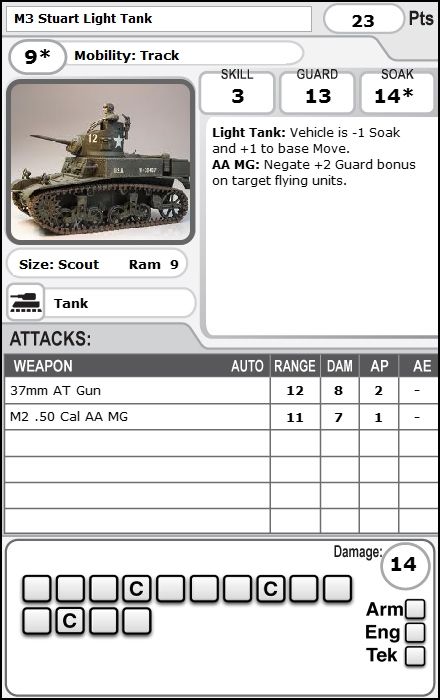
I come from the computer gaming era (born 1971) and as such I wanted to replicate the gradual decline of a tank in my Gruntz game, rather than an instant KO. This is by no means realistic but is just a simulation of the potential to stop a tank like you would see in the various strategy computer games that feature a bar along the top of the tank that reduces as they are hit. In addition to the damage track which is worn down slowly by varied incoming damage you also have a "C" critical point which can potentially take out a key system for example targeting which makes the Tank a very poor shot. Targeting (TEK), Engine (Eng) and the hull (Arm) can all potentially take a critical when a C threshold is filled in when damage is being assigned to the model. If you are extremely unlucky the first C box filled in could result in all three systems being damaged which is very close to a KO condition but unlikely. These three criticals have a simple impact on the vehicle – a negative on the targeting, reduced movement and reduced Soak against incoming damage. It is kind of basic really but does allow for some interesting situations where a lucky first strike could take out the armour, so you still get the feeling that you could make the tank less effective with a small amount of damage done to it and not have to slog through the larger damage grid. Of course bigger tanks and hulls have more damage points but could still suffer from a critical. This is a card created in the Barracks App that supports the Gruntz game and you can see how the damage grid and critical types are represented on the card, so no need to place tokens out next the vehicle in the game.
|