| Mooseworks8 | 18 Jan 2013 11:46 a.m. PST |
I need ideas for basing up armies to play an North African campaign and the Italian invasion of Ethiopia. Obviously sand would feature heavy but what else? Can you post a link or picture to what you have used and what it looks like on your models? While not WW2 I have mixed some "desert" type stuff seen on these VSF Texans below but I am unsure how the material would look for North Africa. Thank for any and all suggestions.
|
| Tom Reed | 18 Jan 2013 11:56 a.m. PST |
I use a really fine grain sand that is used for model railroading. It looks good even with 15mm figures. |
| Pictors Studio | 18 Jan 2013 11:57 a.m. PST |
It depends on the scale. If you are doing 15mm or smaller then just puttying the base and smearing it as it dries so that it is irregular works pretty well with some flocking after you paint it. Another option is sand or using small amounts of Renaissance Ink textured basing gel. For bigger figures painted sand works fine. |
| olicana | 18 Jan 2013 12:27 p.m. PST |
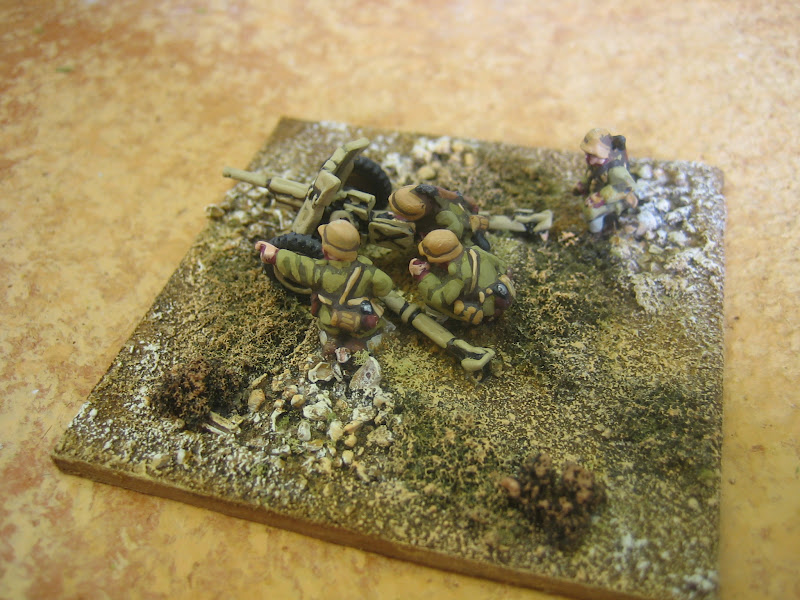
15mm – sand, grit (ground oyster shell, budgie grit, cat litter)'foam' flock, and 'foam' clumps. All ink washed (flock in V. Dark) then dry brushed.
28mm – I do these almost same, but coarser grit. These are Crusades figures so they are a bit greener, for N Africa I'd use less flock, ink the flock and dry brush it.
|
| Nick H | 18 Jan 2013 12:34 p.m. PST |
I like using ballast rock you get for model railways. They are a standard sand colour but you can get them in different sizes and grains, depending on scale. |
| Martin Rapier | 18 Jan 2013 1:16 p.m. PST |
I just use builders sand over a terracotta painted base. Drybrush Magnolia for a very arid look, maybe add a few clumps of static grass. Used the same system for everything from Punic wars carthos to AiW. |
| Bob in Edmonton | 18 Jan 2013 1:24 p.m. PST |
Wow, lovely work by others. I use sand (left over from last year's sand bag that I used on the icy walk) with a few small pebbles mixed in, sealed, drybrushed sandstone, with buff static grass and some olive-coloured railway flocking: link Bob in Edmonton |
| Florida Tory | 18 Jan 2013 1:38 p.m. PST |
I suggest you search Google Images for the region of interest in order to get it right. I recently re-read Churchill's River War and discovered the need to rebase all my Sudan War colonial figures to use a red sand, rather than the sand-colored sand I was used to from North American deserts. I quickly found images that confirmed Churchill's vivid descriptions. Rick |
| Griefbringer | 18 Jan 2013 2:05 p.m. PST |
Not all areas of the North African desert consist of fine sand – there are also some quite rocky areas. |
| Lion in the Stars | 18 Jan 2013 2:22 p.m. PST |
There was a great article on the Flames of War site showing different basing methods for Egypt, Tunisia, Italy, the deep desert, etc… Unfortunately, I cannot find it on the BF site, and don't seem to have a copy either saved or bookmarked… |
| ComradeCommissar | 18 Jan 2013 6:01 p.m. PST |
Here's the FOW article: link I use this method and like the results. |
 John the OFM John the OFM  | 18 Jan 2013 6:07 p.m. PST |
Woodland Scenics model railroad ballast, in various colors and grades. |
| Lion in the Stars | 18 Jan 2013 7:30 p.m. PST |
@Comrade Commissar: That's the one, thank you! *bookmarks, so as to not lose it this time* Practice bases can make good sniper markers, objectives, or other markers. As far as materials goes, I like the Vallejo gels/pastes. Red Oxide paste is great for making sandy bases. The Black Lava material could probably be used as-is if you're doing Pacific volcanic islands, but I tend to paint over it. I prefer to put basing material down BEFORE painting the minis, because the acrylic gel is very easy to clean off of an unprimed mini. Note that there are several other colors/consistencies of this stuff, and you can get interesting effects by putting a second layer of a different texture. I have also used Elmer's Wood Filler, though that dries out in the container easily. It's also very easy to add too much water. This one looks most like flat ground. It's almost too smooth once you paint it, so I like to put a little smear of the Black Lava gel on top of the wood filler. |
| johnnytodd | 18 Jan 2013 7:42 p.m. PST |
I use two part epoxy putty (green stuff) to form my base on a coin, then add texture with a toothbrush, paint color of choice – the result is smooth and rock-solid with nothing to rub off…
|
| number4 | 18 Jan 2013 10:37 p.m. PST |
I use model railroad ballast, with a few bits of (unused!) kitty litter and lichen added in
Herein lies a funny story: I was making an Oasis terrain feature and ran out of ballast. My lovely wife suggested using garlic salt from the kitchen…..yes, it looked superb, very realistic and just the effect I was looking for. However smell, instead of dissipating as we thought, only got stronger as the days went on!! |
| Grandviewroad | 19 Jan 2013 6:57 p.m. PST |
play sand, or finer. I put Elmer's wood fill (tan) on the base – that's the sand that's too small to distinguish – and then use real sand for "bigger sand and small rocks" and mix in some carefully selected kitty litter for those white rocks, or old GW basing gravel for the 'bigger rockier rocks" that are still brown. Looks just like the color pics, basically. |
| olicana | 20 Jan 2013 3:47 a.m. PST |
play sand. Yep, agreed. I like this stuff for bulking out my grit mixes. It has been 'washed' so, in use, it is less 'dusty' than builders sand. |