| Redcoat 55 | 17 Jan 2013 8:12 p.m. PST |
Has anyone ever tried to do the Lexington/Concord Scenario in the British Grenadier Scenario book? If so what table size is required to do it with 15mm figures or 6mm figures? Also, has anyone ever tried the scenario using Black Powder as the Rule set? |
 John the OFM John the OFM  | 17 Jan 2013 9:36 p.m. PST |
I am painting up enough skirmish based figures to do it on a 9'x5' Ping Pong table with 28mm figures. I will be using The Sword and the Flame rules, with 10 man units.
I think that this battle was a bit unique, and using companies as the maneuver element is the way to go.
It will be difficult to "simulate" this battle, particularly the mobile retreat, on any size table, so I am toying with some "scrolling scenery" ideas. |
| MajorB | 18 Jan 2013 3:22 a.m. PST |
If so what table size is required to do it with 15mm figures or 6mm figures? Depends on your ground scale. |
| Sysiphus | 18 Jan 2013 7:45 a.m. PST |
Ran this 20 or more years ago in a classroom w/ my students. Used several 2 by 6 tables linked together. As John says used company sized units, I used painted and labelled wood blocks.
Students enjoyed it and we followed up with a visit to the actual battle road sites.
Would think the careful arrival of the different town militias would be important to gamer flow and success. |
| T J Crockett | 18 Jan 2013 9:57 a.m. PST |
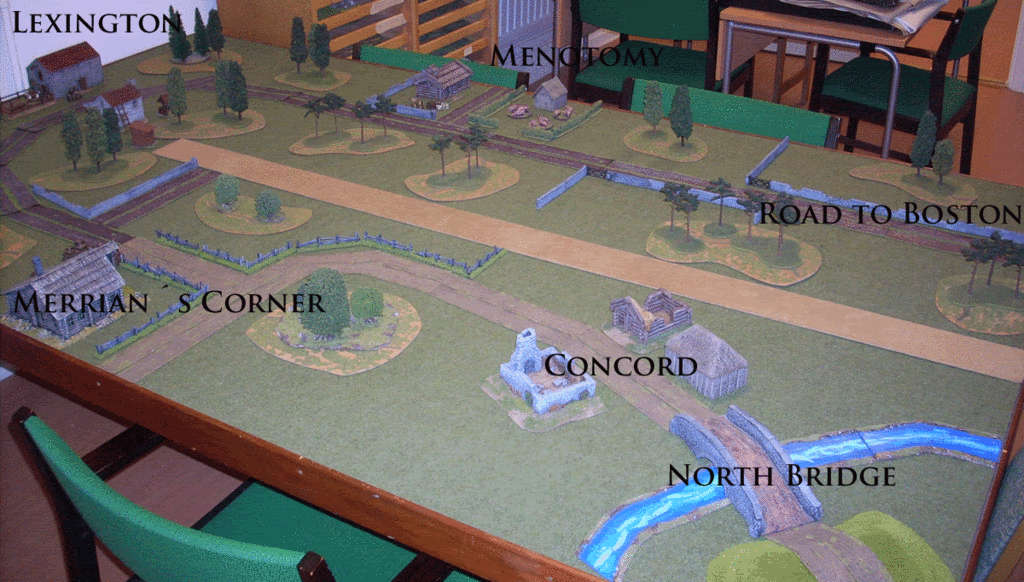
This guy uses an interesting loop set up.
|
| historygamer | 18 Jan 2013 10:56 a.m. PST |
A long, thin table would work, especially if you are using the mm movements (which I don't). |
| MajorB | 18 Jan 2013 1:41 p.m. PST |
That's neat. I might well steal that idea! |
| historygamer | 18 Jan 2013 1:42 p.m. PST |
You could also put up a line of trees to visually break the two halves apart. Just an idea. :-) |
| John the OFM | 18 Jan 2013 1:54 p.m. PST |
The problem here is that Lexington and Concord are a few miles apart. In a "battle" the size of this, thy should not both be on the same board.
Not that the game shown above was not fun, but… It was a series of running skirmishes.
Concord itself could take up the whole table, if done "right". It could also be a rather long game, with the Lobsters trying to get back to Boston, and Minutemen appearing randomly all over the place. I envision MY future game as a "chase" game, like an "Escape from Islandhwana" game, or something similar.
I have enough Minutemen (Lordy, do I! and with the new Perry ones…), I just need to paint up about 5 companies each of Grenadiers and LI. I will probably do it in several games, starting at Concord, with specific burn and pillage objectives that must be accomplished before they get cut off. Accumulate "pilage points" and get moving on the road by Turn 10. Something like that.
Game 2 will be on the long road back, with the Alarm Companies showing up to express their disapproval, and demonstrating why a 2nd Amendment [[DELETED FOR POLITICAL COMMENTARY]] . |
| trailape | 18 Jan 2013 2:37 p.m. PST |
Game 2 will be on the long road back, with the Alarm Companies showing up to express their disapproval, and demonstrating why a 2nd Amendment [[DELETED FOR POLITICAL COMMENTARY]] . 'Sigh' It's come to this. |
| Supercilius Maximus | 18 Jan 2013 2:56 p.m. PST |
I have seen this game played out on a long, thin table with "rolling terrain" (ie the figures remained roughly in the centre of the table, whilst the – admittedly very simple – terrain was shifted in the opposite direction of their movement). Just on an historical point, the British mission was to seize publicly owned military materials illegally acquired by the Committees of Correspondence (on behalf of the Continental Congress), and cannon and gunpowder illegally manufactured in contravention of Government monopolies. Legally bought arms and ammunition in private ownership were specifically to be respected and not seized. |
| historygamer | 18 Jan 2013 3:15 p.m. PST |
|
| Redcoat 55 | 18 Jan 2013 4:46 p.m. PST |
There are many cool ideas here. Thank you everyone. I think it was 21 miles between Boston and Concord. There were multiple routes the British could have returned from Lexington after Percy met Smith's force and Lord Percy did not take the most obvious one. The British Grenadier scenario only covers the British advance and withdrawal between Concord and Lexington to try to make the scenario easier to manage. The crucial time was before Percy arrived. |
| John the OFM | 18 Jan 2013 5:43 p.m. PST |
'Sigh' It's come to this. That was a joke, BY ME. The Editor had nothing to do with it.  |
| Alyxander100 | 18 Jul 2013 7:43 p.m. PST |
Redcoat, Did you ever finalize anything on this? I too am looking into how to game this for BP. I was thinking of playing it at 1:10 or even 1:5 (in 15mm) with companies being the main unit – so most of the companies would be 6 man single stands and have a command figure for each group. For the British, from what I have read, there were a great number of communication errors, troops not following orders etc because of the mixed companies. To game this, I would give each group of companies a commander (like a Brigadier Gen for most other scenarios) and have them all have relatively low command values…I was thinking in the neighborhood of 6 for the regular companies and 7-8 for the Grenadier and Light companies once they formed up after Lexington. Also, as a house rule, since neither group was too keen on a full out knock-down drag out brawl, I would say that each unit wishing to fire would need to pass a command test. If passed, the unit fires at full strength (3 dice) otherwise the unit fires 1 dice (to simulate the disorganized fire resolved without an official order…kind of a "the Lt is saying don't fire…but my finger slipped" and the rest of platoon haphazardly follows with an ill-aimed/poorly disciplined volley.) At any rate, any kind of OOB you may have or scenario suggestions you may wish to share would be more than gladly accepted. I am trying to put together some other scenarios as well, mostly the larger battles during the early years of the conflict in the north – Brandywine Creek, Brooklyn Heights, Freeman's Farm, Bemis Heights, etc. I dont have anything finalized, but would be willing to share anything that I have that may help. |
| Supercilius Maximus | 19 Jul 2013 5:30 a.m. PST |
Also, as a house rule, since neither group was too keen on a full out knock-down drag out brawl, I would say that each unit wishing to fire would need to pass a command test. This might have been the case when Parker and Pictairn faced each other across Lexington green, but once the militia at the North Bridge saw the fires in Concord and assumed the British were burning the town, the gloves were pretty much off. In any event, the British rank-and-file (whatever the state of mind among their officers) seem to have been in a highly aggressive mood, having endured months – in some cases years – of what was seen as Yankee provocation. So I would suggest perhaps the rule should be the other way around, with a specific command test to keep the firing under control (although the idea of the volley being ragged is still a sound one). I'm not sure if they were issued extra ammunition for this mission (a small tin with extra rounds was carried in a coat pocket later in the war) – I suspect probably not – but the pre-war cartridge box only held 36 rounds and before they staggered back into Lexington and the protection of Percy's brigade, Smith's column (and most certainly the lights) had largely used up its ammo. As far as the Americans' attitude was concerned, Parker did order his men to let the British fire first, and the presence of some F&IW vets would have engendered some sense of discipline. However, en route to Lexington, the British reported several instances of one individual coming to the side of the road and firing a blank charge at the column, presumably either to intimidate them or to goad them into firing back for propaganda value (the first shot at Lexington appears not to have been fired by either of the groups lined up there). I would maybe test each militia company for "fire discipline" as it appears on the table, with a "+1" for minutemen companies, and use that to affect accuracy and/or ammo expenditure (bear in mind that large numbers of militia companies "fell out" at various points having fired all their rounds – not sure, but I think they carried about 20, typically). I'd also avoid making musketry too bloody; it has been estimated that it took about 300 rounds to inflict each British casualty (even allowing for some men taking multiple hits). A fair few of the militia casualties were caused by bayonets. |
| epturner | 19 Jul 2013 5:14 p.m. PST |
What SM said. I think the idea is all about Command and Control from both sides. Make it a morale thing. And only a reduced chance of actually hurting anyone. Say, if you actually "hit", half the chance of "killing" a figure. The other result is a morale hit or something similar for skirmish gaming, to a reduced effectiveness for something larger for the "company" or "battalion"… Just noodling around here. Eric |
| Alyxander100 | 19 Jul 2013 7:23 p.m. PST |
Eric, That is a great idea. Black Powder rules that I am playing with don't really have "casualties" per se. When hits are successful they basically cause what would be equivalent to disruptions to the unit. After 3 disruptions the unit becomes shaken and must pass a morale test to stay on the field else they have to retreat – so you could say that the firing results in a loss of desire to stay engaged, this due to being cut off, outnumbered, outclassed or just good old shot up. Fun rules to play with for an evening of "casual" gaming. |
| Supercilius Maximus | 20 Jul 2013 5:53 a.m. PST |
The other result is a morale hit or something similar for skirmish gaming, to a reduced effectiveness for something larger for the "company" or "battalion"… This. At one point, before the column returned to Lexington, the officers had to block the road and present their bayonets at their own men to stop them stampeding back to Boston as an uncontrolled mob. Even when they reached the safety of Percy's brigade, the men just fell out and flopped down on the green; it was some time before they were fit to move again, and then Percy's men had to act as flank and rear guards because Smith's men were spent. Casualties were obviously a factor, but exhaustion and the sheer relentlessness of the enemy units appearing along the route, also contributed to one of the lowest points of morale among British regulars in the entire war. |
| Supercilius Maximus | 20 Jul 2013 10:32 a.m. PST |
As a further thought, it might be an interesting exercise to determine that if Smith's column reaches the sanctuary of Lexington (on the return journey), it then becomes an impediment to Percy – ie "baggage" to be protected – and either cannot add to his fighting strength, or else can only do so once if it gets an extremely good morale throw. Even then, it is only useful for a bayonet attack, being out of ammo. |
| epturner | 21 Jul 2013 11:02 a.m. PST |
SM;
This would almost be similar to the challenge faced by Ebeneezer Francis at Hubbardton, with a gaggle of sick and wounded to move along, yet act as a rearguard. Interesting thoughts. Eric |





 paints brigs for the British fleet.