"Civil disturbance in Russia at 1812" Topic
8 Posts
All members in good standing are free to post here. Opinions expressed here are solely those of the posters, and have not been cleared with nor are they endorsed by The Miniatures Page.
Please use the Complaint button (!) to report problems on the forums.
For more information, see the TMP FAQ.
Back to the Napoleonic Discussion Message Board
Areas of InterestNapoleonic
Featured Hobby News Article
Featured Link
Featured Ruleset
Featured Showcase Article
Featured Workbench Article
Featured Profile Article
Current Poll
|
Please sign in to your membership account, or, if you are not yet a member, please sign up for your free membership account.
Tango01  | 09 Jul 2012 12:29 p.m. PST |
Not too mention in the Russian campaign, but there were a good deal of anarchy in some russian regions in 1812.
As Mr. Lieven point in his book: "There were three times more peasant distubances than in an average pre-war year and most of these disturbances occurred in the areas close to military operations…
The effects of shaken authority were apparent to all. One week after the fall of Moscow Prince Dmitrii Volkonsy recorded in his diary: " The people are ready for disturbances, assuming that everyone in authority had fled in the face of the enemy. In some cases these disturbances were serious, thought always very localized, they required the detachment of smal regular units from the field army"…
The worst peasant disturbances occured in and around Vitebsk province which was the area of operations of Peter Wittenstein's first Corps. A number of landowners were murdered or assaulted in the summer and autumm of 1812, sometimes by crowds of 300 peasants or more. On one notorious occasion a troop of forty dragoons was routed by the rioters, two dragoons were killed, twelve taken prisioner and their officer badly beaten up…
Wittgenstein added that the disturbances had been caused by French incursion into the region and would quickly cease once the enemy was ejected…
Wittgenstein was able, to deploy a Squadron of Bashkirs on one particularly troublesome state…
Alexander wrote to the war minister, Prince Aleksei Gorchakiov that there were no fewer than twenty-nine irregular cavalry regiments, twenty of them Bashkir, en route from the Urals and western Siberia. These might often be of limited use against the French. but they were more than adequate to overawe the peasants of Vitebsk…" Maybe of possible interest for wargames about Russian war of 1812?
Russian military operations with problems to deploy troops because their supplies could be hacked by civil unrest?
Or what about some militia turned on the battlefield and run?.
Even a skyrmish game between revolt peasants and Bashkir cavalry. Apart from that, incredible that Napoleon had not taken into account in his favor the discontent of a population mostly slave. Caliancourt were supposed to know enough about the civil problems of Russia and to advise him in detail!. Amicalement
Armand |
| huevans011 | 09 Jul 2012 2:23 p.m. PST |
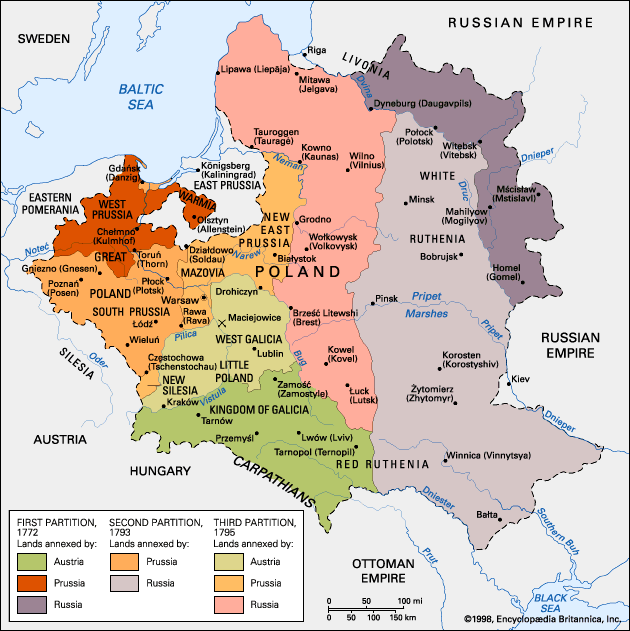
Vitebsk = former Polish territory. Belarus, not Russia per se. Would be interesting to note if ethnic Russian areas had equally serious disturbances. |
| 14Bore | 09 Jul 2012 2:57 p.m. PST |
Going from memory here but peasants who were armed or recovered arms were un-armed at gunpoint after hostilities ended. All in all from my more than a fair share of reading of Russian history I'd put it all that it was just too early for mass revolt but it doesn't surprise me that small areas of lawless happened. |
| Seroga | 09 Jul 2012 2:59 p.m. PST |
Dear Armand, I think that you somewhat misunderstand the composition of the opolchenie (militia). They were typically not serf. They were volunteers. In areas near Petersburg and Moscow, they would be mostly free traders and craftsmen, with some factory workers (some of these might be government serfs, but still they were more or less skilled paid workers). In the south and east, the militia would be again free, the people of Cossack or similar social position. In the north, again free – forresters, hunters, trappers, lumbermen, Protestant Finns and Baltic "Germans", and so on. Some nobles, due to poverty or zeal or both, also volunteered for the ranks. These kind of folks had a lot on the line in serving in the militia …. not just the usual risks, but also the chance for their family to get officially recognized for their service – and perhaps advance to the Russian or Cossack (and similar) nobility. I do not know of any case where they ran away under combat. It may have happened, but I never heard of it. It would have ruined a family's reputation. I know of one instance where their was tumult or semi-mutiny. It was during the forming-up of the Kostromo opolchenie. A rumor went around that they were being taken into the Army. This would have been (i) for 25 years, instead of the duration of the war, and (ii) a reduction to a nearly serf-equivalent soical status. But when the situation was clarified, the tumult stopped and everyone started apologizing to each other. There were some serfs in the opolchenie. For example, volunteers from the empannage properties (personal holdings) of the Imperial family. Great units of light infantry, including the L.-G. Finns, were formed from these volunteers. Also, a noble might bring a few serfs with him (for servants, for bodyguards, to make the local recruitment numbers look good). But, oddly, the whole "tone" or culture of the opolchenie was rather bourgeois and Cossack, instead of serf. I could also add that the opolchenie were "leavened" with detachments from their training battalions (mostly Marines for the Peterburg militia), the healthiest/youngest memebers of the local Internal Guard (like gendarmes, more or less) and retired soldiers from military settlements. On another topic …. I think 300 rioters was not so many, in your example. I think Dr. Lieven is merely taking advange of the Graf Vitgenshtein's headquarter's' generally competent staff work, active reporting, and the accident of almost a complete set of surving documents. I am sure 300 person riots were not uncommon at all in places were the French were moving through. Didn't the French shoot 3000 or so in Moscow? I know of no examples of serf uprisings away from the French army. But, I have never looked carefuly for such. That said, you may recall that this region near Vitebsk had been part of the Polich-Lithuanian Commonwealth into the 1770's or 1790's.
See map
The people here may be ethnically Belarussian or Polish-Lithuanian. Many were Catholic. So, having little taste for obedience to Russian masters that look like they may be losing a war …. well, not too surprising. More surprising is the generally marked loyalty of the recently occupied Finnish and Baltic peoples. |
| Seroga | 09 Jul 2012 3:08 p.m. PST |
"un-armed at gunpoint after hostilities ended." Well, not really. The Internal Guard did search and collect them. But more were turned in due to a purchase program – 5 rubles per gun. This was OK money in an economy were cash was not too much used : an Army ranker made 9 rubles per year. That said, if you count the number of dead French and Allied, and subtract the number of weapons captured, turned in or seized, there are 300,000-400,000 unaccounted for. People are still finding them. But I would think the French destroyed the majority rather than let them be taken. The French were fine soldiers, and would do their duty until the end, I think. |
| Seroga | 09 Jul 2012 3:18 p.m. PST |
"discontent of a population mostly slave." The ones mostly possibly discontented, among people who were ethnically Russian, were the rural serf population – these folks did not have any information other than that the Antichrist had invaded Russia. They were isolated, poor, religious and illiterate. Reform movements of the 1800's, very noticably, were not revolts of the poor – but the actions of nobles (some quite prominent) and academics convinced that Russia's autocracy and the exploitation of the serfs were barriers to mdernization and development. Fomenting a reformers' coup in Petersburg would be alot more likely than starting a serf revolt. I think the marquis de Caulaincourt would know this well. |
| Tango01 | 09 Jul 2012 3:19 p.m. PST |
Many thanks for your guidance my friend Seroga.!
Quite interesting!.
Still, I think that Napoleon would had think about those who were not happy with russian ruler when he decided to invade. Amicalement
Armand |
| Seroga | 09 Jul 2012 3:25 p.m. PST |
"those who were not happy with russian ruler" Poles! For sure! Bien fort amicalement! |
|




 returns to Flintloque to paint an Ogre.