"A few Q's regarding French/British brigade organisation." Topic
14 Posts
All members in good standing are free to post here. Opinions expressed here are solely those of the posters, and have not been cleared with nor are they endorsed by The Miniatures Page.
Please don't make fun of others' membernames.
For more information, see the TMP FAQ.
Back to the Napoleonic Discussion Message Board
Areas of InterestNapoleonic
Featured Hobby News Article
Featured Recent Link
|
| grambo | 18 May 2012 5:52 a.m. PST |
I'd like to ask a couple of questions regarding French/British battalion/brigade organisation in about 1812. I know I could research this myself, and probably should, but I'd like your help please as it will just assist me in organising my new 6mm armies and Napoleonics is not (yet) my specialist field. OK here goes, and thanks in advance for any replies: 1. I understand French infantry brigades comprised battalions from 2 regiments (average?) How many battalions would this consist of? Average number of battalions per typical French brigade? 2. Would 3 Regiments for a British brigade be typical? Just the single field battalion representing each regiment? 2nd battalions would be 'depot' battalions, correct? 3. What would be typical/average 'field' strength of both a French and British battalion please? Around 600 officers and men for brits? 4.In the case of a French 'converged' grenadier battalion would it be fielded within a brigade along with line troops OR be an independent command? 3.What would be the rank of a French Brigade commander and a British Brigade commander. The above would help me a lot,cheers. Lee. |
Ligniere  | 18 May 2012 6:07 a.m. PST |
Grambo,
I assume you're talking about the French in the Peninsular.
1. French brigade – typically two regiments per brigade, one, two or at most three battalions per regiment. It was more common to see two battalions in 1812, due to campaign attrition etc.
2. British Brigade – typically three, but sometimes four battalions per brigade. The light companies would be detached from the parent unit and combined with a rifle company, typically of the 5/60th, to form an independent light battalion. The battalions could be 1st or 2nd, but rarely both would be in the field at any one time. The 2nd battalion might replace the 1st in the field, and the remaining men from the 1st would be transferred to the 2nd, and the cadres sent home to recruit.
3. Average strength for both would be between 500-600 men. Some British battalions, typically those new to theater would be on a higher establishment, closer to 900 men. The frontage of a French battalion would be significantly narrower than a similar strength British battalion due to the use of three and two-rank formations. In my opinion it is important to reflect that difference.
4. Any converged grenadier units that were formed, not seen evidence of any in 1812, would have been independent – at least this was the typical case in earlier years.
5. A French brigade commander would be a General de Brigade, or colonel. A British brigade commander could be a Major General, Brigadier General or a Colonel – it all depends. npm |
| Rod MacArthur | 18 May 2012 6:37 a.m. PST |
Just to say that everything Ligniere wrote above is absolutely correct. If you want to go for average battalion strengths those for French in Peninsula and Waterloo were 540 whereas British were 660. French tended to keep close to their average because as battalion strengths fell they reduced the number of battalions per Regiment to maintain optimum strengths. The British did not have that ability with normally only one battalion per regiment in the field. I tend to make all British line average 600 but have some larger battalions, particularly some (but not all) light infantry. Since I use a ratio of 1:30, I represent French with battalions of 18, most British with battalions of 20, but British Guards, 52nd LI, 43rd LI and 71st LI as battalions of 30. Incidently, all cavalry, British and French (and everyone else for that matter) used the system of maintaining squadron strengths at between 100 to 150 by reducing the number of squadrons per regiment as attrition set in. On my 1:30 figure ratios most of my squadrons are 3 or 4 figures, and I field regiments with the historically correct number of squadrons. Rod |
| grambo | 18 May 2012 7:12 a.m. PST |
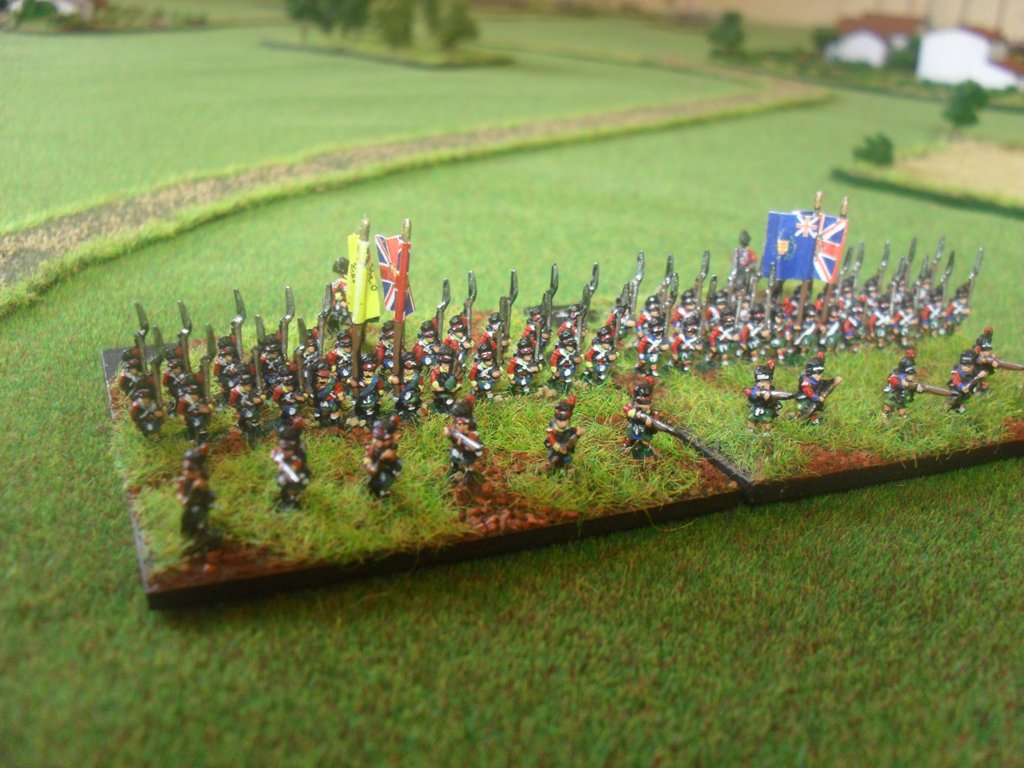
Brilliant info! Just what I was looking for, thank you both. That will help me to organise my armies as I build them up. Ligniere, I take the point you make re different frontages. With my 6mm figures based as they are its difficult to replicate this but I try to show this by basing my French battalions 3 deep and my British battalions 2 deep (see examples below). My rules differentiate battalion formations as either 'massed' or 'Linear'. The skirmishers are just for show really, it was pointed out to me in a previous post on TMP that line battalions did not deploy their voltiguers in this way, but I'm not sure about that? Anyway, thank you for your info. Rod,thank you for the info re cavlary, that is useful too. I will double up my British Guards to 2 bases I think when I do them. Anyway, heres how I'm basing my battalions, its hard with this scale, as you cant use a strict figure scale, but rather I give my battalions a 'combat strength' which accumulates 'hits'. Thanks again,
Lee. British (Scottish) battalions, 2 deep line (Linear).
French line battalions, 3 deep 'column' (massed).
|
| Jemima Fawr | 18 May 2012 7:56 a.m. PST |
British 2nd battalions in the field weren't depot battalions – they were additional field battalions. A new (3rd) depot battalion would be created when a 2nd battalion went to war. If the 3rd battalion was sent to war a new depot (4th) battalion would be created and so on and so on… |
| Rod MacArthur | 18 May 2012 9:17 a.m. PST |
R Mark Davies wrote: British 2nd battalions in the field weren't depot battalions – they were additional field battalions. A new (3rd) depot battalion would be created when a 2nd battalion went to war. If the 3rd battalion was sent to war a new depot (4th) battalion would be created and so on and so on… Not entirely correct. British did not have depot battalions, but if regiments had more than one battalion and one was in UK (normally, but not always, the 2nd), then that acted as a depot. If one or more battalions were overseas then both were established with an additional UK based Recruiting Company each of 1 captain, 2 lieutenants, 1 ensign, 8 sergeants, 8 corporals and 4 drummers. These Recruiting Companies combined to form a depot. If a regiment only had one battalion then it got a recruiting company if sent overseas. The system is explained in detail in General Orders 1811 (available as a free Google download). During the Napoleonic wars the maximum size the British Army reached was 21 Regiments of only 1 battalion, 71 regiments of 2 battalions, 4 regiments of 3 battalions, 1 regiment of 4 battalions (1st Royal Scots), and 1 regiment of 8 battalions (60th). 3rd and 4th battalions were extremely rare. Both 1st and 27th had several years of all of their battalions being overseas but no additional battalions raised. In fact 2nd, 3rd etc battalions were only raised when there was already one at home, as this was used for the initial forming up process. There were two attempts to form 2nd battalions when the 1st were already overseas and both failed with the new 2nd battalions being disbanded within a few months. The reason why some regiments had 2nd battalions and some did not was simply that these were the regiments which had a battalion in UK at the time that the government wanted to expand the army. If the only battalion in the regiment was overseas then a 2nd battalion would not be authorised. I have researched all this in detail from the original manuscript documents in the National Archives at Kew and published my findings in a pair of articles totalling 18,000 words for the Journal of the Society for Army Historical Research. Rod |
le Grande Quartier General  | 18 May 2012 9:36 a.m. PST |
Quick question- where do you get that particular table gamecloth of the type and color pictured? Sorry, not to be off topic, just curious. |
| Ligniere | 18 May 2012 10:13 a.m. PST |
GQG,
The cloth looks like a Noch type material – you see it used by railway modelers.
But Grambo will have the definitive answer….. npm |
| Sparker | 18 May 2012 3:37 p.m. PST |
Hi Lee, great figures – Adler? I love the way you have the Black Watch and Gordons brigaded together, looks good. Just as a matter of interest I don't think these two Highland Regiments ever served in the same formation in the Peninsula… The 92nd (Gordons)were in Howard's Bde, the 2nd Division, the 42nd (Black Watch) in Pack's Bde, the 6th Div. However if the skirl of massed pipes appeals, its worth noting that in Packs Bde the Black Watch, from 1813, were joined by the 79th Cameron Highlanders… |
| grambo | 19 May 2012 3:55 a.m. PST |
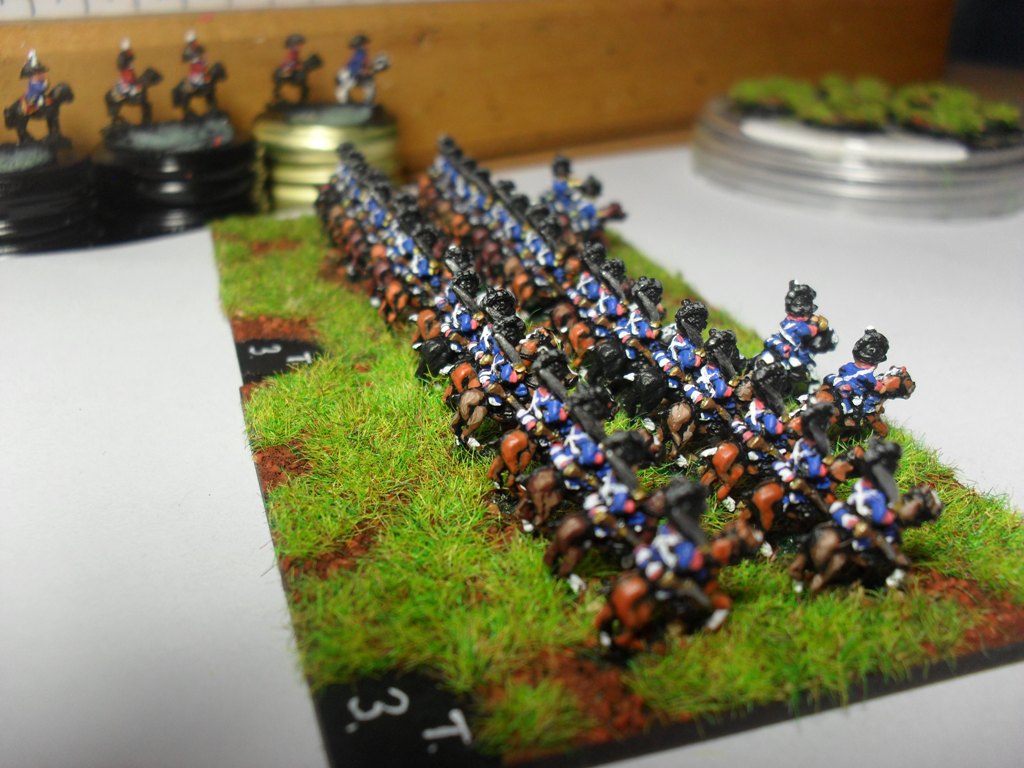
Cheers again for all the great info. Rod, you have certainly done some serious research. Just to reply to a couple of Q's above, GQC, the terrain cloth is a good old Citadel 'Battlemat', it's tough and durable but above all it does have some subtle colouring of dark and lighter greens plus browns in there. I intend to build interchangeable fully landscaped terrain boards in the near future though, as I enjoy this aspect and in 6mm its both managable and affordable! Sparker, thanks for the info and comments. The figures are actually all Baccus6. The image is a random shot from my blog, taken just after I had painted the 2 Highland battalions, I couldnt resist putting them together! But again your input is welcomed and duly noted. Ligniere, although the cloth is by Citadel I do plan to use a lot of model railway methods and supplies on my terrain boards, some of those layouts are very inspiring to us wargamers. Lee. My 2 regiments of Light Dragoons, side by side, ready to charge, much as I'd love to do this in 28mm it is beyond my means and available time, and the mass impact of 6mm figures as not without appeal I think
.
|
| Sparker | 19 May 2012 11:14 p.m. PST |
The Light Dragoons look fantastic! Its a mystery to me how anyone can paint well at that scale, but clearly it can be done… |
| grambo | 20 May 2012 1:47 a.m. PST |
Cheers Sparker. A fine brush and a steady hand I guess! I've only been painting in 6mm since the end of March, before that it was 28mm so took a bit of adjustment to 'get my eye in' on the small scale. But I'm enjoying Napoleonics and learning more by the day :-) Blog link should anybody care to take a look, I plan to fight my first Napoleonic test battle this week, thus the questions re organisation. Napoleonic Therapy Project – link Cheers,
Lee.
|
| ratisbon | 20 May 2012 5:09 a.m. PST |
Very nice figures. What rules do you use? Brigades are units of combat, not administration, thus, they can consist of any number or size of units withing the contrain of size. Brigades greater than 3600 or so, and the Austrians had them, were so large as to be not only unwieldy but also difficult to command by voice. Brigades less than 1800, and there were some, boardered on being too small to have and effect on the grand tactical battlefiled. European nations fielded multiple battalion regiments which at the beginning of campaigns were, for the purpose of battle, brigades commanded by the regimental colonels. As attrition took its toll and battalions were amalgamated or assigned to other duties, regiments which were much smaller were brigaded with other regiments to meet the necessary size, under the command of a brigadier in the French army or a major general in others. The rank of Brigadier did not exist in the British army. It was the honorary title given to the lieutenant colonel appointed to command the brigade. If the rules have a figure scale then the size of a brigade should be between appoximately 1800 and 3600 men. If the rules do not have a figure scale a simple rule of thumb is a brigade should have between 3 and 6 battalions. Bob Coggins |
| grambo | 20 May 2012 6:54 a.m. PST |
Hi Bob, Thank you for the detailed info, useful stuff. My battalion bases do not feature a strict figure scale, but rather are assigned a 'combat strength' value representing battalion size. Each battalion is also given a 'skirmish value' so British Brigades where Rifle companies might be attached for example can be given a higher rating to reflect this. I'm going with an average French Brigade size of 4 battalion bases, and British brigades of mostly 3 to 4. I might be off here but I need to settle this in my mind before I move on. A French brigade of 4 x 31 figure bases (124 figures) don't look bad on the table, and it's an advantage of 6mm scale that I can do this. I've seen games where 8 x 28mm figures are called a Brigade for instance! I'm trying to approach this project from a slightly unconventional angle. I want to represent brigades occupying a 'square grid' terrain which I intend to build featuring a very subtle, disguised grid. I have now settled on squares of 200mm which will each represent an area filled by a brigade plus a battery of supporting guns where required (assigned at Division level). Of course there has to be compromise in ground scale, but it's slowly coming together in my head at least! Cheers,
Lee. |
|