"'Credible' non-human Fantasy minis?" Topic
57 Posts
All members in good standing are free to post here. Opinions expressed here are solely those of the posters, and have not been cleared with nor are they endorsed by The Miniatures Page.
Please remember not to make new product announcements on the forum. Our advertisers pay for the privilege of making such announcements.
For more information, see the TMP FAQ.
Back to the Victorian SF Message Board Back to the Swashbuckling Message Board Back to the Fantasy Discussion Message Board Back to the Blogs of War Message Board Back to the 18th Century ImagiNations Message Board Back to the Pulp Gaming Message Board
Areas of InterestGeneral
Fantasy
Renaissance
18th Century
Napoleonic
19th Century
World War One
World War Two on the Land
Science Fiction
Featured Hobby News Article
Featured Link
Top-Rated Ruleset
Featured Showcase Article
Featured Profile Article
|
Pages: 1 2
| abdul666lw | 09 Feb 2012 10:02 a.m. PST |
To see 'caricatural / cartoonish' non-human figurines on the same gaming table as anatomically correct (or almost so) human ones is outside the limits of my 'willing suspension of disbelief'. It's not merely an allergic reaction to anatomical impossibilities, such as Dwarves with the knees either at the hip or at the ankle. It's mainly because visually they are not of the same *style*: just like Bugs Bunny or Wile E. Coyote appearing in 'Gladiator' or 'Barry Lyndon'; may be fun once (Roger Rabbit) but appaling as a routine. Thus as thought experiment I tried to find the origin of the incongruous appearance of most non-humans (Elves generally excepted) in illustration and miniatures. And then to search for another, more satisfying imho, way to reflect their 'differences' with gaming figurines.
I'll us as examples 18th C. minis of 28-30mm size (the type I'm less unfamiliar with), but 'translation' to other periods / sizes is straightforward. I'm old enough to remember the impact of early Citadel minis (wildly extrapolated from Tolkien, mainly)and how they set a 'style', so I'll try to 'rationalize' it with reference to the WHFB and WH40K backgrounds. In both we are facing an intellectually 'Dark Ages / Early Middle Ages' culture; now look at the illustrations of medieval bestiaries, and how some real animals (seals, sperm whales…) and even plants (cotton tree: a sheep upside down on the top of a trunk!) are depicted and drawn! In such pre-literate societies story tellers and illustrators emphasize the 'exotic'. Images intended for mostly illiterate viewers use gross exaggeration to translate 'graphically' any slight 'strangeness'. So let's treat illustrations of WHFB and WH40K as 'contemporary' ones. For instance, the 'beastmen' auxiliaries of the Imperial forces mentioned and illustrated in Rogue Trader and who disappeared from later 'canonical' texts: a 'rationalist' interpretation is that they were no more than a very 'graphical' collective reference to all ab-humans in Imperial service (ogryns, ratlings, squats) visually 'emphasizing' their 'not really human' nature. This approach fully explains all the apparent silliness of GW minis, such as the Chaotic spikes and decorations, and those characters depicted as bare headed while wearing a reportedly 'sealed' power of terminator armor. It's simply how they are (were / are to be) illustrated in a basically 'visual / graphical' basically illiterate culture. Then, 'official' miniatures are simply copied on these distorted images, as if Pharaonic Egyptian miniature soldiers were done in 3D following slavishly the Egyptian perspective, with the torso at right angle to the head and pelvis!
So what? The most parsimonious approach is to view all the wholly humanoid 'non human' races / species as other subspecies of Homo sapiens. How can their original features be represented with human miniatures?
Dwarves: old references are confused: the Dwarf in the Niebelungenlied is called 'King of Elves', while the 'Elves of Darkness' Dökkálfar / Svartálfar -skilled goldsmiths and armorers living 'in the earth like maggots'- are clearly 'our' dwarves. But there was no indication initially that they were specially shortish (nor chubby!): all 'magical' humanoids shrank as people believed less and less in them, re how the medieval Fées regressed to tiny Victorian faeries.
Minis-wise what is to be translated? While arguable, a short size is now 'canonical' and would be the most blatant distinguishing feature; a beard is almost compulsory; in addition they are depicted as 'conservative', still looking like mail-clad Wagnerian Vikings while at least some humans know of plate armor (idiotic, since they are unsurpassed armorers, but now 'canonical'). Thus against a background of 28mm humans, 'true 25mm' minis (Minifigs?) *with greenstuff beards* would provide 'credible' dwarves ('dwarfs' before Tolkien). For mid-18th C. battles, 'Malburian' minis would look suitably 'conservative'.
Painting-wise Dwarves have a background of miners and blacksmiths, so would wear dark clothes: dark brown, very dark grey… for facings, green would be 'fir tree' and red some dark burgundy / maroon.
Elves don't have to be semi-immortal magical creatures (even if a few gifted individual show some paranormal abilities). They can breed true with humans (a rare event for cultural / ethical reasons) so belong to the same biological species. A subspecies of Homo sapiens having diverged probably before the individualization of the Cro-Magnon line and evolved in isolation, keeping fiercely its 'blood purity. Yet the differences with normal humans are mainly psychological -ethical, cultural: an immense certitude of their total superiority, mental and physical, leading to a deep contempt of 'semi-animal' other humans. Moorcock's Melnibonéans (and Vadhaghs) correspond to such subspecies. Btw 'Elves' / Fées as understood here seem also to correspond to the (extinct?) 'giants' who build these citadels of glassy green stone Conan discovered in several parts of his world.
Even if their hypothetical semi-divine origin ('Angels' half-breed Nephilim en.wikipedia.org/wiki/Nephilim, or their Gibborim immediate descendants) is seen as mythical, they may indeed enjoy a significantly higher life expectancy (hence their repulsion to mate with 'short lived' humans: to them, the offsprings of such union hideously die of Progeria en.wikipedia.org/wiki/Progeria). It would also have interesting consequences on their society and reproductive strategy, explaining why they are so often deemed of 'androgynous' appearance, but it's another topic entirely 
They do NOT have Spock-like pointed ears (I suspect they date from Disney's 'Peter Pan' TMP link); and they don't have to be albinos either link.
Minis-wise for characters 'normal', preferably tall and beautiful, figurines would fit. Black Scorpion (even 'human') ones are reportedly taller than most ranges; so are most Redoubt', but seemingly too bulky. For those wishing their minis to show their 'nature' in an exacerbated way, some Alternative Armies Elves and the Foundry 'Revenant' ones would be adequate (their ears filed down), as would be some 'subdued' vampires in period clothes -'good' vampires representation look like haughty, yet seductive, humans.
Now for troops in my experience (with Ral Partha Elves, mainly) seen 'en masse' on the tabletop 'credible' Elves cannot be distinguished from humans, thus the reciprocal must be true. To 'visualize' their 'advanced' nature, minis intended for a slightly later date can be used, e.g. late 18th C. / early Napoleonic ones against 'Lace Wars' humans -so much the more as the uniforms are more skimpy, translating the slimness of Elves. Additionally to make them more distinctive one could use only minis with Hungarian tight trousers and boots -Hungarian infantry, French Revolutionary Chasseurs à cheval, horse artillery of Napoleon's Old Guard… No pelisse (too blatantly 'historical Hungarian') but skilled converters could give the cavalry a short cape (paper soaked in a solution of cellulose acetate in acetone?). Bur give all tricornes to clearly 'tag' them "18th C.": WF plastic 'generic WSS infantry' link is a relatively unexpensive rich source of tricornes and other accessories. Had not the 'Legion de Saxe' range strackenz.blogspot.com aborted, he would have be perfect for 18th C. Elves.
And *clean shaved* minis: it may be cultural, but perhaps Elves as 'more evolved' than us Cro-Magnons are less hairy, and naturally devoid of facial hair?
Painting-wise use joyful 'candy' light colors, but 'pastel' / unsaturated. Metallic would be great to render high-quality satin or cloth containing tiny bits of colored paste /pearls.
Then if in TSR / GW fashion you have 'Dark Elves' (or an 'Unseelie Court' as in Castle Falkenstein) cloth them in black, violet, deep purple, dark blood red (black and red were the original colors of devilish Hellequin YouTube link). Many black clothes could be shinny ('SM' black leather).
Orcs, as generally represented are imho a very distorted, maligned, prejudiced rendition of Neanderthals à la 13th Warrior (or Conan's Picts). Tolkien did not give much detail, and wrote from a biased perspective: actually, even after being stricken with an 'evil' repute, gobelins, korrigans, brownies… were not depicted as specially ugly.
Minis-wise 'normal' human figurines, but of 'Old School' (crude sculpting) style: e.g. Willie, Jacdaw (Dixon?) for the Lace Wars… would suffice to express their 'roughness' in an 'impressionist' way. Now, to 'translate' their technological backwardness, minis intended for a slightly earlier period (more than for Dwarves) can be used, e.g. Nine Years' War types vs mid-18th C. humans ones -but again with tricornes.
If 'humans' (of 'European ascent / type) settlements are bordered by 'archaic' tribal Orc territories, 'Old School' minis of Dark Ages / early Middle Ages warriors would fit the bill.
Painting-wise as for the 'green' skin, olivâtre in French is used to depict the Lebaneses and Hindus. Clothes would be rather dark and drab.
|
| Lentulus | 09 Feb 2012 11:11 a.m. PST |
I have long thought that some of the (I expect accurate) illustrations of miners in "De re metallica" had some influence on the "Beard and hood" concept for dwarves. for example
|
| Sven Lugar | 09 Feb 2012 11:25 a.m. PST |
|
| abdul666lw | 09 Feb 2012 1:18 p.m. PST |
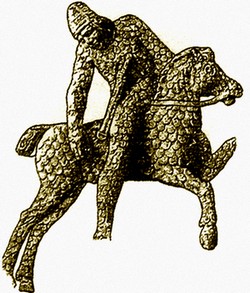
Going so blatantly against the mainstream vision, I was expecting more negative comments! My attempt to 'rationalize' the GW seminal designs and minis benefits from at least one historical precedent: the Sarmatian cataphracts on Trajan's column:
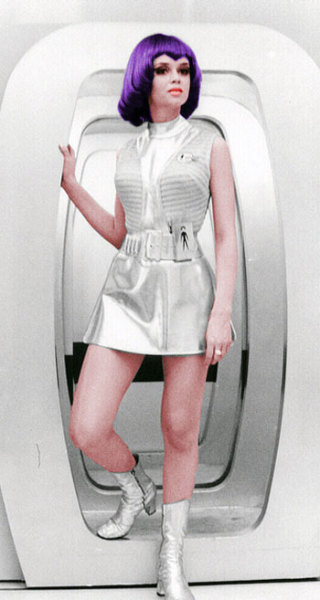
Totally fanciful, but visually carrying so well the idea of 'cavalry armored from head to hoof'. For 'Elves' in very original dress, a possibility that could be used from Late Renaissance to 'Radiumpunk' times through Victorian ones would be to paint the Bronze Age (and Tin Man) NOT red Martians
females
and males ('Imperials' link and 'Pirates' link) with skintight trousers and shirts -as I remember, Flash Gordon himself was not against wearing occasionally his underpants above his trousers:
Their non-human head features hidden by their helmet, their bizarre feet booted, the Parroom Station [Space 1889 style]City Dwellers Lancers would easily provide the cavalry
(That is, if they can be obtained without their mount -as Maidenhead and Shadowforge do for their 'Babes' / 'Tribals'- and fit on a horse). The same, if necessary for variety , for the PSM-CDT-010 Royal Infantry, muskets and PSM-CDC-002 Force Command.
Then *a few* of Privateer Press (Hordes) Skorne link could perhaps be used for Dark Elves / Unseelie Court?
|
| Thomas Whitten | 09 Feb 2012 1:36 p.m. PST |
I'm sorry, but those "NOT red Martians females" scream caricature. If you want something 'credible,' you need go no further then Thunderbolt: link Yes they have pointed ears, but that is better than elongated midriffs. |
| abdul666lw | 09 Feb 2012 10:20 p.m. PST |
I'm sorry, but those "NOT red Martians females" scream caricature Nothing compared to
.
Bronze Age minis may be on the skinny side, but I know not a few historical minis, some rather recent, less anatomically correct: odd proportions, hands larger than the head, orcish face… |
| The Shadow | 09 Feb 2012 11:57 p.m. PST |
Abdul Can you break this down into a few simple sentences, as I'm having a hard time following your point. |
| Early morning writer | 10 Feb 2012 12:08 a.m. PST |
If I may, he is trying to find less 'de-humanized' alternatives to the more stylized conventions that have crept into the hobby for the 'alternative' races. Or so is my interpretation. Elves that are slightly divergent but anatomically sensible, dwarves that might survive outside of a freak show (literally 'survive'), orcs a little more of a challenge but I think he means more along the lines of troglodytes but still human rather than the fanciful interpretations of sculptors in the last few decades. Feel free to correct me, Abdul, if I am off base. Curious discussion point, I would normally stay out of such 'fantasy' thoughts but this one intrigued me. |
| surdu2005 | 10 Feb 2012 3:00 a.m. PST |
Why not just use 20mm figures as Dwarves alongside your 25/28mm humans? |
| abdul666lw | 10 Feb 2012 7:02 a.m. PST |
Can you break this down into a few simple sentences, as I'm having a hard time following your point. -1°) 'Cartoonesque' minis are *visually* incongruous with anatomically humans:as visually 'shocking' as mixing 15mm and 28mm minis all supposedly representing 'normal' people (never mind my attempt of 'rational explanation' of why such representation emerged in the first place), - 2°) the most likely origin of earthling humanoids so similar to humans is a (series of) recent divergence(s) from the Homo sapiens evolutionary line that led to us.
Hence, miniatures manufacturers offerings notwithstanding, strictly humanoid Fantasy races do not need special figurines but can be represented with 'normal human' ones.
Then I tried to search for what peculiarities of such figurines would make them specially appropriate to 'show' the 'canonical' distinguishing features of each of the three 'species' (subspecies, biologically, in my interpretation).
That's why I suggested no only 25mm (against 28-30mm 'humans') but added the (greenstuff) beard (@ surdu2005). Sometimes using 'impressionist' suggestion, e;g. crude sculpting for Orcs.
Also why I suggested slight shifts of 'historical period' to 'visualize' differences of degree of evolution / progress (biological and / or cultural / technological) vs. reference 'humans'. Along the same lines I maintain that (again, miniatures manufacturers offerings notwithstanding) no special minis are needed for:
- witches: witches do NOT look like witches (did the one in 'Sleepy Hollow' look suspicious?). The Inquisition and witch-finders would have an easy time if all witches were ugly crones wearing the Disney® Halloween uniform – and how many innocent would be spared! TMP link - vampires: from Carmilla and Dracula to the heroes of 'Underworld' (and several recent film and TV series- they walk among us unnoticed.
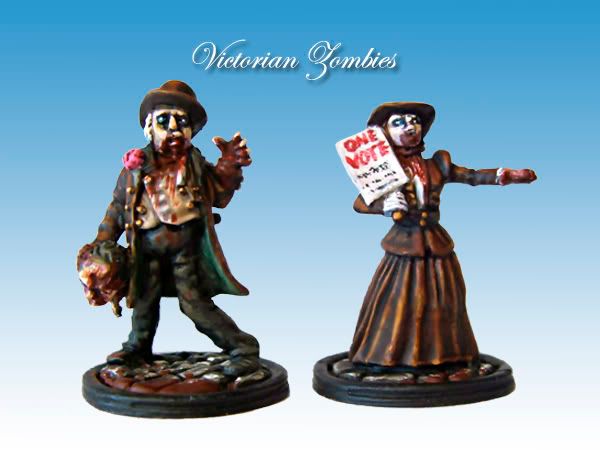
(besides, the scars on the victim neck generally corresponds to a pair of sharp slender incisors, *not* sabertooth canines!). Vampires (and Fées) look like specially appealing, impressive, seductive humans: just find the corresponding minis in normal, 'historical' ranges (again, picking from another, more 'elegant' range than for 'normal humans' can help). TMP link - zombies: the best way to have 'credible' (apt to biologically survive more than a few seconds) zombies in period costume is to 'zombify' normal minis: just like with human extras in movies, a matter of cosmetics / painting / 'weathering'. |
| religon | 10 Feb 2012 7:54 a.m. PST |
@The Shadow, I had similar difficulty following the position presented. The OP has transcended the norms of structure with which I have become complacently comfortable. The questions appear rhetorical rather than invitations for discussion. I read the OP differently from EMW. I read very little to convince me that the OP was interested in dehumanization. He rails against fanciful aesthetic conventions used to present fantasy races in 18th Century wargames. The OP appears to prefer more naturalistic, anatomically plausible fantasy figures. I was amused in the supporting details for dwarves. Some historical writers are "confused" rather than "differ." Confusion implies an underlying fact or truth. I will give the OP the benefit of the doubt and presume that he meant "differ." If the intended word was indeed "confused," it casts the Looney Tunes references in an entirely different light.  |
| Stealth1000 | 10 Feb 2012 8:24 a.m. PST |
I have been thinking along the same lines you have but more in the 15mm to 6mm end of things. |
Dr Mathias  | 10 Feb 2012 9:43 a.m. PST |
I really like the dwarves from MolonLabe/Vendel (I purchased mine from Sgt. Major Miniatures). I'm not crazy about the shields they're supplied with, but I think the size and anatomy is just about right for Tolkien. I wouldn't call them caricatures. Haven't seen the goblins or orcs in person, so I can't speak for them. sgmm.biz/fantasy.html |
| abdul666lw | 10 Feb 2012 9:50 a.m. PST |
@ Early morning writer
You are right on the spot, but my problem is 'visual' rather than ethical.
I'm… annoyed, disturbed, shocked when I see cartoonesque minis side-by-side with 'accurate' ones (unless depicting an episode of Freaks en.wikipedia.org/wiki/Freaks). Not a matter of prejudice against one style or the other, but the Who Framed Roger Rabbit' link effect pushes the sight out of the limits of my 'willing suspension of disbelief' -and I simply cannot enjoy it as a 'normal' eye-candy vignette, diorama or table-top battle. Thus I searched for 'logical reasons' for the very existence of :
- such grotesque minis. Off-topic, actually, and better ignored -not to be drowned by my logorrhea - if you wish so. The proposed explanation -that GW official documents and silly images are 'archeological discoveries from the future' that need to be interpreted (in the same way as Pharaonic Egyptian low-reliefs do NOT prove that by then the Pharaoh was ten times taller than his men, nor that all people had the torso at right angle to the head and pelvis) was just a thought construct for the mere pleasure of it.
And no insult intended, GW fanboys, if I concluded to 'excessive, graphical representations for the illiterate (actually I'm rather fascinated by the 40K background -that was just one of my attempts to present it in a less… fanciful way). - those traditional Fantasy races, and their origin. The most parsimonious 'rationalist' explanation link is that they correspond to other branches of the evolutionary tree leading to 'us'. So similar to us that the divergences are quite recent: they are no more different from us than Neanderthals, but in different ways (with the possible exception of 'Orcs', who could very well be surviving Neanderthals like the 'Eaters of the Dead' link). Then I concluded that, being so visually similar to us, they really don't need special minis (phew!); and searched for ways to reflect their peculiarities using only 'normal' human figurines.
I fully understand that wargaming minis have to 'visualize' their essential features. That's why, for H&M large battles, regular units look better if made from a single figurine mold each, and look ready to wage a clones war; while irregular ones have to combine minis in different poses to look the part of a bunch of individuals.
But this does not have to be pushed *too far*: a witch hunter does NOT have to be in mid-17th C. costume, or a vampire dressed like Bela Lugosi, in a medieval (D&D) or early Renaissance (Mordheim) setting! again this pushes the sight off the limits of my 'willing suspension of disbelief'. Thus I searched for ways to visually translate the traditional distinguishing features of the classical Fantasy humanoid races (but also, see above, 'types' often caricatured in minis such as witches and vampires) using only 'normal' human miniatures. Playing on size, silhouette ('bulky' or slim' ranges), style ('crude' sculpting for 'crude' Orcs), costume, minimal conversions (beard for Dwarves…) and painting.
(For 'zombifying' normal minis, a *great* Victorian demonstration: link
) Tolkien did not invent the 3 main Fantasy races (gobelins as members of the 'Little Folk' existed long before I gave a new meaning to the old generic word 'orc', and as survivals of paganism had already got an 'evil' repute, thanks to centuries of Church efforts) but re-popularized them (for 'Dwarfs', after Disney for the general public). I'm specially interest in Elves because (mixed progressively with Fées of Latin cultures and even Irish Aes Sídhe) they have the richest background -Fées hold a large place in medieval Matter of France, appear in the Matter of Britain -Morgan, the Lady of the Lake. Additionally, as a purely intellectual construct, they can be assimilated to humanoid beings from other… tales (I don't wish to be dawghoused for calling 'creatures' mentioned in then Bible 'mythological'  ) such as the Nephilim / Gibborim , the 'white demi-gods' reportedly mentioned in some Amerindian tradition, the survivors from Atlantis, the 'giants' who build the cities of green glassy stone in the world of Conan… ) such as the Nephilim / Gibborim , the 'white demi-gods' reportedly mentioned in some Amerindian tradition, the survivors from Atlantis, the 'giants' who build the cities of green glassy stone in the world of Conan… As for other, less widespread as populations, Fantasy humanoids..
Ogres? Huge members of the 'Little Folk', huge 'Orcs'. Maybe with some 'Asiatic' facial features if indeed the name as the same roots as 'Hungarian'? Then the word (just like 'Boulgre' / Bulgarian) was sometimes used in old French for 'gay'… (Btw Norse 'Giants' were not specially gigantic, or not permanently, since they could mate with humans; basically, like Dwarfs, a humanoid race / species older than humankind.) Trolls? Some kind of Bigfoot / Yeti / surviving Gigantopithecus. The idea that they are somehow 'killed' by sunlight may be a reminiscence -transmitted from Siberia to Scandinavia through the Fins and Laps- of the frozen mammoths decaying so fast when exposed to sunlight?
(Along similar lines the Norse 'Dwarfs' -skilled armored and jewelers living underground and somehow 'twisted'- may be rooted in pre Indo-European graves with corpses in fetal position buried with a rich funeral treasure?).
Now in some contexts 'troll' have a totally different meaning (pagan / witch YouTube link). |
| abdul666lw | 10 Feb 2012 10:00 a.m. PST |
@religon: not specially 18th C. settings, equally in Fantasy ones: a matter of 'shock of styles', cartoon vs realistic. On the pow was followed with proposals for alternative, visually 'congruous', representations: the 'Who framed Roger Rabbit?' effect. And 'confused'… English is not my native tongue, but since for the authors of the time Dwarfs and Elves were *real*, for them 'Confusion implies an underlying fact or truth' do apply? |
| Thomas Whitten | 10 Feb 2012 10:27 a.m. PST |
A lot of the Bronze Age minis stuff is good. Those women just look odd, and it is not because they are skinny. The ork actually looks less odd because I don't expect it to match up to human proportions. |
| mgaffn1 | 10 Feb 2012 11:36 a.m. PST |
Funny, but I've seen a trend in returning to even more naive, goofy, "old school" miniatures inspired by the crude illustrations of the very early age of D&D. This is not a criticism – the new sculpts are beautiful in and of themselves, merely inspired by the old clunky illustrations. I myself have been bitten by this nostalgia bug – last year I painted up a band of Otherworld goblins, and for 2012 will be painting up their "pig faced orcs".
These will be mixed on the gaming table with some fairly realistic Reaper character figs. So far, they all seem to work wll together – the only figs that would be out of place in this gaming world would be neon green Games Workshop orcs. |
| Lee Brilleaux | 10 Feb 2012 11:41 a.m. PST |
While I understand your dislike of cartoony figures, I'm not persuaded that there's any need for fantasy 'races' to be on the same evolutionary track as humans, or sharing genetic roots. I'm also unsure why your examples involve the Eighteenth century, which seems to me, at least, particularly unsuited to any extension into fantasy beyond blue-tinted wigs and absurd beauty marks. In doing so, to use your own words, you venture "outside the limits of my 'willing suspension of disbelief'." That's my own taste, of course. I prefer that fantasy races exist within the cultural milieu that spawned them, so I dislike hobbits in space and Samurai dwarves, etc. But, that said, people can and should be free to do what they like! |
| joshuaslater | 10 Feb 2012 12:21 p.m. PST |
The Celtos range might be closer to what you're after. |
| abdul666lw | 10 Feb 2012 3:31 p.m. PST |
I'm also unsure why your examples involve the Eighteenth century, which seems to me, at least, particularly unsuited to any extension into fantasy beyond blue-tinted wigs and absurd beauty marks. In doing so, to use your own words, you venture "outside the limits of my 'willing suspension of disbelief'." Everyone his (unfortunately very few 'her' in our hobby) own preferences, of course  ! But why not the 18th C.?
Contemporary mentality? Many people still believed in werewolves and bewitchment, Cagliostro and Saint-Germain were as popular as Mesmer and more than Lavoisier.
Besides, people then were quite imaginative: re Gulliver's Travels (even if disguised political satire), and Restif de la Bretonne's La découverte australe par un homme-volant: ou Le Dédale français
Elves, Dwarfs, 'Little Folk' were known since the Dark Ages and in some form certainly before, 'reappeared' in Victorian times ('Castle Falkenstein', 'For Faerie, Queen and Country') and are to reappear in some future ('Shadowrun'): so they had to be here in the meantime .
Similarly, werewolves are known since Antiquity, the first references to vampires in French literature date from the 1740: and we 'know' they are still here, waging their centuries-old 'underworld' war, with occasional 'Romeo & Juliet' incidents: thus they were here in the 18th C., as they were before and ever will be.
As for zombies they are originally associated with Voodoo, and the religion was already impregnating Haitian culture during the French Revolution, so predates it significantly.
And of course when you move to other Continents you have local beliefs link
18th C. Fantasy is an accepted subgenre of Pirates games: why not on dry land?
_ _ _ _
More generally most types of wargaming can be done in *any* period from Leonardo de Vinci on – simply, it happens that I prefer tricornes and justaucorps.
Interest? Dispersion is the bane of many wargamers. With several independent projects 'cooking' none progresses at a cheering pace, discouragement threatens.
But if several projects are somehow associated, any progress in one of them benefits to all.
So let's suppose you already own a mid-18th C. army (example chosen at random, of course ) and feel tempted by other types of wargaming:
-Colonial? you just have to paint the 'Natives' (most will be usable if later you totally switch to Colonial wargaming) and send an expedition oversea.
To some known continent? yes,
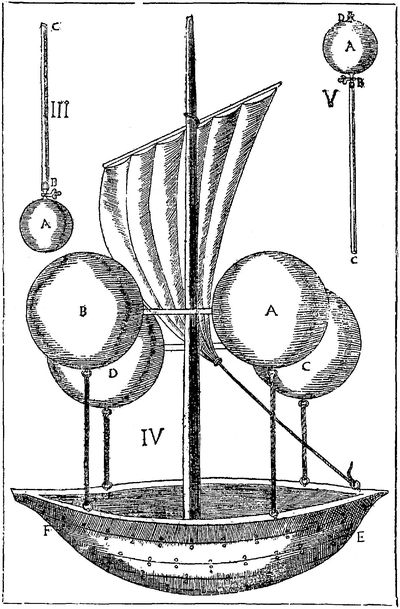
– or to a still undiscovered 7th one (for the 19th C. on I agree that it would have to be 'underground' Pellucidar-fashion): there you can meet Dinosaurs, cavegirls in fur bikinis (traditional encounters for pirates landing on some 'mysterious island') but, why not, Orcs TMP link (or Elves: link and previous posts). -Science-Fiction VSF / steampunk fashion? No difficulty, designs of flying ships were drawn in the late 17th C., steam engines were used to power the pumps draining mine sin the early 18th C.: just build a few models, and here you are!
linklinkdrsandorius.blogspot.com(spectacular illustration in the recent '3 Musketeers 3D' YouTube link ) -Horror / Pulp? a subgenre currently gaining in popularity:
link
link link
link
link
link
link
link
link
link
link
and with already two specially devoted commercial games
- 'A touch of Evil' flyingfrog.net/atouchofevil
- 'Carnevale' link In all cases the new project is merely an extension of your main one, and you have just to complete you collection, NOT to start a new one: minimal dispersion |
| Lee Brilleaux | 10 Feb 2012 5:10 p.m. PST |
Okay, Abdul, you've convinced me of the rich possibilities of C18th fantasy. Those are some great links, and I love the ships with the balloons supporting them. Thanks for those! Still, my point was that fantasy races and elements fit into the culture that bred them, and that extending them outside their proper genre doesn't really work for me. All those websites are strong on actual C18th tropes – witches, werewolves and vampires and general Gothick-ness – and the possibilities of new discoveries done in a period style. And that's great. What I'm not seeing there is the same, rather cliched line-up of elves, dwarves and orcs/goblins in fancy dress that always seem to be the first 'go-to' point for many fantasy designers. And I'm glad of that, because I am very tired of Samurai dwarves and hobbits in spaaace -- :) |
| spontoon | 11 Feb 2012 10:35 a.m. PST |
So, my badgers in kilts are out? |
| Steve64 | 12 Feb 2012 2:56 a.m. PST |
Great post ! Very inspiring work putting that together. Couldnt resist adding to it – I have started posting a multi-part storyline here to follow this brilliant theme (Part 1) :
link Hope you like it. Much more coming. |
| abdul666lw | 12 Feb 2012 3:13 a.m. PST |
@Steve64: Simply excellent, and with eye-candy illustrations: looking eagerly forward to enjoy more! Allow me to directly post one of your pics here, as a teaser for TMP members;
link |
| Alex Reed | 12 Feb 2012 3:44 a.m. PST |
I don't much care for the 18th century. I am pretty conservative when it comes to "fantasy" and I stick with Middle-earth, where the various "races" of living things don't deviate from a rational model, and where Tolkien attempted to give his creation a set of rules for operation. The Dwarves of Middle-earth were supposed to be a bit shorter than humans, but not the strange obese and testosterone-challenged figures produced by modern miniature makers. A lot of that happens because of the lack of skilled enough sculptors. It is fairly easy to get to a competent plateau in sculpting, but it is very difficult to get beyond that plateau into the realm of people like Tom Meier (there are probably only two or three sculptors in the gaming industry to match him). You would need to go to special-effects houses to equal his work. And as such you get non-humans who have distorted anatomies and ratios of limb structure/configuration. Eventually, though, technology will begin to correct for these problems, as people begin to use 3D technologies to sculpt, they will be able to use the prototypes that come with the software to provide them with the correct structure and anatomy for a model. Then we will begin to see models deviate away from the "Cartoonish" appearance that they have attained since the 1980s. |
| abdul666lw | 12 Feb 2012 9:09 a.m. PST |
I am pretty conservative when it comes to "fantasy" and I stick with Middle-Earth What about our Earth by Hyborian times? Sword & Sorcery rather than Heroic Fantasy? No "ab-human" races(*) nor traditional 'monsters' from medieval bestiaries (Howard was closer to Lovecraft), but Fantasy enough. And what about Moorcock's Young Kingdoms? And what about 'authentic' Fantasy taken straight from the Matters of Britain and France (re. the 'Enchanter' series link), from Irish traditional tales, from Beowulf and the Niebelungenlied? Tolkien took bits and pieces from these primary sources to write his own epic. A really 'conservative' approach would be to ignore Tolkien's 'remakes / rewritings' and use unadulterated the roots of his inspiration. ----
*: No dwarfs in Conan's world; no living Elves -but ruins of citadels of green glassy stone built by an 'Elder race'; no Orcs… :? Not explicitly, and of course not under this Tolkienesque name, but the equivalent of 'credible' Orcs / Eaters of the Dead of the 13th Warrior: the dark people of the hills that stir when Acheron is on the verge of re-appearing, and that source of endemic insecurity in some Aquilonian provinces making growing there a good preparation to the life in the Pictish marches. |
| abdul666lw | 12 Feb 2012 10:18 a.m. PST |
A lot of that happens because of the lack of skilled enough sculptors. Actually several *illustrators* went… totally free wheeling first. Specially the brothers Hildebrandt, whom I suspect to be at the origin of the infamous 'pig-faced' orcs.
When talented sculptors strive to faithfully reproduce distorted images, they produce distorted figurines. |
| Alex Reed | 12 Feb 2012 10:12 p.m. PST |
Yes, many of the illustrators are culpable for the distortions of the sculptors. I am just as picky about illustrations of Middle-earth (and other fantasy realms) as I am about the mythos themselves. Alan Lee, John Howe, and Angus McBride being about the only Fantasy illustrators I tend to like. There are a couple of Italians who have done a very good job with their depictions of Middle-earth, but both suffer from an inability to generalize from their art. And, I do have some respect for Hyboria, it is a very different sort of place than Middle-earth (Hyboria being a more generalized Alternative Earth than is Middle-earth). It represents a more syncretic view of ancient fantasy than does Tolkien's Middle-earth (but as such, it loses out in the way of specificity of mythos). As I mentioned, we are at the cusp of a new batch of sculptors entering the market, as the new technologies begin to democratize the ability to control the means of production for miniatures of a high level of quality. We may even begin to see the distortions produced by earlier illustrators sorted out to produce more realistic sculpture from an unrealistic design due to these technologies allowing people to manipulate the imagery better. Also, Peter Jackson's The Hobbit movies will see a new age in the portrayal of Dwarves that moves us back toward the Norse depiction of them as just rather short, but otherwise well-proportioned, people. Speaking of which, Billy Connoly has been cast in the role of Dain Ironfoot, to add to the casting of minor characters of Middle-earth. I can't think of a more appropriate casting for a role. He is a perfect actor for the role. I wonder if this means that all of Dain's troops will be Scots? Now… If you want some decent Dwarves as miniatures, I imagine that GW's products for The Hobbit movies will greatly increase the offerings (As it will for the Wood Elves too). They will have two entire armies (Dwarves and Wood Elves) produced for this movie, not to mention an entirely new line of Goblins/Orcs for the Northern Misty Mountains. I can hardly wait for the latter, as I hate having to think about using Moria Orcs for the Northern Misty Mountains. Hopefully, we will get some Orcs for Dol Goldur as well. |
| abdul666lw | 13 Feb 2012 1:53 p.m. PST |
Fantasy having its requirements, a well sculpted 'Puss in boots'
( mannikinstudios.com/?p=363) would mix perfectly well with 'realistic' human figurines. While
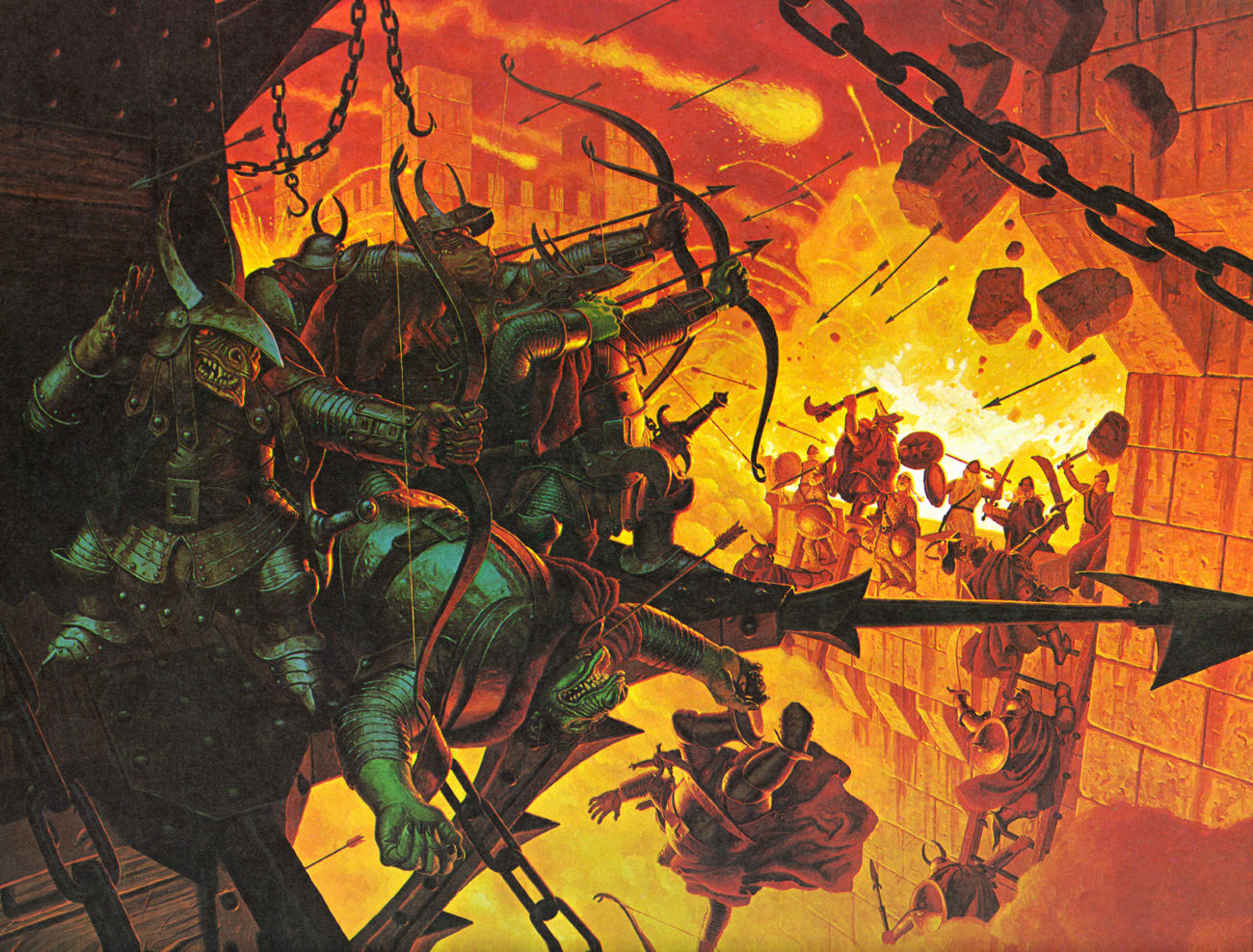
(from link) would probably mix well with GW Orcs. Both styles can be deemed respectable, but simply are too different to be compatible. |
| Alex Reed | 13 Feb 2012 7:47 p.m. PST |
Mix well with GW Orcs? I hope you don't mean their Lord of the Rings Orcs. Because those wouldn't mix at all well with LotR Orcs. The style is completely different. And the same can be said of their Warhammer Orcs (which are mutated monstrosities). The 18th/19th Centuries may have "Fantasy" elements in a lot of it (Victorians were pretty indulgent in that respect – Re: Alice in Wonderland and Through the Looking Glass), but Victorian and earlier fantasy (back to roughly 1400) is a completely DIFFERENT genre than is what Tolkien and others (RE Howard, Morcock, etc.). Tolkien's "fantasy" was explicitly an Algo-Saxon mythos. It incorporated other elements of Frankish, Norse and Scandinavian culture, but there is pretty much no hint of Victorian Era Fantasia within his works. At best it could be said that Tolkien incorporated parts of the Chivalric Romance, and other forms of Romantic tales into his fantasy, but he is in a completely different universe than Shelley, Byron, Dunsany, Lovecraft, and Carroll/Dodgson. The above men are exactly in line with Dodgson/Carroll's Victorian "Wonderland," which was in keeping with the fascination of the times with all things "Spiritual" and "Mystical." Spiritualism was all the rage and most of the Victorian creatures of the time were the results of vivid imaginations combined with new and exciting "drugs" (although not called that at the time) that produced such hallucinations/delusions. This spiritualism had its roots in an earlier Enlightenment fascination with the globe (and what was "inside it")… But I don't know where this insistence to mix Classical fantasy with Victorian Horror and Pre-Enlightenment Fantasticalism comes from. |
| OSchmidt | 14 Feb 2012 10:21 a.m. PST |
As strange as this may sound, given my position as Prince of Dorkness in the Society of Daisy I have to agree with Alex Reed on the inclusion of Fantasy in the 18th century. There comes a point when you have to ask if you want to play with fantasy figures then play with fantasy figures, simply because bringing the whole bag of fantasy in kind of crowds out the real elememts of the 18th century. Besides, we alrady have fantasy figures in the 18th century-- Turks, Hurons, Amazonian cannibals, Lascar pirates, Japanese Samurai, Indian maharajah's etc. Seems like Fantasy enough. The second point is that while I have LOTS of fantasy figures, I don't put barbecue sauce on my my "Coq au vin." The 18th century is my first love and the culture, art, literature, music, drama and science is what attracts me. Recently in the Society of Daisy we are off and on talking about the idea of "Magic" in the 18th century, which is not so far fetched as it sounds- for magic was still believed in. But it's not your lightning bolt/fire ball stuff. But beyond that anything that is in the 18th century must have a Baroque to Rococo beauty about it. Grace style, gentle curves. The grotesqueries like Orcs have no place. Even the trolls must be beautiful. One of the characters in the novel I am writing is a troll girl who, in fact, is very beautiful in a very human way, with just a slight pale green sheen to her skin. Of course if we're going to open the gates untrammeled to fantasy figures then why not have tanks and airplanes as well. One thing. I use Ral Partha Elves for my Burgundian Armies of the Middle Ages. They're perfect. If you look at the art of Burgundy of the period they all have those wasp-waists, small buts, long legs, and broad shoulders-- they look exactly like Ral Partha Elves.
As to the best figures for the 18th century, that was decided over 50 years ago. Surens, Willie figures are the only line of anatomically correct figures I have found. The rest are all squat, fat, with tubby legs and no neck. The only ones that come close are the figures from DPC.
|
| OSchmidt | 14 Feb 2012 10:21 a.m. PST |
Oh wait-- Minden figures are as good as the old Willie's |
| Eli Arndt | 14 Feb 2012 10:35 a.m. PST |
Really this all comes down to a matter of taste. I would say that holding GW responsible for anything other than the green, lantern-jawed orcs is a bit of a stretch. Most modern fantasy imagery is directly drawn from Tolkien and then from Dungeons and Dragons which drew from Tolkien and other sources but made thosei mages popular among fantasy gamers. Dwarves and elves can be made to look more like humans, but then why not just play humans? the exageration of their key features makes them more distinctly their own species which is generally the desires goal of most fantasy games. Most fantasy gamers don't want to break into a dungeon chamber and encounter slightly distorted humans for orcs. They want monsters! If the issue is with sculpting style, then that is all a matter of who you shop from. I am not a huge fan of many of the fantasy figures out there, even for fantasy gaming and in 15mm have often resorted to using 15mm historicals with non-human paint jobs to stand in. Not only are the appearance more subdued than many of the GW-inspired over-the-top sculpts, but they are cheaper :) In my times, I've seen Byzantines and Greeks used as elves. I've seen an entire Hobgoblin horde made from Huns, Mongols and ancient Chinese figures – all painted with orange, red, and yellow skins. Just my two cents - -Eli |
| abdul666lw | 14 Feb 2012 1:53 p.m. PST |
Even the trolls must be beautiful. One of the characters in the novel I am writing is a troll girl who, in fact, is very beautiful in a very human way, with just a slight pale green sheen to her skin. Interestingly, in some very old traditional Swedish texts (songs) 'troll' seems to have a totally different meaning. In 'Herr Mannelig'(*) YouTube link the squire declines to marry the 'female troll' not because she is non-human or ugly, but only because she is not Christian. Exquisite gallantry toward a member of the Fair Sex, even if a hideous non-human one? It could rather suggest that here 'troll' simply means 'not Christian' -just like 'Chaos' in P. Anderson's '3 Hearts & 3 Lions' link and 'Evil' in C. D. Simak's 'Where the Evil Dwells' link . Indeed in 'Konungen och Trollkvinnan' YouTube link the 'troll witch' is so beautiful that she catches the king's heart -without using a 'glamour', since she turns down his offers. And actually in old Danish 'troll-bound' means 'bewitched / spellbound' YouTube link / YouTube link . Thus 'troll' corresponds to both a 'magical being' and a (female, lately) human magic-user, just like Fée in old French (Melusine vs Morgane). Perhaps because the most indomitable Pagans were priests of the Old Faith, and the whole Norse / Germanic area had a strong tradition of female voelvur -re the 'troll witch' (again!) Huld, at the origin of the (sometimes benevolent) Huldra en.wikipedia.org/wiki/Huldra / Holda en.wikipedia.org/wiki/Holda with her fox tail YouTube linkAnyway this suggests a totally different game for a 'troll hunter': not that:
but this:
(already shamelessly assaulted / hijacked another innocent TMP thread to develop this set of ideas TMP link ) |
| abdul666lw | 14 Feb 2012 2:01 p.m. PST |
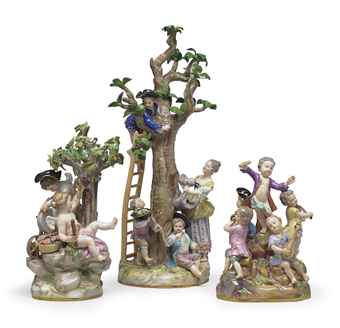
Oh wait-- Minden figures are as good as the old Willie's In a different way, somehow: the modern sculpting is incomparable to the 'Old School' look of the Willie sculpted in the 1960. On the other hand some Willie had an elegance -so required for an idealized 18th C.- that modern 'realistic' sculpts simply lack. Some Willie remind me of period Saxe porcelains, lacking detail but so in harmony with the time:
link |
| Eli Arndt | 14 Feb 2012 2:32 p.m. PST |
I recall some troll legends having troll maidens as beautiful but with a cow tail. If you can cut the tail off before you marry her, she will stay beautiful and be a wonderful wife. If not, she will steal you away under the mountain to slave away or be eaten. Troll does seem to be a word like "Faerie" having more or less or different meanings depending on what specific culture, context or period of time the word is used. -Eli |
| abdul666lw | 14 Feb 2012 2:43 p.m. PST |
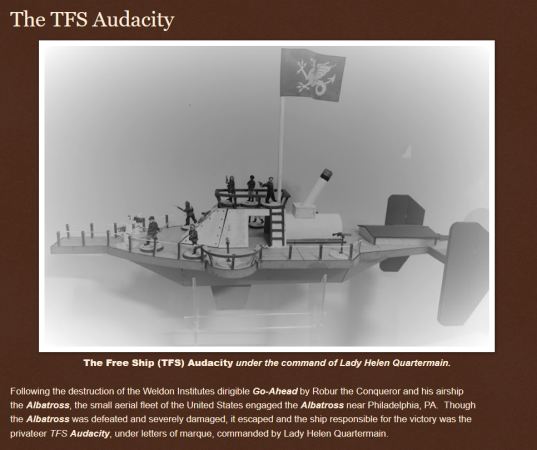
Of course if we're going to open the gates untrammeled to fantasy figures then why not have tanks and airplanes as well. Well… designs for 'airboats' more credible than those of Cyrano de Bergerac were proposed in the late 17th C.
(copied in the models photographed above), in the early 18th C. unmanned balloons had flown, steam engines powered the pumps draining mines, Puckle had designed his machine gun. Thus for instance some form of steam tank YouTube link would not be totally impossible. But steam engines are *so* dirty, noisy, smelly… they are better for later (Revolutionary / Napoleonic?) times. Elegant skyships, on the other hand, their hull covered with rococo decoration, would not look so much out of place? YouTube link(these lack decent painting of the balloon itself
Actually it would be interesting to have two opposite 'convictions' -perhaps each influential in a different country?- one 'rationalist' counting on the scientific / technological progress and the other 'traditionalist' counting on the 'Old Lore'? One supported by an inner circle of the Free Masonry and powerful in Protestant countries, the other the 'official front' of the Prieuré de Sion TMP link and manipulating Catholic monarchies?
|
| abdul666lw | 14 Feb 2012 3:01 p.m. PST |
@ Eli: in some tales, since the lost their magical powers with their tail (or when wedded in church) disappointed husbands treat them badly, beat or even kill them: 'evil' is not always on the same side! It's striking that despite some ten centuries of Christian anathema the 'benevolent' aspect of the 'magical' was not forgotten: even Disney could not eliminate the '3 good fairies' (silly looking, but that's Disney). |
| Eli Arndt | 14 Feb 2012 3:04 p.m. PST |
Part of that has to do with certain areas of the world where the presence of christianity never killed the local beliefs such as in Ireland. -Eli |
| abdul666lw | 14 Feb 2012 3:38 p.m. PST |
But I don't know where this insistence to mix Classical fantasy with Victorian Horror and Pre-Enlightenment Fantasticalism comes from. The frontier is not marked as the Berlin Wall. It's true that the revival of popularity of the Arthurian Cycle in England, of German-Norse mythology in Germany… is associated with later times, the Pre-Raphaelites, Wagner and the late 19th C. nationalisms. Yet the taste for 'medieval' tales is older: the first 'Gothic' novels, Horace Walpole's 'The Castle of Otranto', Clara Reeve's 'The Old English Baron', Ann Radcliffe's 'The Mysteries of Udolpho' were all written in the 18th C..
Besides, Perrault's Contes de ma Mère l'Oye (1697) as well as the Grimm's Fairy Tales, were actually re-writings of pre-existing traditional folk tales, some very old and still popular in the lower classes. While in the countryside many people still believed in werewolves and the Wild Hunt, many sailors in the Maries-Morganes and many miners believed that some bizarre noises were made by benevolent dwarfs warning them of a risk of firedamp explosion. The main difference with mainstream modern Fantasy along the lines of Tolkien is that 'odd' creatures Fées / witches, ogres… do not live in large populations in lands / countries of their own (unless you suppose some underground / Hollow Earth' location) with a culture different from the 'human' one, but appear as secluded individuals or small family groups. Then, a whole village of werewolves could not be excluded, and vampires of the Transylvanian model were occasionally referred to in French literature since the mid 18th C. -even if Sheridan Le Fanu's seminal 'Carmilla' is a century more recent. And of course when coming to the 'Colonies' you can face creatures of local mythos.
As for whole 'Elvish' or 'Orcish' cultures in the 18th C., they are settled in 'newly discovered' continents and actually correspond far more to branches of Humankind, either very 'advanced' (e.g. Timutilank's 'Melnibonean Elves' link) or rather 'primitive' natives (e.g. Steveoc's 'Orcs' link), than to magical creatures Tolkien-fashion.
Actually they belong to a moderate form of SF resting on geographical and biological 'What-if?' (more subdued than the survival of dinosaurs in some 'Lost World' -though cavegirls in fur bikini are always welcome) than to Fantasy.
|
| abdul666lw | 15 Feb 2012 5:07 a.m. PST |
If the issue is with sculpting style, then that is all a matter of who you shop from. Firstly and mostly, yes. Even if they find them funny, I don't think many of us would enjoy (or more than once) to field these:
as generals of their Gallic army against, say, these Romans:
(from link ). The styles are visually incompatible. The degree of (ir)relevance of a 'abhuman race' to the setting for me comes only second and far behind, and can easily be 'rationalized' ('Lost World', Atlantis Successors….
E.g. for 'Elves'
). Then I'm afraid I'd not willingly accept Tolkienesque *Orcs*, how well sculpted, 'realistically proportioned' (globally, the Mithril figurines are very good) they mat be, since they'd still reflect a (biologically unlikely*) prejudiced view. Even when reputedly mischievious / dangerous, gobelins and the like were never described as 'ugly'. Anyway, only naif people of Disney level could believe 'evil' is ugly. 'Evil' has to be beautiful, otherwise nobody would be tempted to succumb to it
Besides, anyone having watched a dogfight (or catfight) knows that any rider would be the very first casualty: war mounts have to belong to species staying upright when fighting (e.g. when males compete). Thus, how much I like the poetic quality of 'Elfquest', the very idea of 'wolfriders' is intrinsically silly. ---
*: requirements of 'biological realism' can sometimes lead to very amusing conclusions: TMP link
(TMP link) |
| OSchmidt | 15 Feb 2012 7:57 a.m. PST |
Depends on the linguistic ecumene you come from, and the specific form. Most endow them with a "magical" ability, but what the contents of that term are is likewise not universal. Trolls, goblins, kobolds, nixies,pixies, sprites, are all in a sense "others" or metaphors for "others" and represent an enact an "invrsion" of normal human life and society. Gradually as the century wore on this reference to "othrs" became Montesque's "Persian Letters" and Bouganville's "Noble Savage." That is a non-European and non western "other." But it is important to realize that the traditional "other" never really went away and that these others represented something different, and perhaps dangeorus to normal life. They were, in fact, the sum of our fears. But they were also the sum of our hopes. Germanic folk tales abound with instances of these magical creatures not only benefiting and helping mankind but in some cases intermarrying with them. In another sense what is important about the legends of the supernatural is that invariably these creatures are met, and interacted with, in the country. The siren is by her oppl the Dryad by her tree, the Troll in their caves of tunnels, the giants in their hill. The second element of the Troll legend is the anthropomorphizing of nature. The Troll and all these creatures are metaphors for nature and the power of nature. The dichotomy is between the Encyclopediast-- the literary savant who is a thing of the city and the law of nature, which the Savants delighted to write about, but in which they rarely immersed themselves. Even Rosseau for all his theatricity shunned nature-- real nature-- for the Parks of Versailles. These races therefore represent nature in the raw, the real nature, the ambivalent and very dangerous nature. |
| abdul666lw | 15 Feb 2012 10:06 a.m. PST |
It was suggested that hypnagogic hallucinations
-specially the feeling that 'there's someone here' and the sensation of a suffocation caused by a weight on the breast
were largely at the origin of the 'Little Folk' as well as 'Incubi / Succubi' in the past and of the Grey Aliens of to-day. ('mare' in 'nightmare as well as in French 'cauchemar' is not a female horse but an old word (13th C.) meaning 'female [!] goblin that causes nightmares' link) As for Rousseau, whose 'view' of Nature and the 'Good Savage' reappear periodically -e.g. in such movies as 'Dance with the Wolves' and 'Avatar'… what can you expect from a man who wrote a full treatise on education link but did not recognize his five own children and abandoned them to orphanages!
As so often, the Lumières had their dark side when one passed from the ideas to the men. |
| Ancestral Hamster | 15 Feb 2012 2:21 p.m. PST |
I find this thread interesting, for while the 18th century isn't a primary gaming interest, I do like to see what other people come up with and play. Also, what interests me about the fantasy genre in general is the cultural aspects. How would a given humanoid species with a more specialized nature than humans evolve in an environment and then interact with the environment and other intelligent species. So moving traditional High Fantasy races like the Elves and Dwarves into later periods is a thought experiment I like seeing/reading. Could a conservative, contemplative, long-lived species like Elves adjust to a world dominated by pushy, rapidly breeding humans where technology is dominant, and magic (even if is not extinct) has fallen by the wayside? [Think of it as how guns gradually overtook longbows. Training archers took years, but a arquebusier just a few months. It might be the same with magic. Eventually, it would become a specialist discipline, probably in fields that technology cannot easily duplicate like mind control/influence.] If so, how do they adapt, and what is their new place in the world? As to sculpting, it comes down to what you are willing to use. Much of my 25mm fantasy collection is of Ral Partha, especially Tom Meier's elves. I've some of his Dwarves as well, but nowhere near as many. So I understand the objection to cartoony sculpts. One has to use what is available though so one has to find the least objectionable sculpts. Anyway, this is basically a show of support for abdul666lw's endeavor, and I'm not offended by it. |
| abdul666lw | 15 Feb 2012 3:39 p.m. PST |
Interesting question about the adaptation of Elves to a (relatively) modern environment! The problem is largely by-passed as for Timurilank's 'Melnibonean' Elves link who live in an archipelago just discovered by 'European' powers. Anyway I suspect his 'Elves' (initially planned as 'Atlanteans' TMP link ) belong to the 'Sci-Fi' rather than to the traditional 'Fantasy' type, being like Moorcock's Melniboneans and Vadhaghs a species of genus Homo (and probably a subspecies of H. sapiens): a biological 'What-if?' hypothesis.
Yet to make them more different from 'ephemeral' (and thus 'inferior', 'closer to the apes') "humans" one can grant them a potentially very long life. Perhaps not the 969 years of Methuselah (note how his descendants had shorter and shorter life, as if a 'pure blood' was diluted each generation link ) but say, a few centuries (unless untimely violent death).
This may have interesting cultural, societal and even physiological consequences.
Very long-lived species practice a 'K' reproductive strategy en.wikipedia.org/wiki/K_strategy . For a 'species' with a life span of centuries, to avoid a population growth exceeding the resources, reproduction has to be drastically controlled (a good thing that Higlander-type 'Immortals' are sterile…). This can be done for a part culturally: the right to have children would be a great 'honor', a privilege (but not restricted to a privileged class: to stay privileged, it needs a *huge* mass of 'un-privileged' "workers" ). Magic could be put in use, but let's stay in a 'Sci-Fi' approach. Then, it would work better, be safer, if there is a natural biological control. The limiting factor, the 'bottleneck' of reproductive rate is the number of potentially fertile females. A simple 'trick' (demonstrated in crowed populations of mice) is to have the puberty of younger females blocked by the pheromones of the mature ones.
This would explain the 'androgynous' look of many Elves (and the nasty comments of Dwarves about the virility and sexual preferences of Elves): almost half of the 'young male' Elves would actually be adult, grown females blocked before puberty, like worker ants and bees (but reversibly). To sound 'scientific' according to Popper a 'theory' has to unequivocally allow predictions that could be submitted to a falsification test. Here the prediction is: in a *violent* Elf society, with significantly shorter life expectation, the proportion of identifiable females would be higher, reaching the 50% of 'normal' higher Mammals sex ratio if the life expectancy drops close to the 'normal human' one. The GW Eldars (Elves in spaaaace) support this hypothesis: we know that the 'Guardians' are the 'general levy' of the craftworld, without sex selection. We observe that among them only a low proportion is visibly female. But among Dark Eldars -high mortality rate- the proportion of females is blatantly higher.
(Indeed the society of TSR Drows link , the original 'Dark Elves', was a matriarchy with a mostly female army). Just an amusing (???) exercise |
| Eli Arndt | 15 Feb 2012 4:55 p.m. PST |
If I recall, the Drow did not have a mostly female army. Rather they had an army of enslaved and mercenary humanoids (orcs, goblins, bugbears, etc..) as well as other monsters. Male Drow were often religated to combat roles or as magic-users while females filled all roles of elites, leaders and high command as well as priestesses. Overall, DRow preferred to use other creatures to do their fighting for them, even going so far as stocking their regions with monstrous flor and fauna and summoning demons when needed.
-Eli
|
| J Womack 94 | 15 Feb 2012 6:02 p.m. PST |
@Spontoon: You've some of those as well, then? Mine are in desperate need of a repaint. Plus, I need to add some more to the collection to make up 'proper' units. |
| Eli Arndt | 15 Feb 2012 6:42 p.m. PST |
I think an animal kingdom would be cool for more of a whimsical setting. Wind in The Willows, The Early Years? -Eli |
| abdul666lw | 15 Feb 2012 10:24 p.m. PST |
Well, we already have Eureka Teddy Bears in tricorne…
But I would not rank them among 'credible' |
| abdul666lw | 16 Feb 2012 5:12 a.m. PST |
Both being of 'cartoon' style (in very different ways) the cute Eureka Teddybears and the ugly GW Orcs can well appear on the same table-top battlefield: 'The forces of Innocence and Honeyed Goodness vs the Evil Empire©®™'.
But it's another topic |
Pages: 1 2
|