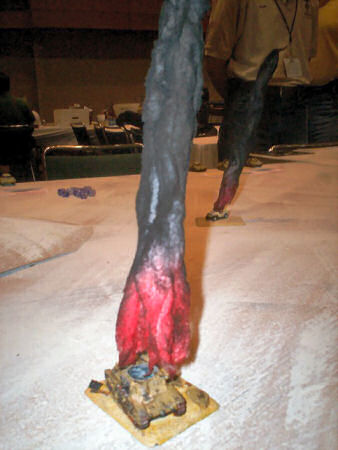
Actually, we had a playtest where the B5 ships met a motley crew of enemy ships, including ST ships. One player had B5 ships and one had ST -- the models can be from any, and I mean, any manufacturer.
The key here is that this is a BIG SCALE game, so players are admirals, not captains. Ships are classified according to type. No page of diagrams of individual systems, no figuring out ranges for each indidual weapon, etc. You're an admiral, not a captain.
Hyperspace Hack is a simple system for bashing fleets together on a scale usually not seen on the tabletop.
The aforementioned B5 fleet owner finally got to use all his ships that had been sitting in the box. He had used a handful in previous space games, but for the first time, he could see them all maneuvering across the tabletop.
I'll be at Historicon (MagWeb booth as usual) demo-ing Hyperspace Hack (and Snappy Nappy, my other just published rule set).
The system is I-go-U-go, so the initiative is important. Firing is sequential, not simultaneous, and you are allowed to combine fire from many firers onto one target.
Firing ranges depend on the type (bigger ships fire farther) and firepower also depends on type (bigger ships have more Attack Factors than smaller ships). Crew quality ranges from Raw to Elite.
The key here is the simple chart that cross references the total attack factors with the target ship for a single die roll resolution. Modifiers (like crew quality) adjust the force of the attack "up and down" rows.
The outcome is either damage the target or kill the target (er, or miss/ineffective against the target).
Morale is by task force, with a die roll when each condition (like a certain number of ship losses) is met.
There are 16 optional rules to increase complexity (torpedo runs, three-sided battle sequence of play, miracle engineer, a fourth ship status--hulk, planet-killing lasers, and so on). Rules are also for boarding, ramming, and repairs, there's a point system for tournaments, campaigns, and balanced scenarios, and I even include "terrain" (ion storms, nebulas, etc.).
I find that you can start with the basics so even a pre-teen (and even those pre-teens with gray hair) can figure HH out, and then add complexity with the optional rules.
But the key is the BIG scale -- think Admiral, not Captain…





 does a mash-up and gets a sci-fi command vehicle.