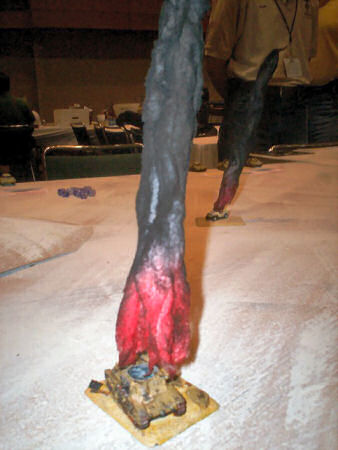
This After Action Report is written predominantly from the American point of view and concerns the first part of a two part battle in a three battle Campaign set in July 1943. The campaign is set in a fictional part of the Pacific but with historical classes of ships and firepower.
-Nevyan
Task Group 32.1 had been ordered to draw Imperial Japanese Navy forces away from an island atoll that the Marines were preparing to assault in the Western Pacific. The task group comprised of one heavy cruiser, two light cruisers, five destroyers and four destroyer escorts would attempt to engage an approaching Japanese cruiser/destroyer squadron some 310 nautical miles from the atoll. At the time Naval Intelligence had reported the Imperial Navy forces as being composed of two light cruisers, six destroyers and three destroyer escorts. Radio messages were leaked by the Americans hinting at an amphibious operation some 650 miles further west of the actual assault.
As the two forces approached each other new intelligence reported that the Japanese forces were actually composed of two heavy cruisers, one light cruiser, five destroyers and three destroyer escorts. Realizing the danger of sending Task Group 32.1 against two heavy cruisers it was decided to provide some air support by repositioning the main element of Task Force 32 closer to their subordinates. While still heavily outgunned there was at least some who hoped that the available air support could manifest in time to help the task group. Both groups decided to split their forces to better search the area of interest. The Americans had split their forces into a first element consisting of the heavy cruiser, a light cruiser, one destroyer and the three destroyer escorts (Task Element 32.1.1) and a second element consisting of a light cruiser and four destroyers (Task Element 32.1.2).
At approximately 0515 on the morning of July 10, 1943 the USS Barton (DD-599) acting as lead screen for Task Element 32.1.1 sighted the leading element of the Japanese forces. With dawn soon breaking and realizing the close proximity of the American forces to the Japanese forces she broke radio silence and reported sighting a Japanese light cruiser possibly of the Agano class. Turning hard to port she trained her forward 5" battery on the cruiser and fired two rounds at what felt to the captain like point blank range. The first round was high and missed the cruiser but the second round hit the superstructure and set at least two fires upon the ship. As the Barton tried to maneuver away the cruiser began opening fire on the little destroyer with her main battery.
From nine thousand yards away the skipper of the USS Griswold (DE-7) watched as the world turned red from the gunfire of the Japanese cruiser. The warning from the Barton had sent his men into frenzied action as they prepared to face down the enemy. Moments later a column of fire rose from the water and a resounding shockwave passed over the bridge. The Barton had exploded under the first salvo from the Japanese cruiser!
Dawn was fast approaching and the sky was turning light grey, in a matter of moments both sides would be engaged as targets appeared upon the seas. Acting quickly the Griwsold and her two sister ships, USS Crouter (DE-11) and USS Gilmore (DE-18) turned towards the black oily smoke rising from the water where the Barton had been. The little escort destroyers would try and put the smoke between them and the enemy cruiser in an attempt to outflank the fast approaching Japanese forces.
Aboard the USS Morrison (DD-560) all hands were at battle stations and awaiting visual confirmation of the Japanese cruiser. What had been reported as an Agano-class light cruiser was actually a Takao-class heavy cruiser! As the cruiser turned away from the burning slick of the Barton the Morrison turned away from the Japanese cruiser. The aft 5" guns blazing away did little damage to the Japanese cruiser and soon geysers of white water showed that the Japanese ship had the Americans range. A parting shell from the Takao disabled the American destroyer and set her stern afire. The Morrison, disabled by the Japanese cruiser was out of this fight for now.
The horizon was turning red as the sun slowly made its climb into the sky and the sound of battle was loud upon the seas! The USS Pensacola (CA-24) was steaming hard and true to join the fight and found her guns to be within range of the Japanese cruiser that had so quickly dispatched the Barton. Unbeknownst to the American captain this Takao class cruiser was the original IJN Takao! Her captain, eager to once again meet the American forces in a head to head battle, turned his ship hard to starboard in an effort to set his batteries for a full broadside at the "T" against the Pensacola. While the Japanese skipper waited for his ship to complete her turn the American commander of the Pensacola had no qualms about letting his foe feel the bite of the Grey Ghost! A vicious salvo from the forward two 8" mounts on the Pensacola scored three hits on the Japanese cruiser as she presented a near perfect broadside. My God, the American skipper thought as he stared down the barrels of the Takao's ten 8" guns. The first shell from the Pensacola ripped through the forward turret of the Takao disabling it, followed quickly by the second shell to the number two turret. The third shell hit just above the waterline but managed to rattle the Japanese ship! "You son of a…" The American skipper gritted his teeth.
Like the thundering voice of some terrible deity the IJN Takao let loose a broadside against the Pensacola. With the forward two turrets disabled that only left six 8" and two 4.7" shells hurtling through the air at the American cruiser. One, two, three shells crashed around the Pensacola throwing geysers of water into the sky. The bridge crew thought they were safe as the white water climbed ever higher around them and then the world turned black. One 4.7" shell and two 8" shells had missed but the remaining shells hit home against the forward mounts and superstructure of the doomed cruiser. Most of the shells hit the forward main batteries destroying them quickly but the worst was yet to come. Two 8" shells ripped through the forward part of the superstructure and into the bowels of the Pensacola where they exploded near a weapon magazine. The ship was mortally wounded and her keel buckled and then cracked. In a matter of minutes the Pensacola would break in half and slip beneath the waves.
"Range to the Jap cruiser is 16,300 yards, sir!"
The bridge crew of the Takao was excited about their victories. In a matter of minutes they had managed to send one American cruiser and one destroyer to the bottom. The Grey Ghost was nothing more than a broken wreck slipping beneath the dark Pacific waves. There was almost light enough to search for more targets. The Takao's commanding officer brought his binoculars to his eyes and scanned the horizon. What is that…?
"How does that broadside feel now, eh?"
Fifteen 6" shells thundered away from the USS Philadelphia (CL-41) towards the Takao. Five geysers marked the misses but ten shots hit home and evened the score for the loss of Pensacola and Barton. The Takao's bridge and superstructure had taken the majority of the hits and she was quickly engulfed in fires and thick black smoke. Within minutes the ship had developed a serious list and men were jumping over the rails into the burning water. The captain of the Philadelphia smiled and ordered his ship to put another six shells into the Japanese cruiser and then maneuver against the Japanese destroyers who were hammering away at the American destroyer escorts.
Griswold, Crouter and Gilmore had managed to slip past the Takao thanks to the smoke left from the Barton. However, as the dawn had come they found themselves in a running gun fight with three Japanese destroyers. The three DE's were of the new Evarts-class but their 3" open top guns were a death trap in a battle against the 5" guns of the Japanese Asashio-class destroyers (IJN Chiyo, IJN Itachi & IJN Hatake). Trying to maneuver and fire was taking a toll on the American ships and trying to run away would only help the Japanese with their longer range. Throwing caution the wind the three destroyers decided to face the enemy head on and hope that a delaying action would give the task group time to wipe out the heavier Japanese ships.
The Griswold turned first and brought her forward battery to bear on the nearest Asashio (Itachi) some 7,500 yards distant. Using armor piercing rounds and with some damned devilish luck the destroyer escort just might turn that Jap destroyer around and make her think twice about tangling with these Americans. 900 yards abeam and 1,100 yards aft the Crouter turned towards and ordered full speed against the enemy. Attempting to draw fire away from his sister ships the captain of the Crouter, a young lieutenant commander, hoped that the lack of returning enemy fire might just improve their chances of scoring hits. Meanwhile the Gilmore had turned hard over and was making all efforts to cut behind the enemy and divide their fire as the three Japanese destroyers formation was forward inline. As the Gilmore made its way behind the destroyers it was able to bring all its guns to bear on the aft end of the trailing destroyer (Chiyo) and pepper her with a good number of 3" shells.
The Itachi turned towards the visible two American escorts and landed two 5" shells into the Griswold but suffered a single 3" shell into the bridge disabling the ships maneuvering. The Griswold, hit but undaunted, answered back with her mighty 3" guns defiant to the end.
Meanwhile the Crouter charged headlong against her opponent, the Hatake, her forward battery blazing away while her aft batteries bracketed what targets they could see. Two armor piercing shells slammed into the hull and superstructure of the Hatake but did little critical damage. Closing the gap between the two ships the American commander ordered his gun crews to "give them hell" just as the Hatake disappeared in a ball of fire!
15,000 yards away the Philadelphia had let loose with her forward batteries and landed three 6" shells into the Hatake, destroying the Japanese ship in a satisfying way. Trying to maneuver for the best shots the captain of the Philadelphia was doing his damned best to ensure that those destroyer escort crews made it through this battle alive. As his warship sliced through the waves the remaining Japanese destroyers began maneuvering away from the American cruiser.
The Griswold, burning and nearly wrecked still had enough fight left in her to keep one of her 3" guns going. As the Itachi turned away from her two more 3" shells struck home and set the Japanese destroyer afire. After another three minutes of retreat the Itachi slowed to a standstill as fire consumed her.
Meanwhile the Gilmore had managed through God or luck to pass between the geysers thrown up by the Chiyo's 5" guns. Peppering the Japanese destroyer with 3" shells the Gilmore broke off her pursuit as the Philadelphia's 6" shells threw a curtain of water around the Chiyo. But luck would not remain on the destroyer escorts side as a 5" armor piercing shell passed through the hull and into an ammunition magazine. The explosion tore a hole through the side of the ship and sent a column of smoke a thousand feet into the air. The Gilmore, listing badly to starboard, was doomed and with the Philadelphia sending revenge tearing through the skies she slipped beneath the waves to join her sisters.
The Philadelphia had no need to close the range with the Chiyo, the skipper knew it was only a matter of time before his guns found their mark. As the Japanese destroyer maneuvered violently to avoid the long reach of the heavy American guns her luck too ran out in those bloody Pacific waters. Two 6" armor piercing shells passed through her upper decks and exploded deep within the ship. Rolling to port she capsized and sank quickly, cold revenge for the death of the Gilmore.
The captain of the Philadelphia surveyed the scene with grim satisfaction. The battle had cost the American forces heavily in both men and ships. The Pensacola, Barton and Gilmore had all been sunk outright by the enemy. The Griswold had burned for over three hours as her crew abandoned ship and was finally scuttled by a quick barrage from the Philadelphia's main batteries. The Morrison though had survived her fire which had raged so badly that the enemy thought her a complete wreck. However, the intrepid crew of that little destroyer had put out the fires and managed to get the ship moving at about 10 knots headed for the nearest friendly port. Steaming abreast of the destroyer escort Crouter the captain of the Philadelphia ordered the pennants flown for Bravo Zulu for the brave crew of such a fine little ship.
The only satisfaction in suffering such heavy losses was in knowing that one IJN heavy cruiser and three destroyers had gone to the bottom also. Poor intelligence and damnable luck had cost his men dearly but hopefully they could rejoin their brothers and find the remaining Japanese ships that intelligence said were nearby.
As the sun rose steadily higher into the sky the captain of the Philadelphia was handed a radio report from Communications. "Task Element 32.1.2 has engaged sizeable enemy force 50 miles North-North East…"




 's commission from one of our own.